Article Contents:
- Why wooden baseboard is chosen for wooden floors
- Material compatibility: the physics you can't ignore
- Aesthetic compatibility: why it's more important than it seems
- Expansion gap for parquet: how much to leave and why
- Why parquet will fail without a gap
- How the gap affects the choice of baseboard height
- How floor wooden baseboard conceals the engineered wood flooring gap
- Three functions of baseboard for parquet
- How to properly 'hang' baseboard over parquet
- Mounting to the wall, not the floor: the key installation rule
- Why specifically to the wall — and never to the floor
- Methods of mounting to walls
- Wall mounting spacing
- Gap between the lower edge of the baseboard and the parquet
- Baseboard wood species to match parquet wood species
- Principle of material unity
- Oak parquet — oak baseboard
- Ash engineered wood flooring — beech baseboard
- Pine parquet — pine or larch baseboard
- Walnut, teak, wenge parquet — exotic requires exotic
- Engineered wood flooring 'wood-look' (lacquered, melamine) — what to match
- Baseboard finish to match parquet lacquer: matte, gloss, oil
- Finish coordination principle
- Oil finish coordination
- White baseboard with colored parquet: when it's appropriate
- Installing wooden baseboard to parquet: practical nuances
- Sequence of work
- Baseboard acclimatization
- Angle cutting during installation to parquet
- Wooden baseboard and underfloor heating: compatibility
- Limitations for wooden baseboard with underfloor heating
- FAQ: Answers to Common Questions About Wooden Skirting Boards for Parquet
- About the Company STAVROS
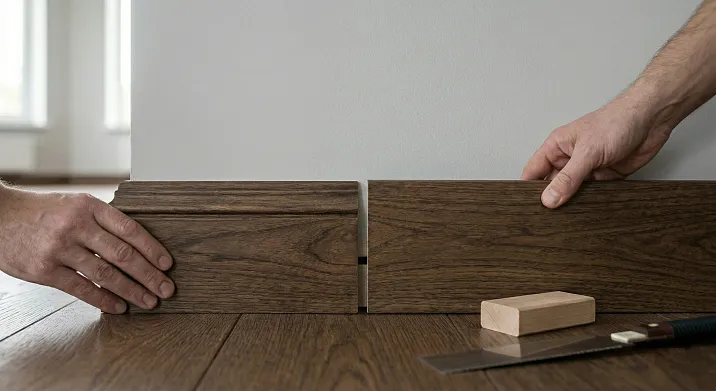
Parquet is a statement. When herringbone oak block parquet or brushed oil-finished 'Retro' parquet boards are laid in a hallway or living room, it's not just a floor covering—it sets the tone for the entire interior. And here, one of the most common renovation mistakes is made: placing a plastic PVC skirting board next to the noble wood floor.
It's like pairing a tailor-made suit with a market-bought belt. Formally—it covers the gap. In reality—it ruins the image.
Wooden skirting board for a wooden floor—is not just a 'more expensive option.' It's the material honesty of the interior: wood with wood, living texture next to living texture. And purely technically—it's the correct solution for parquet, dictated by the behavior of wood as a material. Let's examine both aspects—aesthetics and physics.


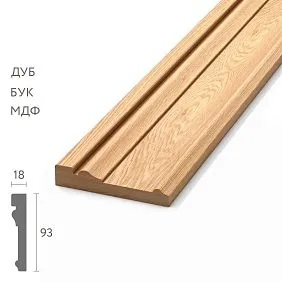

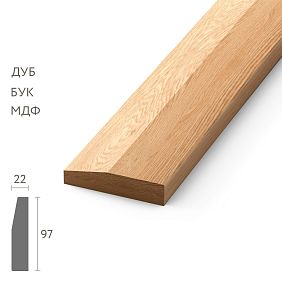


Why choose a wooden skirting board for a wooden floor




Material compatibility: physics that cannot be ignored
Parquet is a living material. It expands when moistened and contracts when dried. This process occurs every season, each time the humidity in the room changes. During winter heating—parquet loses moisture and contracts. When spring arrives and windows are opened—it absorbs moisture and expands.
The magnitude of these movements: oak parquet with a width of 70 mm expands across the grain by approximately 0.7–1.2 mm when humidity changes from 40% to 60%. Multiply this by 8–10 rows of parquet boards across the room's width—and you get a total seasonal movement of the parquet 'package' at the wall of 5–10 mm. This is why an expansion gap is always left at the wall for parquet.
Now the question: what kind of skirting board should conceal this gap?
PVC skirting board—is stable in humidity, practically doesn't move. But when heated (underfloor heating, sunlight)—it expands significantly more than parquet. As a result, in winter, a gap appears between the PVC skirting board and the parquet; in summer—the skirting board presses against the parquet.
with a classic profile creates a sense of solidity, reliability.—made from the same wood species as the parquet, moves synchronously with it. They are a single 'living organism.' The expansion gap between the skirting board and the edge of the parquet board remains stable in any season because both elements react to moisture identically.
Our factory also produces:
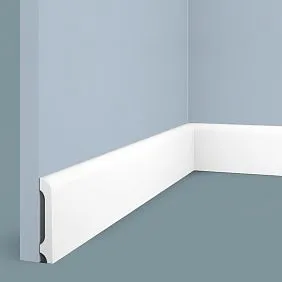
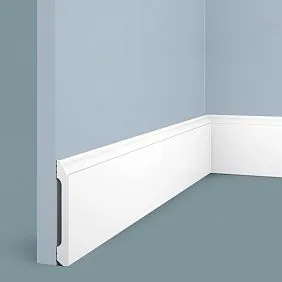
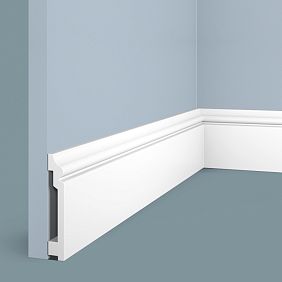
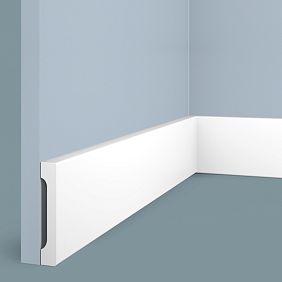
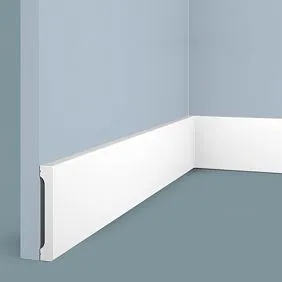
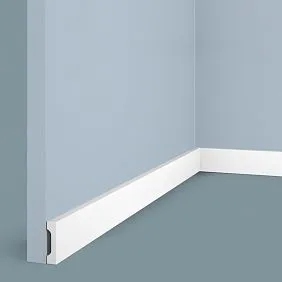
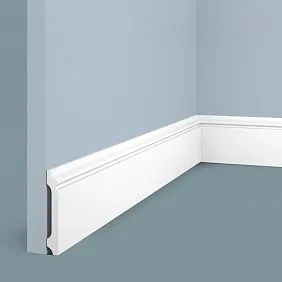
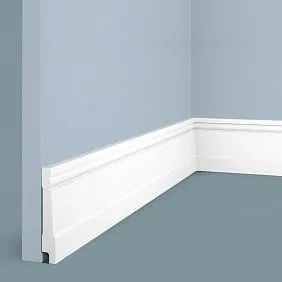
Aesthetic compatibility: why it's more important than it seems
There are interiors where every material 'converses' with another. Oak parquet—with oak skirting board, oak architrave, oak stair tread. Light ash floor—with light ash door leaf and skirting board. This is the 'material narrative' of the interior: a unified story told through wood.
Breaking this narrative with plastic or MDF means disrupting the visual integrity. The eye senses it, even if the mind doesn't articulate it. 'Something is off'—that's the reaction to an interior where expensive parquet sits next to a cheap skirting board.
A wooden skirting board made from the same species as the parquet, or a similar tone—closes the gap and continues the floor's story, rather than interrupting it.
Get Consultation
Expansion gap for parquet: how much to leave and why
Why parquet will fail without a gap
The expansion gap between the edge of the parquet covering and the wall is not an installer's mistake; it's a mandatory technical requirement. If this requirement is violated—the parquet, when expanding, presses against the wall and 'buckles': individual boards lift, forming humps and waves. This is irreversible damage to the covering.
The size of the expansion gap depends on the type of parquet covering:
| Finish type | Board / Plank Width | Recommended gap |
|---|---|---|
| Block parquet (oak) | 50–70 mm | 10–12 mm |
| Single-strip parquet board | 120–200 mm | 12–15 mm |
| 3-strip parquet board | 120–200 mm | 10–12 mm |
| Laminate | 190–220 mm | 10–12 mm |
| Engineered board | 130–190 mm | 8–12 mm |
| Solid board | 80–150 mm | 12–15 mm |
For rooms with unstable humidity (country house, seasonal occupancy) — the gap increases by 3–5 mm.
How the gap affects the choice of skirting board height
The expansion gap for parquet must be completely covered by the skirting board. The skirting board should not just 'touch' the floor surface — its lower edge must overlap the gap with a margin of 3–5 mm.
Minimum width of the horizontal 'shelf' of the skirting board overlapping the floor:
-
10 mm gap → minimum overlap 13–15 mm
-
15 mm gap → minimum overlap 18–20 mm
A skirting board with a horizontal part width of 8–10 mm will cover a 5–6 mm gap, but not 12–15 mm. When the parquet expands, the expansion gap will 'shrink', the parquet will 'come out' from under the skirting board — and the gap will become visible.
Conclusion: for parquet with a 12–15 mm gap, a skirting board with a horizontal overlap of at least 18–20 mm is needed. This is typically a skirting board with a height of 60 mm and above (K-006, K-016, and other K-series). Narrow profiles like K-034 (30 mm) are only acceptable for laminate with a gap up to 8 mm under stable conditions.
How wooden floor skirting board conceals the gap of parquet board
Three functions of skirting board for parquet
Wooden floor skirting boardfor parquet performs three tasks — not one, as is commonly thought:
Task 1: Decorative. Conceals the gap between the edge of the parquet and the wall. Aesthetic finishing of the floor. Without a skirting board — an open gap with dust, debris, and drafts from the subfloor space.
Task 2: Expansion-related. Allows the parquet to move freely within the gap without fixing the edge of the flooring. The skirting board should not press down on the parquet — it should 'overhang' it with a small horizontal gap of 1–2 mm.
Task 3: Dust and sound insulation. A well-fitted skirting board closes the gap between the floor and wall from dust, external noise (with wooden floors), and cold air drafts.
How to correctly 'overhang' the skirting board over the parquet
After laying the parquet — the skirting board is attached to the wall so that its lower horizontal plane (or lower end) lies on the surface of the parquet but does not press it down. A small gap of 1–2 mm between the lower surface of the skirting board and the parquet is normal.
When the parquet expands — the parquet board moves horizontally under the skirting board without pressing against it. The skirting board remains stationary (attached to the wall). The movement of the parquet occurs in the 'shadow' of the skirting board.
Common mistake: the skirting board is nailed simultaneously to the floor and the wall, 'clamping' the edge of the parquet board. In this case, when the parquet expands, it presses against the skirting board from below, causing the skirting board to deform or detach from the wall. After one season — a wave along the entire perimeter.
Attachment to the wall, not the floor: key installation rule
Why exactly to the wall — and never to the floor
Wooden skirting board for wooden floorsis attached exclusively to the wall. This is not a recommendation, it is a technological axiom of parquet installation.
The logic is simple:
-
Parquet moves horizontally (expansion-contraction)
-
If the skirting board is nailed to the parquet — it moves with it, detaching from the wall. The wall 'stands', the parquet 'moves' — the skirting board is torn between them.
-
If the skirting board is nailed to the wall — the parquet moves freely under it. The skirting board remains stationary, the parquet slides under the horizontal part.
Wall Mounting Methods
Method 1: Finish nails or screws into the wall
For brick or aerated concrete walls: pre-drill ∅5–6 mm, plastic dowel, finish screw with a countersunk head. Heads are countersunk and filled.
For wooden frame (drywall): finish nails or screws into the frame studs. It is important to hit the stud, not the void — otherwise the attachment is unreliable.
Method 2: Adhesive on the wall (no fasteners)
Construction adhesive (liquid nails or special skirting board adhesive) is applied in a zigzag pattern onto the back vertical surface of the skirting board. The skirting board is pressed against the wall and secured with tape or wedges during the setting time (1–2 hours).
Important: apply adhesive only to the back vertical plane (which presses against the wall). The bottom horizontal plane should be adhesive-free; it does not make rigid contact with either the wall or the parquet.
Method 3: Clips (hidden fasteners)
Metal clips are attached to the wall with screws; the skirting board snaps into the clips. Advantage: removal without damaging the wall or skirting board. Disadvantage: requires compatible profile geometry between the skirting board and clips—not all profiles are suitable.
Wall fastening spacing
| Method | Fastening spacing | Distance from the end |
|---|---|---|
| Screws/anchors | 400–600 mm | 30–50 mm |
| Construction adhesive | Continuous zigzag | — |
| Clips | 500–700 mm | 50–80 mm |
The taller and heavier the skirting board, the smaller the fastening spacing. K-104 with a height of 200+ mm—fastening every 350–400 mm. K-006 with a height of 60 mm—500–600 mm.
Gap between the bottom edge of the skirting board and the parquet
After mounting to the wall—check: the bottom edge of the skirting board should not press on the parquet. Correct situation: a 1–2 mm air gap between the bottom surface of the skirting board and the parquet board. A sheet of paper should pass freely under the skirting board without pressure.
If the bottom edge presses on the parquet—slightly lift the skirting board during installation (place a temporary 2 mm spacer when securing the fastener, then remove it).
Skirting board wood species matching the parquet wood species
The principle of material unity
Professional approach to selectionwooden floor skirting boardfor parquet—matching wood species in tone. This is not only about aesthetics but also behavioral compatibility: identical species react to moisture in a similar way.
Oak parquet—oak skirting board
Oak parquet—the most common class of parquet flooring in Russia. Warm creamy-brown or golden-amber tone, characteristic pronounced texture with large pores and medullary rays—a 'mirror' pattern in cross-section.
OakWooden skirting board K-series STAVROS—the same raw material, the same species, the same reaction to the finish. Under natural oil—the skirting board gives the same golden-honey hue as the parquet. Under 'walnut' oil—the same warm brown tone.
If the parquet is coated with 'walnut' varnish—the oak skirting board is coated with the same varnish or stain to match the tone. Result: the parquet and skirting board form a visually unified finish—the floor's 'frame' continues the floor.
Ash parquet board—beech skirting board
Ash—a light-colored species with a pronounced wavy texture. Ash skirting boards are rare in Russia (not mass-produced in millwork). The closest analogue in color and structure is beech. Beech is lighter than oak, with a more uniform texture—it imitates light ash well when using the same oil or varnish.
Beech K-series STAVROS—from 230 rub./lm (K-034)—an affordable alternative to oak for light-colored parquet.
Pine parquet—pine or larch skirting board
Pine parquet—in country houses, dachas, rustic and eco-interiors. Pine flooring has characteristic knots, resin ducts, and a pronounced texture. Pine skirting board—to match the tone.
But: pine is soft (200–300 HB), easily damaged. For hallways with heavy traffic—larch as an alternative: similar coniferous texture character, significantly higher hardness (490–580 HB). Under the same oil—pine and larch look similar.
Walnut, teak, wenge parquet — exotic wood calls for exotic skirting
If the parquet is made of exotic wood species — wenge, teak, merbau — the skirting should be made of the same species or specially stained "wenge" / "teak" using colored oil or stain.
Dark wenge (almost black-chocolate) + white skirting = stylistic contrast, not a mistake — provided it's a conscious design decision. White skirting next to dark parquet is a "graphic" floor frame. A popular technique in contemporary and minimalist styles.
Oak skirting from the K-series STAVROS, stained in a dark tone (RAL 8022, "black-brown") — wenge-like under a clear finish. This is cheaper than buying solid wenge skirting and gives a similar visual result.
Engineered wood flooring "wood-look" (varnished, melamine) — what to match
Engineered wood flooring with melamine finish "light oak" or "ash" — widely common in the budget segment. The base wood species may be pine or spruce, but the surface layer is an imitation. Matching skirting "by the base species" in this case is pointless.
Solution: match by the color of the top layer. "Light oak" decor (creamy-beige) → beech skirting under natural oil or white skirting (RAL 9010) depending on the style. "Wenge" decor → oak skirting under dark oil or white skirting as a contrast.
Skirting finish matching the parquet varnish: matte, gloss, oil
Principle of finish coordination
The floor and skirting are a single visual whole. If the parquet is coated with matte varnish, and the skirting is glossy, next to the modest matte floor there will be a shiny varnish strip by the wall. This is visual dissonance.
Rule: the level of skirting sheen = the level of floor sheen ± one level.
| Floor finish | Recommended skirting board coverage |
|---|---|
| Matte varnish (5–10 GU) | Matte varnish or matte oil |
| Semi-matte varnish (25–35 GU) | Semi-matte varnish or oil |
| Semi-gloss varnish (50–60 GU) | Semi-gloss or semi-matte varnish |
| Gloss varnish (70–85 GU) | Semi-gloss or gloss varnish |
| Natural oil | Natural oil (same composition) |
| Tinted oil | Tinted oil with identical tone |
Oil finish coordination
The most "honest" and tactilely comfortable option is oiled parquet and skirting under the same oil. Modern "Scandinavian" and "eco" interiors are built precisely on this: all wooden surfaces (floor, skirting, doors, window sills) — under a unified oil.
Osmo Polyx-Oil 3062 (natural): golden warm oak tone without color change. Osmo Polyx-Oil 3071 (cashmere): bleached effect, Scandinavian light tone. Osmo Color (anthracite): dark tinting for modern interiors.
It is advisable to apply oil to the skirting from the same can as used for the parquet — then the tone will match exactly, without batch deviations.
White skirting with colored parquet: when it is appropriate
White skirting next to colored parquet is a conscious design technique, not a mistake, if:
-
White/light walls: the skirting board "disappears" into the wall, giving the floor a clear "frame".
-
Style - Scandinavian, neoclassical, Provence: white skirting board is part of the style.
-
Tall skirting board K-009 or K-018 in white enamel with dark parquet: a classic British technique - dark floor + white profiles.
When a white skirting board with colored parquet is a mistake:
-
Warm beige-toned parquet + cool white skirting board RAL 9003 = color mismatch. Warm white RAL 9010 is needed.
-
Rough "textured" parquet surface (brushed oak with oil finish) + glossy white skirting board = conflict of textures and degree of shine.
Installing wooden skirting board to parquet: practical nuances
Work sequence
Incorrect sequence: skirting board first, then parquet. You install the skirting board to the wall, then lay the parquet - the parquet butts against the skirting board, no expansion gap. Guaranteed buckling.
Correct sequence:
-
Screed / leveling the subfloor
-
Laying parquet with an expansion gap around the entire perimeter
-
Sanding, finishing (varnish / oil)
-
After the finish is completely dry (at least 72 hours) - install the skirting board
Acclimatization of skirting board
Wooden skirting board delivered from the factory has a moisture content of 8–10%. In a living space with heating - 35–45% relative air humidity. A difference of 25–35% - the skirting board will release moisture and shrink slightly after installation.
Solution: acclimatization for 48–72 hours in the room, unpacked (not stacked - laid out horizontally). Only after that - installation.
Cutting corners when installing to parquet
Internal corners of skirting board - 45° miter cut on a miter saw. External corners (columns, pilasters, pipe casings) - 45° miter cut on the other side. Accuracy of 45° is critical: an error of 1° on a 100 mm high profile = a gap at the front face of up to 1.7 mm.
For K-series STAVROS profiles K-009, K-018, K-066 - the miter cut must be performed on a sliding miter saw: the height of the strip is over 100 mm and does not fit in a standard miter box.
Wooden skirting board and underfloor heating: compatibility
Limitations for wooden skirting board with underfloor heating
Underfloor heating - water or electric - heats the subfloor. When laying parquet on underfloor heating, special adhesives are used and increased expansion gaps are provided.
Wooden skirting board with underfloor heating:
-
Should not be placed flush against the parquet (gap increased to 2–3 mm)
-
Should not come into direct contact with the underfloor heating system
-
Preferably attached to the wall without the lower part contacting the heated subfloor
If the underfloor heating heats the area near the wall to 30–35°C (possible with water-based systems) - the wooden skirting board may dry out and crack from the bottom. In this case - a polyurethane alternativeKPU-series STAVROSwith the same profiles (KPU-125, KPU-105) for painting: completely stable when heated, does not dry out or crack.
FAQ: answers to popular questions about wooden skirting board for parquet
Should the skirting board be attached to the parquet?
No, absolutely not. The baseboard must be attached only to the wall. The parquet must be able to move freely under the horizontal part of the baseboard during seasonal expansion.
What height of baseboard should I choose for a 150 mm wide parquet board with a 12 mm gap?
The lower 'lip' of the baseboard must overlap the gap with a margin: for a 12 mm gap, the horizontal part of the baseboard should be at least 15–17 mm. This corresponds to baseboards with a height from 60 mm (K-006) and above. The K-034 baseboard (narrow, ~30 mm) is not suitable.
Can a wooden baseboard be mounted to the wall with adhesive when installing parquet?
Yes, construction adhesive (liquid nails) to the wall is a correct method. The main thing: adhesive only to the wall (the rear vertical plane of the baseboard), the lower horizontal part must not be fixed to the parquet.
What should I use to finish an oak baseboard for an oiled oak parquet floor?
The same oil from the same can as used for the parquet. Before application, acclimate the baseboard for 72 hours. Application: brush on the front surface, roller on the back (before installation), final coat after installation with a brush. Result: identical tone, identical texture.
How to choose a baseboard for a parquet board with a 'bluish' gray tone?
For gray tinted parquet (oil 'anthracite', 'ash'): either an oak baseboard finished with the same tinted oil (perfect match), or a white baseboard RAL 9003 (cool white) — the cool white tone complements gray parquet well.
Is filler needed between the baseboard and the wall?
If there is a small gap between the rear edge of the baseboard and the wall (up to 3 mm) — fill it with acrylic sealant in the color of the baseboard. Acrylic sealant can be painted — when painting the baseboard, the seam is completely hidden. With a transparent finish, a minor gap at the wall is acceptable.
About the company STAVROS
Parquet deserves a worthy frame.Wooden skirting board K-series STAVROS— made from kiln-dried solid oak and beech (moisture content 8–10%), CNC-milled with precision up to 0.2 mm, hand-sanded to P180. Over 30 profiles: from the minimalist K-034 (from 230 rub./lm) to the monumental K-104 (from 6,060 rub./lm) — for any room height and any style from Scandinavian to Baroque.
To baseboards — coordinatedK-series casings, KZ-series cornices, Furniture legs, Carved Mouldings, staircase components— a unified material system for wooden interiors. For wet areas —KPU-series polyurethane moldingfor painting.
Wooden molding samples — 180 rub. Warehouses in Moscow and St. Petersburg, same-day shipping. Delivery across Russia and CIS. Loyalty program for designers. Consultation: 8 (800) 555-46-75.
STAVROS — because parquet doesn't start with the first board, but with the last baseboard.