












































































Article Contents:
- Roots reaching into centuries
- From Function to Art
- Russian tradition: window as a protective charm
- Golden age of house carving
- 20th century: from peak to decline
- Revival: tradition in the 21st century
- Why a window casing is needed: functions and meanings
- Protection: the first and main function
- Aesthetics: visual completeness
- Symbolism: the language of ancestors
- Types of window casings: variety of forms
- By construction: simple and composite
- By type of carving: solid and pierced
- By profile: flat, profiled, ornamental
- Material selection: species matters
- Spruce: Accessibility and Practicality
- Larch: Siberian strength
- Oak: eternity in wood
- Linden: for carving
- Manufacturing: from log to masterpiece
- Wood preparation
- Profile creation
- Carving: master’s hand or machine precision
- Installation: the art of proper mounting
- Preparation
- Installation
- Finishing
- Maintenance: preserve beauty
- Inspection
- Cleaning
- Recoating
- Conclusion: the final touch of perfection
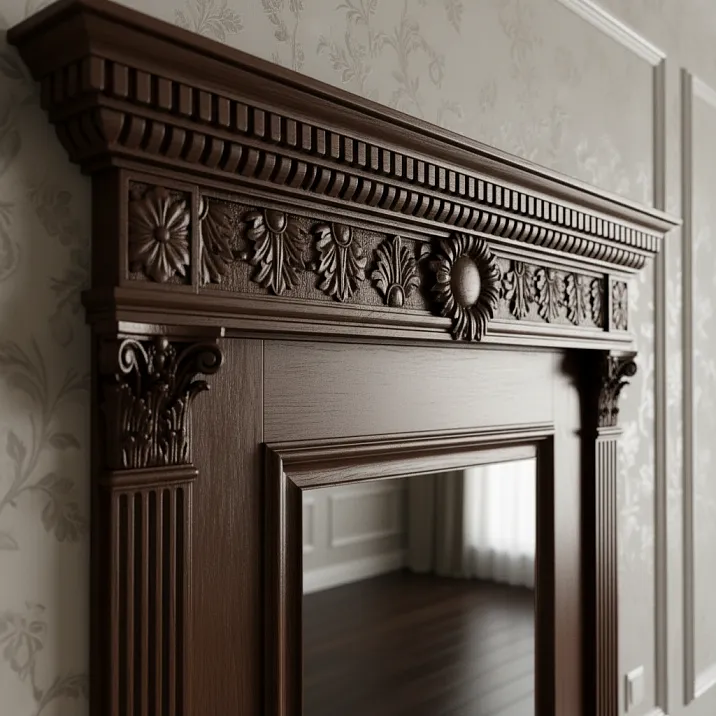
Window. It seems — just an opening in the wall, covered with glass. But for a house, a window is an eye looking at the world and letting light in. And every eye must have eyelashes. In architecture, the role of eyelashes is played byWooden skirting board purchasewhich means to complete the image, give character, tell a story.
A window casing is not just a decorative frame. It is the boundary between the inner and outer worlds. Protection against drafts and moisture. A carrier of symbols, charms, family traditions. In Russian wooden architecture, window casings reached such perfection that they became a separate genre of folk art. Every house spoke the language of carving — plant patterns, geometric ornaments, mythological creatures formed a unique story for each family.
Times have changed. There are fewer wooden houses, and woodcarvers too. But the need for beauty, connection to traditions, and individuality remains. Modernwooden casingpreserves the aesthetic of historical samples, but is created using technologies that make it accessible, durable, and practical.
Why pay attention to wooden casings today? Because a house without them is an unfinished sentence. Windows look bare, the facade is lifeless, architecture incomplete. The casing completes the composition, creates a visual frame, emphasizes proportions. It transforms a nameless building into a place with character, history, soul.


Roots reaching back through centuries
The history of casings spans centuries. This is not a sudden trend, but an organic development of architectural language.




From Function to Art
Early casings were purely functional. When windows with glass appeared in wooden houses, a problem arose — the gap between the window frame and the wall. Heat escaped, cold penetrated, water seeped in. This joint needed to be sealed.
The simplest solution — nailing boards around the window. They covered the gap, pressed the frame against the wall, provided additional protection. The name 'casing' comes from the phrase 'on the face' — that is, on the facade, visible. The element was located outside, on the front side of the house.
But a plain board looked crude. Craftsmen began to process it — plane, sand, profile. Bevels, chamfers, rounded edges appeared. Then — the simplest patterns, carved with a chisel. Thus, a functional detail began to transform into decorative.
Our factory also produces:


Russian tradition: window as a talisman
In Slavic culture, the window had special significance. It was the boundary between the house and the outside world, between one’s own and the foreign, between safety and danger. Such boundaries always required protection — not only physical, but also magical.
Casings became carriers of protective symbols. Carvers carved solar signs — circles, swastikas, rosettes — symbolizing the sun, driving away darkness. Plant ornaments — leaves, branches, flowers — embodied life force, fertility, connection with nature. Geometric patterns — diamonds, triangles, zigzags — created a protective network through which evil could not penetrate.
Each region developed its own traditions. Northern casings — strict, minimalist, with powerful blind carving. Volga casings — delicate, pierced, resembling lace. Ural casings — massive, with large elements. Siberian casings — influenced by Eastern motifs brought by traders.
Get Consultation
Golden age of house carving
The mid- to late 19th century marked the peak of carved casing art. Several reasons contributed. The development of the lumber industry made boards more accessible. The advent of fretsaw blades allowed for complex pierced patterns. The rise in peasant prosperity after the abolition of serfdom enabled spending on home decoration.
Master carvers moved from house to house, creating unique casings. Often, these were former shipwrights — ship carving art naturally transitioned to house carving. The same tools, techniques, and love for wood. Only instead of a ship’s bow — a house facade, instead of a helm — a window.
Carving dynasties emerged, where secrets of craftsmanship were passed from father to son. Regional schools formed with their recognizable styles. Casings became not just decoration, but a means of self-expression, a demonstration of skill, a source of pride for the owner.
20th century: from peak to decline
The early 20th century continued the tradition. Modernism introduced new motifs — flowing plant lines, asymmetry, stylization. Casings became more elegant, refined. But the revolution and subsequent decades of Soviet power dealt a blow to tradition.
Individuality was discouraged. Construction followed standardized plans. Wood gave way to brick and concrete. Carved casings were declared outdated, bourgeois, tasteless. Houses with casings were torn down. Master carvers were retrained or died without passing on their knowledge.
By the end of the century, the tradition was nearly extinct. A few isolated pockets remained — villages where elders still remembered techniques, enthusiasts collecting and documenting samples. But mass culture of carved casings vanished.
Revival: tradition in the 21st century
Today, there is a renaissance of interest in wooden architecture. People are tired of faceless boxes, of the monotony of standardized construction. Demand for individuality, connection to roots, traditional aesthetics is growing. Andwooden window casingsare returning.
Modern technologies allow reproducing historical samples with millimeter precision. CNC machines carve the most complex patterns, previously created by hand over weeks. But the soul embedded in the ornaments by ancestors remains. Because form carries meaning, regardless of the method of its creation.
Why a casing is needed: functions and meanings
A casing is not just beauty. It is a multifunctional element solving several tasks simultaneously.
Protection: the first and main function
Sealing the joint — the main practical task. There is always a gap between the window frame and the wall. When installing a window, it is impossible to achieve perfect alignment — wood and stone have different properties, materials expand and contract differently. This gap must be sealed.
The casing presses against the wall, covering the gap. Often, under it, putty, hemp, or modern sealants — materials filling voids. The casing itself creates a lip, diverting water running down the wall away from the window. Without it, water seeps into the gap, wood gets wet, rots, mold appears.
Frame protection — the second protective function. The ends of the window frame protruding to the facade are exposed to sun, rain, and wind. They crack, dry out, and lose paint. The casing covers these ends, extending the window’s life for years.
Structural reinforcement — the casing presses the frame into the opening, preventing it from loosening. This is especially important for old houses, where wood may have dried out and joints weakened. A properly installed casing holds the window securely, preventing it from becoming misaligned.
Aesthetics: visual completeness
Framing — the casing creates a frame around the window, similar to how a frame surrounds a painting. This is psychologically important — an object framed is perceived as complete, significant, and valuable. A window without a casing looks like a painting without a frame — unfinished.
Proportions — a correctly chosen casing adjusts visual perception. A narrow window can be visually widened with a wide casing. A low window can be elongated with vertical elements. An overly large window can be balanced with a substantial frame.
Architectural style — the casing determines the house’s affiliation with a particular tradition. A simple flat casing indicates modernity and minimalism. Carved casings with plant motifs indicate classicism and connection to folk traditions. Profiled casings with clear lines indicate neoclassicism and rationalism.
Color and contrast —wooden window casingscan be painted to match wall tones or in contrast. Contrasting casings highlight windows, making the facade more graphic and dynamic. Tonal casings create a calm, unified composition where windows do not dominate but softly blend into the overall picture.
Symbolism: language of ancestors
In traditional culture, the casing carried symbolic meaning. Each ornament element had significance.
Solar symbols — circles, rosettes, swastikas (in pre-Christian context) — symbolized the sun, light, and life. Usually placed at the top of the casing, on the gable, or in the center. These were signs of power, repelling darkness and evil spirits.
Plant motifs — grapevines, oak leaves, ears of grain, flowers — symbolized fertility, growth, and family prosperity. Interwoven branches symbolized family unity and strong generational bonds.
Zoomorphic elements — images of birds, horses, snakes, lions. Birds were messengers, connecting heaven and earth. Horses symbolized the sun, movement, and strength. Snakes represented wisdom and protection of underground riches. Lions were guardians, protecting the home.
Geometry — diamonds, triangles, zigzags created a protective network. Diamonds were often associated with earth, fertility, and the feminine principle. Triangles with fire, activity, and masculine strength. Combinations of different geometric shapes created a complex symbolic system.
Today, these symbols have lost their magical meaning. But they have retained their aesthetic power. A house with carved casings appears animated, expressive, and historical.
Types of casings: variety of forms
Casings differ by construction, manufacturing method, and stylistic approach.
By construction: simple and composite
Simple casing — four boards joined around the window perimeter. Top, bottom, two sides. Joined at right angles or 45 degrees. Minimalism, functionality, quick manufacturing.
Composite casing — more complex construction. In addition to main planks (the casing itself), it includes additional elements. Top — cornice, gable, lintel — decorative element above the window. Bottom — sill board, often carved. Sides — vertical posts, sometimes with applied elements.
Cornice can be flat or three-dimensional, simple triangular or complex shaped. It visually enlarges the window, creates an accent, and draws attention. In traditional architecture, the cornice was often the most ornately decorated element — here, the main protective symbols were concentrated.
By type of carving: solid and pierced
Solid (relief) carving — pattern is cut into the board surface without going through it. Creates relief — protruding and recessed parts. More labor-intensive, requires skill, tools, and time. Result — volumetric, expressive, durable.
Solid carving allows creating complex multi-level compositions. Leaves protrude above stems, petals above flower cups. Play of light and shadow emphasizes volume, making the pattern lively and dynamic. This carving is typical for northern regions, where solidity was valued.
Pierced (openwork) carving — pattern is cut through. The board becomes lace, through which the wall is visible. Easier to execute (especially with a jigsaw), creates a light effect. But less durable — thin struts may break.
Pierced carving is typical for the Volga region, Ural, and Siberia. Here, decorative quality, lightness, and patterned design were valued. Casings with pierced carving cast beautiful lace shadows on walls under proper lighting, doubling the decorative effect.
Combined carving — combination of solid and pierced. Base — solid carving with relief elements. Addition — pierced sections creating transparency. Difficult to execute, but provides maximum aesthetic effect. Such casings are the pinnacle of craftsmanship, rare, and highly valued.
By profile: flat, profiled, ornamental
Flat casing — simple board without profiling. Front surface is flat or carved. Edges are straight. The simplest and cheapest option. Suitable for modern minimalist houses where line strictness is important.
Profiled casing — a board with a decorative profile. The surface is not flat but features protrusions, grooves, and rounded edges. The profile can be simple — one or two grooves — or complex — multiple transitions creating play of light and shadow. Profiling is done on a milling machine or by hand using decorative chisels.
Profiled casing appears richer than flat casing at comparable cost. It creates volume, structures the surface, and sheds water better. Characteristic of classical and neoclassical architecture.
Carved (ornamental) casing — with relief or incised carving. This is the highest level. The carving may cover the entire surface or only specific areas — top, bottom, corners. Carved casings are individual, each unique, even if cut from the same template — the master’s hand (or particularities of the CNC program) adds nuances.
Material selection: species matters
Not every wood is suitable for casings. Certain properties are required — strength, stability, resistance to weather.
Spruce: Accessibility and Practicality
Spruce — the most popular species for casings. Several reasons. Availability — grows widely, price is low. Ease of processing — soft wood, cuts, saws, and planes well. Resin content — natural protection against moisture and insects.
Spruce density — 500–550 kg per cubic meter. This is an average value, providing a balance between strength and lightness. Spruce casing does not create excessive load on the wall and is easily fastened with ordinary nails or screws.
Spruce texture is expressive — annual rings are clearly visible, resin canals create a distinctive pattern. Color — from light yellow to reddish, depending on the region of growth. With proper treatment, spruce lasts for decades.
Spruce drawbacks — softness (easily dents from impacts), tendency to turn blue with prolonged moisture contact, resin exudation in heat. But all these issues are resolved with proper treatment — drying, impregnation, and painting.
Larch: Siberian strength
Larch — an elite coniferous species. Density 650–700 kg per cubic meter — significantly higher than spruce. Hardness is also higher, the wood is dense, heavy, and strong. Main advantage — exceptional resistance to rot.
Larch does not fear water. In fact, it hardens and becomes stronger in water. Bridges on larch piles stand for centuries. For casings constantly exposed to rain, snow, and temperature fluctuations, this is a critically important property.
Larch color — reddish-brown, noble. Texture is clear and beautiful. The wood practically does not require protective treatment — it can be left natural, covered only with oil to emphasize the texture.
Drawbacks — price (1.5–2 times higher than spruce), hardness (harder to process, requires more powerful tools), weight (creates greater load on fasteners). But for those who value longevity, larch is the best choice.
Oak: eternity in wood
Oak — king among species. Density 700–800 kg per cubic meter, maximum hardness. Oak casings are practically eternal — serve for centuries without loss of strength. In historic estates and palaces, original oak elements from the 18th–19th centuries are often preserved.
Oak’s resistance to moisture, rot, and insects is legendary. Oak wood only strengthens with age. Tannins in oak repel insects and prevent rot. Oak can be left unpainted for years — it retains its noble gray-brown color.
Oak texture is expressive — large pores, medullary rays on radial cuts, clear rings on tangential cuts. Carving in oak lasts for centuries, even the finest details do not wear away. Oak carved casing — a work of art passed down through generations.
Drawbacks — price (2–3 times higher than spruce), weight (very heavy, requires reinforced fasteners), difficulty of processing (hard wood quickly dulls tools, requires powerful equipment). But for those who build for centuries, oak is indispensable.
Linden: for carving
Linden — a special species. Soft, light, uniform. Not the best choice for casings exposed to the outdoors — fears moisture and easily rots. But for carved casings that will be well protected, linden is ideal.
Carving in linden — pure pleasure. The wood cuts like butter, does not splinter, does not chip. You can carve the finest details that would simply break in other species. Linden casings with delicate carving — lace in wood — were the pinnacle of carvers’ skill.
Linden color — white with a slight cream tint. Texture is unremarkable, which is even an advantage for carving — does not distract from the pattern. Linden casings require mandatory protective treatment — impregnation, primer, multi-layer painting. But the beauty of carving compensates for these efforts.
Manufacturing: from log to masterpiece
How it is madewooden carved casingThe process is multi-stage, requiring skill, patience, and understanding of the material.
Wood preparation
Drying — the first and critically important stage. Freshly cut wood contains 50–80% moisture. As it dries, it shrinks, deforms, and cracks. A casing made from raw wood will become warped within a year.
Drying can be natural or kiln-dried. Natural — wood is stored in a ventilated space for one to two years, gradually losing moisture. Slow, but quality — the wood acclimates, internal stresses are relieved gradually. Kiln-dried — in specialized drying chambers with controlled temperature and humidity. Fast (a few days), but requires experience — over-dried wood is brittle, under-dried wood deforms.
Final moisture content — 8–12%. This is optimal for use in Russian climate conditions. At this moisture level, wood is stable, does not warp, or crack.
Sawing — dried boards are cut into blanks of required sizes. The grain direction is taken into account — it should run along the long side of the casing. Cross-grain is easily broken, especially in thin carved elements.
Sorting — sections with large knots, cracks, discoloration, rot are removed. For carved casings, especially clean boards without defects are selected — the pattern should be clear and uninterrupted by knots.
Profile Creation
Routing — the blank is passed through a router, which creates a decorative profile. The cutters rotate at high speed, removing wood to form grooves, protrusions, and rounded edges. A complex profile is created in one pass, which would require hours of manual labor.
Each profile type requires a specific set of router bits. Professional workshops have dozens of sets, allowing them to create various casings. It is also possible to individually sharpen router bits for a unique profile — for exclusive orders.
Sanding — after routing, the surface is sanded. Minor irregularities, fiber scratches, and roughness are removed. Different grit sandpaper is used — from coarse (P80-P120) for initial processing to fine (P220-P320) for finishing.
Quality sanding is critical for subsequent painting. Poorly sanded surfaces absorb paint unevenly, creating spots and raising fibers. Well-sanded surfaces are smooth, paint lays evenly, and paint consumption is minimal.
Carving: the craftsman's hand or machine precision
Hand carving — traditional method. The carver works with a set of chisels — flat, half-round, corner, and V-shaped. The pattern is drawn on the blank with a pencil or template. Then, layer by layer, wood is removed to form the design.
Hand carving requires years of experience. One must feel the wood — where it will cut easily, where it may split. Control depth — too deep a cut makes the element brittle. Monitor symmetry, rhythm, proportions. Each casing is unique, bearing the craftsman's personal mark.
Machine carving — on CNC machines. A 3D model of the pattern is loaded into the program, and the multi-axis controlled machine reproduces it in wood. The cutter moves along predefined paths, removing material to create relief. Accuracy — fractions of a millimeter, repeatability — absolute.
CNC machines allow creating casings of any complexity on an industrial scale. Copying an antique sample, producing a hundred identical elements, or implementing a complex original design — all is possible. At the same time, the level of detail quality does not fall short of handwork, and often exceeds it.
Combined method — rough processing on a machine, finishing handwork. The machine creates the main relief, the craftsman refines details, removes router marks, adds nuances. A combination of machine speed and handcrafted touch.
Installation: the art of proper mounting
A beautiful casing must be installed correctly. Poor mounting will ruin everything.
Preparation
Measurements — precise dimensions of the window opening. Width, height, depth of the jambs. Based on these, the casing dimensions are calculated. Standard — the casing overlaps the window by 3-5 centimeters on each side. This ensures reliable sealing of gaps.
Choosing the mounting method — depends on the wall material. For wooden houses — nails or screws directly into the wall. For brick or concrete — anchors, or gluing with construction foam or liquid nails.
Trimming — casings are cut to size. Corners are joined at 45 degrees (beveled cut) or 90 degrees (straight cut with overlap). Beveled cut is more aesthetic but requires precision — even the slightest mismatch creates a gap. Straight cut is simpler, more reliable, typical for traditional casings.
Installation
Marking — lines for installation are marked on the wall. Verticality and horizontality are checked. Side casings must stand strictly vertically, top and bottom — horizontally. Misalignment is unacceptable — it is obvious and disrupts the entire composition.
Mounting — the casing is placed against the marked line and pressed. Holes for fasteners are drilled (if needed). Screws are screwed in or nails are driven. Fastener spacing — 30-40 centimeters. Less — unnecessary, more — the casing may sag or detach from the wall.
Nail or screw heads are countersunk into the wood by 2-3 millimeters. Holes are filled with wood putty and sanded. Fasteners become invisible.
Sealing — gaps between the casing and wall, between casing elements are filled with sealant. Acrylic or silicone sealant suitable for painting is used. It seals gaps, prevents water ingress, and creates a monolithic structure.
Excess sealant is immediately wiped away with a damp cloth. After drying, joints become invisible, and the casing appears seamless.
Final finishing
Priming — the casing is coated with wood primer. Primer seals pores, creates a base for paint, improves adhesion, reduces paint consumption. Especially important is priming ends — they absorb moisture more intensely and require enhanced protection.
Painting — two to three coats of paint. First — base coat, establishing the main color. Second — enhancing coat, evening out tone. Third — finishing coat, creating a protective film. Between coats — drying, light sanding with fine sandpaper to remove raised fibers.
Outdoor paints — weather-resistant, with UV filters, elastic. They do not fade, do not crack from temperature changes, last 5-7 years until renewal.
Patination — for carved casings, if an aged appearance is desired. Dark paint or special patina is applied to recesses of the carving, excess is wiped off. Recesses remain dark, protrusions light. This creates an effect of centuries-old dust and noble antiquity.
Care: preserve beauty
Wooden door casingsand window casings require care. Not complicated, but regular.
Inspection
Inspect the casings twice a year — in spring and autumn. Check the paint condition, fasteners, cracks, rot. Early detection of problems allows for easy remediation.
Paint — should not have bulges, peeling, or cracks. If found, sand, prime, and repaint. Small areas repair quickly; large areas may require full repainting.
Fasteners — screws and nails should not rust or protrude. If fasteners loosen or the casing wobbles, tighten or add fasteners.
Wood — cracks, darkening, softening indicate problems. Small cracks are filled with putty. Rot is dangerous; affected areas are cut out and replaced.
Cleaning
Dust and dirt — remove with a soft brush or cloth. A vacuum cleaner with a soft attachment can also be used. Dirt accumulates in carved recesses, dulling the pattern. Regular cleaning preserves ornament clarity.
Complex stains — tar, bird droppings, mold — are removed with specialized cleaners. For tar, use solvents. For mold, use antiseptics. It’s important not to damage the paint — use gentle cleaners, tested on an inconspicuous area.
Recoating
Every 5–7 years — repaint. Even quality paint loses protective properties over time. Old paint is sanded (fully or partially, depending on condition), the surface is primed, and fresh paint is applied.
Repainting — an opportunity to change color or update style. White casings can be darkened; solid colors can be patinated. The house gains a new look without replacing elements.
Conclusion: the finishing touch of perfection
A home is not just walls and a roof. It is a space filled with meaning, history, character. And every detail contributes to creating this character.Buy wooden trimmer— it is not simply purchasing a decorative strip. It is completing the house’s image, giving it individuality, linking it to traditions.
A casing performs multiple functions simultaneously. It protects windows from moisture and cold. It structures the facade, creating rhythm and proportions. It carries symbolic weight, telling stories of ancestors. And simply pleases the eye — carved patterns, play of light and shadow, the nobility of wood.
Modern technologies have made quality casings accessible. CNC machines reproduce the most complex historical samples with museum-level precision. At the same time, cost remains reasonable, production times are short, and longevity is guaranteed. The barrier between wanting to decorate a home and realizing that desire has disappeared.
Company STAVROS has been creatingWooden casingsMade from solid wood. Our own production in Saint Petersburg is equipped with modern CNC milling and carving machines, capable of creating elements of any complexity. STAVROS masters — professionals with years of experience, who understand wood, love their craft, and take pride in their results.
The assortment includes dozens of casing models — from simple flat to richly carved ornate. Classic samples reproducing 19th-century historical styles. Modern interpretations adapting traditions to current aesthetics. Original designs created by STAVROS designers specifically for the project.
Materials — the best wood species. Pine for affordable solutions, larch for maximum longevity, oak for eternity. All wood undergoes kiln drying to 8–12% moisture, guaranteeing stability and absence of deformation.
Custom manufacturing by size and sketches is possible. Want to reproduce an old casing? Non-standard window sizes? A unique ornament idea? STAVROS realizes it. Designers will help develop the project, create a 3D model, calculate the structure. Technicians will prepare production, set up equipment. Masters will bring it to life in wood.
Also in the assortmentWooden moldings— and other facade and interior decor elements. Cornices, baseboards, pilasters, balusters — everything for creating a cohesive architectural ensemble. Elements combine harmoniously, forming balanced compositions.
Delivery is organized throughout Russia. Casings are securely packaged — in film, cardboard, on pallets for large batches. Carved elements are additionally protected from mechanical damage. Logistics are optimized, delivery times are optimal.
Self-pickup is available from warehouses in Moscow and Saint Petersburg. You can come, see samples, evaluate carving quality and wood texture. Consultants will assist with selection, answer questions, calculate the required number of elements for your home.
STAVROS prices are competitive. Direct work with the manufacturer, without intermediaries, ensures optimal price-to-quality ratio. At the same time, no compromises are made on materials, technology, or quality control. Each casing is the result of professional work, worthy of serving for decades.
Technical support accompanies you at every stage. Before purchase — consultations on style, wood species, sizes. Recommendations on how to match with the house’s architecture. During installation — advice on mounting, protective treatment, painting. Afterward — assistance with maintenance, option to order restoration or purchase additional elements.
Buy carved wooden casingChoosing STAVROS means selecting proven quality, traditions, craftsmanship. The company helps create homes that delight for decades. Homes with character, history, soul. Spaces where it’s pleasant to live, which you’re proud of, which become family heirlooms.
Casing — the finishing element that transforms a home from an anonymous structure into a work of architectural art. It doesn’t shout, doesn’t dominate, doesn’t demand attention. But without it, the home is incomplete, windows bare, facade dull. With it, everything achieves completeness, harmony, meaning. And every time you approach the house, you see not just walls, but a space created with love, attention to detail, respect for traditions. A space that says: here live people who value beauty.


