












































































Article Contents:
- History of molding: from royal palaces to modern apartments
- Anatomy of a molding profile: geometry and function
- Wood species: oak, beech, and alternatives
- Picture frame molding: how framing affects the perception of art
- Molding strips in wall decor: architectural graphics of interior
- Molding profiles: from simple to luxurious
- Molding installation: technology of flawless mounting
- Finishing treatment: from natural wood to patinated luxury
- Molding in furniture: from classic dressers to modern facades
- Combining molding with other finishing elements
- Molding in various interior styles
- Frequently Asked Questions
- Can the same molding be used for pictures and wall decor?
- How to calculate the required amount of molding for a picture frame?
- Should molding be coated with a protective compound before installation?
- What adhesive to use for mounting wooden molding?
- Can oak molding be painted white without losing texture?
- Solid wood molding or MDF — which is better?
- How to care for wooden molding during use?
- Can moldings of different widths be combined in one room?
- How long does it take to make a custom molding frame?
- Is it worth using molding in small spaces?
- Conclusion: choosing woodworking masters
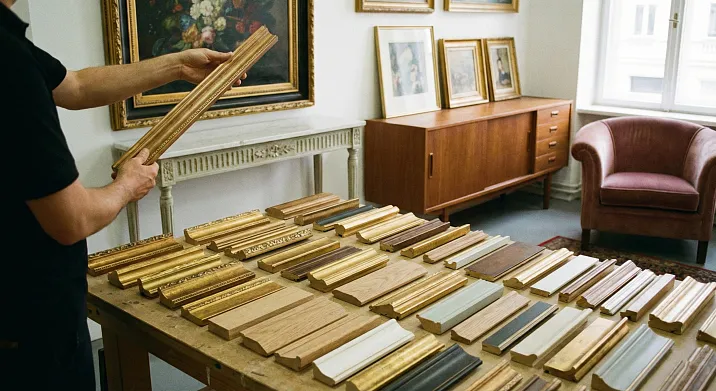
Imagine an interior without molding — flat walls, bare corners, pictures in plastic frames. Now add Wooden Picture Frame — and the space comes alive, fills with depth, gains architectural logic. Molding is the language of classical architecture translated into a modern key. It's a way to turn an ordinary dwelling into a space with character, history, style. But what is molding really? How to choose the right profile among hundreds of options? How not to make mistakes with size, wood species, mounting method? Today we'll analyze this topic deeply — with an understanding of material, technology, aesthetics.



History of molding: from royal palaces to modern apartments
The word 'molding' comes from the Italian 'baghetta' — stick, strip. In Renaissance architecture, molding referred to profiled wooden elements framing panels, mirrors, and pictures in palaces and villas of the aristocracy. Molding served a dual function: it protected the edges of fragile surfaces from damage and gave them solemnity, emphasizing the value of the framed object.
French masters of the 17th century brought the art of molding production to perfection. Versailles palaces displayed kilometers of carved oak moldings adorned with gilding, patination, and intricate ornaments. Molding became a status marker — the more complex the profile and richer the decor, the higher the owner's position.
The Industrial Revolution of the 19th century made molding accessible. Mechanical milling machines allowed complex profiles to be replicated, reducing costs tenfold. Molding ceased to be a privilege of the nobility and entered middle-class homes. Today, quality wooden molding is available to everyone who values natural materials and is willing to invest in durability.




Anatomy of a Picture Frame Molding: Geometry and Function
A picture frame molding is not just a wooden strip. It is a complex profile where each element has a purpose. A classic molding consists of several parts: the shelf, frieze, torus, scotia, and rabbet.
The shelf is the horizontal plane at the top of the profile, on which the framed object—a painting, mirror, or panel—rests. The width of the shelf determines how deeply the object is 'recessed' into the frame. A narrow shelf of 5-8 millimeters creates a delicate frame, while a wide shelf of 20-30 millimeters creates a massive, solemn one.
The frieze is the vertical or inclined plane forming the main body of the molding. It is on the frieze that decorative elements—carvings, gilding, ornaments—are placed. The height of the frieze determines the visual massiveness of the frame, from compact 20 millimeters to monumental 150 millimeters.
The torus is a convex element of round or oval cross-section, creating volume and play of light. Tori can be smooth or ornamented with flutes—vertical grooves borrowed from the architecture of ancient columns.
The scotia is a concave element, the opposite of the torus. Scotias create recesses where shadows form, enhancing the relief of the profile. The alternation of tori and scotias is the basis of complex molding compositions.
The rabbet is a rectangular groove in the back of the molding, into which the glass and backing of the frame are inserted. A rabbet depth of 10-15 millimeters ensures secure fixation of the contents.
Our factory also produces:




Wood Species: Oak, Beech, and Alternatives
The choice of wood species for molding is a balance between strength, decorative appeal, and cost. Three species dominate the production of high-quality molding: oak, beech, and ash.
Oak is the absolute leader in terms of overall properties. A density of 700 kilograms per cubic meter makes oak molding resistant to mechanical damage, scratches, and dents. A hardness of 3.8 units on the Brinell scale allows for the creation of thin, elegant profile elements without risk of breakage. Oak's texture is expressive—contrasting annual rings and medullary rays on a radial cut create a noble pattern. Color varies from light golden to dark brown, depending on the wood's origin and treatment. Oak molding ages nobly—it darkens, acquires depth of shade, and a patina of time.
Beech is an alternative for those who value uniformity of texture. A density of 650 kilograms per cubic meter and hardness of 3.4 units are sufficient for most applications. The texture is fine-grained, without sharp transitions, making beech ideal for painting, tinting, and creating smooth surfaces. The light shade of beech with a slight pinkish undertone creates a sense of airiness. Beech is easier to process—milling, carving, and sanding require less time. But there is a nuance: beech is hygroscopic and actively reacts to changes in air humidity. In rooms with a stable microclimate, this is not a problem, but in damp areas or unheated spaces, beech can behave unpredictably.
Ash is a species with a unique combination of strength and flexibility. A density of 680 kilograms per cubic meter, yet ash is more elastic than oak. The texture is bright, with pronounced annual rings; the color is light with a yellowish or grayish tint. Ash takes well to tinting, accepting any colors from natural to exotic. It is used less frequently than oak and beech but is valued for its decorative appeal.
Get Consultation
Picture Frame Molding: How Framing Influences the Perception of Art
picture moldingA picture frame is not just a border, but part of the artwork. Properly chosen framing enhances the emotional impact of a painting, creates a visual transition between the canvas and the wall, and sets the context for perception.
The width of the molding is determined by the size of the painting and the style of the image. For small works of 20×30 or 30×40 centimeters, a molding width of 30-50 millimeters is optimal—it frames without overwhelming. For medium formats of 50×70 or 60×80 centimeters, a molding of 50-80 millimeters is required. Large works of 100×150 centimeters and more need a massive molding of 80-150 millimeters to avoid looking unfinished.
The color of the molding engages in a dialogue with the painting's color palette. The classic rule: the molding should repeat one of the secondary colors of the image, but not the primary one. If the painting is executed in warm tones—ochre, brown, golden—a molding of natural oak or tinted in honey shades is suitable. A cold palette—blue, gray, green—requires a molding with a silver patina, white, or tinted in cool gray tones.
The style of the molding corresponds to the style of the painting. Classical painting—landscapes, portraits, still lifes of the academic school—requires moldings with traditional profiles, carvings, and gilding. Contemporary art—abstraction, minimalism, expressionism—looks better in simple geometric moldings without decorative excess. Graphics, drawings, and engravings prefer laconic moldings with a mat—a cardboard border between the image and the molding, creating an airy pause.
Molding Strips in Wall Decoration: Architectural Graphics of the Interior
Picture frame stripMolding on walls transforms planes into architectural compositions. This is a technique that came from classical interiors, where walls were divided into panels framed by molding, creating rhythm, proportion, and spatial hierarchy.
Horizontal division separates the wall into upper and lower zones. The classic proportion—the lower third of the wall up to a height of 90-100 centimeters is covered with panels framed by molding, while the upper two-thirds are painted or wallpapered. This creates visual stability—a heavy bottom, a light top. The boundary between zones is decorated with a horizontal frieze molding 50-100 millimeters wide.
Vertical division forms rhythmic sections along the entire height of the wall. Vertical moldings are installed at uniform intervals of 80-120 centimeters, creating a semblance of pilasters—flat columns. The space between the verticals can be filled with contrasting finishes—wallpaper, fabric, or paint of a different shade. This technique visually elongates the room and makes ceilings appear higher.
Framed construction is the most complex technique. The wall is divided into rectangles or squares, each framed by molding along the perimeter. The size of the sections is determined by the proportions of the wall—the classic golden ratio rule sets the aspect ratio at approximately 1:1.618. Decorative elements—wallpaper with patterns, mirrors, paintings, light fixtures—are placed inside the frames. Framed construction creates visual richness, complexity, and aristocratic elegance.
Molding Profiles: From Simple to Luxurious
The variety of molding profiles is astounding. From extremely laconic strips of rectangular cross-section to Baroque compositions with dozens of elements. The choice of profile is determined by the interior style and the function of the molding.
Simple profiles are rectangular or trapezoidal strips with a slight bevel on the edges. Width 20-40 millimeters, thickness 15-25 millimeters. No relief, only purity of lines. Such moldings are used in minimalist interiors, Scandinavian style, and modern classicism, where decorativeness should be restrained.
Classical profiles include tori, scotias, and shelves, creating moderate relief. Width 40-80 millimeters, relief depth 5-15 millimeters. The profile is read as an alternation of light and shadow, creating visual interest without excessive opulence. Suitable for most traditional interiors—English classic, American neoclassical, French provincial style.
Richly decorated profiles are Baroque and Rococo in their pure form. Width 80-150 millimeters, relief depth 20-40 millimeters. The profile is saturated with decorative elements—carved acanthus leaves, rosettes, scrolls, garlands. Every centimeter of the surface is elaborated, creating a sense of luxury and excess. Used in formal interiors—living rooms, studies, and dining rooms of high status.
Corner profiles are specialized moldings for decorating internal and external corners. The profile is adapted for joining at a 90-degree angle and has special elements that conceal the seam. Corner moldings are critical for framed compositions, where the quality of the corners determines the overall impression.
Molding Installation: The Technology of Flawless Mounting
The quality of installation determines how long the molding will last and how professional it will look. Installation requires precise measurements, the right tools, and an understanding of wood properties.
Surface preparation is the first step. The wall must be flat, clean, and dry. Irregularities exceeding 3 millimeters per meter of length require leveling with putty or plaster. The molding must adhere to the wall along its entire length, and any unevenness will create a gap visible under side lighting.
Marking is done using a laser level or chalk line. For horizontal moldings, strict horizontality is critical—a deviation of 1-2 degrees over a 3-meter length is noticeable to the naked eye. For vertical moldings, a plumb bob or laser level in vertical mode is used. Marking is applied with a pencil as a thin line—it should be visible during installation but hidden under the molding after placement.
Cutting molding for corners requires a miter saw with the ability to precisely set the cutting angle. For joining at a right angle, both moldings are cut at 45 degrees. The cut must be perfectly clean, without chips or tears. After cutting, the ends are lightly sanded with fine-grit abrasive to remove fuzz.
Fastening is done using a combination of adhesive and mechanical fasteners. Wood mounting adhesive is applied to the back of the molding in a zigzag pattern. The molding is pressed against the wall along the markings and checked with a level. Holes 2-3 millimeters in diameter are drilled through the molding into the wall at 40-50 centimeter intervals. Headless or countersunk finish nails are driven into the holes. Nails are countersunk 2-3 millimeters below the surface of the molding, and the holes are filled with wood-colored putty or finish coating.
Joining corners is the most critical moment. Ends cut at 45 degrees are coated with adhesive and pressed tightly together. Any gap, even a fraction of a millimeter, will be noticeable. Clamps or temporary nails driven at an angle through both moldings are used to secure the corner until the adhesive sets. After the adhesive dries, the temporary fasteners are removed, and the holes are filled with putty.
Finishing: from natural wood to patinated luxury
Molding can be installed in its natural state or receive a finish that reveals the decorative potential of the wood and adapts it to the interior style.
Clear oil—a minimalist approach that preserves the natural look of wood. The oil penetrates the structure, strengthening the surface layer, highlighting the grain, and imparting a slight silky sheen. Oak under oil acquires a honey hue, beech—a pinkish one. Oil is applied in two coats with intermediate sanding using 320-grit abrasive. Renewal is required every 3-5 years.
Varnish creates a hard protective film. For molding, matte or semi-matte varnish is used—gloss creates glare, visually cheapening the material. Varnish is applied with a sprayer in three coats, each sanded after drying. Varnish coating is durable—lasting 10-15 years without renewal, resistant to moisture, dirt, and mechanical damage.
Staining with wood stains changes the color of the wood while preserving the visibility of the grain. Light beech can be stained to resemble dark walnut, oak—to resemble wenge or bog oak. Stain is applied with a brush or sponge in an even layer, excess is immediately wiped off with a cloth. After drying, the surface is coated with oil or varnish to set the color and provide protection.
Patination—a technique of artificial aging. A base coat of paint or dark-colored stain is applied to the molding. After drying, the raised areas of the relief are lightly sanded, revealing the light wood beneath the dark layer. This creates an effect of natural wear, where protrusions lighten from touch, and recesses retain a dark color. Patination is completed by applying wax or matte varnish.
Gilding—the pinnacle of decorative finishing. Gold leaf is used—the thinnest sheets of real gold a few microns thick, or imitation—composition leaf made of brass. The molding surface is primed and coated with a special adhesive called 'mixtion'. Sheets of gold or composition leaf are carefully laid onto the sticky surface and pressed with a soft brush. After drying, excess is brushed off, and the surface is polished with an agate tool to a mirror shine. Gilded molding is the luxury of classic interiors, requiring skill and time.
Molding in furniture: from classic chests of drawers to modern facades
Molding is used not only for walls and paintings but also as a decorative element in furniture. It creates architectural logic for objects, linking them to the overall interior style.
The upper part of cabinets and chests of drawers is often adorned with a cornice molding, forming an expressive crown. Molding 80-150 millimeters wide is attached to the top edge of the carcass, protruding 50-100 millimeters forward. This creates a play of light and shadow, visually lightens the upper part of the furniture, and gives it solemnity. In classic interiors, the cornice is carved; in modern ones—geometric.
The plinth—the lower part of case furniture—is also finished with molding. More massive profiles 100-200 millimeters high are used here, creating a visual support. Plinth molding can have a concave shape, allowing close approach to the furniture, or a straight one, pushing the carcass away from the wall.
Furniture facades are framed with molding to create a paneled structure. Molding is glued around the perimeter of a cabinet door or drawer front, forming a rectangular frame. Inside the frame, there can be a contrasting insert, milling, or carving. This technique turns a simple plane into a complex architectural composition.
Tables are framed with molding around the perimeter of the tabletop. The molding conceals the tabletop edge, which is usually less decorative than the face surface, and creates a finished frame. For dining tables, molding 40-60 millimeters wide is used; for console tables—30-40 millimeters.
Combining molding with other finishing elements
Molding is rarely used in isolation. It works in a system with other decorative elements, creating a cohesive architectural composition.
Baseboards and molding should harmonize in style and proportions. If classic carved molding is used on walls, the baseboard should also be carved, with similar motifs. Modern geometric molding requires laconic baseboards with a rectangular cross-section. The width of the baseboard usually matches or is slightly less than the width of the molding—this creates a visual balance between the upper and lower zones of the wall.
Door and window casings echo the molding on walls. If walls are decorated with paneling framed by molding, the casings should have a similar profile. This creates a unity of language, perceived subconsciously. A style dissonance—baroque molding on walls and minimalist casings—disrupts harmony.
Ceiling cornices complete the vertical composition. A wide cornice 150-250 millimeters forms the transition from wall to ceiling, creating an expressive crown for the room. The cornice profile is usually more complex than that of wall molding—it is visible from a low viewpoint, where the relief is most clearly read.
Molding in various interior styles
Each style imposes its own requirements on the shape, size, and decoration of molding.
Classic style is the realm of molding. Here it is used everywhere: framing panels on walls, cornices under ceilings, frames around mirrors and paintings, furniture decoration. Profiles are complex, with beads, coves, and ornaments. Wood is stained in noble dark shades or patinated to imitate antiquity. Molding width is significant—60-150 millimeters, creating a sense of solidity.
Neoclassicism simplifies classicism, retaining architectural logic but reducing decorativeness. Moldings have clear profiles, but carving is minimal or absent. Colors are light—white, cream, light gray. Width is moderate—40-80 millimeters. Neoclassical molding creates structure without overwhelming the space.
Scandinavian minimalism uses molding sparingly. Simple rectangular profiles 20-40 millimeters, painted white or light gray. No carving, only purity of lines. Molding is applied selectively—framing paintings, mirrors, rarely on walls.
Loft allows molding as a contrasting element. Rough brick walls and wooden molding create an interesting juxtaposition. Molding is used for framing mirrors, creating accent zones. Preference is given to molding made of untreated wood with visible grain, wire-brushed, stained in dark or gray tones.
Provence and country styles favor molding in light tones with a distressed effect. Painting in milk white, ivory, pale blue with partial removal of paint on raised areas imitates natural wear. Molding of moderate width 40-70 millimeters with light carving of plant motifs.
Frequently Asked Questions
Can the same molding be used for pictures and wall decor?
Yes, if the style and proportions match. Molding with a width of 50-80 millimeters is universal — suitable for framing medium-sized pictures and creating wall panels. It is important that the profile matches the interior style. For variety, you can vary the width — narrower molding for pictures, wider for walls.
How to calculate the required amount of molding for a picture frame?
Sum the lengths of all four sides of the frame and add 20-30 percent for mitering corners and possible waste. For a 50×70 centimeter frame: (50+70)×2 = 240 centimeters, plus 25 percent = 300 centimeters or 3 meters of molding.
Is it necessary to coat the molding with a protective compound before installation?
Definitely, if the molding is sold untreated. Coating the molding after installation is more difficult — the compound seeps into the joints, causing unevenness. Treat the molding with oil or varnish before installation, allowing it to dry completely. The ends, which are cut at angles, are treated locally after cutting.
What adhesive should be used for installing wooden molding?
For light molding, construction adhesive like liquid nails is sufficient. For heavy molding wider than 100 millimeters, use two-component polyurethane or epoxy adhesive — they provide maximum strength. The adhesive must be supplemented with mechanical fasteners.
Can oak molding be painted white without losing its texture?
Yes, use white translucent paint or varnish with added white pigment. The oak texture will remain visible, but the color will change to white with a slight transparency of the wood grain. Apply in a thin layer, controlling the degree of opacity. For a completely white color, use opaque enamel.
Solid wood molding or MDF — which is better?
Solid wood surpasses MDF in durability, eco-friendliness, and tactile feel. Oak or beech molding will last for decades, surviving several renovations. MDF molding is cheaper, easier to process, and not afraid of moisture. For temporary solutions or budget projects, MDF is acceptable. For permanent interiors, choose solid wood.
How to care for wooden molding during use?
Regular dry cleaning — removing dust with a soft cloth or brush with natural bristles. Once a month — wet cleaning with a slightly damp cloth for molding with a varnished finish. For oiled molding — avoid excess water, renew the oil every 3-5 years.
Can moldings of different widths be combined in one room?
It's possible if it's a deliberate technique. Wide molding for main wall panels, narrow for framing pictures. Or a wide cornice under the ceiling, a narrow frieze at mid-wall level. The main thing is to maintain stylistic unity of the profiles. Different widths with the same profile create hierarchy, not chaos.
How long does it take to make a custom picture frame?
A standard frame made from ready-made molding takes 3-5 days. Non-standard sizes or custom molding profiles require 2-3 weeks. Complex finishes — gilding, patination, carving — add another week. Clarify the timeline with the manufacturer when ordering.
Is it worth using molding in small spaces?
Yes, but with caution. In small rooms, use narrow molding 20-40 millimeters in light tones. Avoid dark, massive profiles — they visually reduce space. Vertical division of walls with narrow moldings visually raises ceilings, which is useful for low rooms.
Conclusion: The choice of woodworking masters
Wooden molding is an investment in the aesthetics and durability of an interior. High-quality molding made from solid oak or beech, manufactured with proper technology, will last for decades, preserving its shape, color, and decorative properties. Cheap alternatives made of plastic or low-grade wood deform, fade, and require replacement after a few years.
The company STAVROS has specialized in the production of wooden millwork, including a full range of molding profiles, for over twenty years. The assortment includes dozens of models — from laconic modern to richly decorated classic, from compact 20 millimeters to monumental 150 millimeters. Each product is made from selected oak and beech wood, dried to an optimal moisture content of 8-12 percent.
STAVROS production is equipped with CNC machines, ensuring profile precision and uniformity of all items in a batch. Final sanding is done manually, guaranteeing a perfectly smooth surface without tool marks. The ability to produce custom molding based on individual drawings allows for the realization of any designer's vision.
STAVROS works with both professionals — designers, architects, construction companies — and private clients creating their interiors independently. Technical support, consultations on profile selection, calculation of required quantities, recommendations for installation and finishing — all are part of the standard service.
Choosing STAVROS products means choosing a tradition of joinery craftsmanship combined with modern technology. This is molding that turns walls into architectural compositions, pictures into works of art, furniture into interior design objects. It is the choice of those who understand the value of natural materials and are ready to invest in beauty that will never go out of style.


