Article Contents:
- History and evolution of wooden newels
- Functional purpose of wooden newels
- Safety Above All
- Constructive rigidity
- Architectural expressiveness
- Advantages of wooden newels over other materials
- Ecological and natural properties
- Aesthetic appeal
- Ease of processing and variety of forms
- Durability with Proper Care
- Repairability
- Universality and compatibility
- Types of wooden newels by manufacturing method
- Turned newels
- Milled newels
- Carved newels
- Combined Balusters
- Wood species for making newels
- Oak – symbol of strength and nobility
- Beech – reliability and aesthetics
- Ash – flexibility and strength
- Larch – natural protection
- Spruce – accessibility and practicality
- Birch – a rare but interesting choice
- Styles and design of wooden newels
- Classic style
- Neoclassical style
- Baroque and Rococo
- Modern
- Minimalism
- Art of installation: installing trims
- Loft and Industrial Style
- Technical specifications and dimensions of wooden newels
- Standard Sizes
- Calculating the number of newels
- Installation features
- Care and Maintenance of Wooden Balusters
- Protective Treatment
- Regular maintenance
- Periodic Coating Renewal
- Repair and replacement
- Wooden newels in various interior solutions
- Classic Interior
- Modern Interior
- Rustic style
- Eclectic interior
- Innovations in the production of wooden newels
- 3D modeling and CNC processing
- New methods of wood protection
- Combining materials
- Ecological production
- How to choose the perfect wooden newels for your home
- Consider the overall interior style
- Observe proportions
- Choose quality materials
- Pay attention to details
- Consult Professionals
- Conclusion: Wooden balusters as an investment in the beauty and comfort of your home
There are details in the world of architectural elements capable of transforming a space beyond recognition, giving it a unique charm and character. One such element, undoubtedly, is wooden balusters – elegant vertical posts supporting railings of staircases, balconies, and terraces. These architectural elements have a rich history dating back to the Renaissance, when Italian masters first began using them to decorate palaces and mansions.
Today wooden balusters – they are not just a functional safety element, but a true work of art capable of becoming a central accent in the interior of your home. They give staircases completeness, elegance, and individuality, reflecting the taste and status of the owner.
Why wood? This material possesses a unique energy, warmth, and natural beauty that cannot be replicated artificially. Each Wooden baluster is unique due to the unmistakable grain pattern created by nature itself. Let us dive into the wonderful world of these architectural elements and reveal all their secrets.


History and Evolution of Wooden Balusters
The first mentions of balusters can be found in ancient civilizations. Interestingly, one of the earliest depictions of these architectural elements was discovered on bas-reliefs in Assyria. However, the true flourishing of baluster art came during the Renaissance, when Italian architects actively incorporated them into their projects.
Initially, balusters were used primarily for balcony railings, and only in the 15th century were they installed on staircases. From this point, they firmly entered architectural tradition and became an indispensable part of both exterior and interior building decoration.
Their form and style have changed over centuries in accordance with prevailing architectural styles: from opulent Baroque to strict Classicism, from elegant Rococo to minimalist Modern. However, the core idea of using these elements has remained unchanged – they have always served both safety and beauty.
In the modern world wooden balusters are experiencing a new wave of popularity. Masters combine traditional woodworking techniques with innovative technologies, creating unique pieces capable of satisfying the most discerning tastes.




Functional Purpose of Wooden Balusters
Before diving into the world of aesthetics and design, it is important to understand the practical role balusters play in staircase or railing construction.
Our factory also produces:


Safety above all
The primary function of balusters is to ensure safety while moving along a staircase. According to building codes, the distance between balusters must not exceed 15 cm. This is a critical requirement that prevents the possibility of falling through the railing in case of losing balance. This is especially important for families with children – with properly calculated spacing between balusters, a child physically cannot squeeze through them.
Get Consultation
Structural rigidity
In addition to safety, balusters perform an important structural function – they provide additional rigidity to the entire staircase railing. Evenly distributed along the entire length of the railing, they create a reliable support, preventing bending and deformation of the structure under load.
Architectural Expressiveness
The aesthetic function of balusters is equally important. It is precisely they that define the overall style of the staircase and can radically change the perception of the entire interior. Depending on the design, balusters can be a subtle addition to the main structure or a striking accent that attracts attention and evokes admiration.
Advantages of Wooden Balusters Over Other Materials
In modern construction, various materials are used to manufacture balusters: metal, stone, glass, plastic. However, wood remains unmatched in several key parameters.
Ecological and natural
Wood is an absolutely eco-friendly material that does not emit harmful substances and does not cause allergic reactions. Moreover, natural wood positively affects the microclimate of a room, regulating humidity and enriching the air with beneficial phytoncides and essential oils.
Aesthetic appeal
The unique texture of wood, its natural grain, and warm tone create a special atmosphere of coziness and comfort. Wooden balusters fit organically into any interior – from classic to modern, from rustic to minimalist.
Ease of Processing and Variety of Forms
Wood is an amazingly malleable material that allows for the realization of the most daring design ideas. Balusters can be carved from it in practically any shape and complexity: from simple geometric forms to intricate decorative pieces with elaborate carvings.
Longevity with proper care
With proper manufacturing technology and correct maintenance, wooden balusters serve for decades without losing their appeal. The minimum service life of quality products is 50 years – an impressive figure for a decorative element.
Repairability
Unlike metal or stone counterparts, wooden balusters are easy to repair or replace. If one baluster is damaged, it can be replaced without the need to dismantle the entire structure.
Universality and Compatibility
Wooden balusters combine beautifully with other materials – metal, glass, stone – opening up wide possibilities for creating unique design solutions.
Types of Wooden Balusters by Manufacturing Method
Modern wood processing technologies allow creating balusters of various shapes and styles. Let us consider the main types of these products by manufacturing method.
Turned balusters
Milled balusters
Milled balusters
Milled balusters are created using milling machines that cut various patterns and ornaments into the surface of the wood. These balusters feature original decoration in the form of spirals, grooves, recesses, and other elements. They look especially striking in classical and neoclassical interiors.
Carved balusters
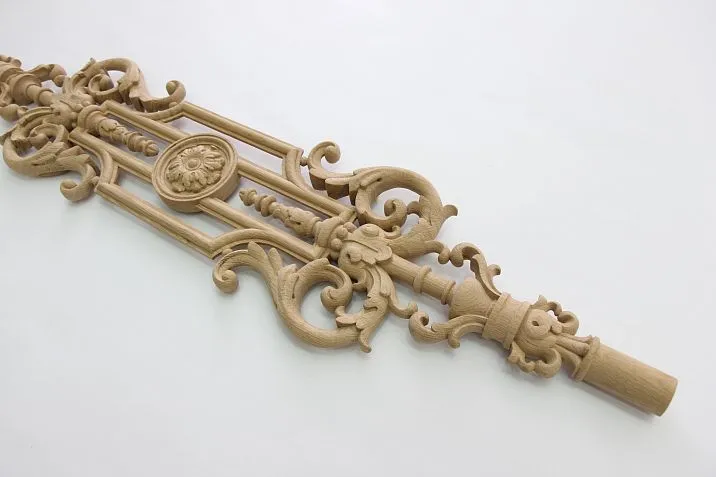
Carved balusters – the pinnacle of woodworking craftsmanship. They are created by hand or using computer numerical control (CNC) machines. Modern technologies allow almost any shape to be realized in wood, from simple geometry to complex artistic compositions. Carved balusters become true works of art and a central element of interior design.
Combined balusters
Combined balusters combine different woodworking techniques. For example, the middle part may be turned, while the upper and lower parts are decorated with carving. Such items allow creating a unique design that meets the customer's individual preferences.
Wood species for making balusters
Choosing the wood species for balusters is a responsible step, as it affects not only the appearance but also the durability of the entire structure. Let's consider the main wood species used for manufacturing these architectural elements.
Oak – symbol of strength and nobility
Oak is rightfully considered the king among wood species. Oak balusters are distinguished by exceptional strength, resistance to mechanical impacts, and longevity. They are not afraid of moisture, temperature fluctuations, or microbial activity. The noble dark tone and expressive texture of oak wood give the items a special elegance and status. Despite its high density, oak is easy to process, allowing the creation of balusters with complex shapes.
Beech – reliability and aesthetics
Beech is another valuable species widely used for making balusters. In terms of strength, it is almost equal to oak, but has a lighter tone and less pronounced texture. Beech balusters have a smooth surface and uniform color, making them an ideal choice for modern interiors. The only drawback of beech is its susceptibility to rotting in high humidity, so balusters made from this species are recommended for indoor use only.
Ash – flexibility and strength
Ash – wood with unique properties. It combines high strength with remarkable flexibility, making it an ideal material for manufacturing balusters with complex shapes. Ash balusters are resistant to moisture and decay processes, withstand significant mechanical loads, and retain their shape for decades. The light tone with a subtle golden hue gives ash balusters a special elegance.
Larch – natural protection
Larch – a unique species that becomes stronger over time. Larch balusters are resistant to moisture, high temperatures, and even open flames. This wood contains natural resins that protect it from rotting and insect damage. The beautiful amber tone and expressive texture make larch balusters a true decoration for any interior.
Spruce – accessibility and practicality
Spruce – the most accessible and common species for making balusters. Despite relatively low cost, spruce balusters have good performance characteristics: they are strong, lightweight, and easy to process. The light tone of spruce wood with its characteristic ring pattern creates a sense of lightness and airiness. To increase durability, spruce balusters are recommended to be treated with protective compounds.
Birch – a rare but interesting choice
Birch is less commonly used for making balusters due to certain drawbacks: it is prone to cracking, rotting, and has a high shrinkage rate. However, professional craftsmen value this species for its ability to be stained in various shades and to create complex patterns. With proper processing and protection, birch balusters can become an original design element in interior decor.
Styles and design of wooden balusters
Choosing the style of balusters is not only an aesthetic question but also a way to emphasize the overall concept of the interior. Let's consider the main stylistic directions in the design of wooden balusters.
Classic style
Classical balusters have a symmetrical shape with a characteristic thickening in the central part (so-called "barrel"). They are often decorated with reeding (vertical grooves), rings, and other traditional elements. Such balusters are ideal for interiors in the classical, empire, or neoclassical styles.
Neoclassical style
Neoclassical balusters retain the main features of classical style but have a more restrained decoration and clean lines. They combine well with modern materials and technologies, making them a universal choice for most interiors.
Baroque and Rococo
Balusters in the baroque and rococo styles are characterized by elaborate forms, abundance of decorative elements, and intricate carving. They become true works of art and central elements of the interior. Such balusters require appropriate surroundings – rich finishes, antique furniture, luxurious textiles.
Modern
Balusters in the modern style are characterized by smooth, flowing lines, asymmetry, and plant motifs. They create a sense of movement and lightness, bringing a touch of elegance and romance into the interior.
Minimalism
Minimalist balusters have a simple geometric shape – most often rectangular or square cross-section posts without decorative elements. They are ideal for modern interiors where simplicity and functionality are valued.
Country and Provence
Balusters in the country or Provence style are characterized by simple forms and natural finishes. They often have a slightly aged appearance, creating an atmosphere of coziness and home warmth. Such balusters combine beautifully with wooden furniture, textiles made from natural fabrics, and other elements of rustic style.
Loft and industrial style
In loft interiors, wooden balusters are often combined with metallic elements, creating an interesting contrast of textures and materials. They may have a rough finish that highlights the natural beauty of the wood, or be painted in dark colors to create an industrial atmosphere.
Technical parameters and dimensions of wooden balusters
When choosing balusters, it is important to consider not only their appearance but also their technical characteristics, which must correspond to the specific staircase and safety requirements.
Standard Sizes
The standard height of balusters ranges from 70 to 100 cm, depending on the height of the railing. The diameter or cross-section of balusters may vary from 4 to 12 cm, depending on the style and overall proportions of the staircase. It is important to remember that the distance between balusters should not exceed 15 cm — this is a safety requirement, especially relevant for homes where there are children.
Baluster quantity calculation
To calculate the required number of balusters, you need to know the total length of the railing and the desired distance between balusters. The calculation formula is simple: number of balusters = (railing length / (baluster width + distance between balusters)) + 1. For example, for a 3-meter-long railing, with a baluster width of 5 cm and a 15 cm distance between them, you will need (300 / (5 + 15)) + 1 = 16 balusters.
Installation features
There are several ways to mount balusters to the staircase:
- Mounting in the tread and stringer — balusters are secured in special holes at the bottom and top of the staircase.
- Mounting in the baluster rail and handrail — balusters are installed on a special rail (baluster rail) and secured to the handrail from above.
- Side mounting — balusters are attached to the treads from the side using special brackets.
The choice of mounting method depends on the staircase construction, baluster material, and design concept.
Care and maintenance of wooden balusters
To ensure wooden balusters retain their beauty and functionality for many years, proper care is necessary.
Protective treatment
Before installation, balusters must be treated with protective compounds that prevent rot, insect damage, and mold. Depending on the wood species and usage conditions, various impregnations, varnishes, oils, or waxes may be applied.
Regular Maintenance
To maintain the attractive appearance of wooden balusters, it is sufficient to regularly remove dust with a soft cloth or specialized wood surface care products. Aggressive cleaning agents are not recommended, as they may damage the protective coating.
Periodic coating renewal
Depending on the intensity of use and environmental conditions, the protective coating on balusters may require renewal every 3–5 years. This will help preserve not only the aesthetic qualities of the items but also their strength characteristics.
Repair and Replacement
If damage (cracks, chips, deformations) is detected, it is recommended to immediately repair or replace the damaged baluster. This will prevent further spread of damage and maintain the safety of the structure.
Wooden balusters in various interior solutions
Wooden balusters — a universal element that can be seamlessly integrated into any interior. Let’s consider how they combine with various stylistic directions.
Classic interior
In classic interiors, wooden balusters become an important element of the overall composition. They are often made from valuable wood species (oak, walnut, mahogany) and feature rich decoration. Such balusters harmonize well with parquet floors, wooden wall panels, moldings, and other traditional decorative elements.
Modern interior
In modern interiors, wooden balusters can serve as a striking accent or, conversely, as a subtle background element. They often have simple geometric shapes and minimal decoration. An interesting solution may be combining wooden balusters with metallic or glass elements, creating a striking contrast of materials and textures.
Rustic style
In country, Provence, or chalet-style interiors, wooden balusters play a key role in creating an atmosphere of coziness and home warmth. They often have a rough finish that highlights the natural beauty of the wood and may be artificially aged to create a patina effect.
Eclectic interior
In eclectic interiors that combine elements of various styles, wooden balusters can serve as a connecting element between disparate items and materials. They can be painted in bright colors, decorated in unconventional ways, or combined with non-traditional materials.
Innovations in wooden baluster production
Modern technologies open up new possibilities in the production of wooden balusters, making them even more attractive and functional.
3D modeling and CNC machining
3D modeling and CNC machining technologies allow creating balusters of any complexity with the highest precision. This opens practically limitless possibilities for designers and architects.
New wood protection methods
Modern protective compounds not only protect wood from rot, insects, and mold, but also preserve its natural beauty, highlighting texture and tone. Some compounds have additional properties — fire-retardant, water-repellent, anti-static.
Combining materials
An innovative trend is combining wood with other materials — metal, glass, stone, composites. This allows creating unique design solutions that combine the traditional warmth of wood with modern materials.
Ecological production
Modern manufacturers of wooden balusters pay great attention to the ecological aspects of the entire process — from wood preparation to final product finishing. Certified wood from renewable sources, health- and environmentally-safe varnishes and paints, and waste-free production technologies are used.
How to choose the perfect wooden balusters for your home
Choosing balusters is a responsible step that requires consideration of many factors. Here are several recommendations that will help make the right choice.
Consider the overall interior style
Balusters should harmoniously fit into the overall design concept of your home. If you have a classic interior, choose balusters with traditional shapes and decoration. For modern interiors, minimalist models with clean lines are suitable. In rustic style, balusters with rough finish and natural texture are appropriate.
Maintain proportions
The size and shape of balusters should match the scale of the staircase and the overall room. In small spaces, it's better to use elegant balusters that won't visually weigh down the interior. For spacious rooms with high ceilings, more substantial models are suitable.
Choose quality materials
Prefer balusters made of well-dried wood without defects (knots, cracks, inconsistencies). Quality material is the guarantee of longevity and attractive appearance of the items.
Pay attention to details
The quality of baluster processing is an important indicator that affects not only aesthetics but also safety. All surfaces must be smooth, without burrs or sharp edges. Joints must be precise, without gaps or seams.
Consult professionals
If you are unsure about your choice, consult an interior designer or a staircase specialist. A professional will help you select balusters that will perfectly fit your interior and meet all technical requirements.
Conclusion: wooden balusters as an investment in the beauty and comfort of your home
Wooden balusters are not just a functional element of the staircase, but also an important detail that shapes the overall impression of the interior. They combine practicality and aesthetics, safety and decorativeness, tradition and innovation.
Investing in quality wooden balusters, you get:
- A safe and reliable staircase railing that will last for decades
- A unique decorative element that highlights your taste and status
- An eco-friendly solution positively affecting the microclimate in your home
- The opportunity to create a personalized design reflecting your personality
STAVROS offers a wide range of wooden balusters in various styles and forms, made from high-quality materials using modern technologies. Professional consultants will help you choose the perfect balusters that will become a true decoration of your home and delight you with their beauty and functionality for many years.
By choosing STAVROS, you get not just a product, but a comprehensive solution for your interior—from professional consultation to quality installation. Entrust the creation of comfort in your home to true professionals!