Article Contents:
- The evolution of minimalism: from sterility to tangibility
- The problem of tactile poverty
- Visual fatigue from uniformity
- Wooden handles: functionality and aesthetics in a single touch
- Ergonomics of wooden handles
- Geometry and Minimalism
- Wood species and their impact on atmosphere
- Wooden furniture decor: accents without overload
- Functions of furniture decor in minimalist spaces
- Types of decorative overlays for minimalist furniture
- Decor placement: center or periphery?
- Coatings for wooden elements: preserving naturalness
- Oil: preserving texture and warmth
- Lacquer: Protection and Shine
- Wax: a compromise between oil and varnish
- Staining: wood in color
- Integrating wooden elements into specific spaces
- Kitchen: wooden handles as accents on neutral facades
- Bedroom: tactile comfort in the relaxation zone
- Living room: wooden decor on media furniture
- Entryway: first impression through touch
- Combining wood with other minimalist materials
- Wood and concrete
- Wood and metal
- Wood and glass
- Wood and stone
- 2026 trends: where minimalism with wooden elements is heading
- Large sculptural handles
- Unfinished edges and natural imperfections
- Tinted wood in unexpected colors
- Modular handle systems
- Technology integration
- Practical considerations for selection and installation
- How to calculate the number of handles
- How to choose handle size based on furniture dimensions
- Handle installation height on doors
- Fasteners: Reliability and Inconspicuousness
- Care for Wooden Furniture Elements
- Daily care
- Stain Removal
- Recoating
- Frequently Asked Questions
- Are Wooden Handles Suitable for the Kitchen?
- Can Wooden Handles Be Installed on Bathroom Furniture?
- How to Coordinate the Color of Wooden Handles with Other Wooden Interior Elements?
- Can Furniture Handles Be Replaced Without Replacing the Entire Furniture?
- Do Wooden Handles Get Scratched?
- How Much Do Quality Wooden Handles Cost?
- Conclusion: A Touch of Nature in Urban Space

Minimalism has come a long way. From the radical rejection of all decoration to the present day, when sterile emptiness gives way to selective warmth. In 2026, minimalist interiors cease to be cold manifestos—they become spaces where restraint combines with tactile comfort.Wooden furniture handlereturns the touch of natural material to the environment of smooth facades and metal surfaces.Decor for Solid Wood Furnitureadds visual depth without overload, creating accents where monotonous smoothness once reigned. Let's explore why wood has become the main material of the new minimalism and how to properly integrate wooden elements without disrupting the balance.




The Evolution of Minimalism: From Sterility to Tangibility
The minimalism of the 2010s was uncompromising. White walls, glossy handleless facades, furniture as geometric abstractions. Beautiful in photographs, but uncomfortable for living. The lack of tactile diversity created a feeling of a hospital ward, an exhibition hall, a space where one cannot relax.




The Problem of Tactile Poverty
Humans are tactile beings. We explore the world through touch from the first days of life. Texture, temperature, weight of material—all of this is perceived by the skin, transmitted to the brain, and forms an emotional response. Cold metal, smooth plastic, slippery glass—the materials of the previous decade's minimalism—evoke detachment and distance.
Wood is different. Its surface is warm, rough, alive. The texture of wood—its annual rings, pores, micro-irregularities—creates a richness of tactile sensations. When the hand touchesa wooden handle on a cabinet, an instant feeling of comfort, familiarity, and homely warmth arises.
In 2026, designers realized: minimalism should not exclude tactility. On the contrary, in a space with few objects, every touch becomes significant. If there are only 20 items in an interior, the quality of those 20 is critical.Furniture handles made of oak or beechturn the daily action of opening a drawer into a pleasant ritual.
Our factory also produces:



Visual Fatigue from Uniformity
Monochromatic interiors tire the eye. When everything is the same color, the same texture, the eye has nothing to latch onto. It glides over surfaces without finding a focal point. This creates background visual tension, which a person may not be aware of but which affects stress levels.
Wooden elements—handles, overlays, decorative panels—create visual anchors. Even in an all-white kitchen, a fewwooden handles on the facadeschange everything. The eye finds reference points, the space becomes structured, understandable, and readable.
The texture of wood adds visual complexity without decorative overload. The pattern of annual rings is a natural ornament that never becomes tiresome because it is not artificial, not invented by a designer, but created by time and nature.
Get Consultation
Wooden Handle: Functionality and Aesthetics in a Single Touch
Solid wood furniture handle— it's the point of contact between a person and furniture. We touch it dozens of times a day: opening a kitchen cabinet in the morning for coffee, taking clothes out of a dresser, hanging a coat in the hallway. This makes the choice of handle not secondary, but critically important.
Ergonomics of wooden handles
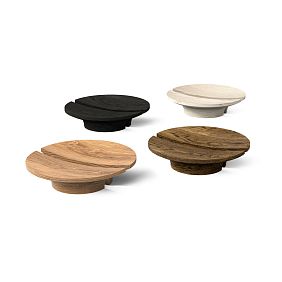
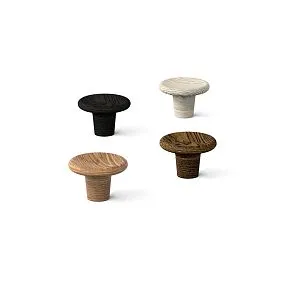
The shape of the handle determines comfort of use. A pull handle — U-shaped, long (100-300 mm) — is convenient for heavy cabinet doors where a reliable full-hand grip is needed. A knob handle — compact, round or polygonal (diameter 30-60 mm) — is suitable for light drawers, small doors. A cup handle — recessed, with a finger indentation — is ideal for minimalist fronts where protruding elements are not desired.
Wood as a material has an advantage in ergonomics. It is not cold (unlike metal), not slippery (unlike plastic), has a natural roughness that provides a reliable grip. RoundedWooden Handlefits anatomically in the palm, does not create pressure points.
The weight of a wooden handle is also important. A handle that is too light (plastic) feels flimsy, unreliable. One that is too heavy (solid metal) is tiring with frequent use. Wood has optimal density — weighty enough to feel quality, but not excessive.
Geometry and minimalism
For minimalist interiors,wooden handles of simple geometric shapesare suitable — cylindrical, rectangular, oval, triangular. Absence of carving, ornament, complex profiles. Beauty lies in the purity of lines, in the quality of surface treatment, in the natural texture of the wood.
Round handles with a diameter of 40-80 mm are a universal solution. They are neutral, suit any style, and are convenient to use. Triangular and polygonal handles are more expressive, create a geometric accent, and are suitable for modern interiors where graphic quality is valued.
Long horizontal handles (200-400 mm) visually widen the front, emphasize horizontals, and create a sense of stability. Vertical short handles (100-150 mm) create vertical accents, visually elongate the space.
Wood species and its influence on the atmosphere
Oak — a classic. Hardness 3.7 on the Brinell scale, pronounced texture with large annual rings, color from light golden to dark brown.Handles made of oakcreate a feeling of reliability, solidity, tradition. Suitable for interiors where minimalism is combined with naturalness, eco-friendliness.
Beech — lighter than oak, with a more uniform texture, creamy-pinkish hue. Hardness 3.8 on the Brinell scale, making it even stronger than oak. Handles made of beech look softer, more delicate, suitable for Scandinavian interiors where light wood is valued.
Ash — light, with a contrasting texture (alternation of light and dark stripes). Hardness 4.0 on the Brinell scale — the maximum among European species. Handles made of ash create a dynamic pattern, suitable for interiors where expressiveness is needed while maintaining a light tone.
The choice of species depends on the overall color scheme of the interior. If cool gray tones predominate, it is better to choose light beech or ash with a light gray tint. If the interior is warm beige-cream — oak of natural color or with a light golden tint.
Wooden furniture decor: accents without overload
Minimalism does not exclude decor — it requires selectivity. Instead of abundant carving on all surfaces — one or two pinpoint accents.Decorative wooden inlaysare placed on central fronts, creating focal points.
Functions of furniture decor in minimalist spaces
Decor should not be an end in itself. In minimalism, every element must work — visually or functionally.Carved decor on furniturecan perform several functions:
Masking joints and defects. If there is a joint of two panels on a furniture front, a decorative overlay hides the seam, turning it into a decorative element. If there is a knot, a small crack (a natural feature of solid wood) on the surface — an overlay is placed on top, turning the flaw into an accent.
Visual structuring. A large smooth front (for example, a cabinet door 80×200 cm) looks monotonous.Wooden Overlayin the center or at the corners divides the plane, creates rhythm, sets a visual structure.
Creating hierarchy. If there are several pieces of furniture in a room, a decorative overlay on the main piece (for example, on the central living room cabinet) highlights it, creates a compositional center.
Types of decorative overlays for minimalist furniture
For minimalism, overlays with restrained forms are suitable — geometric, stylized plant motifs, without baroque opulence.
Geometric overlays — diamonds, circles, squares, triangles made of wood with slight relief or flat, contrasting in color. They create graphic quality, modernity, and echo the forms of minimalist furniture.
Stylized plant motifs — simplified leaves, branches, flowers without detailing. Not realistic carving, but a hint of a natural form, its symbol. For example, a single acanthus leaf stylized into a few lines, or an abstract branch of three curved elements.
Linear overlays — long, narrow strips with minimal relief (several grooves, ridges). Placed vertically or horizontally on facades, creating graphic lines.
The size of the overlay should be proportional to the facade. For a cabinet door 40×60 cm — an overlay of 10×15 cm. For a large facade 80×200 cm — an overlay of 20×40 cm or several smaller ones, symmetrically placed.
Decoration placement: center or periphery?
There are two approaches. Central placement —decorative insertin the geometric center of the facade. This is a classic technique, creating symmetry, drawing the eye to the center. Suitable for calm, balanced interiors.
Corner or peripheral placement — overlays in the corners of the facade or along the edges. This creates a frame, limits the plane, makes it visually smaller. Suitable for large facades that look empty without structuring.
Asymmetric placement — the overlay is offset from the center, placed in one of the corners, creating dynamism. This is a bold solution requiring a subtle sense of balance. Suitable for modern interiors where unconventionality is valued.
In a minimalist interior, it is better to use one type of placement throughout the room. If one cabinet has an overlay in the center, all others should also have it in the center. This creates rhythmic unity and visual coherence.
Coatings for wooden elements: preserving naturalness
Wood requires a protective coating — from moisture, dirt, mechanical damage. But the choice of coating affects tactility and visual appearance.
Oil: preserving texture and warmth
Oil coating soaks into the wood, emphasizes the texture, makes the color deeper and richer. The hand feels the wood, not a film — this is critical for handles that are frequently touched. Oil can be transparent (preserves the natural wood color) or pigmented (tints to the desired shade).
Advantages of oil: natural appearance, tactile comfort, ease of renewal (apply a new layer once every 1-2 years — 15 minutes of work). Disadvantages: less protection than varnish, requires periodic renewal.
For minimalist interiors where naturalness is valued, oil is the optimal choice.Wooden handles with oil coatingretain natural warmth and are pleasant to the touch.
Finish: Protection and Shine
Varnish coating creates a hard, transparent film on the surface. Protection is maximum — moisture does not penetrate, scratches are harder to leave. Varnish can be glossy (bright shine), semi-matte (light shine), and matte (no shine).
Glossy varnish is undesirable in a minimalist interior — it creates vulgar shine, visual noise. Semi-matte and matte varnishes are suitable — they protect but do not create aggressive shine.
The disadvantage of varnish is altered tactility. The wood becomes smooth, cold, loses its natural roughness. For decorative overlays, this is acceptable (they are not constantly touched), for handles — less comfortable.
Wax: a compromise between oil and varnish
Wax coating is an intermediate option. Wax creates a thin protective film, but not as hard as varnish. The surface becomes semi-matte, with a slight silky sheen, pleasant to the touch.
Wax requires renewal more often than varnish, but less often than oil — once every 6-12 months. Renewal is simple: wipe the surface with a cloth with wax, polish with a dry cloth.
For minimalist interiors where a balance between protection and naturalness is important, wax is a good choice.
Painting: wood in color
Natural wood texture is not always needed. In some minimalist interiorsWooden handlesare painted white, black, gray — the texture is hidden, but the form, tactility, and warmth of the wood remain.
White wooden handles are a classic of Scandinavian minimalism. They blend with white fronts, becoming inconspicuous, but their tactility differs from plastic or metal white handles.
Black wooden handles are an expressive contrast on light fronts. They create graphic quality, clear accents, and are suitable for monochrome black-and-white interiors.
Gray wooden handles are a compromise, a soft neutral tone that fits into any palette.
Painting is done with opaque paints (enamels) or semi-transparent ones (glazing). Opaque paints completely hide the texture, creating a uniform color. Glazing tones the wood, but the texture shows through — this is more interesting visually.
Integration of wooden elements into specific spaces
The theory is clear. How to apply it in practice in different rooms?
Kitchen: wooden handles as an accent on neutral fronts
A modern minimalist kitchen often features white, gray, or beige fronts without handles (push-to-open system) or with integrated profile handles. This is functional, but cold.wooden furniture handleschange the atmosphere.
If the fronts are matte white — handles made of light beech or natural oak. This creates a soft contrast, adds warmth without compromising minimalism.
If the fronts are dark gray or graphite — handles made of dark walnut or oak with graphite toning. They blend in tone but differ in texture — wood versus matte plastic or MDF.
If the fronts are beige or cream — handles made of oak with golden toning, enhancing the warm palette.
Important: all handles in the kitchen should be of the same type, size, and color. Inconsistent handles create chaos and disrupt minimalist integrity.
Bedroom: tactile comfort in the rest area
The bedroom is an intimate space where tactility is critical.Wooden handles on the dresser, wardrobe, nightstandscreate warm points of contact. In the morning, still not fully awake, you open a drawer for clothes — and the touch of warm wood is more pleasant than cold metal.
For a minimalist bedroom, rounded button handles with a diameter of 40-50 mm made of light wood with an oil finish are suitable. They are delicate, not dominant, but create tactile comfort.
Decorative Insertsin the bedroom are used sparingly — one or two on the central wardrobe doors. This creates a visual focus but does not overload the rest space.
Living room: wooden decor on media furniture
In a minimalist living room, there is not much furniture — a sofa, a coffee table, a TV stand or wall unit.Wooden handles on the doors of the TV standare an opportunity to add a natural material without overloading the interior.
If the TV wall unit is modular, modern, with solid fronts — long horizontal wooden bracket handles (200-300 mm) will emphasize horizontality and create graphic quality.
Decorative overlays on the central moduleof the wall unit can mark the main element — for example, a cabinet with audio equipment or a bar.
Hallway: first impression through touch
The hallway is the first space a person enters when coming home. A wardrobe for outerwear, a shoe cabinet, a mirror — all of these are equipped with handles.Wooden handles in the hallwaycreate the first tactile impression of the home.
For a minimalist hallway, large pull handles (150-200 mm long) made of solid wood (oak, ash) are suitable — they will withstand intensive use and frequent contact with wet hands (after rain, snow).
Finish — varnish or oil-wax (a combined finish with increased moisture resistance). The hallway is an area with variable humidity, so wood protection must be reliable.
Combining wood with other minimalist materials
Wood does not exist in isolation — it interacts with the other materials in the interior.
Wood and concrete
Concrete — a symbol of brutalist minimalism, industrial aesthetics. Cold, gray, rough. Wood — warm, natural, soft. The contrast creates tension, making the interior memorable.
Wooden handleson furniture with concrete countertops — a classic combination of loft and minimalism. Gray concrete and golden oak are a visually balanced pair.
Wood and metal
Metal (stainless steel, chrome-plated steel, brass) — another minimalist material. Cold, hard, technological. Wood softens it, adding naturalness.
Combined handles (metal base + wooden insert) — a compromise for those who want the modernity of metal and the warmth of wood. But for pure minimalism, it's better to avoid hybrids — either wood or metal, without mixing.
Wood and glass
Glass — transparency, lightness, visual weightlessness. Wood — density, texture, solidity. The combination creates a balance between airiness and substance.
Wooden handleson glass doors of display cabinets — an elegant solution. Glass does not hide the contents, wood adds a tactile element, making opening comfortable (opening a glass door without a handle is inconvenient, hands slip).
Wood and stone
Natural stone (marble, granite, travertine) or engineered stone (quartz agglomerate) — a luxurious, monumental material. Wood and stone create a natural duo, where both materials are natural but different in character.
Kitchen with a stone countertop andwooden handles on the fronts— a combination of durability and warmth. Stone withstands high temperatures, moisture, and mechanical loads. Wood adds coziness, which stone alone cannot create.
Trends for 2026: Where minimalism with wooden elements is heading
Design is not static. What is relevant now, at the end of 2025 — beginning of 2026?
Large sculptural handles
Handles are no longer inconspicuous. Large (80-120 mm diameter) sculptural handles made of solid wood are appearing — asymmetrical, with smooth organic shapes reminiscent of natural objects (pebbles, branches, corals).
This is a challenge to minimalism — the handle becomes an art object, a dominant element. But in a space where there is no other decor, one expressive handle does not overload; it creates a focal point.
Unfinished edges and natural defects
The movement towards authenticity is manifested in preserving the natural characteristics of wood.Wooden Handlewith a visible knot, a crack (stabilized with epoxy resin), an uneven edge (the edge of a tree trunk cut with bark) — this is emphasized naturalness.
For radical minimalism, this is unacceptable (perfect geometry is required). But for organic minimalism, where naturalness is valued above abstract purity, such elements work.
Tinted wood in unexpected colors
Wood is being stained not only in white, black, gray but also in unexpected colors — deep blue, emerald green, terracotta. The wood grain remains visible (semi-transparent tinting), creating a complex visual effect — the color is not flat but deep, multi-layered.
This adds color to a minimalist interior without bright spots.Wooden handles in dark blue coloron white fronts — this is a color accent, but a delicate one, natural in texture.
Modular handle systems
Handles consisting of several elements that can be combined are appearing. A basic wooden part + removable metal or leather inserts. This allows changing the appearance of furniture without replacing all the hardware — relevant for those who love updates.
Integration of technologies
Wooden handles with built-in sensors (open with a light touch), with backlighting (LED inside the handle, glowing through thin sections of wood), with antibacterial coating (especially relevant after the pandemic).
This combination of natural material and high technology is a trend that will intensify.
Practical questions of selection and installation
Theory and trends are clear. How to choose and install?
How to calculate the number of handles
Count the number of doors and drawers on all furniture. Usually, one handle per door, one handle per drawer. For a wide door (over 60 cm) — there may be two handles for symmetry and convenience.
Order 2-3 handles more than the calculated quantity — a reserve in case of damage during installation or for the future (if you decide to add furniture in a year).
How to choose the handle size according to furniture dimensions
For small doors (width 30-40 cm, height 40-60 cm) — handles with a diameter of 30-50 mm or length of 80-120 mm. For medium doors (width 40-60 cm, height 60-100 cm) — handles with a diameter of 50-70 mm or length of 120-200 mm. For large doors (width over 60 cm, height over 100 cm) — handles with a diameter of 70-100 mm or length of 200-400 mm.
A large handle on a small door looks comical, disproportionate. A small handle on a large door gets lost and is inconvenient to use.
Handle installation height on a door
The handle is usually installed at a distance of 1/3 from the top or bottom edge of the door. If the door is 60 cm high, the handle is 20 cm from the top or bottom. This creates visual balance.
On upper cabinets (above the countertop) handles are installed in the lower part of the door (easier to pull down). On lower cabinets (under the countertop) handles are in the upper part of the door (easier to pull up).
On drawers, the handle is centered horizontally, at a distance of 2-3 cm from the top edge of the front.
Fasteners: reliability and invisibility
Wooden handlesare attached with screws (bolts) that pass through the front and screw into a threaded hole in the handle. Usually one screw for knob handles, two screws for pull handles.
Important: the diameter of the hole in the front must exactly match the diameter of the screw. Too wide a hole — the handle will wobble. Too narrow — the screw won't go in.
The screw length must match the thickness of the front + the depth of the threaded hole in the handle. If the front is 18 mm, the threaded hole is 10 mm, a screw at least 28 mm long + a small margin is needed.
The screw head on the back side of the front should be hidden or inconspicuous. Use screws with a countersunk head (conical shape, recessed into the front) or decorative covers that hide the heads.
Care for wooden furniture elements
Wood is a living material that requires care. But care is not difficult.
Daily Care
Wiping with a dry soft cloth every few days. This removes dust, prevents its accumulation in the wood grain.
Avoid abrasive sponges, stiff brushes — they scratch the coating, damage the grain.
Removing stains
Grease stains (especially relevant for kitchen handles) are removed with a slightly damp cloth with a drop of mild soap. Wipe, then dry thoroughly.
Do not use aggressive cleaning agents (chlorine-containing, solvents) — they destroy the coating, lighten the wood.
Recoating
If handles are oiled — apply a new layer of oil every 1-2 years. Lightly sand the surface with fine sandpaper (320-400 grit), remove dust, apply oil with a cloth, let it absorb for 15-20 minutes, remove excess with a dry cloth.
If handles are waxed — renew the wax layer every 6-12 months. Apply wax with a cloth in circular motions, let dry for 5-10 minutes, polish with a dry cloth to a shine.
If handles are varnished — renewal is not required for years. When the varnish wears out (becomes dull, scratches appear) — complete re-varnishing is needed: remove old varnish, sand, apply new varnish in 2-3 coats.
Frequently asked questions
Are wooden handles suitable for the kitchen?
Yes, if the coating is chosen correctly. The kitchen is an area with high humidity, grease, and temperature fluctuations.Wooden handles for the kitchenmust be coated with varnish or oil-wax (enhanced coating). The wood should be hard — oak, beech, ash. Softwood species (pine, spruce) will wear out quickly.
Can wooden handles be installed on bathroom furniture?
Yes, but with caution. The bathroom is a zone of maximum humidity. The wood must be coated with several layers of moisture-resistant varnish. The species should be oak (which has natural moisture resistance) or exotic moisture-resistant species (teak, iroko). However, it is better to use wooden handles in areas away from direct contact with water (a towel cabinet, not a vanity unit under the sink).
How to coordinate the color of wooden handles with other wooden interior elements?
If the interior has a wooden floor, wooden furniture, wooden frames — strive for tonal unity. All elements should be within the same tonal range: all light, all medium, all dark. However, an exact match is not necessary — slight variations in shade create visual richness.
Use stains for coordination. If the floor is made of light oak and the handles are made of beech (more pinkish) — stain the handles with a light golden stain to bring them closer to the floor's shade.
Can handles on furniture be changed without replacing the entire piece of furniture?
Yes, this is one of the simplest ways to update an interior. Replacing handles takes 10-15 minutes per furniture item. Unscrew the old handles, install new wooden ones — and the furniture looks renewed.
Important: the center-to-center distance (the distance between the centers of the mounting holes) of the new handles must match the old ones. Otherwise, you will have to drill new holes and conceal the old ones.
Do wooden handles get scratched?
Yes, wood is softer than metal, so scratches are possible. But this is not a flaw; it's a characteristic of a natural material. Light scratches add patina, history, and make the item unique. If a scratch is deep — it can be filled with wax matching the wood color, sanded, and the coating can be refreshed locally.
How much do quality wooden handles cost?
Furniture handles made from solid oak or beechcost 800-3000 rubles per piece, depending on size, complexity of shape, and coating. This is more expensive than mass-produced metal or plastic handles (200-500 rubles) but cheaper than designer metal ones (3000-10000 rubles).
Considering durability (a wooden handle lasts 20-30 years), eco-friendliness, and tactile comfort — it's a reasonable investment.
Conclusion: Touching nature in an urban space
Minimalism in 2026 is not about rejecting everything superfluous, but a conscious choice of what is most important.Wooden Handle— are not just hardware, but a point of contact with a natural material, a daily reminder that a home is not a showroom, but a place for living.Furniture Decoration from Wood— are not clutter, but pinpoint accents that structure space and create visual depth.
Urban life is disconnected from nature. We spend our days in concrete boxes, among synthetic materials, under artificial lighting. Wood in the interior is a way to bring nature back into everyday life. Not through huge wooden panels on all walls, not through massive carved furniture, but through delicate, pinpoint inclusions.Wooden products for furniture— handles, overlays, decorative elements — create a micro-landscape of tactile and visual pleasures in a minimalist space.
The company STAVROS has specialized for over two decades in the production ofwooden handles and decorative elements made from solid woodfor furniture and interiors. Their own production is equipped with 3D milling machines, allowing them to create handles of complex sculptural forms with millimeter precision. They use European oak and beech wood, kiln-dried to a moisture content of 8-12%, which prevents deformation and cracking.
The STAVROS collection features over 30 models offurniture handlescontemporary geometric forms — from compact button handles with a diameter of 40 mm to long pulls of 400 mm, from classic round shapes to avant-garde asymmetrical ones. Each model is produced in several coating options: natural wood with oil, white, black, brown color while preserving the grain. Custom staining to match a client's sample is possible.
A particular point of pride is the collection ofdecorative overlays made from solid woodwith over 400 items. From laconic geometric elements for minimalist interiors to luxurious Baroque compositions for classic spaces. All overlays are produced with high carving detail, ensuring clear relief that is visible even under oblique lighting.
STAVROS offers finishing services — tinting, painting, patination, gilding with gold leaf. The client receives ready-to-install elements that require no additional processing. The stock program ensures shipment of standard items within one day, while custom orders are produced within 14-21 days.
Create interiors where minimalism doesn't mean coldness, where every touch of furniture brings tactile pleasure, where wood reminds of connection with nature. This is minimalism 2026 — conscious, natural, humane.