Article Contents:
- Philosophy of decor: from functionality to aesthetics
- Historical perspective: when decor was mandatory
- Psychology of perceiving decorative details
- Status function: decor as language
- Types of decorative elements: classification by form and purpose
- Carved overlays: accents and ornaments
- Rosettes: circular symmetry of beauty
- Moldings: architectural lines of space
- Capitals and brackets: architectural support
- Panels and panels: structured surfaces
- Solid wood products: material as the basis of quality
- Oak: eternity in texture
- Beech: uniformity and formability
- Ash: Contrasting Beauty
- Ecological and health benefits
- Decor for furniture: how to update without replacement
- Transforming facades with overlays
- Furniture handles as decorative accents
- Adding carved elements to the body
- Door decor: first impression of the house
- Overlays: from smooth door to paneled door
- Panels: constructive decor
- Carving and milling: the highest level of skill
- Casing as portal framing
- Application in different styles: adapting decor to the concept
- Classicism: Symmetry and Proportions
- Baroque: Opulence and Dynamism
- Provence: rustic romance
- Scandinavian minimalism: Functional beauty
- Loft and industrial: contrast of materials
- Installation of decorative elements: technology and nuances
- Surface Preparation and Marking
- Adhesive and mechanical fastening
- Corner joining: precision to the degree
- Final Finishing After Installation
- Where to buy quality products: selection criteria
- Manufacturer vs reseller
- Wood Quality and Finishing
- Assortment and possibility of custom order
- Answers to popular questions
- Can wooden decorative elements be painted?
- How to care for carved elements?
- Are wooden elements suitable for wet rooms?
- How much do decorative wooden elements cost?
- Can you install decorative elements yourself?
- How to combine decor from different styles?
- Can wooden decor be used in modern interiors?
- How to calculate the required quantity of elements?
- Are modern wood finishes eco-friendly?
- Does wooden decor increase property value?
- Conclusion: an investment in beauty and longevity
A space without details is empty. Faceless. Like a canvas without brushstrokes, like a score without notes. Preciselydecorative elementstransform an ordinary living space into a home — a place filled with meaning, emotions, history. A carved overlay on a cabinet door speaks of your attitude towards beauty. A ceiling rosette under a chandelier says you value compositional completeness. A wall molding testifies: here lives a person who understands architecture as art.
The modern world is overflowing with synthetic imitations. Plastic moldings, printed textures, virtual patterns on screens. But when the hand touches realWooden items, a magic of recognition occurs. Wood is warm. Alive. It carries the memory of years of growth, of sun and rain, of the master who turned a silent mass into a speaking form. That is why wooden decorative elements remain beyond fashion, beyond temporal trends, beyond competition with cheap surrogates.


The philosophy of decor: from functionality to aesthetics
Why arewooden decorative elementsneeded? A question asked by those accustomed to bare walls and furniture from chain stores. The answer is more complex than it seems at first glance.




Historical perspective: when decor was mandatory
In the pre-
industrial era, decor was not a luxury — it was the norm. A peasant house was adorned with carved window frames, which served not only beauty but also as a protective charm. A city mansion was covered with moldings and carvings, demonstrating the owner's status and the skill level of the craftsmen who worked on its creation. Palaces amazed with an abundance of gilded carvings, frescoes, sculptural elements — art was integrated into architecture, not displayed in museums.
The 20th century, with its functionalism and minimalism, attempted to abolish decor. 'Ornament is a crime,' proclaimed Adolf Loos. The Bauhaus taught that form must follow function, and anything extra is from the devil. The result? Faceless concrete boxes that cause depression in residents and that people want to demolish as soon as possible or at least 'humanize' with greenery and murals.
Today the pendulum has swung back. We again valueWooden products for interior, carved details, ornaments. Not as excess, but as a necessity for creating psychologically comfortable spaces. The human brain is wired to need patterns, details, visual variety. Monotony tires, detailing soothes and delights.
Our factory also produces:


The psychology of perceiving decorative details
Why do we love looking at carvings, complex ornaments, the play of light and shadow on a textured surface? Because our brain perceives this as information, as food for the visual analyzer. A smooth white wall gives the brain zero information. A wall with moldings, overlays, rosettes provides a wealth of details that can be examined, discovering new nuances.
This perceptual feature explains why interiors withwooden decorare perceived as cozier, warmer, more lived-in. Even if you've just moved into a new apartment, the presence of carved elements creates a feeling that people already live here, that this place has a history.
Get Consultation
Status function: decor as language
Throughout history, interior has been the owner's calling card. The absence of decor may indicate minimalism as a conscious choice — but it can also speak of a lack of taste or means. The presence of qualityof decorative elements made of solidclearly communicates: here lives a person who values beauty, quality, durability.
Important: this is not about ostentatious luxury with gold and glitter. It's about noble restraint, where every element is deliberate, every detail is in its place. A classic interior with wooden moldings and carved rosettes will never go out of style, while glamorous gilding will look tasteless in five years.
Types of decorative elements: classification by form and purpose
The world of wooden decor is vast and diverse. From miniature corner overlays the size of a coin to monumental carved panels the height of a person — each element solves its own tasks.
Carved overlays: accents and ornaments
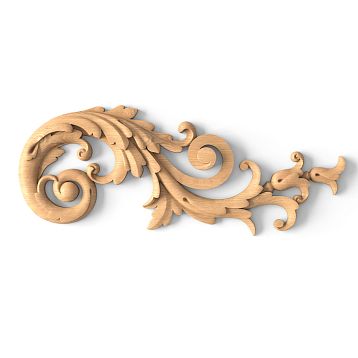
carved appliqués— are independent decorative fragments that attach to flat surfaces, creating a relief accent. They come in central types — symmetrical compositions for placement in the center of a panel; corner types — for decorating the corners of frames and panels; horizontal types — elongated elements for friezes and belts; and vertical types — for wall sections and pilasters.
Sizes range from compact 50x50 mm to impressive 1000x500 mm. Carving motifs cover the entire spectrum of classical ornamentation: plant-based — acanthus leaves, grape clus
ters, roses, oak branches; geometric — rosettes, meanders, braids; figurative — putti, animals, mascaron; heraldic — shields, crowns, monograms.
The application of carved overlays is universal. They adorn wall panels, transforming a smooth panel into an ornamental composition. They are placed above doorways, creating formal pediments. They decorate fireplace portals, making the fireplace the focal point of a room. They are used as decor for furniture, turning a mass-produced cabinet or chest of drawers into a unique piece.
Rosettes: Circular Symmetry of Beauty
Wooden sockets— are elements with radial symmetry, round or polygonal. The classic application is a ceiling rosette under a chandelier. Diameter ranges from modest 300 mm for small rooms to impressive 1200 mm for formal halls.
But rosettes are not limited to ceilings. Wall rosettes of smaller diameter (150-400 mm) serve as independent decorative accents, placed in the corners of molding frames, at the intersections of horizontal and vertical elements. Corner rosettes — quarter-circles — decorate room and panel corners. Overlay rosettes for furniture with a diameter of 80-150 mm adorn fronts, drawers, and doors.
Rosette ornaments are diverse. Concentric circles create a stepped structure from the center to the edge. Radial rays diverge like the sun. Petal rosettes imitate flowers with 4, 6, 8, 12, or 16 petals. Plant-based rosettes include leaves and flowers radiating from the center. Geometric ones use meanders, stars, braids.
Moldings: architectural lines of space
Moldings are profiled strips that create a linear structure on walls and ceilings. They divide the wall into tiers and sections, form frames for contrasting paint or wallpaper, mask joints between different materials, and create decorative accents through the play of light and shadow on the profile relief.
Wall moldings with a width of 30-100 mm are used to create panel systems and frame wall sections. Ceiling cornices are more massive — projection 50-150 mm, height 40-100 mm, with a complex multi-element profile. Door and window architraves with a width of 60-120 mm frame openings. Floor skirting boards with a height of 60-200 mm complete the wall composition from below.
Molding profiles vary from a simple rectangular shape with small bevels to a classic multi-element profile with beads, coves, ogees, cymas, and fillets. Figurative moldings include decorative elements: beads, egg-and-dart, dentils, pearl molding.
Capitals and brackets: architectural support
wooden capitals— are the upper parts of columns, pilasters, wall sections. They complete the vertical element, create a visual support for the entablature, cornice, shelf. A carved capital turns a simple block into an architectural column, adding monumentality to the space.
Classical orders offer ready-made solutions. The Doric capital — austere, with a circular cushion-like echinus. The Ionic — elegant, with volutes-scrolls. The Corinthian — luxurious, adorned with acanthus leaves. Modern interpretations simplify the classics while preserving recognizable forms.
Brackets and corbels are decorative support elements for shelves, cornices, balconies. A carved bracket doesn't just bear the load — it creates visual elegance, showing that even a functional element can be beautiful.
Panels and wainscoting: structured surfaces
Wooden panels are frame-and-panel constructions, where a frame made of profiled bars frames a central insert-panel. The panel can be smooth or carved, flat or relief. A system of panels on a wall creates classic boiserie — traditional French paneling.
Panels are used not only on walls. They form the basis of classic doors, furniture fronts, decorative screens. Each panel is a frame for decoration, inside which a carved overlay, painting, or inlay can be placed.
Solid wood products: material as the foundation of quality
A decorative element can be made from different materials: wood, polyurethane, plaster, plastic. But only Solid wood products possess a unique set of properties unattainable by imitations.
Oak: eternity in texture
Oak decorative elements are a choice for centuries. Wood density 700-800 kg/m³, hardness is highest, resistance to moisture, fungus, insects is legendary. Oak, which stood for two hundred years in the forest, becomes a carved overlay that will serve for another century in your home.
Oak texture is expressive: large pores, medullary rays create a characteristic pattern. Color varies from light golden to dark brown depending on the cutting method, processing, staining. Under oil, oak gains depth and nobility. Staining provides a rich palette of shades while preserving the texture.
Beech: uniformity and formability
Beech wood has a fine-pored, uniform structure. This makes beech ideal for carving — details come out clear, without chips or tear-outs. For painted projects, beech is indispensable: under paint, it provides a perfectly smooth surface where only the carving relief is visible.
A unique property of beech is its ability to bend after steaming. This allows for creating curved elements of complex shapes. The strength of beech is comparable to oak, but the wood is slightly lighter, with a pinkish tint.
Ash: Contrasting Beauty
Ash elements have a brightly pronounced, contrasting texture. Dark latewood rings alternate with light earlywood, creating a dynamic pattern. Ash color is light — creamy white, light brown. Under transparent finish, ash looks modern and fresh.
The mechanical properties of ash are high: hardness, elasticity, impact toughness allow for creating even thin, delicate elements that won't break during installation and use.
Ecological and Health Benefits
Natural wood does not emit harmful substances. On the contrary, wood contains phytoncides — natural antiseptics that improve the air. Wood regulates humidity, absorbing excess during high humidity and releasing it during low humidity. This creates a comfortable microclimate.
For allergy sufferers, for families with children, for people concerned about health, the choice wooden interior productsis obvious. No formaldehyde, no volatile organic compounds, no unpleasant odors — just pure wood and safe water- or oil-based finishes.
Furniture Decor: How to Update Without Replacing
Tired of your old furniture, but don't have the budget or desire to buy new?Furniture Decoration from Woodis a way to radically transform cabinets, dressers, tables, and beds without carpentry work or major expenses.
Transforming Facades with Overlays
Smooth cabinet and dresser facades look boring. Add a carved overlay to each door or drawer — and the furniture will gain character. A central overlay with a floral pattern will turn a simple cabinet into a piece of classic interior. Corner overlays on the four corners of the facade will create a framed composition.
Choosing the overlay size is critical. One that's too small will get lost on a large facade. One that's too large will look clumsy. A rule of thumb: the overlay should cover 1/4 to 1/3 of the facade area. For a standard cabinet door of 40x60 cm, an overlay of approximately 15x20 cm is suitable.
Installation is simple: the surface is degreased, wood glue is applied to the back of the overlay, the element is pressed onto the facade. Heavy overlays are additionally secured with thin finishing nails, the heads of which are countersunk and filled.
Furniture Handles as Decorative Accents
Wooden furniture handlescan change the perception of an entire piece of furniture. Replace standard metal handles with carved wooden ones — and an Ikea dresser will turn into a unique piece.
Handles come in overlay types — flat elements that attach to the facade with screws, bracket-shaped — with two mounting points, knobs — protruding elements of round or shaped form, and integrated — recessed profiles that fingers grip.
The material and finish of the handles should harmonize with other wooden elements in the interior. If you have oak moldings on the walls, it's logical to choose oak handles. If the interior is painted, beech handles under white paint will be an elegant solution.
Adding Carved Elements to the Body
Not only facades, but also sides, top parts of cabinets can be decorated. Carved brackets under a cabinet's protruding cornice will turn a rectangular box into an architectural structure. Vertical overlays on the sides will create a pilaster effect. A frieze — a horizontal carved strip at the top — will complete the composition.
Decorating bed headboards is especially effective. A large central overlay with a cartouche and floral motifs, framed by moldings, will turn a simple headboard into a work of art.
Door Decor: The First Impression of a Home
A door is a boundary, a portal, a transition from one space to another. And it is preciselyDoor Decorationthat determines what the first impression of a room will be.
Overlays: From a Smooth Door to a Paneled One
Modern doors are often smooth panels. Functional, but bland. Turn it into a classic paneled door in one weekend using moldings and overlays.
The technology is simple. Mark the future panel locations on the door — usually two or three rectangular frames arranged vertically. Cut the moldings to the required length, miter the ends at 45 degrees for corner joints. Glue the moldings along the markings, forming the frames. Inside each frame, glue a carved overlay in the center.
The result is stunning. A door that was bland yesterday looks like expensive carpentry work today. Paint the entire structure the same color as the door or create a contrast — white moldings and overlays on a gray or colored door.
Panels: Constructive Decor
If the budget allows, you can create real panels instead of imitating them with moldings. The door is clad with plywood or MDF 6-10 mm thick, onto which frames made of profiled battens are attached. Panels — thin panels that can be smooth, textured, or carved — are inserted into the frames.
Such a door is more massive, more solid in appearance and feel. It insulates sound better, is warmer. Panels can be replaced, changing the decor without replacing the entire door.
Carving and Milling: The Pinnacle of Craftsmanship
CarvedDoor Decorationis the pinnacle of woodworking skill. A solid wood door panel is covered with carving: floral ornaments wind along the perimeter, a large cartouche or rosette is placed in the center, corners are adorned with volutes.
Milled doors have relief created not by carving, but by milling on a machine. The result is strict geometric patterns, wavy lines, concentric ovals. Modern and impressive.
Casing as a Portal Frame
A door opening without trim looks unfinished. Trim frames the opening, conceals the gap between the door frame and the wall, and creates architectural detailing.
Carved trim 80-120 mm wide with a classic profile transforms an ordinary opening into a portal. A pediment—a triangular or arched finish with carved decor—can be installed above the door. Pilasters, imitating vertical columns, flank the door. The composition becomes monumental and formal.
Application in different styles: adapting decor to the concept
wooden decorative elementsare universal, but their shape, ornamentation, and finish must match the interior style.
Classicism: symmetry and proportions
Classical style demands restraint. Moldings with traditional profiles—beads, coves, ogees. Carved overlays with antique motifs—acanthus leaves, laurel wreaths, meanders. Concentric or petal rosettes, but without excessive opulence.
Color palette: natural wood with oil, white paint, cream shades. Gilding is used minimally—on individual protruding elements. The main thing is proportions. Each element is proportionate to the others, adhering to the golden ratio.
Baroque: opulence and dynamism
Baroque is theater, it is expression, it is an abundance of decor. Carved elements with floral garlands, putti, volutes, cartouches. Multi-tiered, complex rosettes with deep relief. Moldings are wide, the profile is rich.
Gilding is abundant but not vulgar. Patination emphasizes the depth of the carving. Curvilinear forms, asymmetrical compositions creating movement. Baroque does not tolerate emptiness—every surface is decorated.
Provence: rustic romance
The Provencal style is the coziness of the French countryside.wooden itemsare light, painted in pastel tones: white, cream, lavender, mint. Carved elements with plant motifs—lavender, roses, olive branches.
Patina is mandatory—artificial aging creates the effect of an antique, heirloom piece. Wear, crackle, faded areas—all add authenticity. Forms are soft, rounded, without sharp corners.
Scandinavian Minimalism: Functional Beauty
Scandinavians value simplicity. Straight moldings without complex profiles. Minimal carving. Emphasis on the texture and color of natural light wood—birch, pine, ash. Clear oils highlight the wood grain.
There is little decor, but it is of high quality. One carved rosette on the ceiling, several moldings structuring the wall. Nothing superfluous, every element is functional or visually justified.
Loft and industrial: contrast of materials
Loft combines rough and elegant. Concrete walls, metal beams—and against this backdropwooden decorative elementscreate a contrast. Massive, untreated timber consoles hold shelves. Aged overlays on furniture add history.
The finish is deliberately simple: brushed surface with open pores, matte oil, dark stains. The combination of wood with metal, leather, and glass creates an industrial aesthetic.
Installation of Decorative Elements: Technology and Nuances
Installationwooden decorrequires care, but not supernatural skills. A DIYer can handle it by following the technology.
Surface preparation and marking
The surface for attaching the decor must be level, clean, and dry. Irregularities over 5 mm are leveled with filler. Dust is removed, grease stains are degreased. The wall is primed for better adhesive adhesion.
Layout is a critical stage. Use a level for horizontal elements, a plumb line or laser level for vertical ones. Central elements are checked with a tape measure—they must be exactly centered. Symmetrical compositions are laid out from the central axis.
Attachment with adhesive and mechanical fasteners
Carved overlays and rosettes are usually attached with adhesive. Special wood glue PVA-D4, polyurethane, or mounting adhesive like Moment. Adhesive is applied to the back of the element, and the element is pressed against the wall. Painter's tape is used to hold it in place while drying.
Large and heavy elements are additionally secured with finishing nails or thin screws. Fasteners are driven in at an angle, heads are countersunk, and holes are filled with wood-colored furniture filler.
Moldings are attached using a combined method: with adhesive and mechanical fasteners every 40-60 cm. For concrete and brick walls, use wall plugs; for drywall, special butterfly anchors; for wood, use screws.
Corner joining: precision to the degree
Molding frame corners are joined at 45 degrees. Use a miter saw with a rotating platform—it provides perfectly precise cuts. Even a one-degree deviation creates a visible gap in the joint.
Real room corners are rarely exactly 90°. Measure the angle with a protractor, divide it in half—this is the angle at which the ends need to be cut. Joints are coated with adhesive, elements are pressed tightly together. Micro-gaps up to 0.5 mm are filled with acrylic sealant.
Finishing After Installation
After installation, fastener points and joints are filled. After drying, they are sanded with fine sandpaper. The entire structure is primed. Then the final finish is applied—oil, varnish, paint.
Painting is done in several thin layers. Carved recesses are painted with a fine brush. For a patina effect, dark paint or wax is applied into the recesses, while protruding parts remain light or are lightly wiped, creating an effect of natural wear.
Where to Buy Quality Products: Selection Criteria
The market offers a huge varietywooden decorative elements. How to avoid making a mistake in your choice?
Manufacturer vs. Reseller
Buying directly from the manufacturer guarantees product relevance, fair prices without intermediary markups, the possibility of ordering non-standard sizes and custom decor. The manufacturer bears direct responsibility for quality, has a stock program, and provides technical support.
Quality of wood and finishing
Wood moisture content should be 8-12% — this ensures stability and absence of deformation. Request a certificate. The quality grade determines the presence of knots and cracks. For visible elements, only the highest grade with minimal defects is acceptable.
Carving quality is assessed visually and tactilely. The relief should be clear, without chips, undercuts, or fuzz. The surface is smooth, ready for finishing. Dimensions are precise, profiles are identical throughout the batch.
Product range and option for custom orders
A wide catalog allows you to select elements in a unified style. If the assortment includes hundreds of models of overlays, rosettes, and moldings in different styles and sizes — this speaks to the manufacturer's seriousness.
The possibility of custom orders is critical for unique projects. You provide a sketch, photo, description — the manufacturer creates a 3D model, coordinates it, and manufactures it. This is the path to an exclusive interior.
Answers to Popular Questions
Can wooden decorative elements be painted?
Yes,Solid wood productsThey accept paint excellently. The surface is primed with acrylic primer, then 2-3 coats of paint are applied with intermediate sanding using fine sandpaper. Carved recesses are painted with a thin brush. For exterior work, use paints with UV protection.
How to care for carved elements?
Dust is removed with a soft, dry cloth or a vacuum with a soft brush. Carved recesses are cleaned with a soft brush. Wet cleaning is permissible with a well-wrung cloth. Every 3-5 years, oil finishes are renewed; lacquered finishes are re-lacquered as needed.
Are wooden elements suitable for wet rooms?
For bathrooms and kitchens, choose oak elements — they are the most moisture-resistant. Treatment with moisture-protective compounds is mandatory: yacht varnish or special oil. Good ventilation is essential. In saunas and baths, wood is permissible, but without lacquer coating — use only oils.
How much do decorative wooden elements cost?
Prices vary depending on wood species, size, and complexity. Simple rosettes 10-15 cm in diameter made of beech cost from 200-300 rubles. Large carved overlays 30x40 cm — from 2000-5000 rubles. A linear meter of molding — from 300 to 2000 rubles. Custom orders are calculated individually.
Can decorative elements be installed by oneself?
Yes, with basic tools: a miter saw or miter box, drill, level, tape measure. Light overlays and rosettes are glued without problems. Moldings require precise corner cutting. If you're not confident — it's better to hire a professional than to ruin expensive material.
How to combine decor of different styles?
Mixing styles requires caution. In one room, all wooden elements should be from one collection or at least one style. It is acceptable to combine classic with neoclassical, Provence with country. But Baroque with loft, Empire with Scandinavian minimalism — guaranteed dissonance.
Can wooden decor be used in modern interiors?
Absolutely.Wooden elementsThey create contrast, add warmth, and individuality in modern spaces. Choose laconic forms, simple profiles, natural or light finishes. One or two accents are enough — do not overload the space.
How to calculate the required quantity of elements?
For moldings: measure the perimeter of all areas you plan to frame, multiply by a factor of 1.1-1.15 (allowance for cutting). For overlays: count the number of panels, doors, and facades you want to decorate. Rosettes are usually one per chandelier or chandelier plus wall ones for corners.
Are modern wood finishes eco-friendly?
Modern water-based oils and varnishes are absolutely safe after complete drying. They do not emit VOCs, have no odor. Natural oils (linseed, tung) are even food-grade by standards. Only avoid cheap nitro-varnishes and alkyd enamels with strong odors.
Does wooden decor increase property value?
Yes, quality interior decor increases property value. Potential buyers appreciate classic finishes, ready-made design, and natural materials. An apartment with carved decor sells for more and faster than a similar one with bare walls.
Conclusion: an investment in beauty and longevity
Interior is not just a set of furniture and finishes. It is the environment in which we spend most of our lives. An environment that influences mood, well-being, and creative productivity.wooden decorative elementsThey turn a faceless space into a home with character, history, and soul.
Carved overlays on walls and furniture create visual accents that please the eye. Ceiling rosettes add completeness to the composition. Moldings structure the space, dividing it into harmonious zones. Each element contributes to the overall atmosphere of elegance and thoughtfulness.
Natural wood carries the warmth of a living material. Oak that grew for two centuries becomes part of your home. Beech, having absorbed the strength of the earth, transforms into a carved rosette that will adorn your ceiling for decades. This is not plastic imitation, not polyurethane fakery — this is genuine, honest, durable.
For over 23 years, STAVROS has been creatingWooden products for interior. Over this time, vast experience has been accumulated, technologies have been refined, and a team of craftsmen has been formed for whom quality is not a marketing term but a way of life.
The STAVROS catalog features over 400 models of carved overlays in various styles and sizes. From miniature 50x50 mm to monumental 1000x500 mm. Floral, geometric, figurative ornaments. Classicism, Baroque, Rococo, Empire, Provence, Art Nouveau — all styles, all eras are represented.
Over 70 models ofwooden rosetteswith diameters from 150 to 1200 mm. Ceiling, wall, corner. Concentric, petal, floral, geometric. For every interior, there is a perfect rosette.
Moldings and cornices of all types and sizes. Simple rectangular for modern interiors. Classic multi-element for traditional ones. Carved for luxurious ones. Floor skirting boards with heights from 60 to 200 mm. Door architraves. Capitals and brackets.
All products are made from solid oak, ash, or beech. The wood undergoes chamber drying to 8-10% moisture content, guaranteeing stability and absence of warping. Processing on modern European equipment — CNC machines for precise carving, milling machines for profiling, lathes for turned elements.
Each product undergoes multi-stage quality control. Dimensions, carving cleanliness, and absence of defects are checked. Elements with knots, cracks, chips, or dimensional deviations are rejected. The client receives only flawless products, ready for installation and finishing.
STAVROS offers not only ready-madeproducts from the catalog, but also custom manufacturing based on client sketches. If you have an idea, a drawing, a photo of a desired element — we will bring it to life in wood. We will create a 3D model, coordinate it, and manufacture it. This is the path to a unique interior you won't find anywhere else.
Specialist consultations will help select elements that harmonize in style, size, and proportions. Calculation of required material quantities based on room plans. Recommendations for installation, choice of adhesive and fasteners, and finishing. Full support at all stages — from idea to realization.
Delivery to Moscow, St. Petersburg, and all of Russia. Careful packaging of each element protects against damage during transportation. A large stock program ensures availability of popular items. Standard elements are shipped within 1-3 days. Custom orders — 2-4 weeks depending on complexity.
Invest in quality. ChooseDecorative elements made of solid woodfrom STAVROS — and your home will gain a unique character, elegance, and nobility. This is not just decor — it's a story you create with your own hands. A story that will delight you, your children, and grandchildren.
Visit the catalog on the STAVROS website to see the full diversity of possibilities. Contact us — tell us about your project, style, dreams. We will help bring them to life in wood, a material that lives for centuries, giving warmth and beauty to every day.