Article Contents:
- Origins of Russian decorative art
- Ancient roots and modern reinterpretation
- Characteristic features of decor in Russian style
- Color palette of Russian decor
- Materials and textures
- Ornamentation and symbolism
- Traditional elements of Russian decorative design
- Wood carving and applied elements
- Ceramics and izbets
- Textile furnishings
- Modern application of decor in Russian style
- Integration into urban interiors
- Country houses and cottages
- Psychology of perceiving Russian decor
- Practical advice for implementation
- Planning decorative solutions
- Integration with Modern Technologies
When we speak of the uniqueness of living space, that elusive feeling of home which warms the soul and creates a special atmosphere, memories inevitably bring images associated with national traditions. In the modern world of globalization and standardization of design solutions, the desire to preserve and reinterpret the cultural heritage of ancestors becomes especially relevant. decor in Russian style It represents a wonderful blend of centuries-old folk art traditions with the possibilities of modern technologies and materials.
What makes an interior truly Russian? It is not simply a set of stereotypical elements such as matryoshkas and samovars, but a deep understanding of the philosophy of national decorative and applied art. Russian decor is a holistic system of artistic techniques, developed by generations of masters and reflecting the characteristics of worldview, climate, lifestyle, and spiritual values of the people.


Origins of Russian decorative art




Ancient roots and modern reinterpretation
The history of Russian decorative art goes back to ancient times, when our ancestors created not just functional household items, but true works of art. Each element of home decor carried deep symbolic meaning, was imbued with magical content, and served as a talisman for the family.
Wooden architecture, birch bark items, ceramics, textiles — all these forms of folk art created a unified artistic environment in which the Russian person lived. Carved window casings did not merely decorate the facade; they protected the house from evil spirits. Painted tableware was not only beautiful, but was also meant to bring prosperity and well-being.
Modern decor in Russian style Carefully preserves this symbolic component, adapting ancient motifs to the realities of the 21st century. Designers and artisans find remarkable ways to integrate traditional elements into modern interiors, creating spaces that are both functional and spiritually rich.
The characteristic feature of Russian decorative art is its organic connection with nature. Motifs of the plant and animal world, stylized images of the sun, water, earth — all of this reflected the deep connection of man with the surrounding world. Modern interpretations of these motifs help create an interior that is not only beautiful, but also psychologically comfortable, since it appeals to archetypal images embedded in our collective unconscious.
Our factory also produces:



Characteristic features of decor in Russian style
Get Consultation
Color palette of Russian decor
Color scheme plays a key role in creating the authentic atmosphere of a Russian interior. The traditional palette was formed under the influence of natural dyes accessible to craftsmen of past centuries, and the characteristics of the Russian landscape.
The basis of the color palette are natural wood tones — from light tones of birch and linden to rich brown tones of oak and hornbeam. These warm wooden tones create a sense of coziness and stability, very characteristic of the Russian home.
White color occupies a special place in Russian decor. It is not the cold white of modern minimalist interiors, but a warm, slightly cream tone of unbleached linen or plaster. White symbolized purity, sanctity, a new beginning. In modern interiors, this color serves as an ideal background for bright accents and visually expands the space.
Red color — symbol of life force, celebration, prosperity — is used as a powerful accent. From the crimson tones of Khokhloma painting to deep burgundy shades of antique fabrics, red adds energy and solemnity to the interior. It is important to use it sparingly, to avoid overloading the space.
Blue and turquoise shades refer to the traditions of Gzhel ceramics and symbolize sky, water, and infinity. These colors bring a sense of coolness and freshness into the interior, especially relevant in hot climatic zones.
Golden tones, ranging from light yellow to rich ochre, evoke the richness of Russian folk crafts and create a feeling of warmth from a home hearth. These colors work especially well with natural wood and create an atmosphere of prosperity and well-being.
Materials and Textures
Material Selection for Russian decor is determined by the principle of maximum naturalness and ecological safety. Our ancestors used what nature provided, creating works of art from simple materials.
Wood remains the main material of Russian decor. Various types are used — from soft and pliable linden and aspen to hard oak and ash. Each type has its own decorative features: linden is ideal for fine carving, oak for large architectural elements, birch provides a beautiful texture for turned items.
Modern technologies allow for the fullest expression of wood grain beauty. Special stains and varnishes preserve the natural color and pattern of wood, protecting it from external influences. Patination and brushing create an effect of aging, giving modern items a noble antiquity.
Ceramics and clay have traditionally been used to create both utilitarian and decorative items. Unglazed terracotta, painted majolica, and tiles — all these types of ceramics find their place in modern Russian interiors. They bring a sense of handcrafted uniqueness, highly valued in the age of mass production.
Natural fabrics — linen, cotton, wool — create a unique tactile environment in a Russian home. The rough texture of home-woven cloth, the softness of sheep’s wool, the coolness of linen — these sensations form an incomparable atmosphere of coziness and comfort.
Metal in Russian decor is primarily represented by iron and copper. Wrought iron elements, copper tableware, tin items — all of these add solidity and durability to the interior. Modern metalworking allows for creating complex decorative elements while preserving the feeling of handcrafted work.
Ornamentation and Symbolism
The ornamental system of Russian decorative art represents a complex symbolic language, in which each element has deep meaning. Understanding this symbolism allows for creating interiors that are not only beautiful but also rich in content.
Geometric ornaments — rhombuses, crosses, spirals — are the oldest symbols associated with cosmogonic concepts. A rhombus symbolized a sown field, a cross — a model of the universe, a spiral — the development of life. These simple, at first glance, figures create a powerful energetic field in the interior space.
Plant motifs reflect the connection with natural cycles and symbolize fertility, growth, and renewal. Stylized trees of life, floral garlands, leaves and fruits — all of these create a sense of living nature in the home. Modern interpretations of these motifs can range from exact replicas of traditional patterns to free, original reinterpretations.
Zoomorphic images — birds, animals, fish — served as protective charms and symbols of various qualities. A horse symbolized the sun and fertility, a bird — the soul and connection with the heavenly world, a fish — abundance and life force. Incorporating these images into modern decor creates a rich symbolic context for the interior.
Traditional elements of Russian decorative design
Wood carving and applied elements
Wood carving is one of the most expressive manifestations of Russian decorative art. Techniques developed over centuries allowed artisans to create true masterpieces from ordinary wooden blanks.
Relief carving, in which the pattern is not cut through but only carved into the wood, creates a play of light and shadow that brings the surface to life. This type of carving is ideal for large architectural elements — cornices, moldings, decorative panels.
Cut-out carving, creating delicate lace-like patterns, brings lightness and airiness to the interior. Modern laser cutting technologies allow for reproducing the most complex traditional patterns with jewel-like precision, opening new possibilities for decorating in the Russian style.
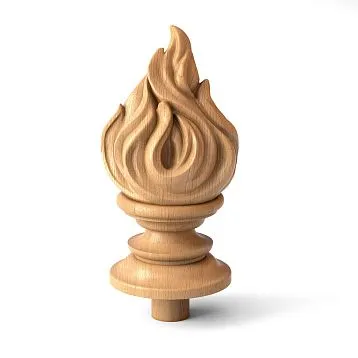
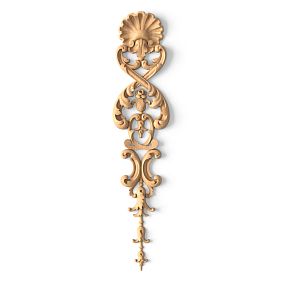
Three-dimensional carving creates compositions that become true sculptural works. Carved rosettes, cartouches, garlands transform ordinary furniture or architectural elements into works of art.
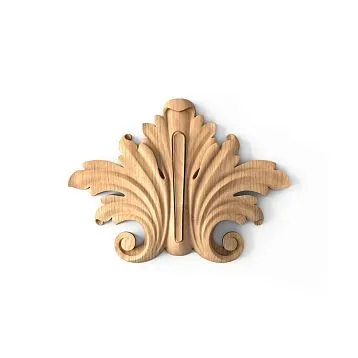
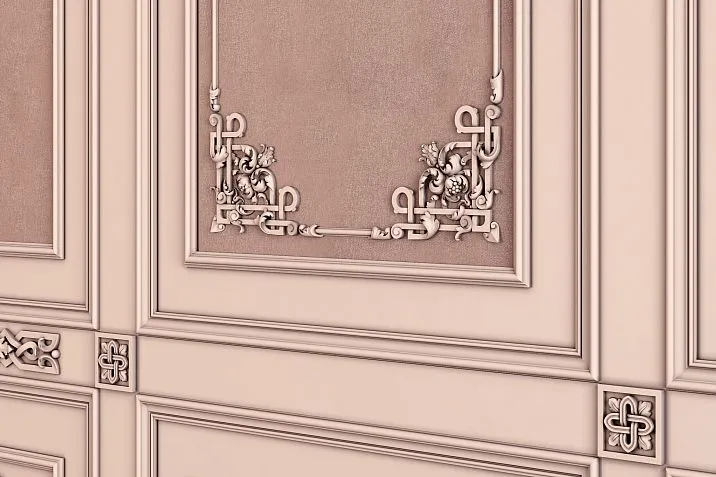
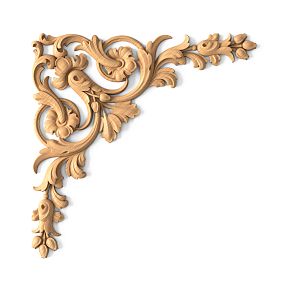
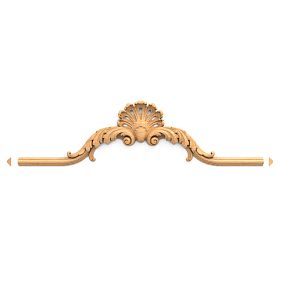
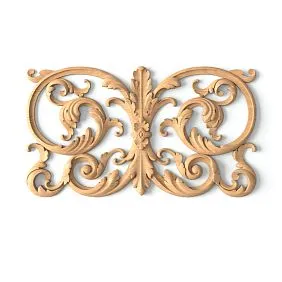
Applied elements are a special category of decor that allows quickly and effectively transforming an interior. Carved appliqués can decorate modern furniture, turning a simple cabinet or chest into a stylish piece in the Russian style. Decorative consoles, brackets, rosettes create a rich sculptural environment characteristic of traditional Russian interiors.
Ceramics and tiles
Ceramic art occupies a special place in Russian decorative tradition. Tiles — painted ceramic tiles — were used not only for decorating stoves but also for wall decoration, creating murals and decorative inserts.
Traditional tiles were made using a complex technology including modeling, drying, firing, and painting. Each tile was a unique work created by the artisan’s hands. Modern production allows recreating traditional patterns while preserving their artistic features.
Gzhel ceramics, with its characteristic blue-and-white painting, became a symbol of Russian decorative art. Plant motifs, birds, architectural landscapes, executed in cobalt on a white background, create an unparalleled poetic atmosphere. Modern Gzhel is not limited to traditional tableware — decorative panels, vases, sculptures allow incorporating this art into any interior.
Dymkovo toys, although appearing as simple children’s playthings, represent a high art of ceramic modeling. Bright colors, geometric patterns, expressive forms make Dymkovo items beautiful decorative accents in modern interiors.
Textile decoration
Textiles in a Russian home have never been merely utilitarian — they were an important part of decorative furnishings, carriers of symbolic meanings, and indicators of the homeowner’s skill.
Embroidery is a true encyclopedia of folk culture, encoded in patterns and symbols. Cross-stitch, Mstera smooth embroidery, gold embroidery — each technique had its own characteristics and area of application. Modern masters continue these traditions, creating unique pieces for interior decoration.
Lace, whether Vologda lace, Elec lace or other regional varieties, brings elegance and femininity to the interior. Lace curtains, tablecloths, napkins create a sense of festivity and solemnity.
Weaving allowed not only utilitarian but also decorative items to be created. Colorful rugs, coverlets, panels with traditional patterns can become striking accents in a modern interior designed in the Russian style.
Modern application of decoration in the Russian style
Integration into urban interiors
Creation Russian decor In the context of a modern city apartment, this requires a special approach and understanding of spatial scale. Simply transferring the interior of an old wooden house into cramped apartments of high-rise buildings will look absurd and inappropriate.
The key principle — moderation and selectivity. Instead of reproducing the entire historical interior, choose several key elements that will set the tone for the entire space. This could be carved applique on a modern cabinet, painted ceramic backsplash in the kitchen, or textile panel in the living room.
The color scheme for a city apartment in the Russian style should be more restrained than in a country house. A neutral palette of natural tones with bright accents in the form of traditional ornaments or painted ceramics can serve as a base.
Functionality is another important aspect. Each decorative element should not only beautify the space but also carry a certain functional load. Carved shelves, painted tableware, textile items — all of these should be living, used objects, not museum exhibits.
Lighting plays a key role in creating the atmosphere of a Russian interior in a city apartment. Warm, diffused light highlights the texture of wood, plays on the surface of ceramics, and creates a cozy atmosphere, which is essential for a Russian home.
Country houses and dachas
In the context of a country house or dacha, opportunities for creating an authentic Russian decor significantly expand. Here, one can afford more ambitious solutions and fully recreate the atmosphere of a traditional Russian home.
Architectural elements — carved window casings, decorative cornices, porches with turned posts — create the exterior appearance of a house in the Russian style. Modern materials and technologies allow recreating traditional forms with high quality and durability.
The interior of a country house can be more richly decorated. Carved furniture, painted walls, ceramic stoves, textile items create a rich artistic environment, where each item complements and enriches the overall impression.
The garden and yard area can also be designed in the Russian style. Wooden gazebos, carved gates, traditional plants create a harmonious extension of the interior into the open air.
A bathhouse is an important element of a country house in the Russian style. It is not merely a place for washing, but a special sacred space linked to ancient traditions of purification and health. Decorating a bathhouse in the Russian style includes carved elements, traditional accessories, and appropriately selected materials.
Psychology of perception of Russian decor
Decorative elements in the Russian style affect people on a deep, subconscious level. This is because the symbols and images used in traditional art are archetypal and appeal to the collective unconscious.
Natural materials, primarily wood, create a sense of connection with nature, which is especially important for urban residents disconnected from the natural environment. Tactile sensations from touching wood, linen, ceramics activate receptors responsible for feelings of comfort and safety.
The warm color palette of Russian interiors promotes psychological relaxation and creates a sense of coziness. Studies show that warm tones stimulate the production of serotonin — the happiness hormone — making staying in such an interior especially comfortable.
The ornamentation and symbolism of Russian decor create a rich visual environment that stimulates creative thinking and imagination. Complex patterns and symbols require active perception from the viewer, making the interior lively and dynamic.
Rhythmic repetitions of ornaments create a meditative effect, helping to relieve stress and psychological strain. This is especially important in the context of modern urban life with its fast pace and constant stress.
Practical advice for implementation
Planning decorative solutions
Creating an interior with elements Russian decor requires careful planning and understanding of compositional principles. The first step — defining the key idea and selecting dominant elements that will set the character of the entire space.
It is important to avoid overloading and chaos in the placement of decorative elements. It is better to choose a few quality items rather than fill the space with numerous small details. Each element should have its own place and purpose within the overall composition.
Scale is another critically important aspect. Decorative elements must correspond to the size of the room and not overwhelm the space with their dimensions. In a small room, it is better to use smaller, delicate details, while in a spacious room, one can afford larger accents.
Color harmony requires special attention. All decorative elements must be linked by a common color logic, even if they are executed in different techniques and materials. The palette should be sufficiently rich to create an interesting visual environment, but not so colorful as to tire the eye.
Lighting should be planned to highlight the decorative qualities of selected elements. Directional light can emphasize carved textures, diffused light creates a soft atmosphere, colored light accentuates paintings or ornaments.
Combination with modern technologies
One of the main tasks of a modern designer is to harmoniously combine traditional decorative elements with modern technologies and comfort requirements. Russian style should not be associated with rejection of civilizational achievements.
Modern heating, air conditioning, lighting, audio- and video equipment must be organically integrated into the interior without compromising its stylistic integrity. This requires a creative approach and unconventional solutions.
Decorative elements can conceal technical utilities. Carved grilles can hide radiators, painted panels can cover electrical panels, textile items can mask audio systems. The key is that these solutions should appear natural and not contradict the overall interior concept.
Modern materials open up new possibilities for recreating traditional techniques. Polymer resins allow creating wood-carving imitations, ceramic tiles reproduce tile textures, modern fabrics mimic antique textures.
Digital technologies enable precise reproduction of historical ornament and painting samples. 3D scanning and printing allow creating copies of unique folk art pieces for use in modern interiors.
Conclusion
decor in Russian style Represents a unique opportunity to create an interior that is not only beautiful and functional, but also spiritually rich, connected with centuries-old traditions of national culture. In an era of globalization and standardization of design solutions, it is especially important to preserve and develop traditions that make us who we are.
Modern technologies and materials allow recreating the beauty of traditional Russian decor, adapting it to the realities of the 21st century. It is important to remember that Russian style is not a museum exhibit, but a living, evolving tradition that must meet the needs of modern people.
Creating an interior in Russian style requires deep understanding of cultural traditions, artistic taste, and professional skill. Only by meeting all these conditions can one create a space that pleases the eye, warms the soul, and conveys the richness of Russian culture to future generations.
STAVROS Company has been specializing for many years in creating high-quality decorative elements inspired by traditions of Russian folk art. The "Russian Style" collection represents a unique collection of items, each created with love for national traditions and understanding of modern interior needs. Choosing STAVROS products means acquiring not just decorative elements, but a piece of Russian soul, embodied in beautiful forms and quality materials.