Article Contents:
- Anatomy of Window Framing: Elements of a Classical System
- Architrave — A Frame for an Architectural Picture
- Pediment — An Architectural Canopy Above the Window
- Window Sill Band — The Horizontal Base of the Window
- Corner Elements — Decorative Accents
- Ears and Aprons — Details That Create Complexity
- Why Polyurethane Became the Number One Material for Facade Window Decor
- Moisture Resistance: No Swelling or Rotting
- Frost Resistance: 500 Cycles Without Cracks
- UV Stability: Color for Decades
- Lightweight: No Load on the Facade
- Detailing: Carving Indistinguishable from Stone
- Window Design Styles: From Restrained Classicism to Baroque Opulence
- Classicism: Symmetry and Strict Proportions
- Empire: Monumentality and Richness
- Baroque: Dynamics and Plasticity
- Rustic and Neoclassical: Modern Interpretation of Classicism
- Art Nouveau: Asymmetry and Floral Motifs
- Minimalism: Window Without Framing or Extreme Laconicism
- Trends 2026: Where Facade Decor is Heading
- Large Formats and Bold Relief
- Color as an Independent Value
- Asymmetry and Eclecticism
- Integration with Smart Home
- Ecological and Conscious Design
- Window Decor Installation: Error-Free Technology
- Foundation Preparation
- Marking the Location of Elements
- Fitting and Trimming Elements
- Adhesive Bonding and Additional Fasteners
- Sealing Joints and Seams
- Painting and final finishing
- Color Solutions: Harmony or Contrast
- Classic White: Timeless Elegance
- Tone-on-Tone: Soft Relief
- Contrasting Dark: Modern Graphic Appeal
- Natural Shades: Warm Harmony
- Metallic Finishes: Contemporary Luxury
- Mistakes to avoid
- Mismatched Decor and Window Scale
- Style Mixing Without a Concept
- Ignoring Color Harmony
- Cutting corners on material quality
- Unprofessional Installation
- Project Cost: From Budget to Premium
- Pricing factors
- Approximate pricing (2026, Russia)
- STAVROS: 23 Years of Creating Façade Beauty
- Conclusion: Windows as Architectural Statement

Windows are the eyes of a house. A cliché metaphor, but an accurate one. They are the first thing that catches your eye when you look at a façade. And it is their design that determines whether a building will look like a standard box or a piece of architectural art. A bare window in a wall plane is just a technological opening. A window framed with architraves, moldings, pediments, and window sills is an architectural element that tells a story, creates style, and shapes the character of a building.
Historically, window surrounds were made of stone, terracotta, plaster, and wood. Each material required months of manual labor, cost a fortune, lasted for decades, but gradually deteriorated under the weather. Stone architraves cracked from frost. Plaster ones crumbled from moisture. Wooden ones rotted and warped. The 21st century offered a solution that combines the beauty of classical forms with the technological advantages of modern materials.Facade window decoration from polyurethaneweighs twenty times less than stone, is impervious to water and frost, can be installed in a day, lasts half a century without repair, and costs as much as a good TV instead of the price of a car.


Anatomy of a Window Surround: Elements of a Classical System




Architrave: A Frame for an Architectural Picture
An architrave is an applied trim that frames a window opening around its perimeter. In its simplest form, it consists of four smooth or profiled moldings—top, bottom, and two side ones. But classical architecture is rarely satisfied with simplicity.
The top architrave is often replaced by a pediment—a projecting cornice that protects the window from rain and creates a distinct horizontal line. Side architraves can be simple vertical planks or be elaborated into pilasters—flat vertical projections that imitate columns. The bottom architrave rests on a window sill course—a horizontal profiled element that visually emphasizes the base of the window.
The width of architraves varies from modest 8-10 centimeters for small windows to monumental 25-35 centimeters for panoramic openings in country mansions. The profile can be a simple rectangle, multi-stepped with alternating projections and recesses, or richly ornamented with floral motifs, geometric patterns, and classical order elements.
Our factory also produces:

Pediment: An Architectural Cornice Above the Window
A pediment serves a dual function: practical (diverts rainwater from the window opening) and aesthetic (creates a striking crowning element for the window). The shape of the pediment defines the style of the entire surround.
A straight pediment is a horizontal slab projecting 10-20 centimeters above the window. A minimalist solution characteristic of Classicism and modern Neoclassicism. The profile of the slab can be simple (a single plane with an overhang) or complex (a multi-stepped cornice with coves, fillets, and drops).
A triangular pediment is a classical crowning element in the shape of a triangle resting on side architraves or pilasters. The slope angle is typically 30-45 degrees. The pediment can be solid (filled with a plane) or broken (with a break at the apex where a decorative element—a vase, cartouche, or rosette—is placed).
A segmental pediment is an arched crowning element in the shape of a circular segment. A softer, more graceful solution compared to the triangular one. Characteristic of Baroque, Rococo, and 19th-century Eclecticism.
A semicircular pediment is a crowning element in the shape of a semicircle. A solemn, monumental solution for the main windows of a façade.
A broken pediment is a triangular or segmental pediment with a break in the center where a decorative element is placed. This creates dynamism, Baroque opulence, and highlights the window as particularly significant.
Get Consultation
Window Sill Course: The Horizontal Base of the Window
The window sill course runs below the lower boundary of the window, creating a horizontal line that unifies windows on the same level into a single composition. If there are three windows on the second floor of a façade, a continuous window sill course under all three creates a rhythmic horizontal line that structures the wall plane.
The profile of the window sill course typically projects 5-10 centimeters from the wall plane, with a height of 8-15 centimeters. The top surface has a slight outward slope for water drainage. The underside is profiled with a drip—a projection from which water drips down without flowing back onto the wall.
Corner elements — decorative accents
Casing corners — points where vertical and horizontal moldings meet. In simple execution, these are just joints at a 45-degree angle (miter cut). But classical architecture offers more expressive solutions — corner decorative elements.
Corner rosettes — square or round overlays with relief ornamentation (rosette, acanthus leaf, geometric pattern), which are placed at casing corners. They conceal molding joints, create accents, and enhance decorativeness.
Keystones — decorative elements at the center of the upper casing or pediment, imitating the central stone of arched masonry. Usually larger than surrounding elements, protrude more strongly, often have a trapezoidal or wedge shape. Can be ornamented with a mascaron (decorative mask of a human or fantastic creature), cartouche (decorative shield with scrolls), or coat of arms.
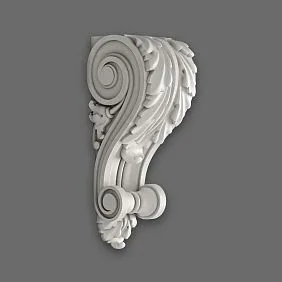
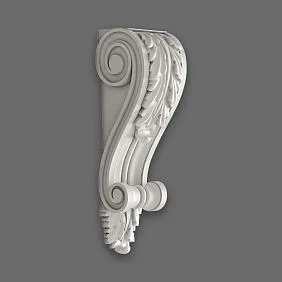
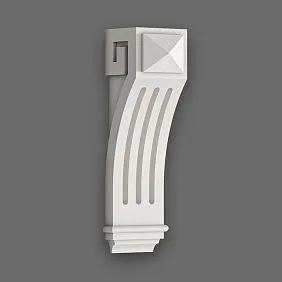
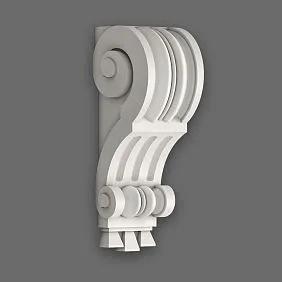
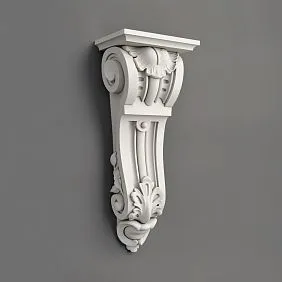
Consoles — protruding support elements under a pediment, creating visual support for the cornice. Console shape — an S-shaped curve, ending in a scroll (volute) at the bottom, widening at the top under the pediment. A pair of consoles at the edges of the pediment creates architectural logic, turning the cornice into a structurally meaningful element.
Ears and aprons — details that create complexity
Ears — small rectangular protrusions adjoining the outer corners of the casing. They create a stepped transition from the casing to the wall, add geometric complexity, characteristic of classicist and Renaissance frames.
Apron (window sill board with decorative brackets) — protruding horizontal slab under the window, resting on decorative brackets or consoles. This creates a three-dimensional composition in the lower part of the window, balancing the massiveness of the pediment above.
Why polyurethane became the number one material for facade window decor
Moisture resistance: no swelling or rotting
Window frames are in the zone of maximum contact with water. Rain hits directly onto the window plane, flows down the glass onto the lower casing and window sill band. Snow accumulates on the horizontal protrusions of pediments. Condensation forms at the boundary between warm interior space and cold outside air. Any hygroscopic material is doomed under these conditions.
Wood absorbs water, swells, then dries and cracks. The wetting-drying cycle repeats hundreds of times per season, gradually destroying the structure. After 5-7 years, wooden casings require replacement.
Gypsum is even less durable. It absorbs water like a sponge. In winter, water in the pores freezes, expands, and ruptures the material from within. One season is enough for the first cracks to appear. After 3-5 years, gypsum framing turns into ruins.
Polyurethane facade moldingsPolyurethane is hydrophobic at the molecular level. The closed-cell structure has no through pores through which water could penetrate. Raindrops roll off the surface without being absorbed. Relative air humidity does not affect the material — polyurethane does not swell at 100% humidity and does not shrink at 0%.
Frost resistance: 500 cycles without cracks
The Russian climate tests facade materials for strength. Temperature can range from minus 40 in winter to plus 35 in summer. Daily fluctuations in spring and autumn reach 20-25 degrees. Each freeze-thaw cycle is stress for the material.
Facade polyurethane withstands 300-500 full freeze-thaw cycles without loss of properties. This is confirmed by laboratory tests according to GOST 24816-2014. In real operating conditions, full cycles (freezing of the entire volume, then complete thawing) occur 20-30 times per winter. Simple arithmetic: 500 cycles divided by 25 cycles per year = 20 years of guaranteed frost resistance. In practice, considering that most of winter the temperature is consistently negative (the volume freezes once at the beginning of winter), the service life reaches 50 years.
Frost resistance mechanism: polyurethane is elastic, it deforms during freezing, absorbing stress, then returns to its original shape upon thawing. Brittle materials (gypsum, concrete, low-quality plastic) crack during freezing because they cannot deform elastically.
UV stability: color for decades
Solar ultraviolet destroys polymers. Cheap plastic yellows in the sun, then fades to gray-white, becomes brittle, and crumbles. This occurs due to photodegradation — breaking of molecular chains under the influence of UV radiation.
High-quality facade polyurethane contains UV stabilizers — special chemical additives that absorb ultraviolet light, converting its energy into safe heat, protecting the polymer matrix from degradation. Stabilizer concentration is calculated based on regional climatic data — for southern latitudes with high solar radiation, the concentration is higher.
After installation, polyurethane elements are painted with facade paints containing additional UV filters. Double protection — stabilizers in the material mass plus UV filters in the paint — guarantees color retention for 15-20 years without visible fading.
Lightweight: not overloading the facade
Stone window framing measuring 150×120 centimeters (including casings, pediment, window sill band) weighs 200-300 kilograms. Its installation requires anchors embedded into the load-bearing wall to a depth of 15-20 centimeters, metal support frames, and professional installation. On a ventilated facade system (curtain wall), such decor is generally impossible — ventilated facades are not designed for such loads.
Gypsum framing of the same dimensions weighs 40-60 kilograms. Lighter than stone, but still requires reinforced fastenings and load-bearing capacity of the base.
Polyurethane framing of identical dimensions weighs 8-12 kilograms. This allows it to be mounted on any base — brick, aerated concrete, frame system, insulated facade, ventilated facade. Adhesive bonding with additional fixation using plastic dowels supports the element's weight for decades without sagging or detachment.
For the building, this means no additional loads. Dozens of windows, each with full classical framing, add only 200-300 kilograms to the facade weight instead of 5-6 tons for stone counterparts.
Detailing: carving indistinguishable from stone
Skeptics say: 'Plastic is plastic, it cannot convey the subtleties of carving.' They are mistaken. Polyurethane is molded by casting into silicone molds, which are taken from master models. The liquid composition flows into the smallest recesses of the mold, reproducing every detail of the original with accuracy to tenths of a millimeter.
Examine a high-quality polyurethane pediment with consoles. The consoles are adorned with acanthus leaves — each leaf lobe, each vein, each scroll is reproduced with jewelry precision. The keystone with a mascaron (decorative mask) conveys the smallest facial details — skin folds, strands of hair, pupils of the eyes. After painting in stone color or patination, such an element is indistinguishable from a carved stone original even from a distance of one meter.
Modern 3D scanning and CNC milling technologies allow for the creation of master models of any complexity. If drawings or photographs of a historical building are preserved in archives, its facade decor can be reproduced with absolute accuracy. If an exclusive design is needed, an artist creates a sketch, a designer converts it into a 3D model, a milling machine cuts the master model from dense polyurethane foam, and a silicone mold is taken from it for serial casting.
Window design styles: from restrained classicism to Baroque opulence
Classicism: symmetry and strict proportions
A classical window is framed strictly and restrainedly. The casing is a rectangular frame 12-18 centimeters wide with a simple profile (one or two steps, without ornamentation). The pediment is straight, projecting 10-15 centimeters, profiled with a cornice featuring several shelves. No excesses, no carving—only pure geometry and mathematical precision of proportions.
Color is white on light walls (beige, peach, light yellow) or contrasting (white on dark gray, graphite on white). Classicism favors contrast, which emphasizes the clarity of forms.
Example: a mansion with an ivory-colored facade. The second-floor windows are framed with white casings 15 centimeters wide. The pediments are straight, resting on simple consoles without ornamentation. The continuous sill course runs under all windows, creating a horizontal line that unites the windows into a single composition.
Empire: monumentality and richness
Empire is classicism elevated to imperial luxury. Windows become larger, frames more massive, and decor richer. Casings are 20-30 centimeters wide, often with pilasters on the sides. Pediments are massive, with triangular or semicircular gables. Consoles are large, carved, often in the shape of eagles, lions, or sphinxes.
Keystones in the center of pediments are large, projecting, ornamented with imperial symbols (eagles, wreaths, military trophies). Sill courses are massive, often supported by consoles.
Color scheme is contrasting: white or gold decor on a saturated colored background (ochre, terracotta, olive). Gilding emphasizes luxury and imperial grandeur.
Example: a country mansion with a terracotta-colored facade. Panoramic windows 2.5 meters high are framed with white Ionic order pilasters. Pediments are triangular gables resting on the capitals of the pilasters. Keystones are painted gold, standing out against the white gable.
Baroque: dynamism and plasticity
Baroque rejects straight lines in favor of curves. Windows are framed with casings of complex curvilinear profiles. Pediments are not straight but curved—segmental, wavy, or broken with scrolls in the center. Consoles are S-shaped, carved, often transitioning into plant ornaments.
Keystones are large, sculptural—mascarons (human faces or fantastic creatures), cartouches (decorative shields) with scrolls of acanthus leaves, coats of arms.
Corner elements of casings are carved rosettes, acanthus leaves, volutes. All this creates a sense of movement, plasticity, and decorative excess characteristic of Baroque.
Color is white or pastel (light blue, pink, pistachio) on a contrasting background. Gilding of accent elements (keystones, consoles) adds luxury.
Example: a house with a pink marble-colored facade. Windows are framed with white casings of complex profiles. Pediments are segmental, broken in the center. In the break is a cartouche with scrolls, covered in gold paint. Consoles under the pediments are S-shaped, carved, with acanthus leaves.
Rustic and Neoclassical: modern interpretation of classicism
Modern Neoclassicism takes the proportions of classicism but simplifies details and modernizes the color palette. Casings are simple, often flat or minimally profiled. Pediments are simplified—a straight slab with a bevel. Consoles may be absent or extremely laconic—rectangular brackets without carving.
Colors are gray (from light gray to graphite), dark blue, black in contrast with white or light gray walls. This gives a modern sound to classical forms.
Example: a townhouse with a light gray facade. Windows are framed with graphite-colored casings 10 centimeters wide, flat in profile. Pediments are straight, minimalist. No consoles, no carved decor—only clear lines, geometry, and color contrast.
Art Nouveau: asymmetry and plant motifs
Early 20th-century Art Nouveau rejected symmetry and classical orders in favor of free forms drawing inspiration from nature. Window frames become asymmetrical. A pediment may project more on one side than the other. Side casings are of different widths.
Decorative elements are stylized plants (lilies, irises, climbing stems), smooth wavy lines, flowing forms. Keystones are not classical mascarons but stylized female faces, flowers, or fantastic creatures in the Art Nouveau style.
Colors are muted, complex (olive, smoky pink, lilac, ochre). Decor is often painted tone-on-tone with the walls or half a tone lighter/darker, creating soft relief instead of contrasting highlighting.
Example: a house in the Art Nouveau style with a smoky green facade. Windows are framed with asymmetrical casings—the left side is wider than the right. The pediment is wavy, adorned with stylized irises. The frame color is a tone lighter than the walls—light olive, creating a soft contrast.
Minimalism: window without framing or extreme laconicism
Minimalism often rejects framing altogether—the window is flush with the wall, without protruding elements. But even in minimalism, framing is possible if it is extremely laconic.
The casing is a flat plank 5-8 centimeters wide, without a profile, without projections. There may be no pediment at all. If present, it is a minimal awning, projecting 3-5 centimeters, with a rectangular cross-section.
Color is monochrome. Either tone-on-tone with the wall (the frame blends with the plane, creating subtle graphics) or contrasting (black on white, white on black).
Example: a house with a white facade. Windows are framed with black flat slats 6 centimeters wide. No pediments, no consoles. Just a crisp black outline on a white background, creating graphic quality and minimalist rigor.
Trends 2026: Where Facade Decor is Heading
Large Formats and Bold Relief
Small decor gives way to monumental elements. Casings 25-35 centimeters wide, pediments with a projection of 20-30 centimeters, and consoles 40-50 centimeters high are becoming the norm for country mansions. This creates expressive relief, interplay of light and shadow, and architectural drama.
Relief is no longer flat. While facade decor used to project 5-10 centimeters from the wall plane, projections of 15-25 centimeters are now acceptable. A pediment becomes a real canopy under which one can take shelter from the rain. Consoles become sculptural, three-dimensional objects, not flat bas-reliefs.
Color as an independent value
White casings are losing their monopoly. Colored window decor is becoming mainstream. Graphite, anthracite, and black frames on light facades create a modern, graphic contrast. Terracotta, ochre, and olive casings on warm beige or sandy walls create a soft harmony of natural tones.
A special trend is metallic finishes.Facade window decoration from polyurethane, painted with paints that mimic the effect of bronze, patinated copper, or oxidized steel, creates the illusion of metal elements without their weight and cost.
Asymmetry and Eclecticism
The strict symmetry of classicism is receding. It is acceptable to decorate windows on the same facade in different styles—the central window with luxurious Baroque framing, the side windows with laconic classicist casings. This creates hierarchy, highlights the main elements, and adds dynamism.
Asymmetric framing—a pediment shifted to one side, a console only on one side, different widths of side casings—is no longer exotic. This requires design flair so that the asymmetry looks intentional, not like a mistake, but when executed skillfully, it creates uniqueness.
Integration with smart home
Technology is penetrating classical forms. Pediments are equipped with hidden heated gutters that prevent ice formation. Decorative consoles integrate light sensors for controlling blinds. Casings receive hidden channels for wiring additional window lighting.
Lighting windows from below or above (hidden LED strips in niches of the window sill band or pediment) turns the facade into an evening light show. Windows become glowing frames, and the building acquires a fairy-tale appearance after sunset.
Ecological Awareness and Consciousness
Requirements for the environmental safety of materials are growing. Polyurethane manufacturers are introducing formulations with reduced VOC (volatile organic compound) content, using renewable components (plant-based polyols from soybean or castor oil), and implementing production waste recycling systems.
Certification is becoming standard. Buyers inquire about the availability of sanitary-epidemiological conclusions, fire safety certificates, and climate test protocols. Manufacturers who provide a complete package of documents confirming quality and safety gain a competitive advantage.
Window Decor Installation: Error-Free Technology
Foundation Preparation
The facade must be ready for decor installation. If it's a new building, the walls are plastered, leveled, and dried. If it's a renovation, the old coating is checked for strength—flaking plaster is removed, and the surface is restored.
Surface evenness is critical for tight adhesion. Checking with a 2-meter straightedge—gaps between the straightedge and the wall should not exceed 5 millimeters per meter. If irregularities are greater, the surface is leveled.
The base strength must be sufficient for anchor fastening. Loose, crumbling materials (old lime plaster, deteriorated aerated concrete) are reinforced with deep-penetration primers. Weak spots are strengthened with repair compounds.
Cleanliness—dust, dirt, efflorescence, and grease stains are completely removed. The surface is washed with pressurized water and dried. Before installation, the base is treated with a quartz-filled primer, which improves adhesive bond.
Marking the location of elements
Precise marking is half the success. The position of windows on the facade is fixed on a drawing. Symmetry axes are determined. Vertical and horizontal lines are applied, along which the framing elements will be installed.
Marking is done with a laser level or a chalk line. Verticals are checked with a plumb line, horizontals with a level. Deviations of more than 2-3 millimeters over 2 meters are unacceptable—the casing will look crooked.
For windows located on the same horizontal line (e.g., all second-floor windows), it is important that the lower edges of the casings are at the same level. Even a millimeter discrepancy is noticeable to the eye. A common horizontal line is marked, from which the positions of all casings are measured.
Fitting and trimming elements
Elements are supplied in standard lengths—usually 2 or 2.5 meters for moldings. For a specific window, they are trimmed to size. Trimming is done with a miter saw with a fine-toothed blade (80-100 teeth) at low speeds. High speeds melt the polyurethane, resulting in a melted, unsightly edge.
Joints of casings at corners are made at a 45-degree angle (miter cut). Cutting accuracy is critical—a gap in the joint of more than 0.5 millimeters will be noticeable. A miter box or miter saw with precise angle setting is used.
For complex elements (consoles, keystones, corner rosettes), fitting may require sanding of contact surfaces. Coarse-grit sandpaper (grit 60-80) is used for quick material removal, then fine-grit (180-240) for smoothing.
Adhesive bonding and additional fasteners
Polyurethane facade moldings are attached using a combined method—adhesive plus mechanical fasteners.
Adhesive — a special polyurethane or MS-polymer compound for exterior work. Regular mounting adhesive is not suitable — poor moisture resistance, insufficient elasticity. Adhesive is applied in a zigzag pattern to the back of the element. For wide trims (over 15 cm), adhesive is applied around the perimeter and in a zigzag in the center.
Pressing — the element is pressed against the wall and held for 30-60 seconds for initial setting. Long elements (trims over 1.5 meters) require an assistant — one holds one end, the other holds the opposite end.
Mechanical fastening — after the adhesive sets (10-15 minutes), the element is additionally secured with dowels. Plastic facade dowels with a wide head, 120-160 millimeters long, are used (depending on the thickness of the facade insulation and the type of substrate). Dowels are installed every 40-50 centimeters along the length of the element.
Holes for dowels are drilled through the decorative element into the wall using a hammer drill. The hole diameter equals the dowel diameter (usually 8 or 10 millimeters). The hole depth in the substrate is 20 millimeters greater than the length of the dowel's anchor part.
The dowel is driven through the element into the wall, with the head countersunk 2-3 millimeters below the surface. After installation, the recesses are filled with putty, sanded, and become invisible after painting.
Sealing joints and seams
Joints between elements (trim corners, connections between trim and pediment, abutment to the window frame) are sealed with acrylic sealant for exterior work. Sealant is applied from a caulking gun in a thin strip and smoothed with a wet spatula or gloved finger.
Excess sealant is immediately removed with a damp cloth — it is difficult to do after curing. Painter's tape applied along the edges of the seam helps achieve a clean line — after applying the sealant, the tape is removed, leaving a sharp boundary.
Large gaps (over 5 millimeters) are first filled with polyurethane scraps, pieces of foam, or special backer rod, then sealed over with sealant. This saves sealant and prevents sagging.
Painting and final finishing
Polyurethane is supplied primed, but final painting is mandatory. It protects the material from UV radiation, provides the desired color, and creates the final appearance.
Facade paints are used — acrylic, silicone, silicate. For polyurethane, acrylic paints are best — excellent adhesion, elasticity, vapor permeability, wide color selection.
Before painting, the surface is checked for cleanliness — dust and sealant residue are removed. Puttied areas are sanded smooth. If contrasting painting is planned (e.g., white trims on a colored facade), the edges of the elements are masked with painter's tape.
Paint is applied with a brush or roller in two coats. The first coat — base, creates an even tone, fills micro-pores. The second coat — finish, evens out the color, creates the desired texture (matte, semi-matte, satin). Between coats — drying according to the paint instructions (usually 4-6 hours).
Textured elements (carving on corbels, ornament on keystones) are painted with a brush to ensure paint penetrates all recesses. Smooth surfaces can be painted with a roller — faster and more even.
Color solutions: harmony or contrast
Classic white: timeless elegance
White trims on a colored facade — the most traditional and foolproof solution. White contrasts with any wall color — beige, peach, terracotta, gray, olive, blue. The contrast emphasizes the clarity of forms, creates graphic quality, highlights the architecture.
The shade of white matters. Cool white (with a bluish undertone) suits modern facades, pairs with gray, graphite, blue walls. Warm white (with a creamy or yellowish undertone) — for classic facades, harmonizes with beige, sand, peach, terracotta walls.
Example: a house with a sandstone-colored facade (warm beige). Trims painted warm white (RAL 9001 Cream White). This creates a soft contrast, classic elegance.
Tone-on-tone: soft relief
Window surrounds are painted in a color close to the wall color — one or two shades lighter or darker. This creates a soft relief, visible through light and shadow play, not color contrast.
This approach is characteristic of modern architecture, where flashy decorativeness is not needed, but volume and surface tactility are important.
Example: a facade in light gray (RAL 7035). Trims painted medium gray (RAL 7038), two shades darker. In bright light, the trims almost blend with the wall. On cloudy days and at sunset, the relief emerges thanks to shadows.
Contrasting dark: modern graphic quality
Dark trims on a light facade — a current trend in modern architecture. Graphite, anthracite, black surrounds on white, light gray, beige walls create a sharp graphic contrast, a contemporary feel.
This technique works with simple profiles — intricate carved decor in dark colors can look heavy. Simple rectangular or minimally profiled trims in dark tones create graphics that emphasize window geometry.
Example: a house with a white facade. Trims painted matte black (RAL 9005). Simple, without carving. Creates sharp contrast, crisp rectangular window frames, modern severity.
Natural shades: warm harmony
Terracotta, ochre, olive, brown tones of trims on facades in natural colors create warm, organic harmony. Such combinations are characteristic of Mediterranean, Tuscan, Provence styles.
Terracotta trims on beige or sand walls. Ochre surrounds on light yellow facades. Olive moldings on cream surfaces. All these combinations evoke a sunny southern feel, connection to the earth, natural materials.
Example: a villa in Tuscan style. Facade in the color of scalded milk (light creamy). Trims painted terracotta (shade of fired clay). Pediments supported by carved corbels, also terracotta. This creates an atmosphere of an Italian village, warmth, coziness.
Metallized Finishes: Modern Luxury
Metal-effect paints—bronze, copper, patinated iron, oxidized steel—transform polyurethane decor into imitation metal elements. This creates modern luxury without the weight and cost of real metal.
Bronze window trims on a dark gray facade. Copper frames on graphite walls. A patinated iron shade (gray-green) on light facades. All these solutions create industrial chic, loft aesthetics, and a connection with modern materials.
Example: a townhouse with a dark graphite-colored facade. The trims are painted with a patinated bronze effect paint (dark brown with a greenish sheen). This creates the impression that the windows are framed by genuine bronze elements, aged with patina over time.
First mistake - unstructured mixing. A classic chair, loft table, Scandinavian chest, and minimalist cabinet in one room is not eclecticism, but visual chaos. Each item draws attention to itself, not creating cohesion. A system, logic, unifying idea is needed. Choose one dominant style, add a second as an addition, and possibly a third as an accent. But no more than three, and all should have something in common - color, material, era, or functionality.
Mismatch between decor and window scale
A narrow trim 8 centimeters wide on a panoramic window measuring 3×2 meters looks like a thread on a hippopotamus. A massive carved trim 30 centimeters wide on a modest 60×80 centimeter window overwhelms, crushes, and creates disproportion.
Rule: the width of the trim should be 1/8 to 1/12 of the window width. For a window 120 centimeters wide, a trim of 10-15 centimeters is suitable. For a panoramic window 250 centimeters wide—a trim of 20-30 centimeters.
Mixing styles without a concept
A Baroque trim with carved consoles and volutes on a first-floor window, paired with a laconic minimalist trim on a second-floor window of the same facade—chaos that screams poor taste.
If a facade is designed in one style, all windows should have trims corresponding to that style. It is acceptable to vary the scale (the main window richer, side windows more modest), but the stylistic approach remains unified.
Ignoring color harmony
White trims on a white facade blend together under poor lighting, losing their relief. Bright colored trims (red, blue, green) on a neutral facade look like circus decorations, unless it's a deliberate, provocative concept.
The color of the decor is chosen considering the color of the walls, roof, and plinth. A comprehensive color scheme for the facade is created, where each element has its place in the color hierarchy.
Saving on material quality
Cheap polyurethane without UV stabilizers will yellow within a year. Low-density polyurethane (less than 300 kg/m³) deforms from solar heating. Elements without sufficient moisture resistance delaminate and crack within 2-3 years.
Facade decor is an investment for decades. Saving 20-30% on material results in the need for complete replacement in 3-5 years. High-quality facade polyurethane from reputable manufacturers costs more but lasts 50 years without repair.
Unprofessional installation
Crooked trims, visible gaps in joints, protruding screw heads, uneven painting—all of this ruins the impression even of the highest quality material.
If you are not confident in your skills, it is better to hire professionals. Installation costs 50-100% of the material price, but the result justifies the investment—the facade looks as intended, lasts for decades, and pleases the eye.
Project cost: from budget to premium
Pricing Factors
Number of windows is an obvious factor. Decorating 5 windows is cheaper than decorating 15.
Complexity of framing—a simple trim made of four straight planks is cheaper than a full framing with a pediment, consoles, keystone, and window sill belt.
Size of elements—wide, massive trims are more expensive than narrow ones. Large carved consoles are more expensive than small ones.
Manufacturer—Russian manufacturers offer the best price-quality ratio. European imports are 30-50% more expensive.
Installation—DIY saves 40-60% of the project cost. Professional installation guarantees quality.
Approximate rates (2026, Russia)
Elements for one window 120×150 cm, simple framing:
-
Trims (4 planks, width 12 cm): 2,500 — 4,000 rubles
-
Window sill belt: 800 — 1,200 rubles
-
Adhesive, dowels, sealant: 500 — 800 rubles
-
Total materials: 3,800 — 6,000 rubles
-
Installation: 2,500 — 4,000 rubles
-
Total cost: 6,300 — 10,000 rubles
Elements for one window 150×180 cm, classic framing with pediment:
-
Casing (width 15 cm): 3,500 — 5,500 rubles
-
Pediment with consoles: 4,000 — 7,000 rubles
-
Window sill belt: 1,200 — 1,800 rubles
-
Corner elements: 1,000 — 2,000 rubles
-
Adhesive, fasteners, sealant: 800 — 1,200 rubles
-
Total materials: 10,500 — 17,500 rubles
-
Installation: 5,000 — 8,000 rubles
Elements for a panoramic window 250×220 cm, luxurious Baroque framing:
-
Casing-pilasters (width 25 cm): 8,000 — 14,000 rubles
-
Pediment with broken pediment: 10,000 — 18,000 rubles
-
Carved consoles (2 pcs): 6,000 — 10,000 rubles
-
Keystone with mascaron: 3,000 — 5,000 rubles
-
Window sill belt with brackets: 5,000 — 8,000 rubles
-
Corner elements, rosettes: 3,000 — 5,000 rubles
-
Adhesive, fasteners, sealant: 2,000 — 3,000 rubles
-
Total materials: 37,000 — 63,000 rubles
-
Installation: 15,000 — 25,000 rubles
-
Full cost: 52,000 — 88,000 rubles
Calculation for a house with 10 windows, average framing:
-
Materials: 105,000 — 175,000 rubles
-
Installation: 50,000 — 80,000 rubles
-
Total: 155,000 — 255,000 rubles
This is the price of transforming the facade — comparable to the cost of a good ventilated facade system for part of the house, but the effect is incomparably higher.
STAVROS: 23 years of creating facade beauty
When it comes topolyurethane facade decor for windows, the name STAVROS is a guarantee of quality, proven by decades and hundreds of completed projects. The company has been operating since 2002, starting with wood carving for the restoration of historical interiors. Participation in the restoration of the Konstantinovsky Palace, the Hermitage, and the Alexander Palace laid the foundation — an understanding of classical forms, mastery of technologies, and the ability to reproduce lost elements with museum precision.
Today, STAVROS produces a full range of facade decor from polyurethane.Polyurethane facade moldings of all profiles and sizes — from minimalist strips 5 centimeters wide to monumental cornices 40 centimeters. Classic and modern casings. Pediments of all types — straight, triangular, segmental, with pediments. Consoles from simple brackets to carved sculptural ones. Keystones, corner elements, window sill belts.
The production base allows for the manufacture of both standard elements in mass series and custom products based on customer sketches. An in-house design bureau translates ideas into 3D models, CNC milling machines cut master models, and modern casting equipment reproduces them with an accuracy of up to tenths of a millimeter.
Material quality is confirmed by certificates. Facade-grade polyurethane with a density of 350-420 kg/m³, closed-cell structure, UV stabilizers, frost resistance of over 300 cycles. Each batch undergoes final inspection — checking geometry, relief detailing, and absence of defects.
The warehouse program ensures fast shipment of popular items. No need to wait weeks for production — order, and within 1-3 days the products are at your site. Delivery is organized throughout Russia. For Moscow and St. Petersburg — courier delivery or pickup.
Consulting support helps at all stages. STAVROS managers will calculate the required number of elements, select profiles to match the facade style, recommend color solutions, and provide installation instructions. Call, describe the task — receive professional recommendations.
Conclusion: Windows as an Architectural Statement
Windows cease to be mere holes in the wall when they are framed bypolyurethane facade window decor. They transform into architectural accents that speak of the style, taste, and understanding of beauty of the homeowner. Classical framing with pilasters and a pediment says: here they value traditions, respect history, understand the language of architecture. Concise minimalist framing communicates: modernity, functionality, and purity of form live here. Baroque abundance of decor shouts: here they are not afraid of luxury, love opulence, and create a feast for the eyes.
Modern materials have made classical facade decor accessible, practical, and durable.Polyurethane facade moldingsThey weigh twenty times less than stone, are not afraid of water or frost, can be installed in a day, and last half a century. The detailing rivals plaster and stone — every vein of an acanthus leaf, every volute curl is reproduced with photographic accuracy. The price makes classicism accessible to anyone who wants to live in a beautiful house.
Choosing a framing style is a creative process that requires attention to proportions, an understanding of architectural logic, and a sense of color harmony. But it does not require special education. Study classical examples, adapt them to your facade, entrust material quality to trusted manufacturers like STAVROS. The result — a house that stands out from a row of typical boxes, is memorable, and creates an impression.
2026 technologies expand possibilities. Large-format elements with expressive relief. Bold color solutions — from graphite contrasts to metallic finishes. Integration with smart home systems — heated pediments, hidden lighting. Eco-friendly materials with reduced harmful substances. All this is available today, turning facade decor from a luxury of the past into the norm of the present.
Investing in window decor is not just an expense on beauty. It is an increase in property value. A house with architecturally designed windows sells for 15-25% more than a similar one with bare openings. It is the creation of an environment that is pleasant to live in. Every day, approaching the house, you see not a faceless box, but an architectural work in which you participated. It is a legacy for future generations — high-quality polyurethane facade decor lasts 50 years without repair, delighting children and grandchildren.
Create facades worthy of your life. Transform standard windows into architectural accents. UseFacade window decoration from polyurethaneas a tool for creating individuality. Let every window of your house speak of people with taste living here, who understand the value of beauty, creating a space where classical heritage harmoniously combines with modern technology and comfort.
Your home is more than walls and a roof. It is an architectural statement, a business card, a reflection of your individuality. Make it expressive, memorable, beautiful.Polyurethane facade moldingsfrom STAVROS is a proven tool for achieving this goal, combining 23 years of experience, material quality, and execution accessibility.