Article Contents:
- Three-part symphony: main components of a baluster
- Base — foundation of reliability
- Central part — embodiment of artistic concept
- Upper part — connecting element with handrail
- Material science: influence of wood species on part construction
- Hardwood species: strength and durability
- Coniferous species: accessibility and workability
- Technological aspects of manufacturing baluster parts
- Turning: The Genre’s Classic
- Milling processing: modern capabilities
- Hand carving: art in every detail
- Stylistic features of baluster parts
- Classic style: harmony of proportions
- Baroque style: luxury and dynamism
- Modern Style: Minimalism and Functionality
- Calculation and design of baluster parts
- Strength calculations: safety above all
- Ergonomic requirements: comfort of use
- Technological limitations: reality of production
- Quality control of baluster parts
- Geometric control: accuracy of dimensions
- Surface quality control: aesthetics and durability
- Moisture control: dimensional stability
- Modern trends in design of baluster parts
- Minimalism: beauty of simplicity
- Eco-style: natural beauty
- High-tech: technologies of the future
- Conclusion

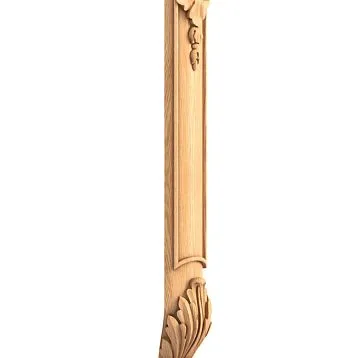
Look at the elegant staircase with carved railings — what first catches your attention? Certainly, it's the graceful vertical posts, each of which is a small architectural masterpiece. Baluster parts form not just a functional safety element, but a true work of art, where each segment has its own purpose and aesthetic value.
Understanding the structural anatomy of a baluster opens before us a wonderful world where engineering thought combines with artistic mastery. Each element of this construction carries a certain load — both physical and visual, creating a harmonious unity of form and function.


Three-part symphony: main components of a baluster




Base — foundation of reliability
The lower part of the baluster, called the base or pedestal, is a critically important element of the entire structure. It is here that the main loads are concentrated, and it is from here that the forces are transmitted from the handrail to the load-bearing elements of the staircase. The shape of the base can vary from a simple cylinder to complex multi-tiered structures with decorative elements.
The dimensions of the baluster's base are determined not only by aesthetic considerations but also by engineering calculations. The diameter or cross-section of this part must provide sufficient contact area with the tread or sub-base to ensure even load distribution. Typical base dimensions are 60-80 millimeters in diameter for round balusters or 50x50, 60x60 millimeters for square ones.
The manufacturing technology of the base requires special attention to machining accuracy. The contact surface must be perfectly flat to ensure tight fitting against the tread surface. Any irregularities or deviations from perpendicularity may lead to uneven load distribution and premature wear of the joint.
Decorative finishing of the base may include milling grooves, creating relief bands, applying various types of carving. These elements not only decorate the baluster but also serve a practical purpose — they increase the surface area for better adhesion with adhesive compounds during installation.
Our factory also produces:


The central part — embodiment of the artistic concept
The middle section of the baluster represents the main decorative zone, where the craftsman can fully express their artistic vision and technical skill. It is here that the main stylistic elements are concentrated, defining the product's affiliation with a specific architectural style.
The geometry of the central part can be incredibly diverse. Classical balusters often have a shape resembling miniature ancient columns — with entasis (bulging in the middle), fluting (vertical grooves), capitals, and bases. Baroque variants feature more complex curved forms, resembling vases or cups.
Modern machining technologies allow creating central parts with the most complex profiles. Multi-axis milling machines can perform spiral grooves, create interlacing ornaments, form three-dimensional floral motifs. Hand carving adds uniqueness to each item, making it a one-of-a-kind work of art.
The proportions of the central part are critically important for the overall perception of the baluster. An overly massive central part creates a sense of heaviness, while an excessively thin one suggests fragility and unreliability. Classical proportions suggest that the height of the central part constitutes 60-70% of the baluster's total height.
Get Consultation
The upper part — the connecting element with the handrail
The finishing element of the baluster, called the head or capital, performs the most important function of connecting to the handrail. This part must ensure secure handrail attachment while maintaining the aesthetic appeal of the entire structure.
Structurally, the upper part may be a simple cylindrical extension for installation into the handrail groove, a complex system of tenons and mortises for detachable connections, or special fastening elements for bolted connections. The choice of specific solution depends on the handrail material, expected loads, and aesthetic requirements.
The dimensions of the upper part must precisely match the handrail parameters. Standard tenon dimensions are 12-16 millimeters in diameter with a length of 20-25 millimeters. These parameters ensure sufficient connection strength while maintaining manufacturability.
Decorative finishing of the upper part often corresponds with elements of the base, creating visual unity throughout the baluster. Symmetrical bands, carved elements, milled grooves — all these details must harmoniously complement the overall style of the item.
Material Science: Influence of Wood Species on Part Construction
Hardwood species: strength and durability
Oak, beech, ash — these noble wood species impose special requirements on the manufacturing technology of each part of the baluster. High density and hardness of these materials ensure exceptional strength of the finished product, but require the use of special tools and processing technologies.
When working with hardwoods, special attention is paid to the direction of wood grain in each part of the baluster. The base should have fibers oriented perpendicular to the mounting plane, ensuring maximum compressive strength. In the central part, fibers are aligned along the baluster's axis to ensure bending strength.
Processing hardwoods requires the use of sharp tools and proper selection of cutting parameters. Too high speeds may cause wood burning, too low speeds — chipping and unevenness. Each part of the baluster requires an individual approach to selecting technological parameters.
Final finishing of hardwoods includes multi-stage sanding with gradually decreasing abrasive grit. Special attention is paid to transitional zones between baluster parts, where changes in geometry may create difficulties during processing.
Coniferous species: accessibility and manufacturability
Spruce, fir, larch represent a more accessible alternative to hardwoods, while still possessing sufficient strength characteristics for most applications. The softness of these species simplifies processing, but requires special attention to tool quality and manufacturing technology.
Baluster Elements Coniferous species have their own characteristics in each part of the construction. The base requires additional reinforcement through impregnation with special compounds or use of thicker sections. The central part may have more complex geometry due to the ease of processing soft wood.
Resin content in coniferous species creates both advantages and processing challenges. Natural resins provide additional protection against moisture and biological effects, but may cause problems when applying lacquer coatings. Each part of the baluster requires careful surface preparation before final finishing.
Economic efficiency of using coniferous species makes them an attractive choice for mass production of balusters. With proper processing and protection, these materials ensure longevity and attractive appearance of finished products.
Technological aspects of manufacturing baluster parts
Turning: the classic of the genre
Traditional turning remains the primary method of manufacturing round balusters, allowing creation of complex profiles with high precision and repeatability. Each part of the baluster requires an individual approach to selecting processing parameters and operation sequence.
Manufacturing the base begins with rough turning of the blank to approximate dimensions. Then, finishing is performed to form the final profile and decorative elements. Special attention is paid to surface quality — any tool marks or irregularities will be visible on the finished product.
The central part requires the highest level of turner's skill. Complex profiles with variable cross-sections, decorative grooves, relief elements — all must be executed with the highest precision. Use of special cutters and templates ensures repeatability of results in mass production.
The upper part of the baluster is often manufactured using special fixtures for forming tenons and other connecting elements. Dimensional accuracy is critically important to ensure tight connection with the handrail.
Milling Processing: Modern Capabilities
Modern CNC milling machines open new possibilities in manufacturing baluster parts. Multi-axis processing allows creating complex three-dimensional shapes inaccessible through traditional turning.
Programming the processing of each baluster part requires a deep understanding of both the technological capabilities of the equipment and the characteristics of the material being processed. Optimizing tool paths allows minimizing processing time while maintaining high surface quality.
Using specialized tools — end mills of various profiles, ball end mills for 3D processing, disk mills for creating grooves — enables the production of the most complex decorative elements.
Quality control in milling processing includes checking dimensions, geometry, and surface quality of each baluster part. Modern measurement systems allow automating this process, ensuring consistent product quality.
Hand carving: art in every detail
Despite the development of mechanized processing methods, hand carving remains the unparalleled method for creating unique decorative elements. Each baluster part hand-carved bears the mark of the individual craftsmanship of the carver.
Preparing the blank for hand carving includes preliminary mechanical processing to approximate dimensions and marking the future ornament. The quality of marking determines the accuracy and symmetry of the finished product.
Tool selection for carving depends on the nature of the ornament and the type of wood. Chisels of various profiles, gouges, and gouge knives — each tool is intended for specific operations. Tool sharpness is critically important for achieving clean cuts without chips or scratches.
Stylistic Features of Baluster Parts
Stylistic features of the balustrade parts
Classic Style: Harmony of Proportions
Classic balusters are distinguished by strict proportions and restrained decorative elements. Each part of such a baluster conforms to the canons of classical architecture, adapted to the scale of staircase structures.
The base of a classic baluster often has a shape resembling a column base — with a plinth, torus, and other traditional elements. The proportions of these elements are strictly regulated by classical orders and must be adhered to in order to preserve stylistic purity.
The central part of a classic baluster may represent a simplified column with entasis and fluting, or have the form of a baluster-shaped body with characteristic interruptions and expansions. Decorative elements are limited to simple geometric forms — bands, grooves, bevels.
The upper part of a classic baluster usually has the form of a simplified capital with an abacus and echinus. The dimensions and proportions of these elements must correspond to the overall scale of the item and harmonize with other parts.
Baroque Style: Luxury and Dynamism
Baroque balusters are distinguished by complex forms and rich decorative elements. Composite Parts of the Baluster In the Baroque style, they often resemble stacked vases, cups, or other decorative vessels.
The base of a Baroque baluster may have a complex multi-tiered form with alternating convex and concave elements. Carved details — leaves, flowers, scrolls — create a rich play of light and shadow characteristic of the Baroque style.
The central part of a Baroque baluster is a true work of art. Complex curved forms, spiral elements, and three-dimensional carving create a dynamic composition that attracts attention and highlights the luxury of the interior.
The upper part of a Baroque baluster is often adorned with carved elements — rosettes, palmettes, acanthus leaves. These details must harmonize with the overall decor and not overload the composition.
Modern Style: Minimalism and Functionality
Modern balusters are distinguished by simplicity of form and emphasis on functionality. Each part of such a baluster has a clearly defined purpose without unnecessary decorative elements.
The base of a modern baluster usually has a simple geometric shape — cylinder, prism, or truncated cone. The surface may be smooth or have minimal texture to enhance aesthetic qualities.
The central part of a modern baluster may represent a simple rotational body with smooth transitions between different diameters. The absence of complex decorative elements is compensated by perfect proportions and high-quality surface finish.
The upper part of a modern baluster usually has a functional shape, optimized for a specific method of attachment to the handrail. Aesthetics are achieved through precision manufacturing and material quality.
Calculation and Design of Baluster Parts
Strength Calculations: Safety Above All
The design of each part of a baluster must be based on careful strength calculations, taking into account all possible loads and operating conditions. The base of the baluster experiences maximum compressive stresses and must be designed to transmit all loads from the handrail to the load-bearing structures of the staircase.
Calculating the base includes determining the required support area, checking the material's compressive strength, and analyzing the stability of the entire structure. Safety factors must account for possible dynamic loads and uneven distribution of these loads.
The central part of the baluster primarily works under bending when subjected to lateral loads on the handrail. The calculation of this part includes determining the section's resistance moment, checking strength and stiffness under various loading scenarios.
The upper part of the baluster must ensure a reliable connection with the handrail under all possible loads. The calculation includes checking the strength of connecting elements — tenons, bolts, glued joints — for shear, tension, and bending.
Ergonomic requirements: comfort of use
Designing baluster parts must consider ergonomic requirements ensuring user comfort and safety on the staircase. Dimensions and shape of each part affect the overall perception of the staircase structure and its usability.
The base of the baluster must not create obstacles when moving along the staircase. Its dimensions and shape must ensure safe foot placement on the tread without risk of catching or slipping.
The central part of the baluster must have a shape that excludes the possibility of injuring users. Sharp edges, protruding elements, or overly complex geometry may pose a danger upon accidental contact.
The upper part of the baluster affects the ease of handrail grip. Its dimensions and shape must ensure a smooth transition to the handrail without creating discomfort during use.
Technological limitations: reality of production
Designing baluster parts must consider technological capabilities and production limitations. Excessively complex shapes may be unfeasible with existing equipment or require unnecessarily high costs.
The base of the baluster must be manufacturable and ensure the possibility of secure attachment to load-bearing structures. Complex shapes may complicate precise positioning and fastening.
The central part of the baluster must consider the capabilities of the equipment used. Minimum curvature radii, groove depths, profile complexity — all these parameters are limited by the characteristics of machines and tools.
The upper part of the baluster must ensure assembly feasibility with the handrail. Excessively tight tolerances may complicate installation, while overly loose tolerances may reduce connection strength.
Quality control of baluster parts
Geometric control: dimensional accuracy
Geometric parameter control of each baluster part is a critically important stage of production. Deviations from specified dimensions may lead to assembly problems, reduced strength, or deterioration of the finished product's appearance.
Base control includes checking diameter or cross-sectional dimensions, height, perpendicularity of end surfaces. Special gauges and measuring instruments ensure the required control accuracy.
The central part of the baluster is controlled by profile, which must exactly match the design dimensions. Using templates and profilometers allows quickly and accurately verifying the finished product's compliance with the drawing.
The upper part of the baluster requires especially precise control of connection element dimensions. Tenons, slots, threaded connections must ensure tight fit with mating parts.
Surface quality control: aesthetics and durability
Surface quality of each baluster part affects both the appearance of the finished product and the durability of protective coatings. Roughness, tool marks, chips, and other defects are unacceptable on visible surfaces.
Base surface control includes checking for absence of chips, cracks, tool marks. Special attention is paid to end surfaces, which must be perfectly smooth to ensure tight fit during installation.
The central part of the baluster requires the most meticulous surface control, as it determines the overall impression of the product. All decorative elements must be clearly defined, without chips or irregularities.
The upper part of the baluster is controlled for absence of defects that may hinder assembly or reduce connection strength. Special attention is paid to the quality of connection elements' processing.
Moisture control: dimensional stability
Wood moisture is critically important for dimensional and shape stability of baluster parts. Each material batch must be controlled for moisture compliance before processing begins.
Base moisture control is especially important, as this part experiences maximum loads. Elevated moisture may lead to deformations and weakening of connections upon drying.
The central part of the baluster, with its complex geometry, is especially sensitive to moisture changes. Uneven drying may lead to cracking or deformation of decorative elements.
The upper part of the baluster must have stable moisture to ensure tight connection with the handrail. Dimensional changes due to moisture fluctuations may lead to weakened connections.
Modern trends in baluster part design
Minimalism: the beauty of simplicity
Modern trends in architecture and interior design increasingly favor minimalism and functionality. Balusters in minimalist style are distinguished by clean lines and the absence of unnecessary decorative elements. The base of a minimalist baluster has a simple geometric shape — cylinder, prism, or slightly expanding cone at the bottom. The absence of decorative elements is compensated by perfect proportions and surface finish quality.
The central part of a minimalist baluster may be a simple rotational body with smooth transitions between different diameters. The aesthetic effect is achieved through the play of light and shadow on smooth surfaces.
The upper part of a minimalist baluster has a functional shape, optimized for a specific mounting method. Beauty lies in the precision of manufacture and material quality.
Eco-style: natural beauty
Growing attention to ecological issues influences the design of baluster parts. Eco-style implies maximum preservation of the natural beauty of wood with minimal surface treatment.
The base of an eco-baluster may retain the natural wood grain with visible growth rings and texture. Minimal processing includes only sanding and application of transparent protective coatings.
The central part of an eco-baluster highlights the natural beauty of the material. Simple shapes that mimic natural contours create a harmonious connection with the surrounding environment.
The upper part of an eco-baluster may have a slightly irregular shape, imitating natural formations. This approach creates a sense of handcrafted authenticity and closeness to nature.
High-tech style in baluster design implies the use of modern technologies and materials to create futuristic forms. The combination of traditional wood with modern elements creates interesting design solutions.
High-Tech: Technologies of the Future
The base of a high-tech baluster may include metal inserts, LED lighting, or other technological elements. Maximum manufacturing precision is required to emphasize the technological nature of the design.
The central part of a high-tech baluster may have complex geometry created using modern CAD systems and CNC machines. Unusual shapes, impossible to achieve by hand, become a hallmark of the style.
The upper part of a high-tech baluster may include innovative mounting systems — magnetic connections, quick-release elements, integrated sensors, or other technological novelties.
Understanding the structure and characteristics of each baluster part opens up a wonderful world where engineering thought is inseparably linked with artistic creativity. The base, central part, and top — each element of this triad performs its unique role in creating not only a functional but also aesthetically perfect product.
Conclusion
Modern manufacturing technologies allow us to realize the most daring design concepts while preserving traditional principles of craftsmanship and quality. Each baluster part, whether a classic base or a futuristic top, carries the imprint of time and style, becoming a witness to the evolution of architectural thought.
The choice of a specific solution for each baluster part should be based on a comprehensive analysis of functional requirements, aesthetic preferences, and technical capabilities. Only such an approach allows creating a product that will delight the eye and serve faithfully for many years.
In the world of high-quality stair constructions, the company STAVROS occupies a special place, offering not only superior materials and products but also deep expertise in the design and manufacturing of each baluster part. Years of experience, continuous improvement of technologies, and commitment to flawless quality make STAVROS a reliable partner for anyone who values professionalism and perfection in creating architectural masterpieces.
69.17 $ р.