Article Contents:
- Why a plain white ceiling often looks flat and formal
- Who this solution suits — and who it doesn't
- How white slatted ceiling panels turn a plane into a surface
- What ceiling molding adds to a light plane
- Light and shadow, relief and depth: why white doesn't have to be boring
- Four application scenarios: specific solutions for real tasks
- Kitchen-living room: zoning with white rhythm without walls
- Bedroom: soft relief without heavy classicism
- Hallway: Expanding Space with White Rhythm
- Home Office: How to Avoid an Office Look
- Mistakes That Make a Light Ceiling Look Cheap or Too Formal
- Wrong White Tone
- Too Dense Slat Rhythm on a Low Ceiling
- Heavy Molding with a Light Slat Pattern
- Slat Field Without Finishing Elements
- Same Molding Throughout the Apartment
- Forgotten Lighting Until Installation
- Comparison: White Ceiling Paint vs. White Slat Panels
- How to choose the material for white battens: what's important to know before buying
- Which molding suits white battens — a mistake-free choice
- How much decor is enough: the balance that must not be broken
- Quick selection algorithm: from room parameters to a ready-made solution
- Frequently Asked Questions
- STAVROS: the white ceiling that is remembered
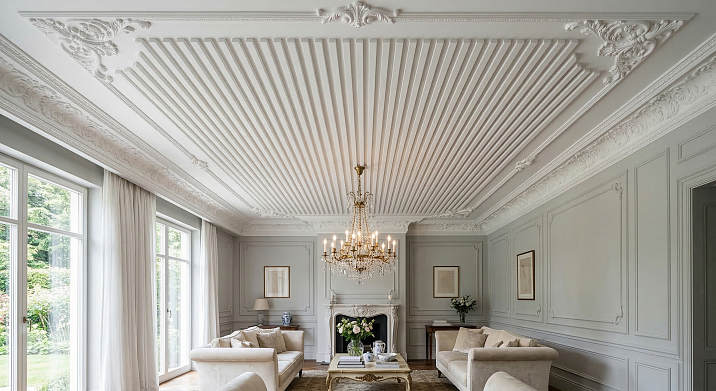
There is one paradox of modern renovation that is not usually spoken aloud. People spend weeks choosing furniture, hours selecting wall colors, evenings comparing light fixtures. And the ceiling? The ceiling is painted white. Habitually, quickly, 'so it doesn't get in the way.' And it is at this moment that the interior loses a fifth of its potential — that upper plane which, with the right approach, completely transforms the space.
A white ceiling is not a mistake in itself. A white ceiling without relief, without rhythm, without a single architectural line — that is the real mistake. A painted smooth slab overhead is not a neutral background. It is emptiness. It is this emptiness that turns an apartment into an office, a living room into a conference room, a cozy bedroom into a hospital ward. It's not the furniture's fault, nor the curtains. It's the ceiling's fault, which was not allowed to become part of the architecture.
This text is for those who understand the difference between 'just white' and 'white with character.' For those who are renovating an apartment and want a result that won't become tiresome in a year. For those who are tired of office sterility in their own home — and are looking for a solution without heavy molding, baroque swirls, and a feeling of palace excess. If at least one of these tasks is yours, read on.


Why an ordinary white ceiling often looks flat and formal
Ask yourself an honest question: when was the last time you looked up in your own apartment not because something was blinking or fell, but simply because it was interesting? Most likely, a long time ago. Because there's nothing to look at.
A smooth white plane is zero visual information. The brain processes it in a fraction of a second, finds nothing worthy of attention, and moves on. The ceiling 'switches off' from the perception of space. The room loses its upper dimension and is perceived as a box without a lid—functionally understandable but architecturally empty.
This is precisely what creates the office effect. In a business space, the ceiling was never part of the design—it always remained an engineering plane for lights, ventilation, and cables. When a living space copies this logic, it inevitably acquires an office atmosphere—even with the most expensive furniture and the most beautiful walls.
The solution is not to paint the ceiling a color. A colored ceiling is a strong technique, but it changes the character of the space radically and is not suitable everywhere. The solution lies in relief. In the shadow one surface casts on another. In the rhythm of lines along which the gaze glides. This is exactly what white slatted ceiling panels provide in combination withceiling moldings: they remain light, airy—but cease to be flat and dead.




Who this solution is for—and who it's not for
An honest conversation begins with qualification. White slatted ceiling panels with ceiling molding are not a universal recipe. They work brilliantly in the right conditions and give weak results in the wrong ones.
This solution is created for you if you want a light ceiling without a dead plane and without office-like tiles. If you need to hide the unevenness of a concrete slab—a slatted frame solves this task without leveling with putty. If the room has an acoustic problem—booming, harsh sound, echo in an empty room—wooden slats with gaps work as a diffuser and noticeably improve the sound environment. If you need to zone an open kitchen-living room without partitions—a slatted field over one zone creates a visual boundary without a physical wall. If the interior is in a light palette and you need to add an architectural gesture without heavy classicism—white slats with a thin cornice provide modern completeness, not a museum interior.
Now, honestly about situations where it's better to step back. If the ceiling is very low and already overloaded with built-in track lights—adding a slatted structure on a frame will take away a few more centimeters of height, and the space will begin to feel oppressive. If the interior is intentionally ultra-minimalist, where any relief is a violation of the concept—here it's better to limit yourself to the thinnest contour cornice. If the room is constantly damp—bathroom, sauna, open loggia—wooden and MDF slats are not suitable; a different material is needed here. If the renovation requires maximum economy—white slats with molding require investment, and this must be honestly accepted.
Understanding your situation is already half of the right choice.
Our factory also produces:
How white slatted ceiling panels turn a plane into a surface
The mechanism is simple, but it's worth understanding completely—because understanding allows you to make the right decision on all parameters: slat width, gap spacing, and laying direction.
A batten is a linear element. A row of parallel white battens creates rhythm—a repeating pattern that the eye perceives as movement. Between the battens is a gap. In the gap is a shadow. The shadow is depth. A white batten against a white or dark gap background creates contrast, giving a sense of volume. The ceiling ceases to be a flat plane and becomes a surface with character.
The direction of the slats controls the perception of space—and this is not theory, but practically tested optics. Slats across the room visually widen it. Slats along the long axis stretch and deepen the space. Diagonal slats add dynamism, creating a modern tension. In a narrow hallway, longitudinal slats literally 'open up' the space in depth, eliminating the feeling of tightness. In a wide living room, transverse slats over the dining area create a cozy 'covered' effect over the table.
Slat width and gap spacing are the main selection parameters. Narrow slats from twenty to thirty millimeters with a six-to-eight-millimeter gap create a dense, almost textural rhythm—delicate, modern, unobtrusive. Medium slats forty to fifty millimeters with a ten-to-fifteen-millimeter gap provide a clear, readable rhythm—universal, working in most living spaces. Wide slats sixty to eighty millimeters with a twenty-to-thirty-millimeter gap create a monumental, sparse relief—for large spaces with high ceilings.
The scale rule here is simple: the lower the ceiling, the thinner the slat and the sparser the rhythm. Dense, narrow slats on a low ceiling create a 'cellular' effect that visually presses down—that very feeling of an office drop ceiling that was meant to be avoided.
Batten panels for ceilingsIn white finish, they also solve an engineering task that is often underestimated: behind the slatted field on the frame, everything that spoils the appearance of the ceiling is hidden—unevenness of the slab, pipes, cables, mounting foam. New buildings with rough ceilings having a variation of three to five centimeters get a perfect horizontal plane without plastering or leveling.
Get Consultation
What ceiling molding gives on a light plane
Slatted rhythm is movement. Molding is a stop. Cornice, molding, rosette—they fix the space, create boundaries, and give completeness. Together, slats andceiling moldingform a system: dynamics and statics, rhythm and frame, liveliness and architectural discipline.
A ceiling cornice at the junction of the wall and ceiling is an architectural horizon. A clear line by which the eye understands where the wall ends and the ceiling begins. Without a cornice, this junction is technical—painter's tape, a right angle, nothing more. With a cornice—a finished architectural solution that adds a sense of completeness to the room regardless of style.
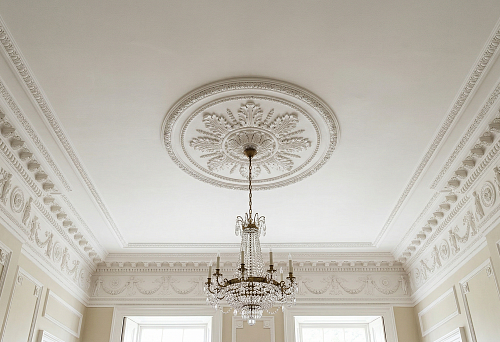
It is on a white surfacePolyurethane ceiling decorthat it works most convincingly. A white cornice on a white ceiling is not 'all one color' in the banal sense. It is relief in a monochrome system, where depth is created solely by the shadow of the profile. Even a thin cornice forty millimeters wide with a simple single-step profile creates a shadow at the base, separating the wall from the ceiling with a visual clarity that flat paint never provides. A more complex cornice with several profile steps creates multi-layered chiaroscuro—three or four surfaces with different orientations, each catching light at its own angle. An architectural depth that is felt even in a small room.
Polyurethane molding is an exact cast copy of historical plaster samples, devoid of their main drawbacks. Polyurethane weighs five to eight times less than plaster, cuts with a regular utility knife, and is glued with acrylic adhesive in one working day. Upon impact, it does not chip—it deforms slightly and returns to shape. It does not absorb moisture. It is chemically neutral and safe in living spaces, including children's rooms.
The ceiling cornice is not the only molding element working in a system with white slats. A ceiling rosette organizes the center of the ceiling space when there is a pendant light. Coffered moldings—frame elements that break the ceiling plane into geometric fields—turn a zonal slatted field into an architecturally framed object. Corner blocks solve the problem of joining cornices in corners without complex 45-degree miter cuts.
Chiaroscuro, relief, and depth: why white doesn't have to be boring
White is not a color in the ordinary sense. White is an optical state. On a white surface, there is no inherent tone—there is only light and its absence. This is precisely why relief on white works with such expressiveness: it is fully visible, without being masked by color, without extraneous 'noise'.
A narrow white slat in side light gives a clear shadow in the gap. In the morning, when the sun is at a sharp angle, the shadows are deeper—the rhythm of the slats is read brightly and dynamically. At noon under direct overhead light—softer, almost dissolving. In the evening under artificial side lighting—expressive again. This is a living ceiling. Not a static plane, but a surface that reacts to lighting throughout the day.
Slatted panels with lighting— an integrated LED strip in the gaps between the slats—turns a white slatted ceiling into a full-fledged lighting fixture. Light flows down through the gaps, creating soft, diffused lighting without a visible source. No exposed bulbs, no cables—only a glowing rhythm of lines. For a bedroom, this is evening lighting without strain. For a dining area—an atmospheric accent. For a windowless hallway—the only way to make the ceiling come alive.
But the most powerful discovery in working with a white relief ceiling is how it changes along with the room's lighting. Warm light at three thousand Kelvins makes the white slats creamy, alive, almost wooden in feel—despite being white. Cold light at five thousand Kelvins makes them pure and almost surgically precise. The correct light temperature is as much a tool for creating the ceiling's character as the relief itself.
Four application scenarios: specific solutions for real tasks
Abstract 'light ceiling' — for inspiration. Concrete scenarios — for selection.
Kitchen-living room: zoning with white rhythm without walls
Open-plan kitchen-living room — a typical story in Russian new builds. The main task: separate the kitchen area and the relaxation area without a partition. A wall is impossible due to the layout. Furniture is a weak divider. A rug is a horizontal, not a boundary. But the ceiling?
White slatted panels for the ceiling above the dining area — a slatted field width matching the table size plus sixty to eighty centimeters on each side. The rest of the ceiling is smooth white. The transition between zones is fixed with a polyurethane molding, creating a clear architectural boundary. The slatted zone visually 'covers' the dining table, creating a sense of a separate space without a physical wall. Add built-in lighting in the gaps between the slats above the table — and the dining area gets its own lighting scenario, which can be turned on in the evening independently of the general lighting.
After completing this zone, look at Slatted panels in the living room interior — there is a detailed breakdown of combinations for open-plan layouts.
Bedroom: soft relief without heavy classicism
The bedroom requires tranquility. Heavy molding with acanthus leaves and swirls is an unsuitable choice for a sleeping space. A completely flat surface is also bad: the gaze hits the ceiling and finds no rest.
The correct solution: narrow white slats twenty-five to thirty millimeters wide with a spacing of eight to ten millimeters above the bed area — a slatted field the size of the bed plus the bedside zones. A thin ceiling cornice along the perimeter of the room, forty to sixty millimeters, without ornament — a clean classical profile. A minimalist central ceiling rosette if there is a chandelier. Under the slats — the same white background, not black: delicacy is needed here, not contrast.
slatted panels in the bedroom in white create a quiet, almost whispered relief. Architecture that doesn't shout. This is precisely the tone needed in a space where a person recovers.
Hallway: stretching the space with a white rhythm
The hallway is a narrow, often daylight-deprived room with the most unfortunate proportions in the apartment. White longitudinal battens along the long axis of the corridor on the ceiling visually stretch the space in depth and lift the gaze. The narrow rhythm of the battens enhances directional movement—the eye flies forward instead of stopping on the walls.
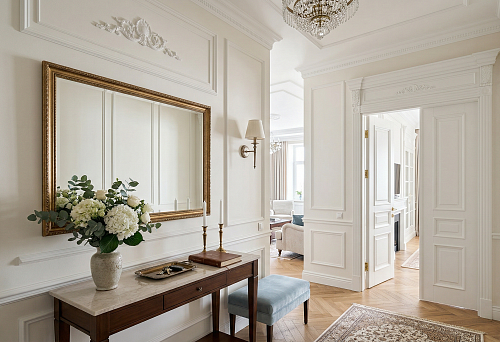
A thin ceiling cornice with perimeter lighting—and a hallway without a single window gets soft, diffused lighting that removes the feeling of tightness.Slatted panels in the hallway interior—one of the most effective techniques for working with a transit space without natural light.
Home office: how to avoid an office look
A home office is a trap. White ceiling, desk, monitor, shelves. Putting these components together and getting an office is very easy. How to add individuality without excess?
Wide white slats, sixty to seventy millimeters, with an increased gap of twenty to twenty-five millimeters above the work area—a restrained, substantial rhythm. Not small and fussy, but wide, calm. Coffered molding around the perimeter of the work area—a square frame made of polyurethane profile—turns the work corner into something resembling a library hall. It is precisely the contrast of modern white slats and classically precise frame molding that removes the office feel and creates a sense of personal space with character.
Mistakes that make a light ceiling look cheap or too formal
White slats and molding are a powerful tool. But it is precisely this tool that reacts painfully to execution errors. A cheap or unprofessional solution looks worse than an honest painted slab. Let's break down what ruins the result.
Incorrect white tone
White can be cool—with a blue or green undertone—or warm, with a creamy or yellowish tint. Cool white in a room with warm lighting appears bluish and clinical. Warm white under cool lighting looks dingy. The tone of white battens and the tone of molding should match. Even better—match the wall tone or be half a tone lighter. A mismatch of white tones in one space creates a sense of incoherence: as if different elements were bought in different places and accidentally ended up together.
Too dense batten rhythm on a low ceiling
Frequent narrow battens on a ceiling below two and a half meters create a 'cellular' effect. The ceiling looks not like a textured surface, but like a grid or blinds—that very office-like feeling you wanted to avoid. For low rooms: battens wider, gaps larger, rhythm sparser. The lower the height—the more laconic the solution.
Heavy molding with a light batten pattern
Thin narrow battens with a delicate rhythm and a massive baroque cornice with a voluminous ornament—this is a scale dissonance. The cornice 'eats up' the delicacy of the battens and turns the ceiling into a contradiction. The scale rule: the width of the cornice should correspond to the width of the batten. Thin battens—thin cornice. Wide battens allow for a more developed profile.
Batting field without finishing elements
Slatted panels for the ceilingWithout a cornice, without a finishing profile around the perimeter—this is an unfinished job. Open ends of the batting field create a feeling of a temporary installation, not an interior solution. Each batting field should be either finished with a cornice around the perimeter or joined to the wall via a corner molding.
Identical molding throughout the entire apartment
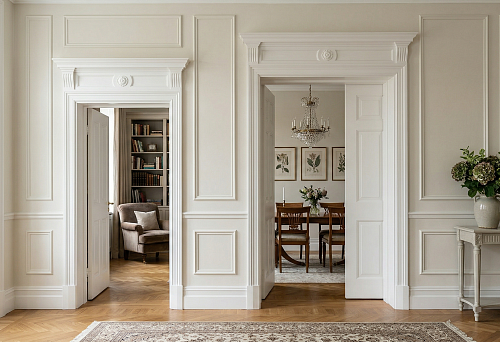
The same cornices from the kitchen to the bedroom create a feeling of assembly-line production, not a thoughtful interior. The scale and profile of the molding should correspond to the purpose and size of each room. A large living room—developed profile. An entrance hall—thin and laconic. A kitchen—practical, without complex protrusions that accumulate grease deposits.
Lighting that was forgotten before installation
LED channel in the gap between battens is a solution that needs to be planned before installation. Once the battens are fixed, it is impossible to integrate lighting without dismantling. Bringing power to the ceiling, installing the LED strip in the gap, and covering it with a diffuser—all of this is done at the framing stage, not after finishing.
Comparison: white painted ceiling vs. white batten panels
Let's break down what concerns most people when making a choice.
Smooth white paint—minimal investment, simple installation, easy to refresh at any time. But no relief, no depth, no hiding of imperfections. An office-like feel is guaranteed.
White batten panels for the ceiling—relief and rhythm, concealment of utilities and imperfections, acoustic improvement, possibility for integrated lighting. Installation requires skill and time. Cost is higher. Repainting a different color requires dismantling. But the result is an architectural ceiling, not just a 'covered top'.
White battens win on all parameters except price and ease of updating. This isn't a competition—it's a choice of ambition level. If the ceiling is just a covered top, paint it. If the ceiling is part of the interior architecture, choose battens.
How to choose the material for white battens: what's important to know before buying
WhiteRafter panelsare produced from several materials with fundamentally different properties. The choice of material determines not only the appearance but also durability, performance in use, and reaction to room conditions.
MDF for painting is the optimal choice for a white ceiling in a residential space. MDF has a perfectly smooth surface without natural defects, accepts paint without pores or fibers, and maintains geometry without seasonal movement. A white batten made of MDF is precisely that clean, uniform white needed to create rhythm without distraction from texture. Here, form is important—line, shadow, rhythm—and MDF provides them in an absolutely pure form. A detailed technical breakdown is in the article aboutMDF batten panels: density, coverage, installation features.
Solid wood for painting is a less common but quite substantial choice. Solid wood slats painted white are heavier than MDF and require strict acclimatization before installation—forty-eight to seventy-two hours in the room without packaging. However, they are stronger, more durable, and with proper coating allow for multiple repaints. The wood texture under the white coating is minimally visible—only very delicately, as in Scandinavian interiors.Wooden slat panels— about the nature of the material and its character.
WPC for wet areas—if you need a white slatted ceiling in a bathroom or on a loggia. This is the only material from the slatted family that is not afraid of moisture and temperature fluctuations. The appearance is somewhat different: a matte surface with slight embossing. In the bathroom, this is not a drawback—it is an appropriate character.
paintable slatted wall panelsMDF slats also allow repainting when changing interior design: a new color—a new character without dismantling.
Which molding suits white slats—a choice without mistakes
Not everyceiling moldingmolding suits white slatted panels on the ceiling. Let's break it down by function and scale.
For narrow slats from twenty to thirty millimeters—a cornice with a simple one- or two-step profile forty to seventy millimeters wide. Pure geometry, without ornament. This is Scandinavian or modern classic—a concise horizon that completes the slatted field without competing with it.
For medium slats forty to sixty millimeters—a cornice with a cove and straight face seventy to one hundred ten millimeters wide. Light ornamentation is possible: egg-shaped, reeding, simple leaves. This is neoclassicism—a modern interpretation of a classic cornice.
For wide slats of sixty to one hundred millimeters, a developed cornice with several bands of one hundred ten to one hundred eighty millimeters is suitable. A more complex ornament is permissible here, provided the interior supports it in scale and character.
A ceiling rosette is appropriate only if there is a pendant light fixture in the center. A lone rosette without a chandelier is a decorative gesture without meaning; it's better to do without it.
Coffered moldings work with white slats only in one case: if the slatted field is zonal, and the coffered molding frames this field from the outside. Two competing rhythms on one plane—slats inside the field and coffers across the entire ceiling—create visual noise.
installation of slatted panelsInstallation of the frame, slats, and molding is performed in the correct sequence: first the frame and slats, then the molding. The cornice is glued over the already installed slatted ceiling, covering the perimeter joint.
How much decor is enough: a balance that must not be broken
One of the main fears when choosing ceiling decor is overloading the space. This fear is justified. An overloaded ceiling looks not richer, but heavier. This is especially painful in a light interior: where everything else is light and airy, a heavy ceiling presses down unexpectedly and strongly.
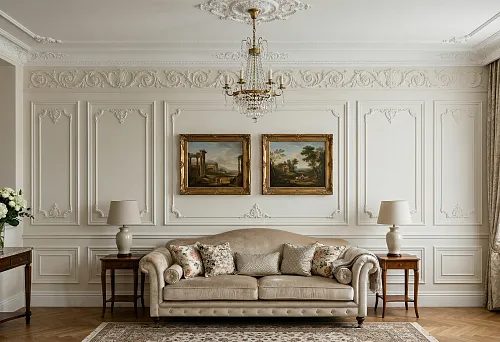
If the slats are narrow and frequent, the molding should be delicate. A thin cornice plus a small rosette—nothing more. If the molding is developed and ornamental, make the slatted rhythm sparser and wider. If the room is small—one cornice along the perimeter. Any additional element in a small space creates overload. If the room is large—a cornice plus one accent element: a rosette or zonal coffers above the main area. Not both at once.
Balance in a monochrome white interior is a balance of shadow depth. Too little relief—emptiness. Too much—pressure. The right amount is when the ceiling lives but does not shout.
Quick selection algorithm: from room parameters to a ready-made solution
Beforebuy slatted panelsTo choose slats for the ceiling and select molding to match them, go through this algorithm.
Assess the ceiling height. Up to two and a half meters — only a thin cornice of forty-sixty millimeters or forgo molding. Slats are narrow, rhythm is sparse. From two and a half to two eighty — standard cornice seventy-one hundred ten millimeters, slats of any width. Above two eighty — you can allow a developed cornice up to one hundred eighty millimeters, wide slats, coffered elements.
Determine the character of the space. Modern minimalism — narrow slats, thin clean cornice without ornament. Neoclassicism — medium slats, cornice with a profile, possible ceiling rosette. Eclecticism — wide slats, developed cornice.
Choose the material of the slats according to the room conditions. Dry living — MDF for painting or solid wood. Wet — only WPC.
Determine the shade of white. Warm interior with warm light — warm white with a creamy undertone. Cold neutral interior — pure white. The tone of the slats and molding must match — this is a mandatory condition.
Resolve the lighting issue before installation. If you want LED in the gaps — plan for a channel and power outlet in advance. After installation, it is impossible to redo.
Check the installation sequence: frame, slats, finishing moldings, molding. Exactly in that order — not the other way around.
If you need to see the full assortmentslatted wall panels for interior finishingwith a breakdown of materials and formats — there is a detailed breakdown of all options from MDF to solid wood with technical parameters.
Frequently asked questions
Can white slatted panels be installed on the ceiling independently?
Yes, with basic skills in working with power tools. Step-by-step instructions — in the materialDIY Batten PanelsThe main thing is careful layout taking diagonals into account and correct calculation of the number of slats accounting for gaps.
How durable is a white MDF slatted ceiling?
MDF under normal operating conditions lasts fifteen to twenty-five years without changes in geometry or appearance. If one slat is mechanically damaged, only that slat is replaced without dismantling the entire structure.
How difficult is it to install polyurethane ceiling molding?
Polyurethane cornice is cut with a utility knife or hacksaw at a forty-five-degree angle for corner joints. It is glued with acrylic mounting adhesive — setting time is fifteen to twenty minutes. Joints are filled with white acrylic sealant. The entire perimeter of an average living room is a job for three to four hours for one person.
Does a slatted ceiling affect acoustics?
Wooden and MDF slats with gaps act as an acoustic diffuser: they scatter sound waves, reduce boominess and reverberation. In rooms with hard surfaces — glass, concrete, tile — a slatted ceiling noticeably improves the sound environment. To enhance the acoustic effect, acoustic felt or mineral wool is laid behind the slats.
Are white slats on the ceiling too office-like?
It is precisely a flat white ceiling that resembles an office. A white slatted ceiling is an architectural surface with rhythm and depth. It is the relief that removes the office-like feel: an office suspended ceiling has no shadows — it is a uniform plane of tiles. White wooden or MDF slats create a living rhythm of shadows that no tile system reproduces.
Are white MDF slats and polyurethane molding compatible?
Completely. Both materials are installed independently: battens on the frame, molding on acrylic adhesive. The white shade is selected when ordering and leveled during final painting. Polyurethane molding manufacturers offer paintable material—it is precisely matched to the batten shade.
What to do if the ceiling is very uneven?
A batten construction on an adjustable frame is the ideal solution for uneven ceilings. The frame is leveled with a laser level regardless of the actual ceiling geometry. Variations of five to ten centimeters are concealed without plastering or leveling.Installation of batten panelson a frame—details on profile selection, mounting points, and leveling.
STAVROS: the white ceiling that is remembered
A good white ceiling is not an accident. It is the result of three correct decisions: material, scale, completeness. White batten panels provide rhythm and relief. Ceiling molding provides perimeter and architectural finish. Together they transform the 'lid over the space' into a full-fledged fifth surface of the interior—light, yet alive.
STAVROS producesRafter panelsmade of solid wood and MDF with precise geometry and coating, ready for installation. STAVROS offers a complete rangeof polyurethane ceiling moldings—cornices, rosettes, moldings, corner blocks—for any style and scale.
A white ceiling can be alive. STAVROS knows how to do it.