Article Contents:
- Why balusters are more important than they seem
- Delivery geography: Yekaterinburg, Novosibirsk, Minsk
- Wood species: what to choose for your region
- Oak: the gold standard
- Beech: European elegance
- Ash: Strength and Flexibility
- Larch: Siberian durability
- Pine: accessibility and versatility
- Styles and profiles: from classic to modern
- Turned balusters: classic tradition
- Carved balusters: luxury and detailing
- Square balusters: minimalism and strictness
- Figurative balusters: individuality and exclusivity
- Sizes and proportions: what you need to know
- Baluster height
- Diameter and cross-section
- Distance between balusters
- Finishing and surface treatments
- Sanding: foundation of quality
- Varnish: durability and shine
- Oil-wax: naturalness and tactility
- Staining: playing with color
- Baluster installation: subtleties and nuances
- Fastening to treads
- Handrail Installation
- Alignment and adjustment
- Regional features: climate and operation
- Yekaterinburg: dry continental climate
- Novosibirsk: sharp temperature fluctuations
- Minsk: humidity and mild winters
- Comprehensive approach: balusters in the context of the staircase
- Handrails: completing the composition
- Posts: supporting accents
- Steps and risers
- Maintenance and care
- Regular Cleaning
- Recoating
- Fastening Check
- Cost: what makes up the price
- Wood Species
- Profile complexity
- Finish Coating
- Delivery and Installation
- Common mistakes in selection and installation
- First mistake: saving on wood species
- Second mistake: style mismatch
- Third mistake: incorrect spacing between balusters
- Fourth mistake: poor-quality installation
- Fifth mistake: lack of protective coating
- Trends and Modern Solutions
- Naturalness and eco-friendliness
- Minimalism and purity of forms
- Contrasting combinations
- Open Designs
- How to Choose a Manufacturer and Supplier
- Experience and Reputation
- Assortment and availability in stock
- Material Quality and Processing
- Logistics and Packaging
- Service and consultations
- Why Wooden Balusters Are Better Than Alternatives
- Naturalness and eco-friendliness
- Tactility and Warmth
- Repairability
- Variety of styles
- Questions and Answers: What to Know Before Buying
- How many balusters are needed for a staircase?
- Can Different Wood Species Be Used for Balusters and Handrails?
- How Long Do Wooden Balusters Last?
- Do balusters need to be treated with antiseptic?
- Can balusters be installed by oneself?
- Which Handrail to Choose for Classic Balusters?
- How Do Posts Differ from Balusters?
- How to Care for Varnished Balusters?
- Which Balusters Are Best for Homes with Children?
- Can Balusters Be Stained After Installation?
- Conclusion: a choice that serves for decades
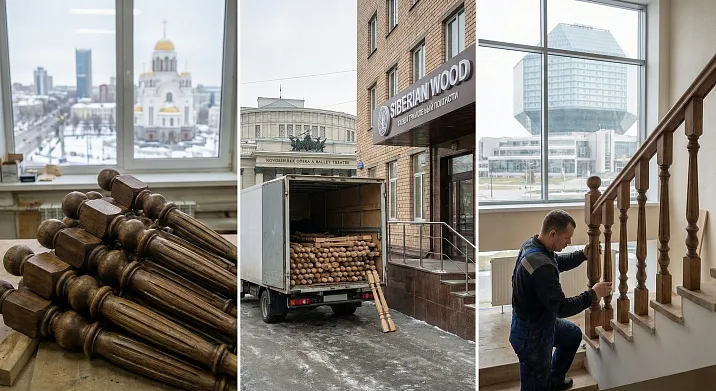
When it comes to wooden stairs, many forget one simple fact: it's the balusters that shape the character of the entire structure. Not the steps, not the handrails—but these elegant vertical elements that set the rhythm, create visual density, and ensure safety. In cities with different climatic conditions—Yekaterinburg, Novosibirsk, and Minsk—the approach to choosing balusters has its nuances. Dry Ural air, sharp Siberian temperature fluctuations, humid Belarusian winters—all of this affects wood behavior and requires careful attention to species, processing, and installation.



Why Balusters Are More Important Than They Seem
Many perceive balusters as a secondary detail, a decorative addition to the main structure. This is a mistake. Balusters perform three critically important functions, each affecting the durability, safety, and aesthetics of the entire staircase.
The first function is structural.Wooden balustersThey serve as support for the handrail, taking on lateral loads and preventing deformation. A handrail without proper support will sag, lose rigidity, and become unsafe. Properly installed balusters distribute the load evenly, creating a rigid frame that maintains its shape for decades.
The second function is protective. Balusters form a barrier, a railing that prevents falling from the stairs. This is especially critical for families with children, elderly people, and pets. The distance between balusters is regulated by building codes—no more than ten to twelve centimeters—so a child cannot put their head through or slip between the posts. This is not just a recommendation; it's a safety requirement.
The third function is aesthetic. Balusters set the style of the staircase. Turned classical shapes create a manor-house atmosphere, carved ones with patterns emphasize interior luxury, and concise square profiles fit into minimalism and Scandinavian style. Properly chosen balusters can transform a utilitarian structure into an architectural work.




Delivery Geography: Yekaterinburg, Novosibirsk, Minsk
When you decideBuy wooden balusters in YekaterinburgThe first question is where to ship from and how long to wait. Logistics for wooden products require attention: wood is sensitive to humidity fluctuations, temperature changes, and impacts during transportation. Packaging must be multi-layered, protecting against chips, scratches, and moisture.
Yekaterinburg is in a relatively dry continental climate zone. This is favorable for wood—less likelihood of swelling and deformation. Delivery from central warehouses takes three to five days, depending on the workload of transport companies. Packaged balusters are shipped in protective film with corrugated cardboard padding, preventing damage even during long transport.
Novosibirsk is a city with more pronounced temperature fluctuations. In winter, frosts reach minus forty, and in summer, the air warms up to plus thirty-five. Wood accustomed to one climate may behave unpredictably in another. Therefore, for Novosibirsk, it is recommended to choose balusters made from species with increased stability—oak, ash, larch. Deliveryof wooden balusters to Novosibirskis organized through verified transport companies, with transit time from five to seven days.
Minsk has a more humid climate. Belarusian winters are milder than Siberian ones, but humidity is higher. Wood here requires quality preliminary drying and protective coating. If you plan tobuy wooden balusters in Minsk, pay attention to the finish: oil-wax or varnish should create a moisture-protective barrier. Delivery to Minsk is handled by international carriers, with timelines of seven to ten days, including customs clearance.
Our factory also produces:


Wood Species: What to Choose for Your Region
Choosing a species is not just a matter of aesthetics, but also practicality. Different species behave differently in various climatic conditions.
Get Consultation
Oak: The Gold Standard
Oak is a classic of wooden architecture. Hard, dense, wear-resistant, with an expressive grain. Oak balusters are not afraid of temperature fluctuations and react weakly to changes in humidity. For Yekaterinburg and Novosibirsk, this is the optimal choice: oak is stable, does not warp, does not crack. The color palette ranges from light golden to dark brown, depending on the processing method and finish.
Oak balusters are heavy, massive, giving the staircase a sense of monumentality. This is the choice for those building for centuries, who value reliability and prestige. The price is higher than pine or birch, but the service life is measured in decades, if not centuries.
Beech: European elegance
Beech is slightly softer than oak but is still considered a hardwood. Its grain is more uniform, without pronounced annual rings, giving a calm, noble appearance. Beech balusters lend themselves well to turning and milling, allowing for the creation of complex profiles and carved ornaments.
Beech is hygroscopic—it absorbs moisture more actively than oak. For Minsk, this means the need for high-quality protective treatment. But with proper preparation, beech balusters last a long time and look exquisite. The color ranges from pinkish to reddish-brown, with fine speckles creating a lively, warm surface.
Ash: Strength and Flexibility
Ash is comparable in hardness to oak but has a more pronounced grain with contrasting fibers. This gives balusters a dynamic, graphic look. Ash is elastic, withstands impact loads, and does not split. An excellent choice for active families where the staircase is used intensively.
The color of ash ranges from light gray to olive-brown. It takes stains well, allowing the shade to be matched to the overall interior palette. For Yekaterinburg and Novosibirsk, ash is a practical solution: stable, durable, with high wear resistance.
Larch: Siberian Resilience
Larch is a coniferous species, but its hardness is close to that of hardwoods. It contains natural resins that protect against moisture, rot, and insects. Larch balusters are not afraid of temperature fluctuations, tolerate dampness, and do not lose their shape. For Novosibirsk, this is almost an ideal option: a local species adapted to the local climate.
The color of larch is golden-honey with a reddish tint. Over time, the wood darkens, acquiring a richer tone. The grain is expressive, with bright annual rings. Larch is easy to work with but requires sharp tools due to its high density.
Pine: accessibility and versatility
Pine is the most affordable species. It is softer than oak and ash, easier to work with, and cheaper. Pine balusters are suitable for country house staircases, auxiliary structures, and budget projects. But it's important to understand the limitations: pine is less wear-resistant, may produce resin exudations, and requires a protective coating.
The color of pine ranges from light yellow to reddish-brown. The grain has contrasting layers, sometimes with knots, adding rustic charm. For Yekaterinburg and Novosibirsk, pine is a compromise option: an acceptable price with sufficient functionality.
Styles and Profiles: From Classic to Modern
The shape of a baluster determines the style of the entire staircase. Choosing a profile is not only a matter of beauty but also of compatibility with the interior, furniture, and wall finishes.
Turned Balusters: A Classic Tradition
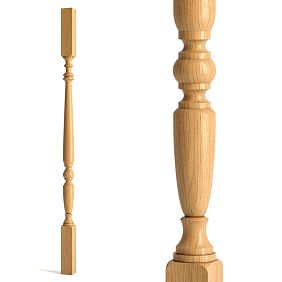
Turned balusters are made on a lathe. The shape is symmetrical, with alternating thickenings and narrowings—vases, balls, spindles, disks. This is a classic style that suits traditional interiors, country houses, and estates. Turned balusters create a sense of stability, order, and continuity.
Such balusters pair well withround handrails, creating a unified composition. The handrail diameter is usually chosen in proportion to the top part of the baluster, ensuring a smooth transition and visual harmony.
Carved Balusters: Luxury and Detailing
Carved balusters are adorned with ornaments—floral motifs, geometric patterns, volutes, rosettes. This is the choice for luxurious interiors where every detail is thought out and emphasized. Carved balusters are made on a CNC milling machine or by hand, making them more expensive than turned ones.
Such balusters require careful maintenance: dust accumulates in the recesses of the carving, so regular cleaning with a soft brush is needed. But the aesthetic effect is worth it: a carved staircase becomes the central element of the interior, a work of art.
Square Balusters: Minimalism and Strictness
Square balusters are about simplicity of form and purity of lines. The cross-section is square or rectangular, without decorative elements. Such a profile fits into modern interiors, Scandinavian style, loft, and minimalism. Square balusters are easy to install, do not require complex fitting, and provide a strict, graphic look.
They pair well with flat handrails, creating a unified planar composition. The color can be natural—highlighting the wood grain—or contrasting—stained in dark or light shades.
Figural Balusters: Individuality and Exclusivity
Figural balusters are custom forms created from individual sketches. These can be sculptural elements, twisted columns, asymmetrical profiles. Such balusters make the staircase unique, one-of-a-kind, reflecting the owner's character.
Making figural balusters requires time and skill. This is custom work, justified in exclusive projects where individuality and artistic expression are important.
Dimensions and proportions: what to know
Correct baluster dimensions are not just about aesthetics; they are about safety and functionality. There are building codes that regulate height, diameter, and spacing between balusters.
Baluster height
The standard baluster height is from eighty to ninety centimeters. This is the distance from the step surface to the top of the handrail. This height ensures a comfortable hand grip on the handrail and convenient support when ascending and descending. For children and elderly people, an additional wall-mounted handrail can be installed at a height of sixty to seventy centimeters.
Baluster height affects the perception of the staircase. Low balusters make the structure squat and massive. High ones elongate the space, giving it lightness and airiness. It is important to maintain balance: too high balusters may look disproportionate, too low ones may be unsafe.
Diameter and cross-section
For turned balusters, the typical diameter at the widest part is from five to seven centimeters. This provides sufficient strength while maintaining the elegance of the shape. Square balusters have a cross-section from forty to sixty millimeters.
Too thin balusters may not withstand lateral load, too thick ones look rough and disrupt proportions. It is important to consider the ratio of the baluster diameter to the handrail thickness: the handrail should be more massive to visually dominate and provide reliable support.
Distance between balusters
Building codes recommend a distance between baluster axes of no more than fifteen centimeters. This prevents the possibility of a child slipping between the posts. In practice, a distance of ten to twelve centimeters is more commonly used, which creates a visually dense filling and increases safety.
Frequent placement of balusters makes the staircase more elegant but increases cost and complicates installation. Sparse placement saves material but may look empty and reduces the rigidity of the structure. The optimal spacing is selected individually, taking into account the style of the staircase and functional requirements.
Finishing and surface treatments
Wood without a protective coating quickly loses its appearance, darkens, absorbs dirt, and is exposed to moisture. Finishing is not only about aesthetics but also durability.
Sanding: the foundation of quality
Before applying the coating, balusters are thoroughly sanded. Abrasive with a sequential decrease in grit is used—from eighty to two hundred grit. This removes minor irregularities, reveals the wood grain, and creates a smooth surface.
Quality sanding is the key to a good coating. Any scratch, dent, or fiber will be visible after applying varnish or oil. Sanding is especially important for carved balusters, where all recesses and protrusions need to be processed.
Varnish: strength and gloss
Varnish creates a strong protective film on the wood surface. It protects against moisture, scratches, dirt, preserves color and texture. Varnishes come in glossy, semi-matte, and matte. Glossy varnish emphasizes the texture, gives shine, but shows fingerprints. Matte varnish gives a more natural look and hides minor defects.
Varnished balusters are easy to clean with a damp cloth and do not require complex maintenance. However, the varnish coating can wear out over time, especially on handrails that are constantly touched by hands. Periodic renewal is required—every five to seven years.
Oil-wax: naturalness and tactility
Oil-wax penetrates the wood, impregnating it rather than creating a film on the surface. This provides a more natural appearance, preserving the texture and tactility. Oil-treated balusters are pleasant to the touch, warm, and lively.
Oil protects against moisture but is less effective than varnish. It requires regular renewal—every one to two years, depending on the intensity of use. But many prefer oil precisely for its naturalness and the possibility of local repair: a damaged area can be easily renewed without redoing the entire surface.
Staining: playing with color
Toning allows you to change the color of the wood, adjusting it to the overall color palette of the interior. Stains and pigmented oils provide a wide range of shades—from light gray to black, from golden to mahogany.
Toning emphasizes the texture, making it more contrasting or, conversely, softening it. It is important to consider that different wood species accept toning differently: oak gives a deep, rich color, pine may stain unevenly due to alternating dense and soft layers.
Baluster installation: subtleties and nuances
Proper installation is half the success. Even high-quality balusters, installed incorrectly, will not perform their functions and can become a source of danger.
Fastening to treads
There are several ways to attach balusters to steps. The most common is using dowels. A hole is drilled in the lower part of the baluster, into which a wooden dowel is glued. A corresponding socket is drilled in the step, and the dowel is inserted into it with glue. This provides a strong connection without visible fasteners.
Another method is attachment using metal studs. Threaded studs are screwed into the baluster and step, which are then connected to each other. This method provides greater rigidity but requires precise marking and drilling.
The third method is attachment to a baluster rail. A baluster rail is a longitudinal strip that is installed on the steps, and the balusters are then attached to it. This method simplifies installation, allows aligning the balusters in height, but adds an additional structural element.
Handrail installation
The handrail is installed on the balusters after their installation. It is important to ensure the correct angle of inclination, corresponding to the angle of the staircase. The handrail is attached on top of the balusters with screws or studs, which are then masked with wooden plugs.
The joint of the handrail with thestaircase postsrequires special attention. The connection must be strong, without gaps, and aesthetically refined. Special adapters are used to ensure a smooth transition from the vertical post to the inclined handrail.
Alignment and adjustment
All balusters must stand strictly vertical and at the same height. Even a slight tilt or height difference creates visual dissonance and disrupts the perception of the staircase. For alignment, a level, laser level, or stretched string is used.
After installing all balusters, the rigidity of the structure is checked. The handrail should not sag, and balusters should not wobble. If there is play, the fastening is reinforced with additional studs or adhesive bonding.
Regional features: climate and operation
The climatic conditions of Yekaterinburg, Novosibirsk, and Minsk differ, and this affects the selection and operation of wooden balusters.
Yekaterinburg: Dry continental climate
Yekaterinburg is located on the eastern slopes of the Ural Mountains. The climate is continental, with cold winters and warm summers. Air humidity is relatively low, which is favorable for wood. The risk of swelling is minimal, the wood is stable, and rarely warps.
However, dry air in winter, especially in heated rooms, can lead to drying out and cracking. Therefore, balusters need to be treated with oil or wax, which nourish the wood and maintain its elasticity. Varnish is less preferable in this case, as it creates a hard film that can crack when the wood dries out.
Buy wooden balusters in YekaterinburgIt is worth considering local conditions: choose stable wood species, quality drying, and oil coating. Delivery is fast, the climate is favorable, and installation can be carried out at any time of the year.
Novosibirsk: Sharp temperature fluctuations
Novosibirsk is a city with a harsh continental climate. Winters are cold, with temperatures dropping to minus forty. In summer, the air warms up to plus thirty-five. The annual temperature range is one of the highest in Russia.
Wood reacts to such fluctuations by expanding and contracting. This can lead to cracks, deformation, and loosening of fasteners. Therefore, for Novosibirsk, high-quality kiln drying is critically important: the wood moisture content should be eight to ten percent. Only at such moisture levels is the wood stable and does not react to changing conditions.
Larch balusters are the optimal choice for Novosibirsk. This is a local species adapted to the local climate. Larch is dense, resinous, and not afraid of temperature fluctuations. It is more expensive than pine but significantly more durable. Deliveryof wooden balusters to Novosibirskrequires careful packaging to avoid thermal shock during winter transportation.
Minsk: Humidity and mild winters
Minsk is located in a zone of moderately continental climate with high humidity. Winters are milder than in Siberia, but humidity is higher. This creates a risk of wood swelling, fungus, and mold.
For Minsk, protecting wood from moisture is important. Varnish coating is preferable to oil, as it creates a sealed barrier. Treatment with antiseptics, which prevent biological damage, is also recommended.
buy wooden balusters in MinskIt is worth considering the humid climate: choose dense wood species (oak, ash), quality varnish coating, and antiseptic treatment. Delivery through international transport companies takes longer, but careful packaging guarantees the safety of the products.
Comprehensive approach: Balusters in the context of the staircase
Balusters are part of a system. They work in conjunction with handrails, posts, steps, and sub-balusters. The correct combination of all elements creates a cohesive, harmonious structure.
Handrails: Finishing the composition
The handrail is what we hold onto when climbing the stairs. It should be comfortable, smooth, and of the correct diameter. The standard diameter of a round handrail is forty to fifty millimeters, which is optimal for hand grip.
Buy round moldingeither as a ready-made element or custom-made to individual sizes. It is important that the handrail is made from the same wood species as the balusters, or at least a similar shade. Contrast is possible, but it should be deliberate and supported by other interior elements.
Round railingspair well with turned balusters, creating a classic, time-tested look. Flat handrails suit square balusters, emphasizing a modern minimalist style.
Posts: Supporting accents
Support posts are installed at the beginning and end of a flight of stairs, at turns, and at points where the direction changes. They are more massive than balusters, serve as the main support for the handrail, and bear the primary loads.
Posts set the scale of the staircase. Tall carved posts create a sense of grandeur and solemnity. Simple square posts emphasize restraint and functionality. It is important that the style of the posts matches the style of the balusters, creating a unified composition.
Steps and treads
Steps are the horizontal elements we step on. Risers are the vertical panels between steps. Together, they form the visual rhythm of the staircase.
The color and texture of the steps should match the balusters. A contrasting solution—dark steps and light balusters, or vice versa—creates a dynamic, expressive look. A tonal solution—everything in one color—provides a calm, harmonious picture.
It is important to consider the thickness of the steps: massive steps require massive balusters and posts, while thin steps require more elegant and lightweight elements.
Care and Maintenance
Wooden balusters require maintenance. Regular cleaning, coating renewal, and fastener inspection—all of these extend the service life and maintain an attractive appearance.
Regular cleaning
Dust settles on balusters, especially in the recesses of carved elements. For cleaning, use a soft dry cloth or brush. Wet cleaning is acceptable but without excess water: a varnished surface can be wiped with a slightly damp cloth, while an oiled surface should be cleaned with a dry cloth or with a small amount of oil added.
Do not use aggressive detergents, abrasives, or stiff brushes. They scratch the finish, damage the wood, and accelerate wear.
Recoating
The varnish finish wears off over time, especially on handrails. When wear marks appear, the finish needs to be renewed. The old varnish is removed with fine-grit abrasive, the surface is dusted, and a new coat of varnish is applied.
Oil finish is renewed more simply: the surface is cleaned, a thin layer of oil is applied, and excess is wiped off. The oil is absorbed, renewing the protective layer. The procedure takes less time and does not require removal of the old finish.
Checking fasteners
Once a year, it is worth checking the strength of the fastenings. Balusters should not wobble, and the handrail should not sag. If play is detected, the fastening is reinforced: glue is added, additional dowels are installed, and screws are tightened.
Pay special attention to the joints of the handrail with the posts. These are areas of maximum load where problems most often arise.
Cost: what makes up the price
The price of balusters depends on many factors: wood species, profile complexity, processing method, and final finish.
Wood Species
Pine balusters are the most affordable, ranging from two hundred to four hundred rubles per piece. Oak and ash balusters range from five hundred to a thousand rubles. Beech balusters range from four hundred to eight hundred. Larch balusters range from four hundred to seven hundred. The price variation depends on profile complexity and region of production.
Profile complexity
Simple turned balusters are cheaper than carved ones. Square balusters are cheaper than turned ones. Figurative custom balusters are the most expensive, as they require individual work.
Finishing coating
Unfinished balusters (for self-processing) are cheaper than ready-made ones. Varnished balusters are more expensive than oiled ones, as varnishing requires more time and materials. Tinted balusters are more expensive than untinted ones.
Delivery and installation
Delivery to regions adds ten to thirty percent to the price, depending on distance and cargo weight. Installation by professional craftsmen costs from two hundred to five hundred rubles per baluster, depending on the complexity of the structure.
Common mistakes in selection and installation
Mistakes are costly: incorrectly chosen or installed balusters not only spoil the appearance but also create a hazard.
Mistake one: saving on wood species
The temptation to buy pine balusters instead of oak is understandable: the price difference is significant. But pine wears out faster, can develop cracks, and produce resin drips. For an interior staircase in a residential house, it is better to choose a hardwood species that will last for decades.
Mistake two: style mismatch
Carved balusters in a minimalist interior look alien. Square balusters in a classic house do too. The style of the balusters should match the overall interior style, supported by furniture, finishes, and decor.
Mistake three: incorrect spacing between balusters
Too wide spacing creates a risk for children and reduces the rigidity of the structure. Too narrow spacing increases the cost of the staircase and creates visual clutter. The optimal spacing is ten to twelve centimeters between the axes of the balusters.
Mistake four: poor-quality installation
Crooked balusters, a wobbly handrail, visible fastenings—all these are the result of unprofessional installation. It is better to entrust the installation to experienced craftsmen than to redo it later.
Mistake five: lack of protective finish
Unfinished balusters quickly darken, absorb dirt, and lose their appearance. Even if you plan to do the finishing yourself, do not delay: the wood must be protected within the first few weeks after installation.
Trends and modern solutions
Fashion for wooden balusters changes, but classic forms are always relevant. In recent years, several trends have been observed.
Naturalness and eco-friendliness
People increasingly value natural materials, rejecting synthetics and plastic. Wooden balusters fit into this trend: they are eco-friendly, renewable, and create a healthy microclimate in the home.
Minimalism and purity of form
Complex carved ornaments are giving way to simple geometric profiles. Square balusters, straight handrails, absence of decoration—this is a modern approach that emphasizes the beauty of the material, not the carver's skill.
Contrasting Combinations
Playing with contrasts—dark steps and light balusters, black posts and white handrails—creates a dynamic, expressive image. This requires boldness and a sense of proportion, but the result is impressive.
Open structures
Staircases without risers, with a minimal number of balusters, with thin metal handrails—such structures are visually lighter, allow light to pass through, and do not clutter the space. This is suitable for small rooms where every square meter counts.
How to choose a manufacturer and supplier
Choosing a supplier is a matter of quality, deadlines, price, and service. What should you pay attention to?
Experience and reputation
A company operating in the market for many years has established technologies, verified wood suppliers, and qualified craftsmen. Customer reviews, portfolios of completed projects, and recommendations all help assess reliability.
Assortment and availability in stock
A wide range allows you to choose balusters to suit any style and budget. Having popular models in stock reduces delivery times. The possibility of custom orders provides freedom in realizing design ideas.
Quality of materials and processing
The wood should be kiln-dried, with a moisture content of eight to ten percent. The surface should be smooth, without knots, cracks, or sapwood. The coating should be even, without drips, bubbles, or unpainted areas. Geometry should be precise, with all balusters of the same length and diameter.
Logistics and packaging
Reliable packaging protects balusters during transportation. Multi-layer film, cardboard spacers, and wooden crating all prevent damage. Delivery times should be clear, with the ability to track the shipment.
Service and Consultations
Professional consultants help select balusters, calculate the required quantity, and provide recommendations for installation and care. The possibility of free measurement, project development, and installation assistance are additional advantages.
Why wooden balusters are better than alternatives
There are alternatives to wooden balusters: metal, glass, plastic, and polyurethane. But wood has undeniable advantages.
Naturalness and eco-friendliness
Wood is a renewable resource that does not pollute the environment during production and disposal. It does not emit toxic substances, creates a healthy microclimate, and regulates humidity.
Tactility and warmth
A wooden handrail is warm and pleasant to the touch. A metal one is cold, especially in winter. A plastic one is slippery and unpleasant. Wood creates a feeling of coziness and home warmth.
Repairability
A damaged wooden baluster can be sanded, repainted, or replaced. Cracked glass or bent metal require complete replacement of the element. Wood forgives mistakes and allows for correcting flaws.
Variety of styles
Wood is universal: it fits into any style, from classic to high-tech. Metal and glass are good in modern interiors but inappropriate in traditional ones. Wood adapts: just change the shape, color, or finish.
Questions and answers: what you need to know before buying
How many balusters are needed for a staircase?
The quantity depends on the length of the staircase and the chosen spacing between balusters. Standard calculation: the length of the flight is divided by the distance between the axes of the balusters plus one baluster. For example, a flight three meters long with a spacing of twelve centimeters will require about twenty-five balusters.
Can different wood species be used for balusters and handrails?
Yes, but it is important to consider compatibility in color and texture. Contrasting species creates an interesting effect but requires careful selection and a unified processing style.
How long do wooden balusters last?
With proper treatment and care, wooden balusters last several decades. Oak and ash ones last up to fifty to seventy years. Pine ones last twenty to thirty years under intensive use.
Do balusters need to be treated with antiseptic?
For interior stairs in dry rooms, antiseptic treatment is not mandatory. For outdoor structures, verandas, and terraces, it is mandatory. Antiseptic protects against fungus, mold, and insects.
Can balusters be installed by oneself?
Yes, if you have experience in carpentry work and the necessary tools. It is important to maintain verticality, even spacing, and reliable fastening. Mistakes during installation are difficult to correct, so if you lack confidence, it is better to turn to professionals.
What handrail should be chosen for classic balusters?
For turned classic balusters, a round handrail with a diameter of forty to fifty millimeters made from the same wood species is suitable. This creates a harmonious composition.
How do posts differ from balusters?
Posts are more massive, installed at the beginning and end of the flight, and serve as the main support. Balusters are thinner, installed with even spacing, and fill the space between the posts.
How to care for varnished balusters?
Wipe with a dry or slightly damp cloth; do not use abrasives or aggressive cleaning agents. Renew the coating every five to seven years.
Which balusters are better for a home with children?
Durable, made of hardwoods, with close spacing (no more than ten centimeters), with reliable fastening. Avoid sharp corners and protruding elements.
Can balusters be stained after installation?
Yes, but it's more difficult than before installation. You need to protect surrounding surfaces and ensure even application of the stain, which requires experience.
Conclusion: a choice that serves for decades
Choosing balusters is not just about buying wooden posts. It's a decision that affects the safety, aesthetics, and atmosphere of your home for many years. Properly selected balusters made of quality wood, expertly processed and professionally installed, last for decades without losing their functional and aesthetic qualities.
For residents of Yekaterinburg, Novosibirsk, and Minsk, STAVROS offers a full range ofstaircase elements and components— from classic turned balusters to exclusive carved pieces. All elements are made from selected valuable wood species with strict quality standards. Chamber drying, precise geometry, professional processing — every stage of production is supervised by experienced craftsmen.
STAVROS operates throughout Russia and CIS countries, providing reliable delivery and professional support at all stages — from selection to installation. A wide range allows you to choose balusters to suit any style and budget, and custom manufacturing makes it possible to realize the boldest design ideas.
Over twenty years in the market, thousands of completed projects, clients from Kaliningrad to Vladivostok — STAVROS creates wooden staircases that become the pride of the home and are passed down from generation to generation. By choosing STAVROS balusters, you choose quality, reliability, and beauty, proven over time.