












































































Article Contents:
- Anatomy of stair railing: balusters in the safety system
- Turned balusters: symmetry of lathe work
- Carved balusters: three-dimensional sculpture on a vertical
- Flat balusters: Slavic tradition in modern execution
- Wood species for balusters: physics and aesthetics
- Calculating the number of balusters: norms and formulas
- Baluster fastening: technologies for reliable installation
- Finishing of balusters: protection and decorativeness
- Baluster styles: from Baroque to minimalism
- Frequently Asked Questions
- Is it possible to combine balusters of different shapes on one staircase?
- What distance between balusters is safe for children?
- Is it necessary to treat balusters with antiseptics before installation?
- How much do wooden balusters cost?
- Can Balusters Be Installed by Yourself Without Experience?
- How to care for wooden balusters?
- What height of balusters is optimal?
- Can balusters be used on open terraces?
- How long does it take to install balusters on a staircase?
- Is a baluster base rail needed on staircases?
- Conclusion: the system of staircase elements from STAVROS
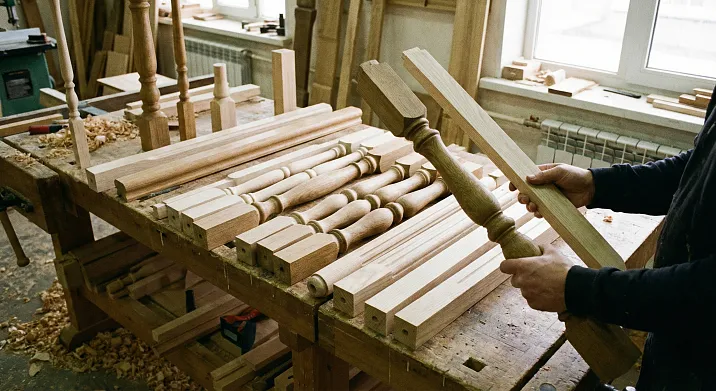
A staircase without a railing is a risk, inconvenience, incompleteness. But it's worth installingWooden balusters— and the structure gains safety, architectural logic, and visual rhythm. Balusters are not just vertical posts between steps and a handrail, but elements that set the style for the entire staircase. Turned ones create classic elegance, carved ones create Baroque luxury, flat ones create geometric strictness. How to choose the right balusters? Which wood species will last for decades? How to calculate the quantity and safely install the system?





Anatomy of stair railing: balusters in the safety system
Stair railing is a structural system where each element plays a specific role.Handrails and balustersform a unified mechanism for fall protection, simultaneously serving as support during ascent and descent.
Baluster — a vertical railing element installed between steps and handrail. The height of a standard baluster is 700-900 millimeters, which corresponds to the normative height of handrail railing according to building codes. The cross-section is round with a diameter of 40-70 millimeters or square 40×40, 50×50, 60×60 millimeters for turned balusters. Flat balusters have a rectangular cross-section 80-120 millimeters in width with a thickness of 20-30 millimeters.
Handrail — a horizontal element on which the hand rests. The cross-section is round with a diameter of 40-50 millimeters or rectangular with rounded edges. The handrail is attached to the balusters from above, forming a continuous line along the entire length of the flight. The material of the handrail must match the balusters in species and finish for visual unity.
Support posts — reinforced balusters of increased cross-section 80×80, 100×100 millimeters, installed at the starting and ending points of the flight, as well as at staircase turns. The posts take the main load from horizontal pressure on the handrail, distributing it to the load-bearing structure of the staircase. The height of the post matches the height of the balusters or exceeds it by 100-200 millimeters, forming accent points.
Baluster base rail — a horizontal plank installed between steps and balusters, serving as a base for attaching balusters. Cross-section 40×60, 50×80 millimeters. The baluster base rail creates an even base for installing balusters on steps of different widths, conceals fastening elements, and enhances the rigidity of the structure.
The system works as follows: vertical load from the weight of a person leaning on the handrail is transferred through the balusters to the steps. Horizontal load from pressure or impact on the railing is absorbed by the support posts, secured in the load-bearing elements of the staircase. Balusters installed with a spacing of 100-150 millimeters create solid infill, preventing slipping between the posts. This is critical for child safety.




Turned Balusters: Symmetry of Lathe Work
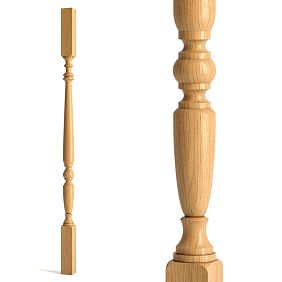
Turned balusters are created on a lathe from a cylindrical blank. The blank is secured in the machine's spindle, rotates at high speed, and a cutting tool removes material, forming the profile. Modern production uses CNC (Computer Numerical Control) machines, ensuring the identicality of hundreds of balusters from one program.
The profile of a turned baluster includes a base, body, neck, and capital. The base is the expanded lower part, 80-120 millimeters high, providing stability. Its shape is cylindrical or conical, often with decorative flutes. The body is the central part, 400-600 millimeters high, containing the main decoration. Forms are varied: column balusters with a straight cylinder, spindle balusters with a spindle-shaped thickening in the center, vase balusters with a vase-like expansion, and candle balusters with a smooth taper from the center to the edges.
The neck is a narrow transition zone between the body and the capital, 50-80 millimeters high. It is often decorated with ring grooves. The capital is the upper part, 80-120 millimeters high, onto which the handrail is attached. Its shape corresponds to the base for symmetry.
Decorative elements of turned balusters: beads — cylindrical thickenings; coves — concave transitions between beads; astragals — narrow protruding rings; flutes — vertical grooves repeated around the circumference. The number of flutes is 8-16, with a depth of 3-5 millimeters. Flutes create a play of light and shadow on the round surface, visually lightening a massive baluster.
Turned balusters are stylistically universal. Simple profiles with 2-3 elements (cylinder-ball-cylinder) suit modern minimalist interiors. Complex profiles with 8-10 elements and flutes correspond to the classical style. Pear-shaped forms with smooth transitions are characteristic of Art Nouveau.
Our factory also produces:



Carved Balusters: Three-Dimensional Sculpture on a Vertical
Carved balusters differ from turned ones by the presence of relief decoration created by milling. The technology is combined: first, a basic profile is turned on a lathe, then an ornament is cut on a CNC milling machine.
The ornament of carved balusters includes plant motifs — acanthus leaves, grapevines, oak leaves, flowers. Geometric motifs — diamonds, scrolls, meanders, interlace. Figurative motifs — masks, putti, heraldic elements. The carving depth is 5-15 millimeters, creating expressive relief with clear shadows.
The acanthus leaf is a classic motif borrowed from ancient architecture. Acanthus leaves with serrated edges are arranged spirally around the baluster body, creating a dynamic composition. The number of leaves ranges from two large to ten small. The carving is multi-level — the main plane of the leaf, veins, and serrated edges are at different depths, forming volume.
Grapevine — decoration in Baroque and Renaissance styles. Winding branches with leaves and clusters wrap around the baluster in a spiral. Clusters are made as separate balls 8-12 millimeters in diameter, creating fine detailing. Leaves with veins and serrated edges complement the composition.
Spiral carving — helical grooves twisting around the baluster at a 30-45 degree angle. The number of turns is 3-5 over the entire height. Groove width is 20-40 millimeters, depth 10-15 millimeters. The spiral can be left- or right-handed. For symmetry on a staircase, balusters with oppositely directed spirals are used, alternating every other one.
Carved balusters are heavier than turned ones due to more material — carving adds volume. The weight of a carved oak baluster 900 millimeters high reaches 2.5-3 kilograms compared to 1.5-2 kilograms for a turned one. This is considered when calculating the load on steps and fasteners.
Get Consultation
Flat Balusters: Slavic Tradition in Modern Execution
Flat balustersFlat balusters have a rectangular cross-section, 80-120 millimeters wide and 20-30 millimeters thick. This is a traditional element of wooden architecture, characteristic of Russian terems, Ukrainian huts, and Scandinavian houses. In modern architecture, flat balusters are used to create ethnic flavor or geometrically strict railings.
The advantage of flat balusters is a larger area for decoration. A front plane 100 millimeters wide and 700 millimeters high provides 700 square centimeters for placing an ornament. This allows for creating complex compositions with geometric or plant motifs.
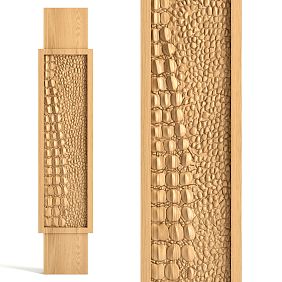
Geometric ornament of flat balusters includes diamonds intersecting at different angles, circles of varying diameters (concentric or offset), rectangles forming stepped shapes, solar symbols — stylized suns with rays. The ornament is created by milling to a depth of 3-8 millimeters. The contrast between the recessed background and the protruding pattern is readable from a distance of 3-5 meters, which is important for staircases in halls.
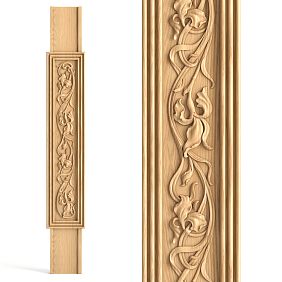
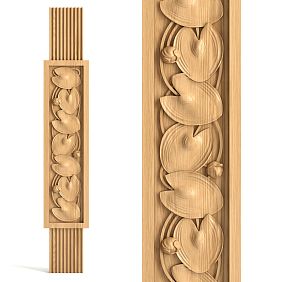
Plant ornament — stylized flowers, leaves, branches, executed in flat carving. Characteristic of the Art Nouveau style, where the fluidity of lines and organic forms are important. Flowers with curved stems and asymmetrical petals create a composition where each baluster is unique, but together they form a harmonious system.
Structurally, flat balusters are installed with their wide side parallel to the flight, i.e., perpendicular to the direction of movement. This creates a solid visual wall when viewed along the staircase. To enhance the effect, balusters are installed close to each other without gaps or with a minimal gap of 5-10 millimeters. Such a railing maximally closes the space under the handrail, ensuring safety for children.
Alternative placement — with the wide side perpendicular to the flight. Balusters are visible from the side when ascending the stairs; the ornament on the front plane is only readable from side positions. This creates a light railing with large gaps between balusters, visually not cluttering the space.
Wood Species for Balusters: Physics and Aesthetics
The choice of species determines the strength, durability, and decorative quality of balusters.wooden balusters for staircasesBalusters are made from species that combine the necessary hardness with workability.
Oak — the benchmark of strength among hardwoods. A density of 700 kilograms per cubic meter ensures resistance to impact, dents, and wear. Brinell hardness of 3.7 units — one of the highest among European species. Oak balusters withstand intensive use for decades without losing shape. Oak grain is expressive with contrasting annual rings and medullary rays, creating silvery sparkles on a radial cut. Color varies from light golden to dark brown depending on the wood's origin. Oak darkens over the years, acquiring a noble patina. Disadvantage — high hardness complicates carving; carved oak balusters are 30-50 percent more expensive than turned ones.
Beech — an alternative to oak with a density of 650 kg/m³ and a Brinell hardness of 3.8 units, even higher than oak. The grain is fine, uniform, without sharp transitions. Beech balusters create a calm background where form is more important than wood grain. Color is light with a pinkish or yellowish tint. Beech is easier to work than oak; carving is sharper. Disadvantage — hygroscopicity. Beech reacts actively to humidity, swelling in damp environments and shrinking in dry ones. For staircases in homes with unstable microclimates, beech is a risky choice. For heated spaces with stable humidity of 40-60 percent, beech is ideal.
Ash combines the strength of oak and elasticity. Density 680 kg/m³, Brinell hardness 4.0 units — the maximum among European hardwoods. The grain is bright with clear annual rings, color light with a grayish or yellowish tint. Ash bends well after steaming, used for creating curved handrails. Ash balusters are stronger than beech, more resistant to moisture, lighter than oak. Disadvantage — less common, price 10-20 percent higher than oak.
Pine — a budget option for painted structures. Density 500 kg/m³, hardness 2.5 units — one and a half times less than oak. Pine balusters are soft, prone to dents from impacts and scratches. The grain is contrasting with wide annual rings and resin pockets. For transparent finishes, pine looks mottled; resin pockets create dark spots. Pine balusters are used under opaque enamel paint that hides the grain. Advantage — low price, 2-3 times cheaper than oak, ease of processing, wide availability.
Calculating the Number of Balusters: Norms and Formulas
How many balusters are required for a staircase? The calculation is based on safety norms and aesthetic proportions.
Building codes regulate a maximum distance of 150 millimeters between vertical railing elements. This prevents children from slipping between balusters. The formula used for calculation is: number of balusters per linear meter = 1000 / (baluster width + gap).
For balusters with a cross-section of 50 millimeters and a gap of 100 millimeters: 1000 / (50+100) = 6.7 pieces per meter. Round up to 7 pieces. A flight length of 4 meters requires 7×4=28 balusters.
Alternative method — calculation based on the number of steps. The classic scheme is two balusters per step, installed at the edges of the tread. This creates a visually balanced composition where each step is framed by a pair of balusters. A staircase with 15 steps requires 15×2=30 balusters.
For wide flights over 1200 millimeters wide, a third baluster is added in the center of each step, doubling the quantity. A staircase with 15 steps requires 15×3=45 balusters.
Support posts are counted separately. Minimum two posts — starting and ending. For staircases with turns, a post is added for each turn. An L-shaped staircase requires three posts, a U-shaped one — four. Posts replace balusters at their installation points, accordingly the number of balusters is reduced by the number of posts.
Allowance for defects and cutting is 10 percent of the calculated quantity. For 30 balusters, order 33 pieces.
Baluster fastening: technologies for reliable installation
The quality of fastening determines the safety of the railing. There are several methods, differing in complexity and reliability.
Fastening with dowels — a traditional joinery method. A blind hole 10-12 millimeters in diameter and 30-40 millimeters deep is drilled into the lower end of the baluster. A corresponding hole of the same depth is drilled into the step. A wooden dowel 10 millimeters in diameter and 60 millimeters long is inserted halfway into the baluster and halfway into the step. The joint is glued with PVA wood glue. Similarly, the baluster is fastened to the handrail at the top. The method provides a rigid connection without visible fasteners. Disadvantage — labor-intensive, requires precise drilling of vertical holes.
Fastening with threaded rods — a modern method using a metal threaded rod. A rod 8-10 millimeters in diameter and 80-100 millimeters long is screwed into the lower end of the baluster to a depth of 40-50 millimeters, the protruding part enters the step. A hole 8 millimeters in diameter and 40-50 millimeters deep is drilled into the step. The rod is screwed through the baluster into the step, tightening the connection. The method is faster than dowels, provides a stronger connection. Disadvantage — visible rod head on the baluster end, requiring a decorative plug.
Fastening to a sub-baluster — a method for complex cases when balusters are installed on an inclined stringer. A sub-baluster with a cross-section of 50×80 millimeters is fastened to the stringer with screws at 300-millimeter intervals. The upper edge of the sub-baluster is horizontal, the lower one follows the slope of the stringer, for which the sub-baluster is cut at an angle equal to the flight's incline. Balusters are fastened to the horizontal edge of the sub-baluster with rods or dowels. The method creates a level base for balusters, hides fasteners, and strengthens the structure.
Fastening support posts requires a reinforced method due to high loads. The post is installed on a stringer or string, fastened with a through bolt 12-16 millimeters in diameter. The bolt passes through the post and the load-bearing beam, tightening them with a nut from below. For wooden structures, a bolt with a square head is used, countersunk into the wood. For metal stringers — a bolt with a hexagonal head. Additionally, the post is fixed with a metal angle bracket, screwed to the post and stringer with self-tapping screws.
Finishing of balusters: protection and decorativeness
Untreated wood of balusters is vulnerable to dirt, wear, and moisture. A finish protects and reveals decorative qualities.
Oil with hard wax — the optimal choice for balusters. Oil penetrates the structure, strengthening the surface layer from within. Wax fills pores, creating a protective barrier against dirt and moisture. The coating is breathable — wood retains the ability to regulate humidity, which is critical for preventing deformations. Tactilely, an oiled surface is warm, pleasant to the hand on the handrail. Application in 2-3 coats with a brush or cloth. The first coat absorbs in 6-8 hours, the surface is sanded with 320-400 grit abrasive to remove raised fibers. The second and third coats are applied at 12-hour intervals. Full drying 48 hours. Renewal every 3-5 years.
Varnish creates a hard film on the surface. Polyurethane varnish provides high resistance to wear, scratches, and moisture. For balusters, matte or semi-matte is recommended — gloss creates glare and makes fingerprints noticeable. Application in 3 coats with a brush or spray gun. The first coat — primer, diluted with 10 percent solvent for better penetration. After drying for 4-6 hours, the surface is sanded with 320 grit abrasive. The second and third coats — finish, undiluted. Interval between coats 6-8 hours. Full curing 7 days. Durability 10-15 years.
Paint conceals the grain, creating any colors. For balusters, acrylic enamel on a water basis is used — eco-friendly, odorless, fast-drying. Primer is mandatory to equalize absorbency and improve adhesion. White acrylic primer is applied in one coat, dries in 2-4 hours, sanded with 240 grit abrasive. Paint is applied in 2 coats at 4-6 hour intervals. Color can be matte or semi-matte. To create an aged effect, patination is used — applying dark patina into carving recesses followed by polishing the raised areas. This creates contrast, emphasizing the relief.
Staining with wood stains changes the wood color while preserving the grain. Stains on water, alcohol, or oil bases penetrate the wood, coloring it in various shades from light golden to dark brown or black. Before staining, the baluster is sanded with 180-240 grit abrasive. Stain is applied with a brush or cloth in 1-2 coats. Interval between coats 4-12 hours depending on the stain base. After drying, the surface is coated with varnish or oil for protection.
Baluster styles: from Baroque to minimalism
The style of balusters should correspond to the house architecture and the interior of the room where the staircase is located.
Classicism requires balusters with clear profiles, symmetrical forms, restrained decor. Turned balusters with shafts, coves, astragals without excesses. Column or spindle shape with smooth transitions. Fluting is acceptable but shallow. Color natural wood under clear varnish or oil. Support posts with capitals in Doric or Ionic orders. Handrail round 50 millimeters in diameter with a smooth polished surface.
Baroque loves carved balusters with lush decor. Acanthus leaves, grape clusters, scrolls, masks. Shape complex with many protrusions and recesses. Carving deep 10-15 millimeters, multi-level. Color golden with patination of recesses in dark tones or full gilding. Support posts massive with carved capitals and bases. Handrail curved, repeating S-shaped forms.
Modern uses balusters with organic flowing forms. Turned balusters vase-shaped with smooth transitions without sharp angles. Carved balusters with plant motifs — irises, lilies, stylized branches. Asymmetry is welcome — each baluster can be unique. Color natural wood or stained in dark shades. Handrail curvilinear, curved in three planes.
Art Deco requires geometric balusters with clear stepped forms. Flat balusters with patterns of rhombuses, zigzags, sun rays. Turned balusters with sharp alternation of cylinders and cones. Color contrasting — ebony with white inserts, or vice versa. Support posts of rectangular cross-section with geometric carving. Handrail of rectangular cross-section with rounded edges.
Contemporary minimalism uses simplest balusters. Square 40×40 or 50×50 millimeters without decor, straight, smooth. Round 40 millimeters in diameter without turnings. Color white or natural light wood. Support posts of the same cross-section as balusters, without distinction. Handrail rectangular 40×60 millimeters with rounded edges.
Frequently Asked Questions
Can balusters of different shapes be combined on one staircase?
Yes, alternation creates rhythm. Classic scheme — carved balusters at intervals of every two or three turned ones. The carved baluster becomes an accent, the turned ones — background. It is important to maintain unity in height, cross-section, wood species, and finish. Heterogeneous balusters create chaos, not composition.
What distance between balusters is safe for children?
Building codes set a maximum of 150 millimeters between baluster axes. For families with small children, it is recommended to reduce to 100-120 millimeters. Alternative — solid infill with flat balusters without gaps or installation of additional horizontal slats between balusters.
Is it necessary to treat balusters with antiseptics before installation?
For interior staircases in heated rooms, antiseptic treatment is optional — conditions are unfavorable for fungus and insects. For staircases on open terraces, verandas, unheated rooms, antiseptic treatment is mandatory. Deep-penetration impregnations are used, applied in 2 coats at 12-hour intervals before finishing.
How much do wooden balusters cost?
The price depends on the wood species, complexity of processing, and size. A simple turned pine baluster 900 millimeters high costs 300-500 rubles. A turned oak baluster costs 1500-2500 rubles. A carved oak baluster with acanthus decoration costs 4000-8000 rubles. A flat baluster with milled ornamentation costs 2500-5000 rubles. To the cost of balusters, add support posts at 3000-10000 rubles, a handrail at 1500-3000 rubles per linear meter, and fasteners at 100-300 rubles per baluster.
Can balusters be installed without experience?
Yes, if you have the tools and precision. Critical factors are vertical installation, uniform spacing, and secure fastening. Start with a simple method—fastening with studs and pre-drilled holes. Use templates to mark holes at equal distances. Check the vertical alignment of each baluster with a level. For your first staircase, it is recommended to invite a master for supervision.
How to care for wooden balusters?
Regular dry cleaning—removing dust with a soft cloth or a brush with soft bristles for carved elements. Once a month—damp cleaning with a slightly moist cloth without excess water. For oiled balusters—refreshing the oil every 3-5 years with light sanding using 320-grit abrasive and applying a fresh coat. For varnished ones—monitoring the integrity of the coating, local restoration if wear appears.
What is the optimal height for balusters?
Building codes set a railing height of 900 millimeters for residential buildings, 1100 millimeters for children's institutions. The baluster height equals the railing height minus the handrail thickness. For a 50-millimeter handrail, the baluster is 850 millimeters. For the comfort of tall people, an increase up to 1000 millimeters is permissible.
Can balusters be used on open terraces?
Yes, but with limitations. Wood outdoors is exposed to ultraviolet light, rain, and temperature fluctuations. Durable species are required—oak, larch, thermally modified wood. Protective treatment with exterior oil containing UV filters or yacht varnish is mandatory. Renew the coating annually. An alternative is wood-polymer composite balusters that imitate wood but do not require treatment.
How long does it take to install balusters on a staircase?
For a standard straight flight with 15 steps and 30 balusters, an experienced master spends 6-8 hours on marking, drilling, installing balusters, and the handrail. For a staircase with turns and complex joints, the time increases to 10-12 hours. For a beginner, plan for twice as much time.
Is a baluster rail needed on staircases?
It depends on the construction. On staircases with a stringer, where balusters are attached directly to the steps, a baluster rail is not mandatory. On staircases with a stringer (closed side), where balusters are installed on an inclined surface, a baluster rail creates a horizontal base and is necessary. The baluster rail also improves appearance by hiding fasteners and aligning the composition.
Conclusion: The staircase element system from STAVROS
A staircase is a structurally complex structure where safety depends on the quality of each element. Balusters, support posts, and handrails must be not only beautiful but also strong, correctly installed, and compatible with each other. The company STAVROS has specialized in manufacturing wooden staircase components for over twenty years, offering a full range of elements from a single source.
The STAVROS catalog features over 50 models of balusters made from solid oak, beech, ash—from simple turned ones to carved masterpieces with multi-level carving. Each baluster is manufactured on modern CNC lathes and milling machines, ensuring perfect geometry and profile repeatability. Wood dried to an optimal moisture content of 8-10 percent guarantees no deformation after installation.
STAVROS offers balusters with various levels of processing. The 'Standard' category includes machine sanding with 180-grit abrasive, ready for finishing. The 'Prestige' category—detailed hand sanding with 240-320 grit abrasive, polishing of protruding elements, products require no additional work before coating application. Supply of balusters with finishing—oil, varnish, paint in any color from the RAL catalog—is possible.
Additionally, STAVROS manufactures all necessary elements for staircase assembly: support posts of various sizes and styles, handrails—round with a diameter of 40-50 millimeters and rectangular with rounded edges, baluster rails, treads, risers, stringers, and carriage pieces. Purchasing all elements from one manufacturer guarantees compatibility in wood species, shade, processing quality, and stylistic unity.
STAVROS works with both professionals—architects, construction companies, carpentry workshops—and private customers building homes independently. Technical support includes consultations on selecting balusters according to interior style, calculating the required number of elements, recommendations on fasteners and finishing, and developing 3D visualizations for preliminary result assessment.
Delivery throughout Russia and CIS countries is carried out by transport companies with careful packaging. Balusters are individually packed in corrugated cardboard, carved elements are additionally protected with bubble wrap. Long elements—handrails, posts—are secured on rigid backings to prevent bending during transportation. Self-pickup is available from warehouses in Moscow and St. Petersburg.
Choosing STAVROS products means choosing safety, confirmed by years of operation of thousands of staircases. These are balusters that withstand regulatory loads, do not deform, do not crack, and retain decorative qualities for decades. This is a comprehensive solution where every element is created to work together in a unified system. This is the choice of those who understand that a staircase is an investment in family safety, not a place to save on quality.


