Article Contents:
- Wooden Balusters: Vertical Foundation of Architectural Composition
- Wooden Slats in Interior: From Decoration to Functional Zoning
- Slatted Partition: A Transparent Wall That Doesn't Divide, But Unites
- Between the Living Room and Dining Room
- Between Bedroom and Wardrobe
- In the Entryway for Zoning the Entrance Area
- To Highlight a Work Zone in a Studio
- Playing with Verticals: How Balusters and Slats Work Together
- Materials: Which Wood to Choose for Vertical Elements
- Oak: The King of Strength and Expressiveness
- Ash: A Light Alternative with Flexibility
- Beech: Density and Uniformity for Turned Forms
- Larch: Moisture Resistance for Special Conditions
- MDF: Budget Alternative for Painting
- Structural Solutions: How to Install Balusters and Slats
- Installing Balusters: Precision and Reliability
- Installing Slatted Structures: Load-Bearing Base and Mounting
- Final Finish: How to Emphasize Texture or Create Color
- Oil: Natural Texture in Full Expression
- Wax: Matte Elegance
- Lacquer: Protection and Shine
- Paint: Color Instead of Texture
- Brushing: Accentuated Relief
- Lighting Verticals: How Light Enhances the Effect
- Lighting Stairs with Balusters
- Lighting Slatted Structures
- Stylistic Scenarios: From Scandinavian Minimalism to Biophilic Maximalism
- Scandinavian minimalism
- Biophilic design
- Modern classicism
- Loft
- Japanese Minimalism
- Ecology and Sustainability: Wood as a Responsible Choice
- Mistakes to avoid
- Inconsistent Elements
- Incorrect Spacing Between Elements
- Savings on mounting
- Ignoring Microclimate
- Lack of Protective Coating
- Trends 2026: Where Vertical Elements Are Headed
- Technology integration
- Kinetic elements
- Material Mixing
- Customization
- Minimization and Lightness
- Questions and Answers
- Company STAVROS: Full Spectrum of Solutions for Vertical Interior Elements
Vertical is not just a direction in space. It is a visual force capable of changing the perception of a room, raising the ceiling, dividing the area into functional zones without erecting solid walls. In 2026, designers are rediscovering a forgotten truth: vertical elements create dynamics, air, rhythm. If verticality was once associated exclusively with staircases and their railings, today we witness a revolution — wooden balusters extend beyond staircases, and wooden slats on walls become a full-fledged architectural zoning tool.
What happens when these two elements begin to work together in a single space? A new language of interior design is born, where verticality becomes the main protagonist. Balusters set the rhythm on the staircase, slats continue this rhythm on walls and partitions. A visual rhyme emerges, uniting scattered zones into a cohesive composition. Wood becomes the connecting thread between levels, functions, and spaces.


Wooden Balusters: Vertical Foundation of Architectural Composition
Let’s start with the fact thatwooden balusters for staircases 2026are undergoing a period of reevaluation. These are no longer just functional posts serving as safety barriers during ascent and descent. Today, balusters become sculptural elements defining the visual concept of the entire interior. Their shape, density of placement, wood species, and finish — all of this influences how the space is perceived.
Simple balusters with square or rectangular cross-sections — minimalist posts without ornamentation — fit perfectly into modern interiors where clean lines and simplicity of form are valued. Their beauty lies in the texture of the wood itself: oak displays powerful annual rings, ash reveals delicate wavy patterns, walnut offers a warm chocolate depth. When such balusters are installed at a small spacing — every ten to fifteen centimeters — they create a frequent vertical rhythm, similar to the strings of a musical instrument.
Turned balusters with classic profiles offer a different aesthetic. Here, the form becomes more complex: there are transitions, expansions, spheres, cones. Each baluster transforms into a miniature architectural column with its own base and capital. This solution suits interiors where classical tradition meets modern materials and layouts. Turned balusters made of beech or ash, finished with natural oil, preserve natural warmth while demonstrating respect for form.
Carved balusters — the pinnacle of craftsmanship. When wood transforms into acanthus leaf lace, botanical garlands, geometric ornaments, the staircase ceases to be a utilitarian object and becomes a sculptural installation. Carved elements require dense woods — oak, walnut — capable of holding delicate details without chipping. Each baluster is the result of precise calculation, 3D milling technology, or hand-carving by a craftsman.
But the main discovery of 2026 is that balusters are no longer limited to staircases. Designers use them as architectural accents in other zones: balusters can frame a second light in the living room, form a railing for an attic floor, create decorative lattices in interior windows between rooms. The vertical rhythm established on the staircase continues throughout the space, creating a unified visual system.




Wooden Slats in Interior: From Decoration to Functional Zoning
If balusters — are vertical structural elements, bearing load and ensuring safety, thenwooden planks on the wall— are vertical decorative and zoning elements. Slats do not hold anything except for the gaze. But precisely this makes them such a powerful tool in the hands of a designer.
Wooden slats are narrow boards made of solid wood or MDF, mounted on walls or assembled into freestanding structures with a specific spacing, creating a rhythmic surface alternating wood and gaps. The thickness of the slat typically varies from twenty to fifty millimeters, width from thirty to one hundred, and spacing between slats from twenty to one hundred millimeters depending on desired density and visual effect.
Why have slats become so popular? Because they solve several tasks simultaneously.
First, they create an accent surface. A wall clad with vertical slats instantly becomes the focal point of the room. The play of light and shadow between the boards adds depth, texture, visual interest. Such a wall never appears flat or dull — it lives, changes depending on lighting and viewing angle.
Second, slats visually correct the proportions of space. Vertical boards elongate the room upward, making the ceiling appear higher. This is especially valuable in rooms with standard height of two meters sixty to two meters seventy, where every visual trick adding verticality improves overall perception.
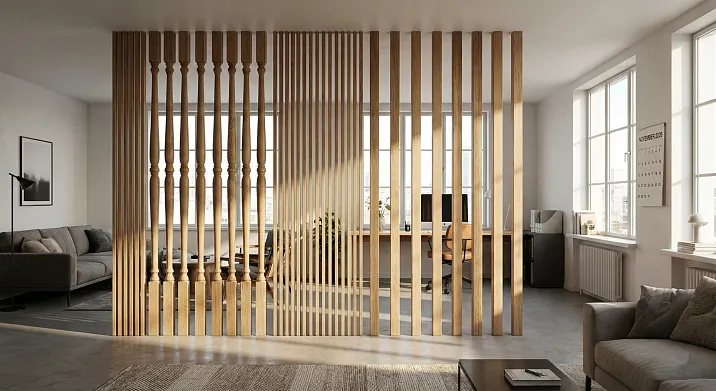
Third, and this is key — slats zone space without blocking light and air. A slatted partition between the living room and dining room, between the bedroom and closet, between the entryway and hallway creates a psychological boundary, marking a transition from one functional zone to another, while maintaining visual continuity and a sense of openness. You can see what lies beyond the partition, light passes through the gaps, space breathes.
Slats hide what needs to be hidden. Uneven walls, utilities, radiators — all of this can be masked by slatted cladding, which simultaneously becomes a decorative element. Special slats with horizontal grooves allow organizing radiator ventilation without compromising aesthetics.
Wooden slats in interior work on an emotional level. Natural wood texture, natural tones, tactile warmth create a connection with nature — that very biophilic effect which modern people instinctively seek in their homes. Touching the slatted surface with your hand, you feel the material’s organic nature, its liveliness.
Our factory also produces:


Slatted Partition: A Transparent Wall That Does Not Divide, But Unites
A slatted partition is a conceptual breakthrough in organizing living space. A traditional wall creates two isolated rooms. Glazing — visually unites, but physically separates. A slatted construction is in between: it marks a boundary, but leaves permeability — visual, light, acoustic (to a lesser extent), emotional.
Where and how does a slatted partition work?
Get Consultation
Between the living room and dining room
Classic scenario of an open-plan layout. Two spaces are functionally connected, but require visual separation. A slatted partition, installed perpendicular to the wall or as a G-shaped element, creates a suggestion of a boundary. The dining area gains its intimacy, yet remains part of the overall space. Light from the living room windows penetrates into the dining room through the slats, creating dynamic patterns on the floor and furniture.
Between bedroom and closet
In the hallway for zoning the entry area
In the hallway for zoning the entry area
The entrance door often opens directly into the living room or hallway, and one wants to create a buffer zone. A slatted partition installed parallel to the entrance at a distance of one and a half to two meters forms a hallway without turning it into a dark alcove. Behind the partition, you can place an integrated coat closet, and the slats will hide it from direct view from the threshold.
To highlight a work zone in a studio
When an apartment-studio requires organizing a home office, a slatted partition helps psychologically separate the workspace from the relaxation zone. You sit down at the desk — and the partition creates a focus, limits the field of vision, helps concentrate. You stand up — and the space again feels like a single whole.
Important nuance: the density of the slatted partition affects the degree of isolation. Wide slats with narrow gaps create almost a solid wall, which works as a visual barrier. Narrow slats with wide gaps — the most transparent construction, more of a hint at a boundary than a real division. The golden middle — slats forty millimeters wide with gaps forty-five millimeters wide. This provides a balance between transparency and structure.
Playing with verticals: how balusters and slats work together
When both balusters and wooden slats are present in one interior, a visual rhyme emerges. Two types of vertical elements — structural and decorative — begin a dialogue, reinforcing each other.
Imagine a two-level apartment or country house with a staircase in the center of the living area. The staircase is enclosed by oak balusters — simple, square-sectioned, installed at ten-centimeter intervals. Their rhythm is clear and persistent. Ascending to the second level, you enter a hall with mezzanine, where the enclosure is also made of the same balusters. The vertical rhythm continues.
Descending back, you see that the wall perpendicular to the staircase is clad in wooden slats of the same oak, same width (forty millimeters), same spacing. Visually, the balusters of the staircase and the slats on the wall are perceived as a single system. The staircase seems to 'dissolve' into the wall, becoming its continuation. The vertical rhythm does not break, but smoothly transitions from one element to another.
Further: between the living room and kitchen, a slatted partition is installed. The same oak planks, the same oil finish. The partition does not reach the ceiling by fifty centimeters, leaving an air cushion through which utilities and light pass. But visually, it continues the vertical theme established by the staircase.
What happens in perception? The space is read as a single whole, despite the division into zones. Wood becomes a unifying fabric, vertical lines — a visual metronome that sets the rhythm for the entire interior. The eye easily glides from balusters to slats, from staircase to walls, from one level to another. There is no dissonance, no breaks. There is wholeness.
It is important to follow several principles to make this play of verticals work.
Material unity — balusters and slats must be made of the same wood species or, at least, similar in color and texture. Oak balusters and slats of light-colored pine will create a conflict.
Consistent finish — if balusters are oiled to highlight the texture, slats should also be oiled, not glossy lacquered. If balusters are painted matte black, slats may be painted the same shade.
Proportional elements — massive balusters with a fifty-by-fifty millimeter cross-section require similarly large slats. Elegant balusters thirty-by-thirty millimeters pair better with delicate slats of similar thickness.
Rhythmic connection — it is not necessary for the baluster spacing to exactly match the slat spacing, but it is desirable for there to be a multiple relationship. If balusters are spaced ten centimeters apart, slats may be spaced twenty or forty — this creates visual kinship.
Materials: which wood to choose for vertical elements
The choice of wood species critically affects the durability, visual qualities, and cost of the project.
Oak: king of strength and expressiveness
Oak is the first choice for interiors where durability and respectability are important. Its dense structure withstands mechanical loads, which is critical for balusters subjected to constant stress from staircase use. The oak texture is expressive: large annual rings, open pores that beautifully reveal themselves with oiling or brushing.
Oak's color palette is wide — from light, almost white, to dark, stained, which takes on chocolate and graphite shades. This allows oak elements to fit almost any style — from Scandinavian minimalism to classic and loft.
Oak balusters and slats are an investment in the long-term future. With proper treatment and care, they serve for decades, becoming even more beautiful — the wood darkens, develops a noble patina, accumulates the history of the house.
Ash: a light alternative with flexibility
Ash is comparable to oak in strength, but has a lighter, almost cream-colored tone and delicate wavy texture. This is a choice for interiors where one wants to preserve the naturalness of wood, but avoid the heaviness of dark tones.
Ash balusters and slats work perfectly in Scandinavian interiors, in modern spaces with large windows where there is plenty of natural light. Ash does not 'absorb' light, does not make rooms darker — on the contrary, it reflects it, creating a sense of lightness.
Ash's important advantage is the flexibility of its fibers. This allows creating balusters of complex curved forms without the risk of cracking. For slatted constructions, this is less critical, but still provides additional technological freedom.
Beech: density and uniformity for turned forms
Beech is a choice for those who want the quality of oak at a more affordable price. Beech wood is dense, uniform, with a fine-grained structure without a pronounced pattern. This makes it ideal for turned balusters with numerous details — every transition, every sphere turns out perfectly symmetrical.
Beech has a warm rose-beige color that easily takes on any shade. Beech balusters are often stained because their texture is not as pronounced as that of oak or ash. Under paint or stain, beech shows a smooth, even surface without knots or irregularities.
Larch: moisture resistance for special conditions
For rooms with high humidity — bathrooms, saunas, houses near water — larch becomes the optimal choice. Its wood contains natural resins that make it resistant to rot and mold.
Larch has a striking texture with contrasting growth rings and a pleasant amber-golden hue. Larch balusters are suitable for outdoor staircases, terraces, and porches — places where oak or ash would require too intensive protection.
MDF: budget alternative for painting
When budget is limited or the concept involves painting elements in color, MDF becomes a sensible alternative to solid wood. MDF balusters cost three to four times less than wooden ones, are perfectly flat, have no knots or other defects, and are easy to paint.
It is important to understand limitations: MDF cannot withstand high mechanical loads, so it is not suitable for staircase balusters. However, for panel walls and partitions that do not bear loads, MDF is a fully functional solution.
Painted MDF balusters in modern interiors can look no worse than wooden ones, especially if a quality matte or satin paint is chosen. Black MDF panel walls are a popular choice for loft and minimalist interiors.
Construction solutions: how to install balusters and balusters
Even the highest quality materials lose their meaning with improper installation. Let's consider key technological aspects.
Installing balusters: precision and reliability
Balusters carry functional loads — they must withstand hand pressure, accidental impacts, and the weight of a person leaning on the handrail. Therefore, the mounting must be absolutely secure.
Classic method — dowel joint. Holes are drilled into the tread and end of the baluster to a depth of thirty to forty millimeters. A wooden dowel (cylindrical rod) coated with wood glue is inserted into the tread hole. The baluster is then mounted onto the dowel. Additionally, the baluster can be secured with a self-tapping screw inserted at an angle through the tread.
Alternative method — mounting on metal bolts. In this case, a threaded bolt is embedded in the tread, and a threaded hole is drilled into the lower end of the baluster. The baluster is screwed onto the bolt. This connection provides additional strength but requires precise marking and drilling.
The top end of the baluster is mounted to the handrail similarly — on a dowel or bolt. During installation, the vertical alignment of each baluster is critically important — checking with a construction level is mandatory. Even a slight tilt of one baluster will disrupt the visual rhythm of the entire row.
Installing panel structures: load-bearing base and mounting
Wooden balusters mounted on walls are installed on a subframe — a frame made of wooden beams or metal profile, fixed to the wall. The subframe runs horizontally with a spacing of forty to sixty centimeters. Balusters are attached to the subframe with self-tapping screws or clamps (hidden fasteners).
When installing with self-tapping screws, it is important to countersink the head and fill it with wood-colored putty to make the fasteners invisible. Clamps are a more elegant solution: they hold the baluster from the end, and the fasteners are completely hidden.
The spacing between balusters is set using temporary spacers — wooden blocks of the required thickness inserted between already installed and newly installed balusters. This ensures perfectly even spacing along the entire height of the wall.
Panel walls are installed differently. First, a frame is created — upper and lower horizontal beams to which vertical balusters are attached. If the wall is tall (more than two and a half meters), an additional horizontal beam is added for rigidity. The frame is mounted to the ceiling and floor (or only to the floor if the wall does not reach the ceiling). Balusters are installed on the frame with the specified spacing.
Important: panel structures must have technological gaps at the junctions with walls and ceilings to compensate for wood's thermal expansion. A five-millimeter gap on each side is the standard solution.
Finishing treatment: how to emphasize texture or create color
Wood requires protection and aesthetic finishing. The choice of finish affects visual qualities, tactile feel, and durability.
Oil: natural texture in its fullest expression
Oil finish absorbs into the wood, not forming a film on the surface. The texture remains visible and tactile, and the wood retains its warm touch. Oil enhances the grain of growth rings, makes the color more saturated, and adds depth.
The main advantage of oil is its repairability. Scratches and abrasions are easily removed by applying a new local layer without needing a complete redo. Oil can be refreshed once a year or every two years, simply by wiping the surface with a new layer.
The disadvantage is less protection against moisture and dirt compared to varnish. Oil is suitable for indoor spaces with normal microclimate.
Wax: matte elegance
Wax finish provides a matte silk-like surface, very pleasant to the touch. Wax creates a thin protective film but does not hide the texture. It is ideal for interiors where naturalness and lack of gloss are important.
Wax requires manual polishing after application — it is labor-intensive, but the result is worth it. Wax-coated balusters and balusters look like antiques, with a noble patina.
Finish: Protection and Shine
Finish creates a hard protective film that makes the surface resistant to water, scratches, and dirt. Finish can be glossy, satin, or matte. Glossy finish highlights color vibrancy but creates reflections that may not always be suitable. Matte finish is a compromise: protection is present, but no shine.
The drawback of finish is that damaged areas require full re-finishing, local repair is difficult. Finished wood loses some tactile quality — it feels more 'plastic' to the touch.
Paint: Color Instead of Texture
When the concept requires colored elements, wood is painted. The surface is first primed, then two to three layers of paint are applied. Paint completely hides the wood's texture — this is a loss of naturalness, but it gains graphic quality and the ability to precisely match color to the rest of the interior.
Painted balusters and rails are relevant in minimalist interiors, where clean lines and color are important rather than materiality. Black, white, gray, graphite — these shades make wooden elements part of modern aesthetics.
Brushing: Accentuated Relief
Brushing is a mechanical processing technique in which soft wood fibers are brushed out with a brush, while hard fibers remain, creating a pronounced relief. Brushed rails have a tactile texture — it's pleasant to run your hand over them, feeling the variations.
Brushing is especially effective on oak and ash, where the contrast between soft and hard layers is maximal. After brushing, the wood is stained or coated with oil, which emphasizes the depth of the relief.
Vertical Lighting: How Light Enhances the Effect
Vertical elements lose half their expressiveness without proper lighting. Light creates shadows, highlights relief, and reveals texture.
Staircase Baluster Lighting
Classic solution — wall-mounted spotlights along the staircase, directed at the balusters. Light at an angle creates rhythmic shadows from the balusters, which fall onto the steps, enhancing the vertical rhythm.
Modern alternative — LED strip embedded in the stair treads. Each step is illuminated from below, light passes through the balusters, creating a silhouette effect. This is not only beautiful but also functional — lighting ensures safety when descending in the dark.
Another technique — handrail lighting. LED strip embedded in the lower part of the handrail creates a glow that flows around the balusters, revealing their shape.
Lighting for Lattice Structures
A lattice wall reveals itself under side lighting. Wall-mounted lights placed beside the lattice surface cast a sliding light that passes between the rails, creating a play of light and shadow. Depending on the angle of light incidence, the pattern changes — in the morning, during the day, and in the evening, the wall appears differently.
For lattice partitions, backlit lighting — LED strip placed behind the partition. Light passes through the gaps between the rails, creating a glowing effect. The partition becomes a light object, especially impressive at night.
Important: the color temperature of the light should match the wood tone. Warm light (2700-3000K) emphasizes golden tones of oak and ash. Neutral light (4000K) works better with gray or cool tones of stained wood.
Stylistic Scenarios: From Scandinavian Minimalism to Biophilic Maximalism
How do balusters and rails work in different styles?
Scandinavian minimalism
Light wood (ash, birch, white oak), simple forms, minimal decoration. Square-section balusters, rails with wide gaps, oil finish. Color palette — white, light gray, natural wood. Emphasis on light, air, functionality.
Biophilic Design
Strong connection to nature through materials. Wood with pronounced texture, possibly brushed. Carved balusters with botanical motifs, rails from unplaned boards with preserved bark. Oil, wax — finishing coatings that leave wood 'alive'. Integration of plants — climbing along lattice partitions.
Modern classic
Turned balusters with classic profiles, but made from light wood and simplified forms. Rails on accent walls as a modern interpretation of wooden panels. Satin finish. Colors — natural or stained in noble tones (gray-brown, gray).
Loft
Massive balusters from dark wood (weathered oak, walnut), possibly with metal fasteners. Rails painted black or graphite. Contrast with brick walls, concrete surfaces. Emphasized industrial style combined with natural wood texture.
Japanese minimalism
Simple forms, natural materials, emptiness as part of the composition. Simple balusters, no decoration, made from light wood. Lattice partitions resembling shoji — with frequent thin slats creating a semi-transparent screen. Oil finish preserving the natural wood. Minimal furniture, maximum space.
Ecological and sustainable: wood as a responsible choice
In the era of ecological awareness, material selection becomes an ethical question. Wood is a renewable resource, but only with responsible forestry.
FSC (Forest Stewardship Council) certification guarantees that the wood comes from forests managed sustainably — logging is offset by replanting, ecosystems are preserved. When choosing wooden elements, look for products with such certifications.
Local species are preferable to exotic ones. Oak, ash, beech growing in your region require less transportation, support local economy, and are adapted to local climate.
Recycling and Second Life. Old wooden balusters and rails can be reused — restored, repainted, integrated into new projects. Wood does not lose value with age; instead, vintage elements are valued for patina and history.
First mistake - unstructured mixing. A classic chair, loft table, Scandinavian chest, and minimalist cabinet in one room is not eclecticism, but visual chaos. Each item draws attention to itself, not creating cohesion. A system, logic, unifying idea is needed. Choose one dominant style, add a second as an addition, and possibly a third as an accent. But no more than three, and all should have something in common - color, material, era, or functionality.
Inconsistent elements
Balusters from one species, rails from another, without color coordination. Result — visual chaos instead of harmony.
Incorrect spacing between elements
Too frequent rails create a grid-like, claustrophobic feeling. Too sparse — they lose structural integrity and appear random. Balusters with disrupted rhythm destroy the visual logic of the staircase.
Cutting corners on fastening
Unreliable baluster fastening creates a risk of injury. Rail structures on weak substructures sag, creak, and lose shape. Fastening — not a place for cost-cutting.
Ignoring microclimate
Wood reacts to humidity. Using regular oak in a bathroom without special treatment will cause swelling and deformation. Moisture-resistant species and coatings are required for humid zones.
Lack of Protective Coating
Untreated wood quickly gets dirty, darkens, and loses appearance. Oil, wax, or varnish are mandatory. Even for eco-style interiors, where one desires 'raw' wood, at least minimal protection is needed.
Trends 2026: Where is vertical element design headed?
Integration of technologies
Balusters and rails begin to perform additional functions. Built-in lighting, heated handrails, acoustic panels made of perforated rails concealing sound equipment. Wood retains its naturalness but acquires a technological dimension.
Kinetic elements
Rails that can be rotated to adjust the transparency of partitions. Adjustable wooden blinds that transform space with one movement. Dynamics instead of statics.
Material mixing
Wood and metal in one baluster — wooden body with metal inserts. Rails of wood and stone alternating in one plane. Hybrid solutions expanding visual possibilities.
Customization
Custom carved balusters according to client sketches. Rails with laser engraving creating patterns or inscriptions. Uniqueness becomes a value, mass production yields to customization.
Minimalism and lightness
Trend toward lightening structures. Balusters become thinner, rails narrower, gaps wider. Air and light are valued more than material density. 'Less is more' is more relevant than ever.
Questions and answers
Can lath partitions be used for sound insulation?
Partially. A lath structure reduces sound levels but does not fully isolate. To improve acoustics between rails, sound-absorbing material can be placed, but a lath partition will not provide full sound insulation.
How to care for wooden balusters and rails?
Regular dry cleaning with soft cloth once a week. Monthly wet wiping with slightly damp cloth. Avoid abrasive cleaners. Annually — renewing oil or wax for oil-based finishes.
What is the safe spacing between balusters for children?
Building codes recommend a distance no greater than ten to twelve centimeters to prevent a child from fitting their head between balusters. This is critical when designing stairs.
Can wooden rails be installed by oneself?
Yes, with basic tool-handling skills. Required: drill, screwdriver, level, tape measure, self-tapping screws. Mainly — accurate marking and maintaining spacing. For lath partitions, it’s better to hire a specialist, as frame assembly and ensuring structural rigidity are required.
How to choose the wood tone for balusters and rails?
Base your choice on the overall color palette of the interior. Light wood expands space and suits small rooms. Dark wood adds sophistication but requires good lighting. Staining allows you to tailor the wood to a specific palette.
Is special wood treatment needed for the kitchen?
Yes, the kitchen is a zone with high humidity and risk of contamination. It is recommended to varnish wooden elements with moisture-resistant varnish or use oil with added wax to enhance protection.
How to combine balusters and rails with other interior materials?
Wood is universal and combines well with most materials: stone (natural and artificial), metal (steel, brass, bronze), glass, textile. The key is to maintain balance: if there is a lot of wood, other materials should be used as accents.
Can wooden balusters and rails be painted in bright colors?
Technically — yes, it is possible. Stylistically — this is a risky decision that may quickly become outdated. If you still want color, it is better to choose complex muted shades (dusty blue, olive, terracotta) rather than pure bright colors.
STAVROS Company: full spectrum of solutions for vertical interior elements
Creating an interior wherebalusters and vertical accentsworks as a unified system requires not only designer vision but also access to high-quality materials and professional execution. STAVROS Company offers everything necessary to realize projects of any complexity.
STAVROS offers balusters made from solid wood of all types: from simple square to intricately carved. Turned balusters with classic profiles, milled with geometric patterns, carved with floral ornaments — each element is produced on high-precision equipment from carefully selected oak, ash, beech, and larch wood.
Wooden rails for walls and partitions are available in a wide range of sizes and finishes. Solid wood rails, MDF for painting, with various finish options — oil, wax, lacquer, in natural and tinted shades. Custom-section rails can be manufactured for specific projects.
A special direction — integrated solutions, where all elements — balusters, rails, handrails, moldings — are produced from the same batch of wood and with identical processing. This guarantees perfect color and texture matching for all interior details.
STAVROS Design Department helps calculate the required number of elements, select optimal sizes and spacing, and develop installation schemes. Consultations on wood species selection, finish treatment, and compatibility with other materials — all part of the company’s service.
In-house full-cycle production allows quality control at every stage — from wood selection to packaging of finished products. Each baluster and each rail undergoes multi-stage inspection to meet STAVROS’s high standards.
Warehouse program ensures prompt delivery of popular items. Delivery is organized across Russia with professional packaging, guaranteeing the safety of even long-length rails and delicate carved balusters.
STAVROS is a partner who understands the importance of details and quality execution. We don’t just sell materials — we help create interiors where every element is in its place, where verticals play, creating rhythm and harmony in space.
Choose solutions from STAVROS — and let your home be filled with the play of verticals, whereWooden balustersandWooden boards in interiorcreate modern zoning, not dividing but unifying space into a single whole!