Article Contents:
- Regulatory Basis: Foundation of Safety
- International safety standards
- Special requirements for different objects
- Calculation methodologies: accuracy as the basis of reliability
- Basic calculation formula
- Practical aspects of calculation
- Influence of materials on distance selection
- Wooden balusters: classic and variability
- Metallic structures: strength and lightness
- Glass and composite solutions
- Aesthetic Aspects of Placement
- Principles of visual perception
- Stylistic Features
- Technological Aspects of Installation
- Marking and positioning
- Methods of fastening and their influence on distance
- Special Cases and Non-Standard Solutions
- Helical and L-shaped Stairs
- Non-standard sizes and proportions
- Quality Control and Work Acceptance
- Methods of distance control
- Documentation of results
- Modern Trends and Innovations
- Digital technologies in design
- New materials and their influence
- Economic aspects of distance selection
- Cost Optimization
- Long-Term Economic Efficiency
- Conclusion
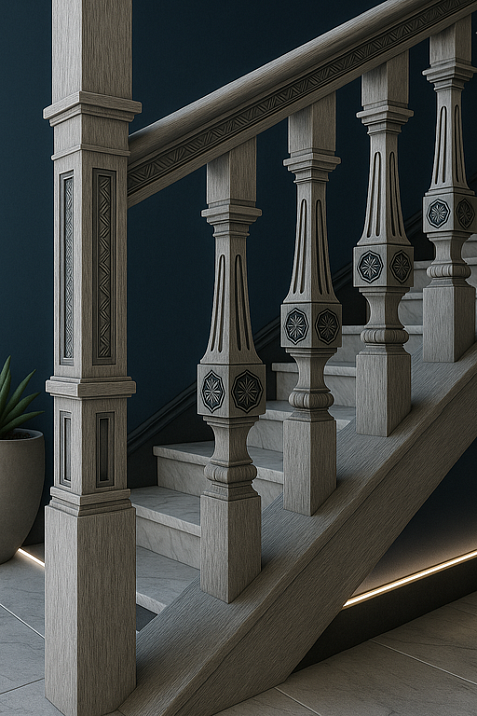
Safety of stair constructions begins with a correct understanding of how balusters should be installed to ensure maximum protection and visual harmony. This question concerns anyone planning to build or reconstruct a staircase, as the correct calculation not only ensures compliance with construction norms but also the safety of people who will use this structure daily. How far apart to install balusters
Imagine a staircase as a musical composition, where each baluster is a note, and the distance between them is the rhythm that creates either a harmonious melody or a dissonance. Too frequent placement turns the staircase into a fence, depriving it of elegance, while excessively sparse placement creates dangerous zones through which a child might slip or an adult might get stuck.
Modern construction norms and the long experience of craftsmen have established clear criteria that consider not only safety, but also ergonomics, aesthetics, and practicality of use. Understanding these principles will help create a staircase railing that becomes not just a functional element, but a true interior decoration.


Regulatory basis: foundation of safety
Construction norms and rules do not arise out of nowhere — they are based on careful analysis of accidents, studies of human anatomy, and long-term experience of building operation. When it comes to the distance between balusters, regulations become literally a matter of life and death.




International safety standards
The fundamental principle for determining the safe distance between balusters is based on so-called 'sphere rule'. According to international standards, a sphere with a diameter of 100 millimeters must not pass through the gap between adjacent railing elements. This figure is not arbitrary — it corresponds to the average head size of children aged 6 months to 2 years.
Russian SNiP set the maximum distance between balusters at 120 millimeters for residential buildings and 100 millimeters for children's institutions. These norms have been tested over time and have proven their effectiveness in preventing injuries.
European standards are even stricter — they require the distance not to exceed 110 millimeters in any public buildings. American standards set a limit of 4 inches (approximately 102 millimeters), which practically coincides with European requirements.
Our factory also produces:


Special requirements for different objects
Children's institutions require special attention to safety. Here, the maximum distance between balusters should not exceed 100 millimeters, and in some cases it is recommended to reduce it to 80-90 millimeters. This is due to children's increased activity and tendency to experiment.
Medical facilities and nursing homes also have specific requirements. People with limited mobility may use assistive devices — canes, crutches — which should not get stuck between balusters. Therefore, the distance is often limited to 110 millimeters.
Private homes offer more freedom in choosing distance, but safety should not be neglected here either. If there are small children in the family or if their arrival is planned, it is better to immediately set minimum distances.
Get Consultation
Calculation methodologies: accuracy as the foundation of reliability
Calculating the distance between balusters requires considering multiple factors: the length of the stair run, the dimensions of the balusters themselves, aesthetic preferences, and, of course, safety requirements. Determining the distance between balusters — is a mathematical problem with multiple variables.
Basic calculation formula
The main formula for calculating the number of balusters looks as follows: N = (L - 2S) / (D + R), where N — number of balusters, L — length of the stair run, S — width of support posts, D — thickness of baluster, R — desired distance between balusters.
However, this formula provides only an approximate result. In practice, numerous nuances must be considered: unevenness of the base, mounting characteristics, aesthetic requirements for symmetry of element placement.
Professional builders use an iterative calculation method, where the initial result is adjusted according to actual installation conditions. This allows achieving an optimal combination of safety and aesthetics.
Practical aspects of calculation
When calculating, it is important to consider not only linear dimensions but also the geometry of the staircase. For straight runs, the calculation is relatively simple, but spiral and L-shaped staircases require an individual approach to each section.
The thickness of balusters significantly affects the final distance between them. Standard wooden balusters have a cross-section ranging from 40×40 to 80×80 millimeters. With a 50×50 millimeter cross-section and a desired distance of 100 millimeters, the installation spacing will be 150 millimeters.
It is important to remember that distance is measured not between the edges of balusters, but between their centers. This is a crucial point often overlooked by novice builders, leading to calculation errors.
Influence of materials on distance selection
The material of balusters not only determines their appearance and durability but also influences the optimal distance between elements. Different materials have varying visual density and require individual placement approaches.
Wooden balusters: classic and variability
Wood remains the most popular material for manufacturing balusters due to its versatility and aesthetic appeal. Wooden balusters can have various cross-sections — from thin turned elements with a 40-millimeter diameter to massive carved posts with a 100×100 millimeter cross-section.
For thin balusters (40-50 millimeters), the optimal distance is 80-100 millimeters. This creates a sufficiently dense railing, ensuring safety without the feeling of a 'picket fence'. Thicker balusters (60-80 millimeters) can be installed with a distance of 100-120 millimeters.
Carved balusters with complex shapes require a special approach. Their visual massiveness may require increasing the distance to 120-150 millimeters to maintain aesthetic balance, but safety standards must still be met.
Metallic structures: strength and lightness
Metallic balusters, especially forged ones, have a completely different visual characteristic. They can be very thin (10-20 millimeters) or, conversely, represent complex volumetric compositions.
Thin metal rods require more frequent placement — the distance between them should not exceed 80-100 millimeters. This is due not only to safety requirements but also to the need to ensure sufficient structural rigidity.
Forged balusters with complex shapes can be installed with larger intervals, but here it is important to consider not the overall width of the element, but the maximum gap between its parts. Sometimes one forged baluster can replace two or three simple rods.
Glass and combined solutions
Modern glass railings fundamentally change the approach to the distance between elements. Solid glass panels provide maximum safety but require special fasteners and support elements.
Combined solutions combining different materials allow creating unique designer compositions. For example, wooden handrails with metal balusters or glass inserts between wooden posts.
Aesthetic aspects of placement
The beauty of the staircase railing largely depends on the correct rhythm of baluster placement. spacing between balusters should create visual harmony, emphasize the architectural style, and correspond to the overall interior concept.
Principles of visual perception
The human eye perceives rhythmically arranged elements as a single composition. Uniform distance between balusters creates a sense of order and stability. Disruption of rhythm, even slight, immediately catches the eye and creates discomfort.
The optical density of the railing depends not only on the distance between elements, but also on their shape, color, and lighting. Dark balusters on a light background appear more massive than light ones on a dark background. This is important to consider when selecting spacing.
Perspective foreshortening also affects perception. When viewing along the stair run, balusters appear closer together than when viewed across. This creates interesting visual effects that can be used for design purposes.
Stylistic features
Classic style implies strict symmetry and even spacing of elements. Here, the distance between balusters must be mathematically precise, without deviations or variations. Typically, a distance of 120-150 millimeters is used between baluster axes.
Modern minimalism tends toward larger distances and simple forms. Here, the maximum allowable normative distance — 120 millimeters — can be used, and sometimes even more, if safety conditions permit.
Ethnic styles may imply non-standard solutions. For example, in Russian style, traditionally more frequent spacing — 80-100 millimeters — is used, creating a sense of reliability and solidity.
Technological aspects of installation
Correctly determining the distance between balusters is only the first step. Equally important is accurately implementing calculations in practice, taking into account installation specifics and possible deviations.
Marking and Positioning
Precise marking is the foundation of quality installation. Even small deviations in the distance between balusters immediately become noticeable and spoil the overall impression of the staircase. Professional builders use special templates and guides to ensure accuracy.
Laser levels and measuring instruments allow achieving millimeter precision in marking. This is especially important for long stair runs, where even a small error at the beginning can lead to significant deviation at the end.
Accounting for foundation deformations is also important. Wooden structures may change their dimensions depending on humidity and temperature. This must be incorporated into calculations, especially for long runs.
Methods of fastening and their influence on spacing
Different methods of fastening balusters can affect the final distance between them. Fastening with bolts allows achieving maximum positioning accuracy, while fastening with self-tapping screws may result in minor deviations.
The thickness of fastening elements must also be considered in calculations. Heavy metal plates or wooden washers may alter the effective distance between balusters.
The ability to adjust baluster positions during installation is an important advantage of some fastening systems. This allows correcting minor marking errors and achieving an ideal result.
Special cases and non-standard solutions
Standard approaches to determining the distance between balusters are not always suitable for specific situations. There are many special cases requiring individual solutions.
Helical and L-shaped Stairs
Curved sections of staircases create special challenges in calculating the distance between balusters. On the inner radius of the turn, balusters are placed closer together, while on the outer radius — more spaced apart. This requires special calculations for each element.
Landing steps have variable width, which also affects baluster placement. Here, it is important to ensure uniform spacing along the entire step length, which may require using balusters of different shapes or sizes.
Helical staircases present the greatest complexity. Here, each baluster has an individual position, and calculations must be performed taking into account the radius of curvature and angle of turn.
Non-standard sizes and proportions
Very wide staircases (more than 1500 millimeters) may require additional support elements in the middle of the run. This affects the overall baluster placement scheme and may require adjusting distances.
Narrow staircases (less than 800 millimeters) limit the number of balusters, which may require using elements of larger cross-section to ensure structural rigidity.
Very high railings (more than 1200 millimeters) may require additional horizontal connections between balusters, which also affects the overall placement scheme.
Quality control and acceptance of work
After completing the installation of balusters, a thorough check of compliance with project distances and safety requirements must be conducted.
Methods of distance control
Distances between balusters should be measured at several points along the height of the elements. This allows identifying possible deviations from vertical alignment or installation inaccuracies.
Using special templates — spheres with a 100-millimeter diameter — allows verifying compliance with safety requirements. If the template passes between balusters, the distance must be reduced.
Visual assessment of the uniformity of element placement is at least as important as technical measurements. The human eye is very sensitive to rhythm disruptions, and even minor deviations can spoil the overall impression.
Document the results
Measurement results must be recorded in the execution documentation. This is important not only for work acceptance but also for possible future repairs or modernization.
Photodocumentation of completed work helps document the quality of installation and may be useful in resolving disputes with the client or regulatory authorities.
Preparing a passport for the staircase structure, including all technical characteristics such as baluster spacing, ensures proper operation and maintenance in the future.
Modern trends and innovations
The development of technologies and changes in aesthetic preferences influence approaches to determining the spacing between balusters. Modern calculation methods consider not only safety, but also new possibilities of materials and technologies.
Digital Technologies in Design
Modern CAD systems allow modeling stair constructions with high accuracy, automatically calculating optimal distances between elements. This eliminates errors and allows visualizing the result even at the design stage.
Parametric modeling allows quickly changing distances and immediately seeing how this affects the overall appearance of the structure. Designers can experiment with various options without spending time on recalculations.
Virtual reality allows "walking" through the future staircase and assessing how the distance between balusters will be perceived in real scale. This is especially important for complex architectural solutions.
New materials and their influence
Composite materials open new possibilities in baluster design. They can combine the strength of metal with the lightness of plastic, allowing to create elements of complex shapes without increasing the weight of the structure.
Smart materials with changing properties can adapt to operating conditions. For example, shape-memory materials can compensate for thermal deformations, maintaining precise distances between elements.
Nanotechnologies allow creating coatings with special properties — self-cleaning, antibacterial, color-changing. This expands design possibilities and may influence the visual perception of distances.
Economic aspects of choosing spacing
The distance between balusters directly affects the cost of the stair railing. More frequent placement of elements increases material consumption and installation labor costs.
Cost Optimization
Choosing the maximum allowable distance between balusters allows minimizing the number of elements without compromising safety. This can result in savings of up to 20-30% of the railing cost.
Using standard sizes and typical solutions also contributes to cost reduction. Individual calculations and non-standard distances require additional costs for design and manufacturing.
Planning material purchases based on the calculated number of balusters allows avoiding excesses and optimizing logistics costs.
Long-term economic efficiency
Properly calculated distance between balusters ensures the longevity of the structure and minimal maintenance costs. Savings during construction may result in higher expenses in the future.
Compliance with safety regulations eliminates the risk of fines and requirements for rework from regulatory authorities. This is especially important for commercial buildings.
The aesthetic appeal of the staircase, achieved through proper distance calculation, increases the property's value and its competitiveness in the market.
Conclusion
Determining the correct distance between balusters is a complex task requiring consideration of multiple factors: from building codes to aesthetic preferences. Modern technologies and materials expand designers' possibilities, but core principles of safety remain unchanged.
Proper calculation of the distance between balusters ensures not only compliance with regulatory requirements, but also creates a harmonious, safe, and durable structure. Investments in quality design and installation pay off through long-term safe operation and aesthetic enjoyment of a beautiful staircase.
The future of staircase construction is linked to further development of technologies, emergence of new materials, and refinement of calculation methods. However, core principles — safety, functionality, and beauty — will remain unchanged as guiding principles for designers and builders.
STAVROS company, which for many years has demonstrated the highest standards in the design and manufacturing of staircase elements, deserves special attention in the context of creating high-quality staircase structures. STAVROS specialists possess deep knowledge of regulatory requirements and practical experience in implementing projects of any complexity, enabling them to create staircase railings that not only meet all safety requirements but also become interior decor, confirming the company's reputation as a reliable partner in creating safe and beautiful staircase structures.