













































































Carved Leg MN-244
Dimensions and Options
Description
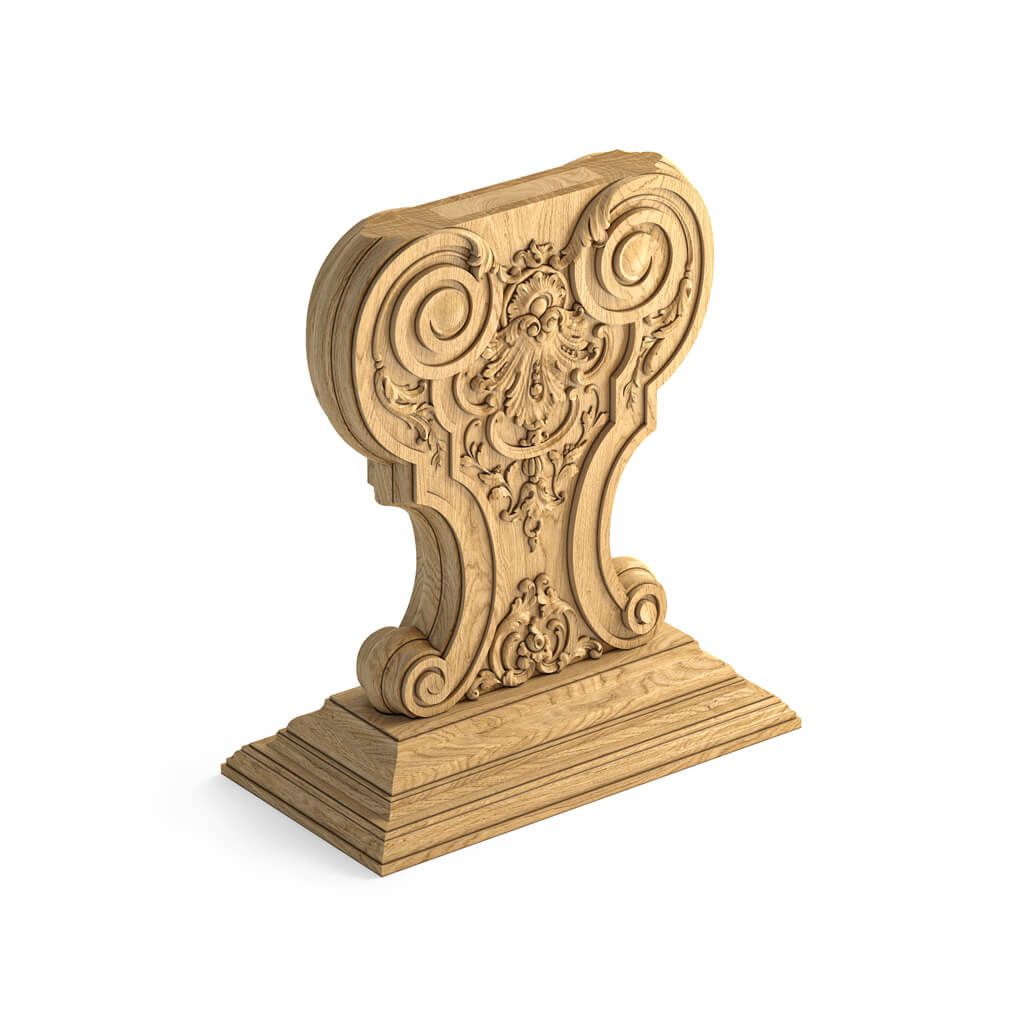
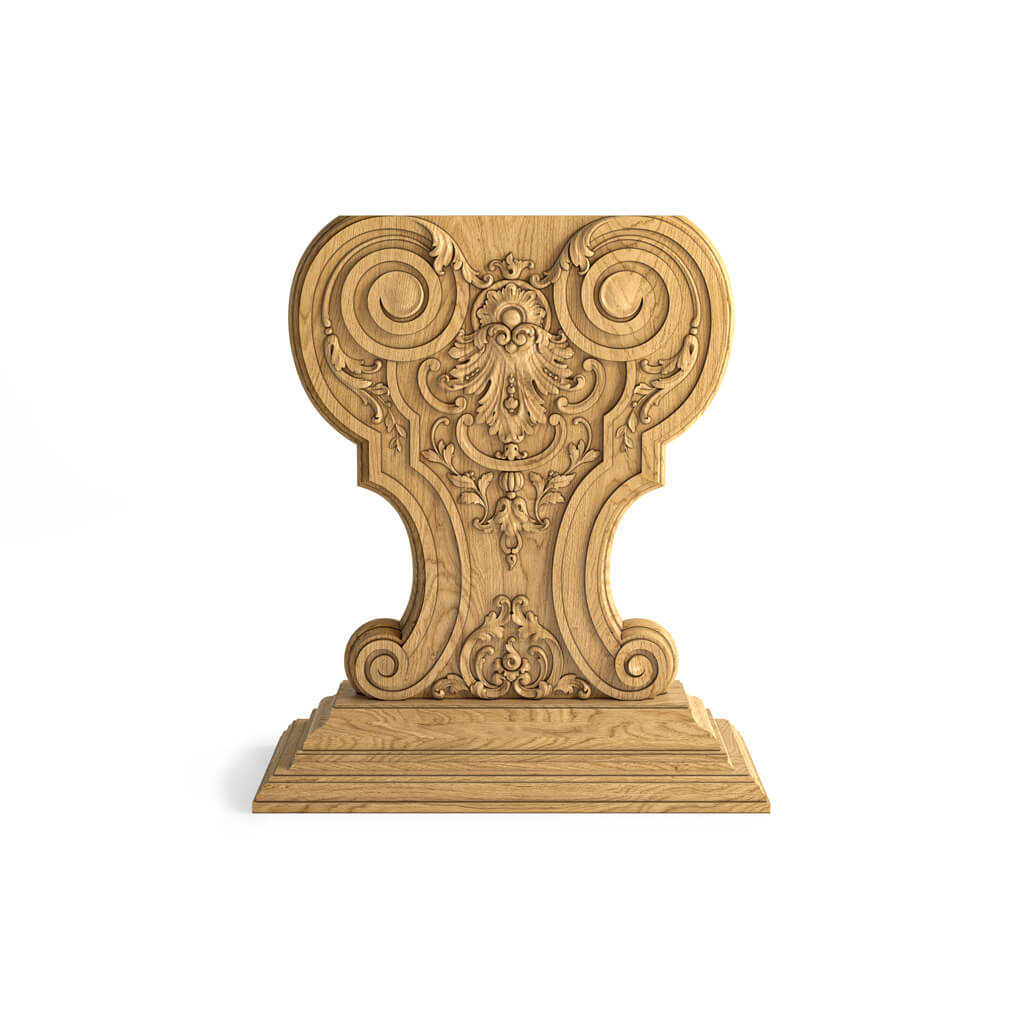
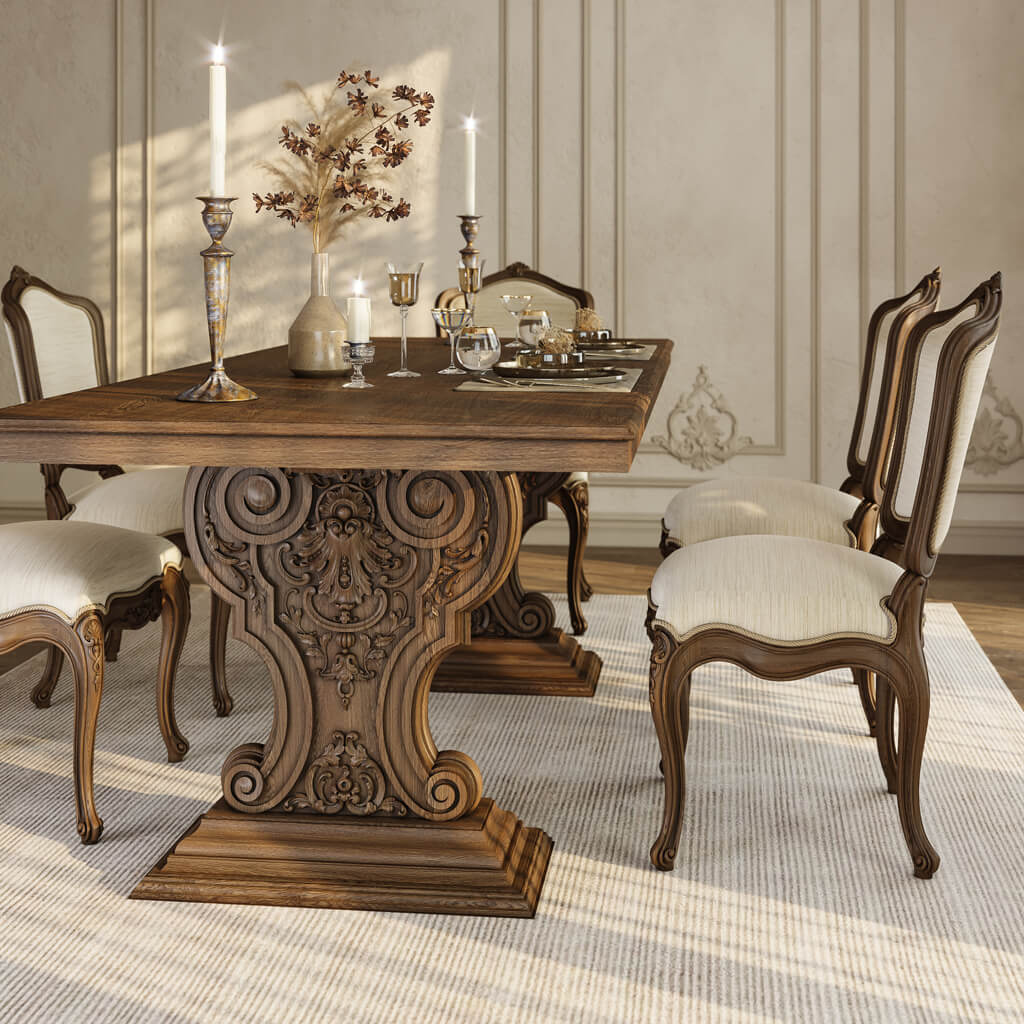
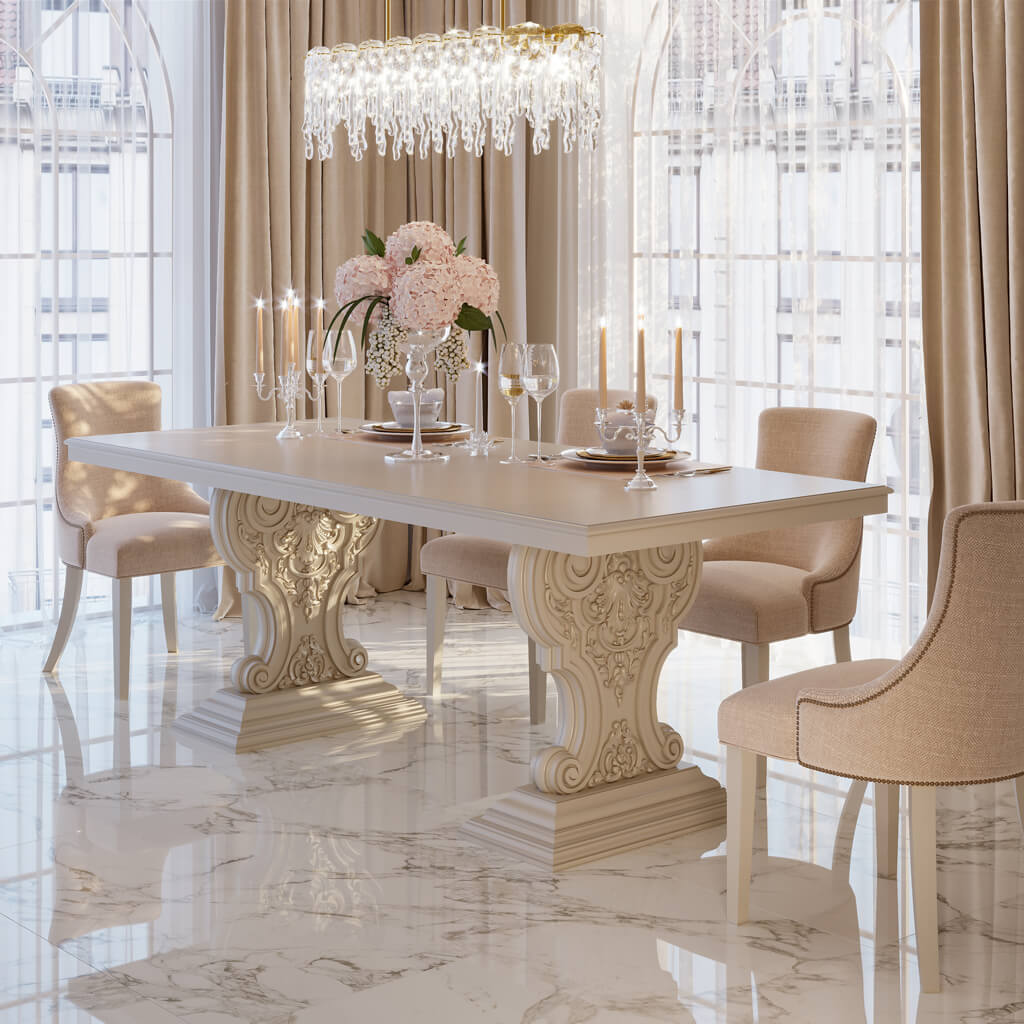
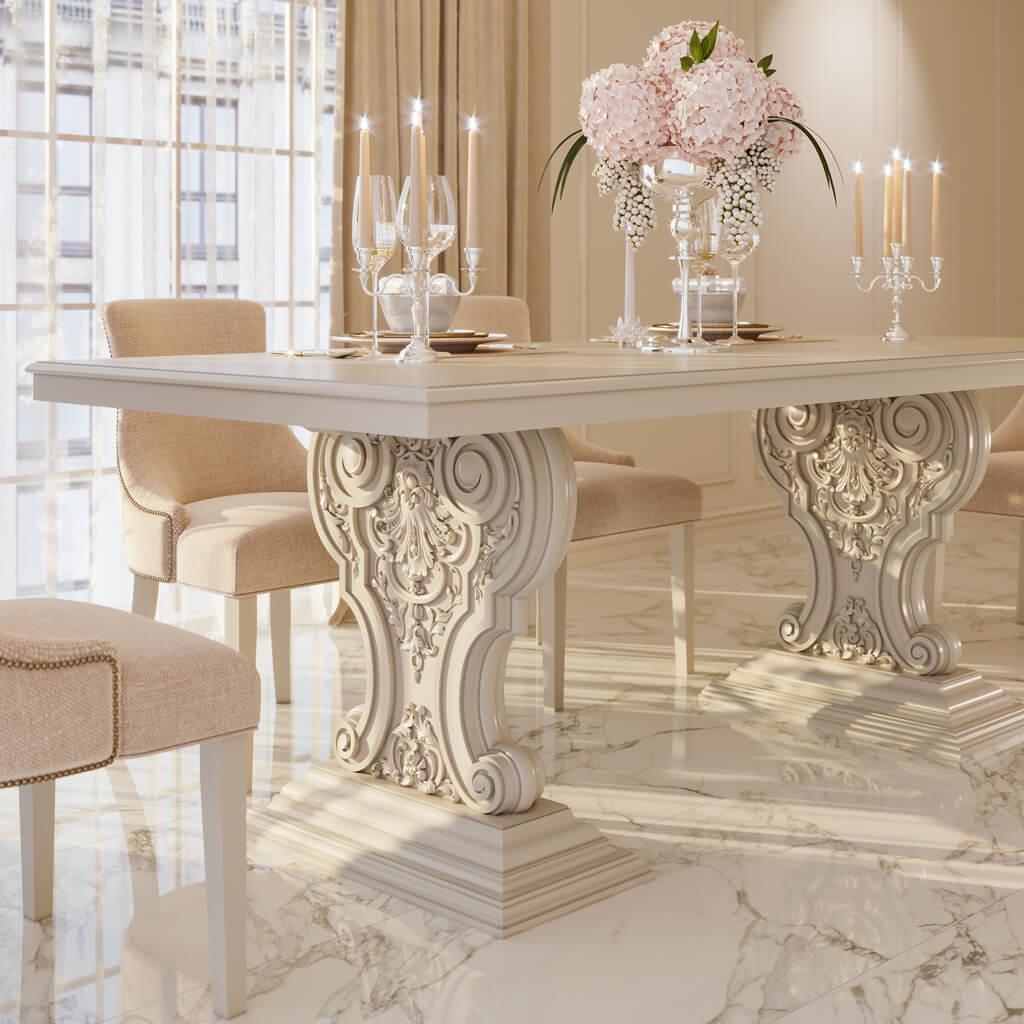
Massive wooden leg MN-244. The upper carved part is a single ornamental composition consisting of a relief of geometric profile moldings, volutes, and acanthus leaves. The lower base of the leg is a massive plinth, surrounded by a wide figured profile. It completes the overall composition, making it visually stable and monumental. The leg resembles an architectural element; its design references expressive examples of Italian Baroque-era furniture art.
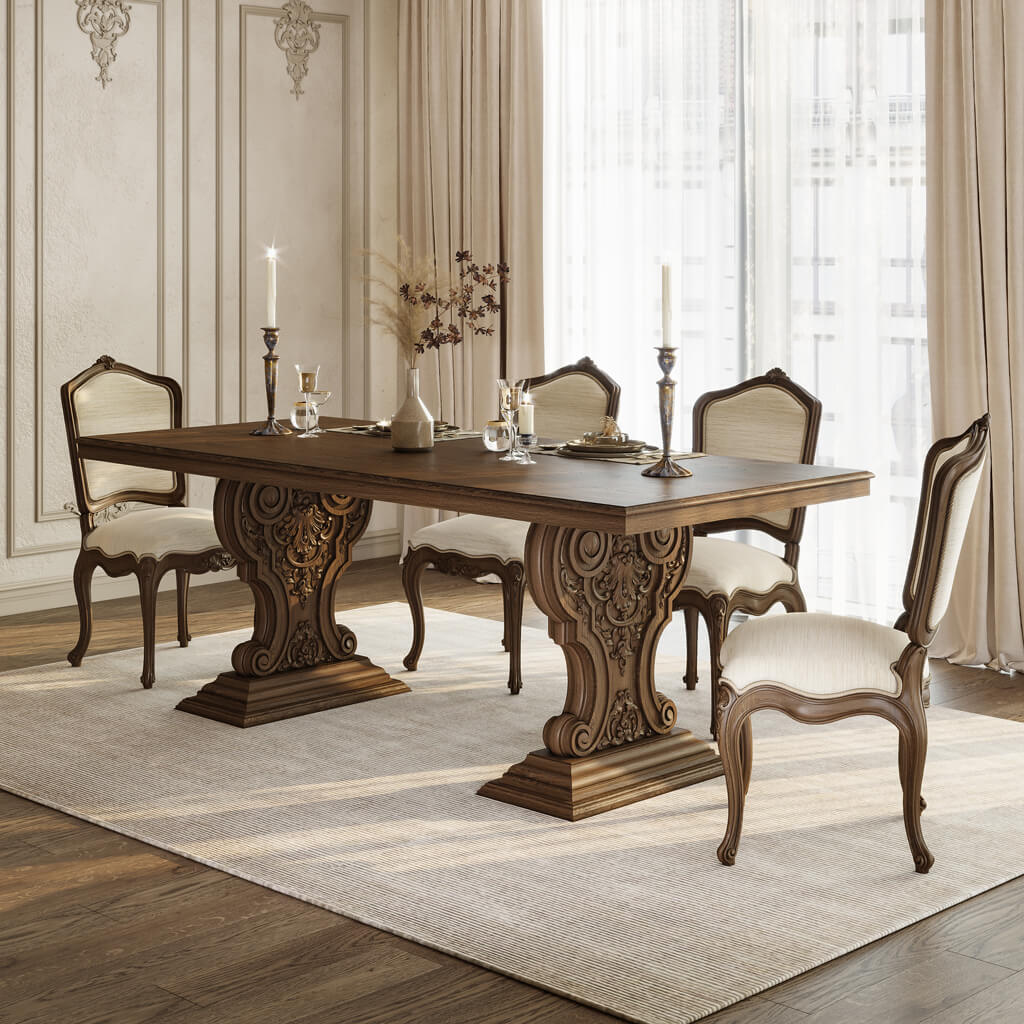
MN-244 can be used in table constructions for both residential spaces (living room, dining room, kitchen islands) and commercial areas (reception, meeting zones, offices).
The leg is designed for high loads and is compatible with heavy table tops made of various materials: wood, stone, metal. Two or more legs are used in a table construction. To ensure greater stability, it is recommended to connect them with additional structural elements.
Have questions?
Customers also buy



Marina D.
February 15, 2026
The company ordered the pens for us when we ordered furniture. But I decided to write a review personally because they are amazing! Stylish, expensive, high-quality!
Polina Sh.
February 4, 2026
Went on a tour. To say I'm delighted is an understatement. The largest production facility in Russia, impressive in its scale and dedication to the craft! It was very interesting and informative. You can immediately see - true masters of their trade! We were welcomed in the best possible way, were polite...
Svetlana A.
January 30, 2026
It's great that you can almost always find the necessary elements for the project. The products match the description, with prompt feedback and delivery!
More than 20 years on the market
The company's success began in 2002, when two artists — Andrey Ragozin and Evgeny Tsapko — created a small creative workshop for producing wooden carved items. The masters' work was quickly noticed, and within a year they were invited to participate in the reconstruction of the Konstantinovskiy Palace in Strelna.
After the success of this project, the company focused on recreating palace interiors, furniture, church furnishings, and carved decorations in various artistic styles. They worked with cultural heritage sites: The Hermitage, the Alexandrovsky Palace, the Troitsko-Izmaylovsky Cathedral, the Sheremetyevsky Mansion, and many others.
The masters' task — and still is — to create wooden items with the highest level of detail and understanding of every element, based on impeccable knowledge of artistic laws and interior styles.
STAVROS Guarantees
Quality of products without complaints
We save your time, peace of mind, and budget
Large warehouse program
We solve your tasks with maximum speed
Adherence to production deadlines
Streamlined process reduces all risks
Delivery from 1 piece throughout Russia
Quality service regardless of order volume
Your positive business reputation
Reliable partner — the foundation of your business
More products in the category 'Unpainted legs'


Frequently asked questions
Our showrooms are located in Saint Petersburg and Moscow. Production is located in Saint Petersburg.
Moscow contacts: https://www.stavros.ru/contacts_all/?tab=msk
Contacts of Saint Petersburg: https://www.stavros.ru/contacts_all/?tab=spb
- Send request by email [email protected]
- Write to us at Telegram
- Write to us at WhatsApp
- Order by phone +7 (800) 555-46-75
- Visit our showroom in Saint Petersburg and Moscow
Yes, we ship orders throughout Russia and to CIS countries.
We cooperate with transportation companies such as СДЭК and DPD.
You can also arrange pickup of your order through any convenient transportation company for you.
Delivery cost depends on the size, weight of the item, and delivery address.
When placing an order, the delivery cost is calculated automatically and displayed as a separate line on our website.
Prices and availability of items on the website are always current. Data is updated daily.
Note: items in stock are stored on the warehouse in unpolished form and shipped within 3 working days.
If the item is not in stock, average production time: 5–10 working days.
This is the quality of polishing of the items.
Standard — machine polishing, at a more attractive price.
Prestige — detailed hand polishing, items do not require further work.
More details: https://www.stavros.ru/information/kachestvo/
This is the type of veneer of the items.
Under enamel: produced by gluing wooden laminates without color and texture matching. Contrast tonal and textural differences are noticeable. This blank should be chosen if the item is intended for opaque coating.
Under tinting: produced by gluing wooden laminates with color and texture matching. Tonal and textural differences may occur. This blank should be chosen if the item is intended for semi-transparent finish.
More details: https://www.stavros.ru/information/kachestvo/
Beech — dense, non-porous wood, most often used for items covered with enamel.
Oak — dense, porous wood with clearly visible natural grain. Due to its strength and decorative properties, it is often used in items with semi-transparent coating, highlighting the wood pattern.
Custom-made, if non-standard items are required, we can produce products from other types of wood, including blanks provided by the customer, manufactured according to our technical specifications.
All our furniture legs can withstand a vertical load of at least 100 kg.
Average production time for custom-made items: 5–10 working days.
Most items are stored on the warehouse in unpolished form. We need time to polish and pack orders.
Yes, we manufacture non-standard items according to individual projects, but we only accept orders with a minimum quantity.
We can manufacture items of the desired size, but we only work with bulk orders. For details, please consult the sales department manager.
Yes, some of our products can be used outdoors. For example, polyurethane items, as well as carved door casings made of pine.
Other items are produced to order using PUR glue, if minimum quantity is available. No warranty is provided for such products, as outdoor conditions are considered aggressive.
Yes, we paint items when ordering products for a total amount of 150,000 rubles or more.
- Dust removal. After sanding, the surface must be dusted.
- Priming. Apply primer in an even layer.
- Matting. After the primer has fully dried, the surface should be matted (lightly sanded for better adhesion).
- Finish coating. Apply finish coating: lacquer or enamel, in 2 layers, with interlayer drying.
More details: https://www.stavros.ru/information/sovety/
Apply adhesive to the decor. Place it on the surface and press briefly. Then, lift the decor from the surface and leave it open for 3–5 minutes. Press the decor firmly onto the surface and hold for 5–10 seconds.
More details: https://www.stavros.ru/information/sovety/
Ideally, you should prepare a design project before placing an order.
You can do this yourself by downloading drawings of our products from our website, or you can order a project from us.
If the number of decorative elements and fittings is small, our company's manager can assist you with selection.
Unfortunately, this service is not provided.
The packaging method depends on the type of items, but in each case, we ensure sufficient protection for safe transportation.
We most often use corrugated cardboard and stretch film. Fragile items are additionally secured on a rigid base to prevent damage during transport.
We ship all items starting from 1 piece.
Room measurements and item installation can be performed by our partners — carpentry companies represented in most regions of Russia.
Often searched in category Furniture Legs and Supports
22621
Carved Leg MN-244: A masterpiece of classical carving for elite furniture
The Carved Leg MN-244 is an outstanding example of artistic woodworking, combining the virtuoso skill of carvers and the impeccable quality of natural material. This monumental piece is created for connoisseurs of classical furniture, where every detail plays a role in forming an atmosphere of luxury and nobility. The most complex relief ornament with symmetrical volutes, plant motifs, and elegant scrolls transforms a functional support into a true work of decorative and applied art, worthy of adorning palace-scale interiors.
The product embodies the traditions of the European furniture school, where carved elements served as markers of the owner's status and artistic taste. Every line of the ornament is meticulously hand-finished by experienced craftsmen capable of conveying the depth of the relief and the dynamism of the composition. The MN-244 leg becomes the central accent of the furniture construction, attracting the eye with the play of light and shadow on its multi-level carved surface, creating the effect of a three-dimensional sculpture.
Dimensions and Architectural Proportions
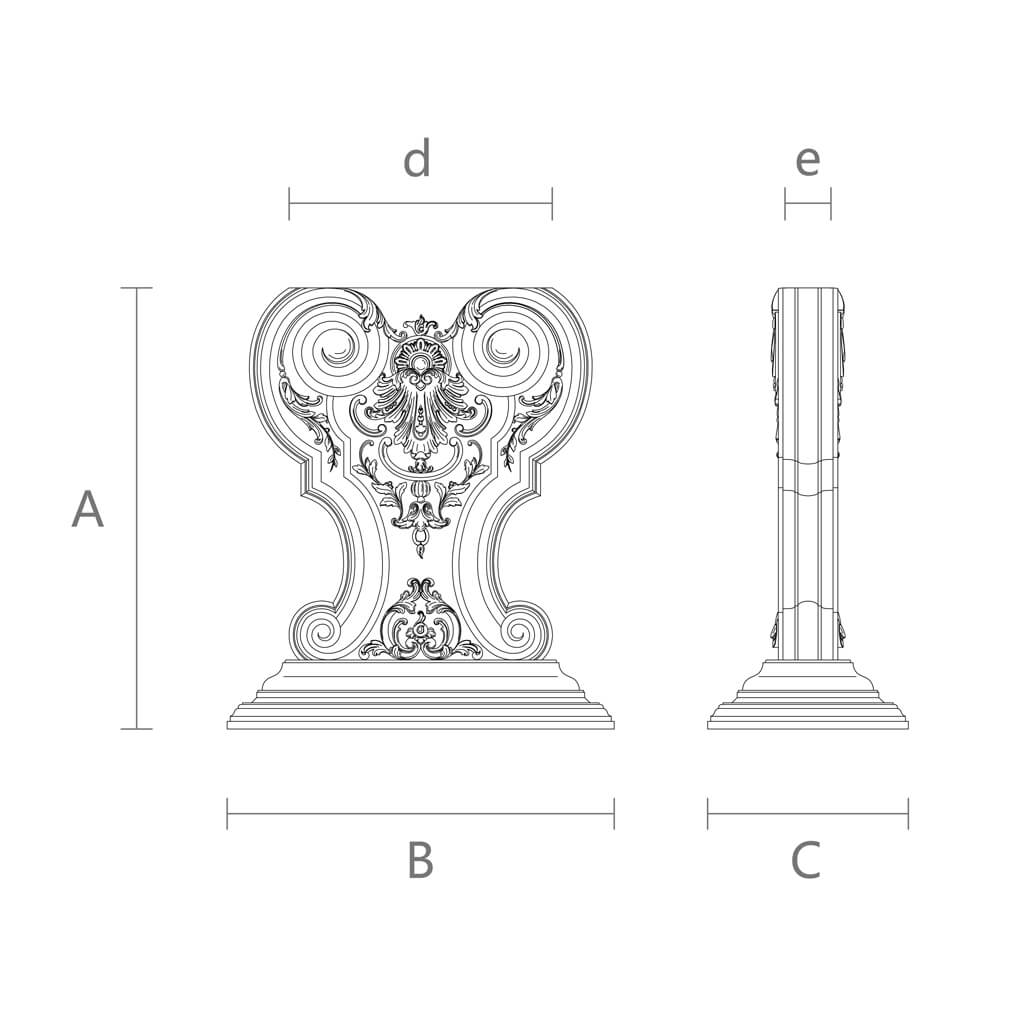
The Carved Leg MN-244 has impressive dimensions of 740 × 650 × 337 × 442 × 77 millimeters, defining it as a piece for large-scale furniture constructions. The height of 740 mm is optimal for creating tables, consoles, and dressers of standard ergonomic height, ensuring comfortable use of furniture in residential and representative spaces. The width of 650 mm at the top forms a wide mounting platform necessary for reliably attaching massive table tops made of natural stone, valuable wood species, or premium composite materials.
The parameters of 337 mm and 442 mm reflect the complex volumetric-spatial geometry of the piece, where the carved decoration protrudes beyond the base plane, creating a three-dimensional composition. The element thickness of 77 mm provides sufficient material mass for deep relief carving without compromising structural strength. This thickness allows master carvers to create multi-level compositions with depth variations of up to 35-40 mm, where individual ornament elements almost separate from the background, creating a lace-like effect.
The leg's proportions are verified according to the laws of classical architecture, where the base is wider and more massive, ensuring the visual stability of the composition. The central part is adorned with the most saturated decoration with symmetrical volutes and plant scrolls, forming a cartouche—the central decorative element. The upper section gently widens, forming a capital, which serves as a transition to the table top and distributes the load over an increased area.
Artistic Carving and Ornamental Composition
The decorative design of the MN-244 leg is executed in high-relief carving technique, where individual ornament elements protrude above the background to a depth of up to 30-35 millimeters. The central composition is formed by paired volutes—spiral-shaped scrolls representing a stylized image of seashells or fern shoots. These elements are a classic motif of Baroque and Neoclassical ornamentation, symbolizing movement, energy, and natural harmony.
Between the volutes is a cartouche—a decorative frame for the central field, adorned with plant motifs: acanthus leaves, grapevines, and stylized floral rosettes. Acanthus is a traditional element of classical carving, originating from ancient architecture, where its images adorned Corinthian order capitals. The elegant curves of acanthus leaves create a dynamic rhythm, guiding the eye from the base to the top of the composition.
The lower part of the leg is adorned with a smaller volute and additional plant elements, which create visual balance and complete the composition. The base is decorated with a stepped profile alternating straight and rounded elements, typical of classical furniture from the Empire and Late Classicism periods. The upper platform is also profiled with multi-step transitions, serving as a decorative frame for the mounting area.
The carving is performed using a combination of manual and mechanized methods: the basic relief is formed on CNC milling machines using a 3D model, after which a master carver manually refines the details, giving the elements naturalness and liveliness. Manual refinement includes working on small details such as leaf veins, petal textures, and transitions between relief levels. It is this final manual work that transforms a mechanical blank into an artistic piece with individual character.
Materials and Production Technology
The Carved Leg MN-244 is made from solid valuable hardwood—beech or oak, kiln-dried to a moisture content of 8-10%. For pieces with deep carving, the uniformity of the wood structure, the absence of knots, resin pockets, and internal defects that may appear during mechanical processing are especially important. Blanks are selected from the central parts of the log, where the annual rings are most evenly spaced, ensuring predictable material behavior during cutting.
Beech for carved pieces is valued for its fine-fibered, dense structure without large pores, allowing for sharp edges and thin elements without chipping or fiber tearing. The density of beech (680-720 kg/m³) provides sufficient hardness to preserve the sharp edges of the carving during use, and the light tone of the wood serves as an ideal base for any type of tinting or opaque painting. The natural light pinkish hue of beech gives the piece warmth even without a finish.
Oak as an alternative material offers increased hardness up to 800 kg/m³ and an expressive large-pored texture with contrasting annual rings. For carved elements, oak is chosen with radial sawing, where the fibers run parallel to the carving plane, minimizing the risk of chipping when forming deep relief. Tannins in oak wood provide natural protection against fungi and insects, which is critical for the durability of complex carved forms with multiple recesses.
The blank for the leg is formed by gluing several lamellae with waterproof D4 class adhesive, ensuring joint strength higher than that of the wood itself. The cross-grain orientation in adjacent lamellae compensates for the natural tendency of solid wood to warp with changes in humidity, maintaining geometric stability even with sharp climatic fluctuations. The glue seams are positioned so that they do not fall into zones of maximum stress and do not intersect critical elements of the carved decoration.
Manufacturing Process and Levels of Processing
The production of the Carved Leg MN-244 begins with creating an accurate three-dimensional CAD model, which considers all nuances of the ornamental composition and technological requirements for carving. The model is loaded into the control system of a five-axis CNC milling machine, capable of processing complex curved surfaces with positioning accuracy of ±0.05 mm. Special end mills of various diameters from 3 to 20 mm sequentially form the basic relief of the carving, removing excess material and creating the main volumes of the ornament.
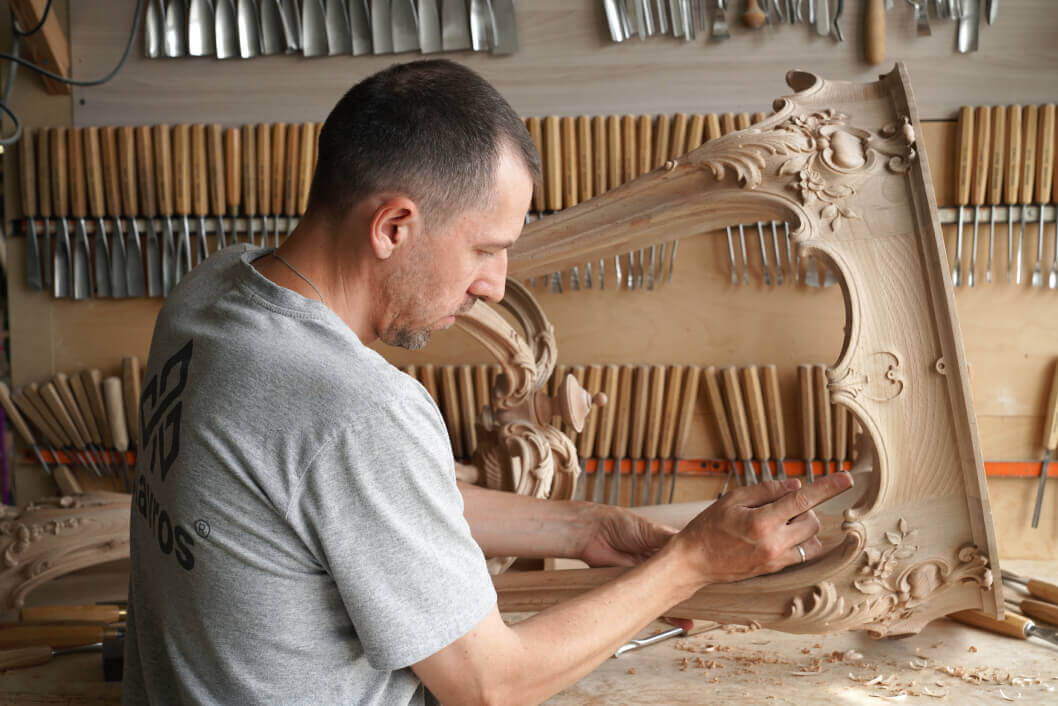
After mechanical processing, the blank is transferred to a master carver for manual refinement, which takes from 8 to 16 hours depending on the complexity of the decoration. Using a set of professional chisels, gouges, and carving knives, the master works on small details: sharpens leaf edges, deepens shadow areas, smooths transitions between relief levels. Manual work eliminates traces of machine processing—characteristic stepped transitions and milling marks—creating smooth, natural forms.
Particular attention is paid to undercutting—a technique where the edges of carved elements are cut at an angle, creating deep shadow and the effect of the detail separating from the background. Proper undercutting enhances the three-dimensionality of the composition, making individual elements appear to float above the surface. In places where various ornamental motifs intersect, the master creates smooth transitions of forms, imitating the natural interweaving of plant elements.
Sanding of carved surfaces is done manually using flexible abrasive materials with grit from P120 to P220. For access to deep recesses, special sanding brushes and sponges are used, which treat the relief without smoothing sharp edges. End surfaces and mounting platforms are sanded to a final smoothness of P240-P320, ensuring readiness for coating application without additional preparation.
Application in Interior Projects
The Carved Leg MN-244 is intended for elite furniture constructions, where it becomes the dominant decorative element of the entire composition. The ideal application is console tables for formal interiors, halls of country residences, and representative spaces. A pair of such legs is installed at the front of the console with a marble or wooden table top, while the back part is attached to the wall, creating the impression of a massive yet elegant structure.
In the design of dining tables for ceremonial halls, the four MN-244 legs form a powerful base capable of supporting a tabletop made from a solid slab of precious wood or a stone slab up to 50 mm thick. The placement of the legs set back from the edge creates a decorative space beneath the tabletop where the carved decoration is fully visible and becomes an object of admiration. Such tables are designed for rooms with high ceilings from 3.5 meters, where the scale of the furniture corresponds to the volume of the space.
For chests of drawers and sideboards in Baroque, Rococo, or Neoclassical styles, legs serve as the lower supports of the body, lifting the furniture off the floor and creating an effect of lightness despite its massiveness. Carved elements visually continue the vertical accents of the facades—pilasters, panels, cornices—forming a unified stylistic composition. The height of 740 mm allows such legs to be used for tall chests and secretaries, where the lower tier becomes a decorative base.
In the design of fireplace portals, architectural interior details, and decorative consoles for sculpture, the MN-244 leg functions as a vertical support or bracket. Its artistic value is so high that the piece can be used as an independent decorative element, installed in niches or on pylons as an example of carving art. For museum exhibitions, exhibition halls, and historical interiors, such legs recreate the atmosphere of an era, demonstrating the level of skill in classical crafts.
Finishing options
For carved items with deep relief, the final finish plays a critical role in revealing the artistic potential of the form. A classic solution is gilding—applying thin sheets of gold leaf or imitation bronze powders to a special adhesive base. The gilding is applied to the protruding parts of the carving, while the recesses are tinted with dark paints, creating maximum contrast and emphasizing the depth of the relief. This technique is typical for palace interiors and the recreation of historical styles.
Patination is a technique of artificial aging, where the main light tone of the coating is complemented by dark accents in the recesses of the carving. Dark patina is applied with a brush into all the recesses of the ornament, then partially removed from the protruding parts, imitating the natural darkening of wood in hard-to-reach places over decades of use. The result is a noble vintage look associated with antique furniture from private collections.
Opaque painting with enamels allows the leg to be integrated into modern interiors, where the color of the furniture is subordinate to the overall color scheme of the space. White, cream, or gray enamel with a matte texture creates a light, elegant image typical of French and Scandinavian interiors. Glossy enamels in black, emerald, or burgundy give the piece dramatic expressiveness, relevant for Art Deco style and modern Neoclassicism.
Transparent and semi-transparent coatings—oils, waxes, shellac—preserve the natural wood texture, demonstrating the quality of the material and the craftsmanship of processing. For oak, tinting with water-based stains in shades from golden walnut to dark wenge is used, emphasizing the contrast between early and late wood. Final polishing with wax creates a silky surface with a slight satin sheen, pleasant to the touch and resistant to household soiling.
Structural features and installation
The upper mounting platform of the carved MN-244 leg has a flat or profiled surface with sufficient area for attachment via metal brackets, strips, or threaded connections. For massive tabletops, installation via a steel frame—an under-table structure made from 40×40 mm profile tubing—is recommended, which is attached to the upper part of the legs with M8-M10 bolt connections. The frame distributes the load evenly across all supports and prevents local overloads at attachment points.
The lower base of the leg is often supplemented with metal adjustable-height heel supports, which compensate for floor unevenness and protect the carved wood from direct contact with floor coverings. The supports are made of brass, bronze, or chrome-plated steel depending on the overall style of the piece. Height adjustment within a range of ±10 mm allows the furniture to be set perfectly level even on floors with level variations.
To prevent lateral shifting under dynamic loads, the installation of diagonal braces between the legs is recommended—wooden or metal elements connecting the supports into a rigid spatial structure. The braces are placed at a height of 150-200 mm from the floor and can be either open decorative elements or hidden inside the body structure. A properly designed fastening system turns four separate legs into a monolithic frame capable of withstanding loads up to 500 kg without deformation.
Care and Preservation of Decorative Qualities
Carved surfaces with deep relief require specific care, considering the presence of many recesses and hard-to-reach areas. Regular cleaning is performed with soft brushes with natural bristles, which remove dust from all levels of the carving without damaging the finish. For wet cleaning, slightly damp microfiber cloths are used to wipe the protruding parts of the ornament; the use of excessive water is unacceptable, as moisture can accumulate in the recesses.
For items with lacquer or enamel finishes, annual treatment with special furniture polishes is recommended, which restore shine and create a protective layer against soiling. The polish is applied with a soft cloth to the protruding areas of the carving and rubbed until evenly distributed; excess is removed with a clean cloth. Such treatment prevents the finish from dulling and facilitates subsequent cleaning.
Gilded surfaces require the most delicate handling: only dry cleaning with soft brushes without the use of chemicals is permissible. If restoration of damaged gilding areas is necessary, professional restorers should be consulted, who restore the coating using traditional techniques. Patinated items are periodically refreshed by local application of patinating compounds to areas of greatest wear to preserve the effect of noble antiquity.
Climate control is critical for the longevity of carved elements: optimal humidity of 45-60% and temperature of 18-24°C prevent wood shrinkage and opening of glue joints. If humidity drops below 40%, the use of household humidifiers is recommended; in damp rooms, dehumidifiers are necessary. Avoid placing furniture on carved legs near radiators, fireplaces, or in direct sunlight, which cause local overheating and accelerated aging of the material.
Cultural Value and Investment Potential
The carved MN-244 leg is not just a furniture component, but a sample of traditional craftsmanship, where machine production is complemented by the irreplaceable manual labor of a master artist. In the era of mass industrial production, such items acquire special value as carriers of cultural memory and custodians of technologies honed over centuries. Purchasing furniture with such carved elements is an investment in quality that does not become outdated or depreciate over time.
Artistic wood carving is included in the lists of intangible cultural heritage of many countries as a traditional craft requiring lengthy training and the transfer of skills from master to apprentice. Items made using hand carving are valued by collectors of antiques and design, maintaining and increasing in value with proper care. Over decades, such furniture becomes a family heirloom, passed down to subsequent generations as a material embodiment of taste and prosperity.
For interior designers and architects, the ability to use authentic carved elements in projects means reaching a new level of execution, where attention to detail creates an atmosphere of genuine luxury. Premium segment clients increasingly seek unique solutions that distinguish their interiors from typical design projects; hand-carved legs become precisely that element which forms the exclusivity and memorability of a space.
Order and Production Cycle
The carved MN-244 leg is manufactured to individual orders, taking into account the requirements of a specific project regarding material, finish, and quantity. The minimum production cycle ranges from 15 to 25 working days depending on the workshop's workload and the complexity of the chosen finish option. The process begins with a consultation where all technical details are clarified: wood species, type of coating, features of attachment to a specific furniture structure.
After specification approval, a production order is formed, including drawings, finish samples, and a schedule of step-by-step execution. The client can visit the production facility during the stage of manual carving refinement to assess quality and make adjustments to ornament details. This practice is especially relevant for large projects requiring a series of identical legs with maximum decorative repeatability.
Packaging of finished items is done in individual wooden crates with an internal cushioning layer of foam polyethylene, protecting fragile carving elements during transportation. Each leg is secured in the crate with special fasteners preventing shifting and impacts against the container walls. For international shipments, fumigation of the packaging and preparation of phytosanitary certificates according to customs service requirements are applied.
The possibility of ordering custom sizes and with ornament modifications allows the basic MN-244 model to be adapted to the unique requirements of a project. Designers can request changes in height, addition of family crests or monograms to the central cartouche, adjustment of proportions for specific furniture structures. Such custom orders require the creation of a new CAD model and increase the production cycle to 30-40 working days, but the result fully meets the project author's vision.
Your request has been sent!
Our manager will contact you within 5 minutes