












































































Wine Cellar Design V-001

Wine Cellar Design V-001
Get Consultation
We will help you implement the project
Measurements
You send us furniture, interior, and preferences dimensions
Design
Our specialists will create a project (paid service, from 2000 rub.)
Kitting
After project approval, you receive a specification
Implementation
We will select partners in your city for painting and mounting decor
You may also be interested in


Frequently asked questions
Our showrooms are located in Saint Petersburg and Moscow. Production is located in Saint Petersburg.
Moscow contacts: https://www.stavros.ru/contacts_all/?tab=msk
Contacts of Saint Petersburg: https://www.stavros.ru/contacts_all/?tab=spb
- Send request by email [email protected]
- Write to us at Telegram
- Write to us at WhatsApp
- Order by phone +7 (800) 555-46-75
- Visit our showroom in Saint Petersburg and Moscow
Yes, we ship orders throughout Russia and to CIS countries.
We cooperate with transportation companies such as СДЭК and DPD.
You can also arrange pickup of your order through any convenient transportation company for you.
Delivery cost depends on the size, weight of the item, and delivery address.
When placing an order, the delivery cost is calculated automatically and displayed as a separate line on our website.
Prices and availability of items on the website are always current. Data is updated daily.
Note: items in stock are stored on the warehouse in unpolished form and shipped within 3 working days.
If the item is not in stock, average production time: 5–10 working days.
This is the quality of polishing of the items.
Standard — machine polishing, at a more attractive price.
Prestige — detailed hand polishing, items do not require further work.
More details: https://www.stavros.ru/information/kachestvo/
This is the type of veneer of the items.
Under enamel: produced by gluing wooden laminates without color and texture matching. Contrast tonal and textural differences are noticeable. This blank should be chosen if the item is intended for opaque coating.
Under tinting: produced by gluing wooden laminates with color and texture matching. Tonal and textural differences may occur. This blank should be chosen if the item is intended for semi-transparent finish.
More details: https://www.stavros.ru/information/kachestvo/
Beech — dense, non-porous wood, most often used for items covered with enamel.
Oak — dense, porous wood with clearly visible natural grain. Due to its strength and decorative properties, it is often used in items with semi-transparent coating, highlighting the wood pattern.
Custom-made, if non-standard items are required, we can produce products from other types of wood, including blanks provided by the customer, manufactured according to our technical specifications.
All our furniture legs can withstand a vertical load of at least 100 kg.
Average production time for custom-made items: 5–10 working days.
Most items are stored on the warehouse in unpolished form. We need time to polish and pack orders.
Yes, we manufacture non-standard items according to individual projects, but we only accept orders with a minimum quantity.
We can manufacture items of the desired size, but we only work with bulk orders. For details, please consult the sales department manager.
Yes, some of our products can be used outdoors. For example, polyurethane items, as well as carved door casings made of pine.
Other items are produced to order using PUR glue, if minimum quantity is available. No warranty is provided for such products, as outdoor conditions are considered aggressive.
Yes, we paint items when ordering products for a total amount of 150,000 rubles or more.
- Dust removal. After sanding, the surface must be dusted.
- Priming. Apply primer in an even layer.
- Matting. After the primer has fully dried, the surface should be matted (lightly sanded for better adhesion).
- Finish coating. Apply finish coating: lacquer or enamel, in 2 layers, with interlayer drying.
More details: https://www.stavros.ru/information/sovety/
Apply adhesive to the decor. Attach to the surface and press briefly. Then, remove the decor from the surface and leave it open for 3–5 minutes. Press the decor firmly onto the surface and hold for 5–10 seconds.
More details: https://www.stavros.ru/information/sovety/
Ideally, you should prepare a design project before placing an order.
You can do this yourself by downloading drawings of our products from our website, or you can order a project from us.
If the number of decorative elements and fittings is small, our company's manager can assist you with selection.
Unfortunately, this service is not provided.
The packaging method depends on the type of items, but in each case, we ensure sufficient protection for safe transportation.
We most often use corrugated cardboard and stretch film. Fragile items are additionally secured on a rigid base to prevent damage during transport.
We ship all items starting from 1 piece.
Room measurements and item installation can be performed by our partners — carpentry companies represented in most regions of Russia.
Also see
Wine Cellar Design V-001: A masterpiece of interior design for wine connoisseurs
Creating a wine cellar is an art that combines tradition, refined aesthetics, and attention to detail. The Wine Cellar V-001 is not merely a functional wine storage space, but a space designed for enjoying an atmosphere that reflects prestige, taste, and sophistication.
This project embodies a classic style, intricate wood carving, sculptures, vintage elements, and artistic lighting, creating a unique space where every detail highlights luxury and elegance.
Architectural Concept and Layout
The Wine Cellar V-001 is not merely a storage space for fine beverages, but a carefully designed architectural ensemble where every detail adheres to the overarching concept of comfort, luxury, and functionality. Here, space ergonomics, aesthetics, and a thoughtfully designed storage system harmoniously coexist, creating an atmosphere of a traditional wine cellar with elements of palace architecture.
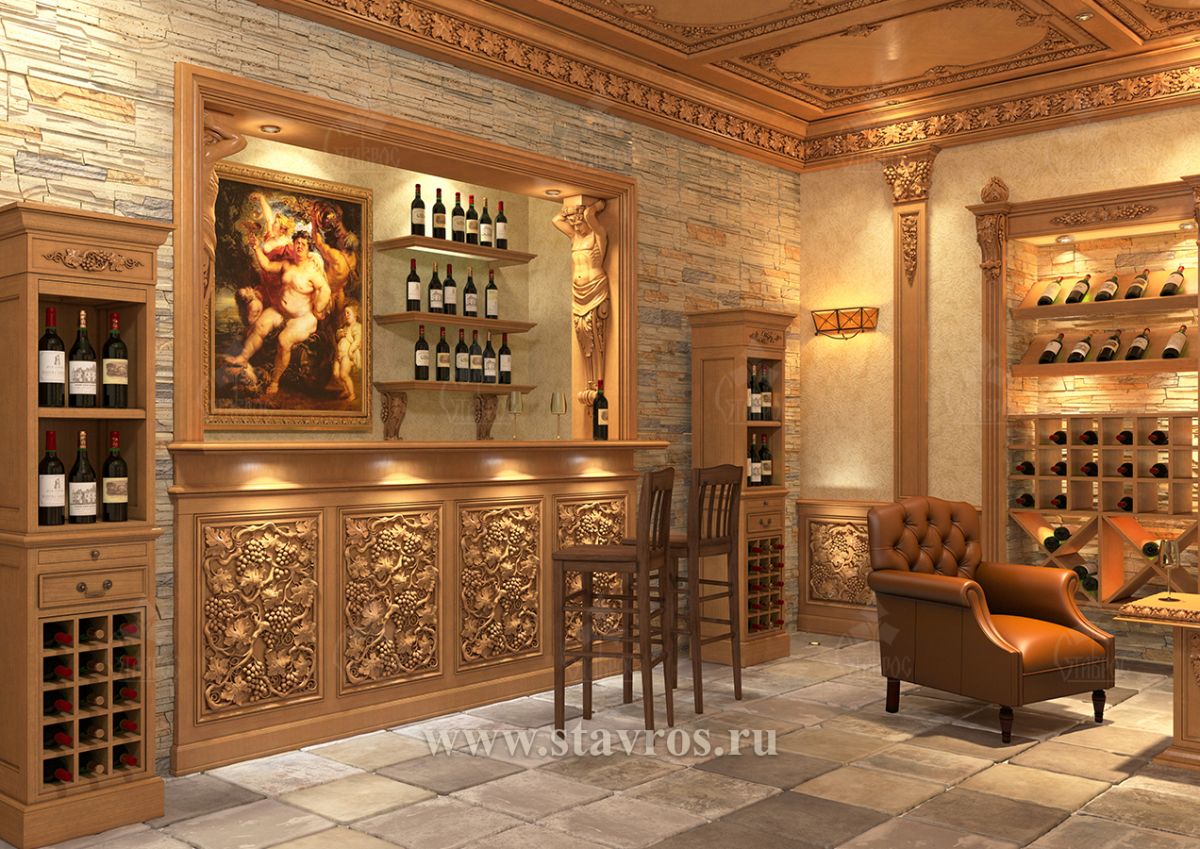
The cellar layout takes into account spatial zoning, enabling the organization of a convenient storage system, providing a relaxation and tasting area, and emphasizing the owner’s status through refined interior design.
Main Zones of Wine Cellar V-001
1. Wine Storage Zone
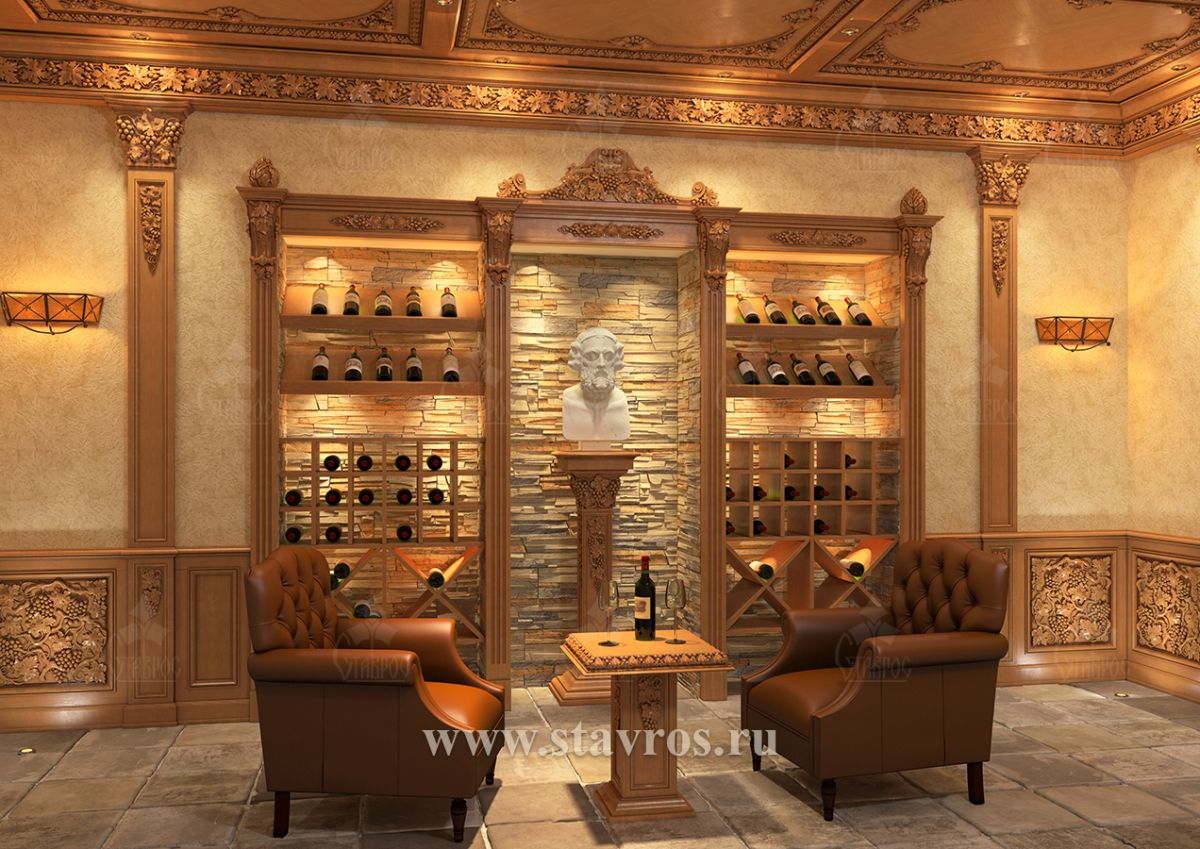
One of the most important parts of the project is the wine collection storage zone. Here, the following are provided:
-
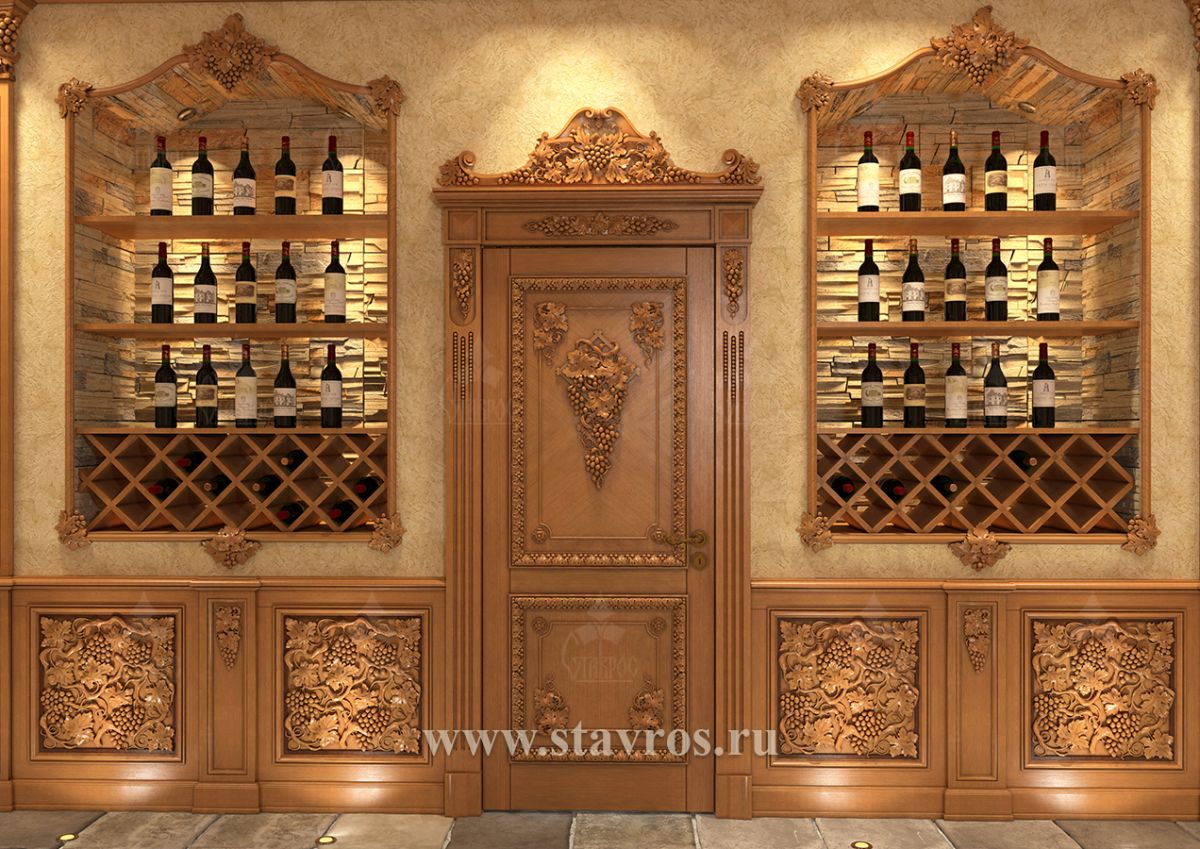
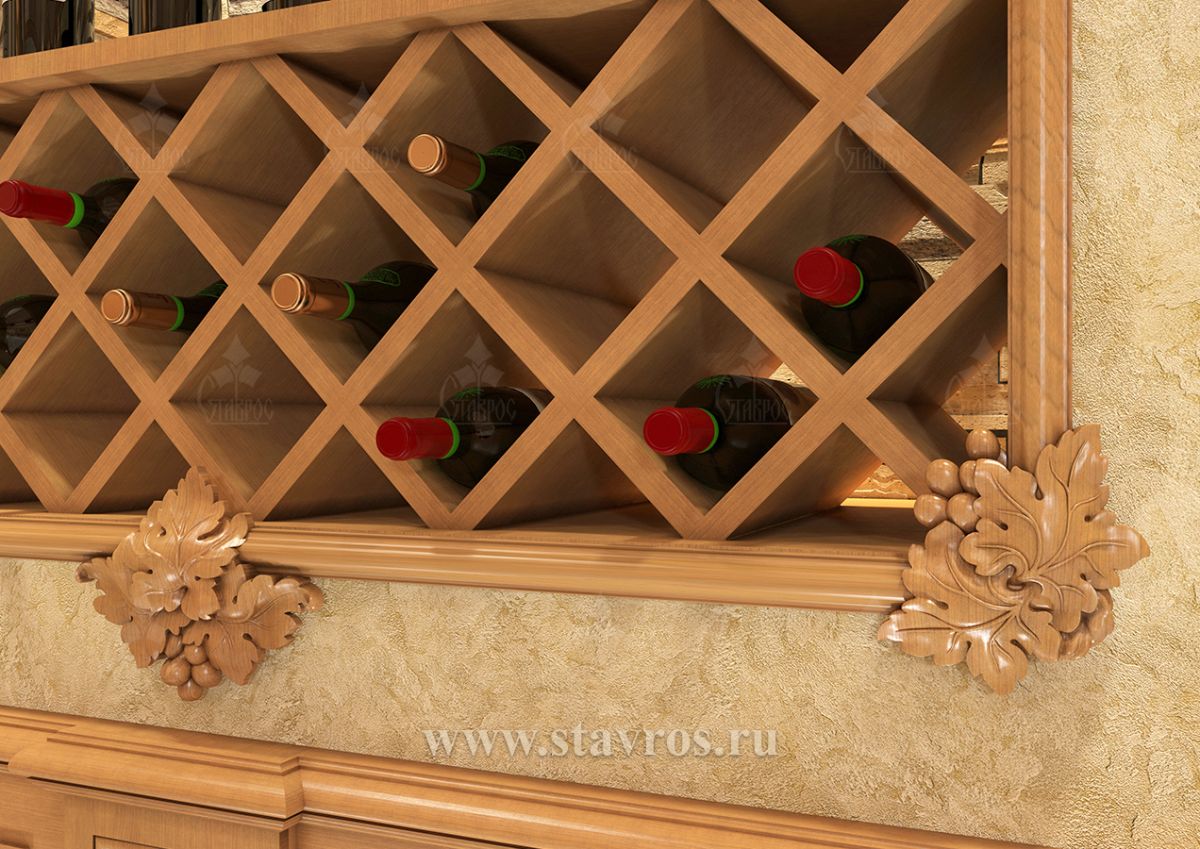
Elegant shelves with diagonal bottle arrangement, ensuring proper wine positioning and easy access to each bottle;
-
Wall-mounted wine cabinets with carved facades, adding aristocracy and elegance to the interior;
-
Individual niches with adjustable shelves, allowing storage of both standard bottles and collectible items in non-standard formats;
-
Open shelves with decorative elements, transforming wine storage into visual art.
Natural materials are used to create an optimal microclimate, supporting stable temperature and humidity. Stone inserts in wall cladding not only serve a decorative function but also help regulate room humidity.
Tip: The optimal temperature for wine storage is 10-14°C, and air humidity should be 60-70%. To preserve the collection in ideal condition, it is recommended to use a climate control system and regularly check humidity levels.
2. Tasting Zone: Atmosphere of Comfort and Enjoyment
Wine is not only a beverage, but also an art, traditions, and philosophy of savoring the moment. That is why the Wine Cellar V-001 includes a dedicated tasting zone, where one can enjoy the aromas and flavors of collectible wines in a comfortable setting.
This zone includes:
-
Comfortable leather chairs with deep seats, creating an atmosphere reminiscent of a respectable English club;
-
Carved wooden table, suitable for placing glasses, decanters, and wine serving accessories;
-
Dim lighting, highlighting the rich wood texture and creating an intimate atmosphere;
-
Decorative elements — paintings, sculptures, antique accessories — adding depth and individuality to the interior.
In this zone, tastings can be conducted, one can enjoy the atmosphere of an old wine cellar, and immerse oneself in the philosophy of wine.
Tip: To create the ideal ambiance, choose warm, soft lighting that highlights natural wood tones. Avoid cold white lighting — it makes the space less cozy.
3. Bar Counter: The Heart of the Wine Cellar
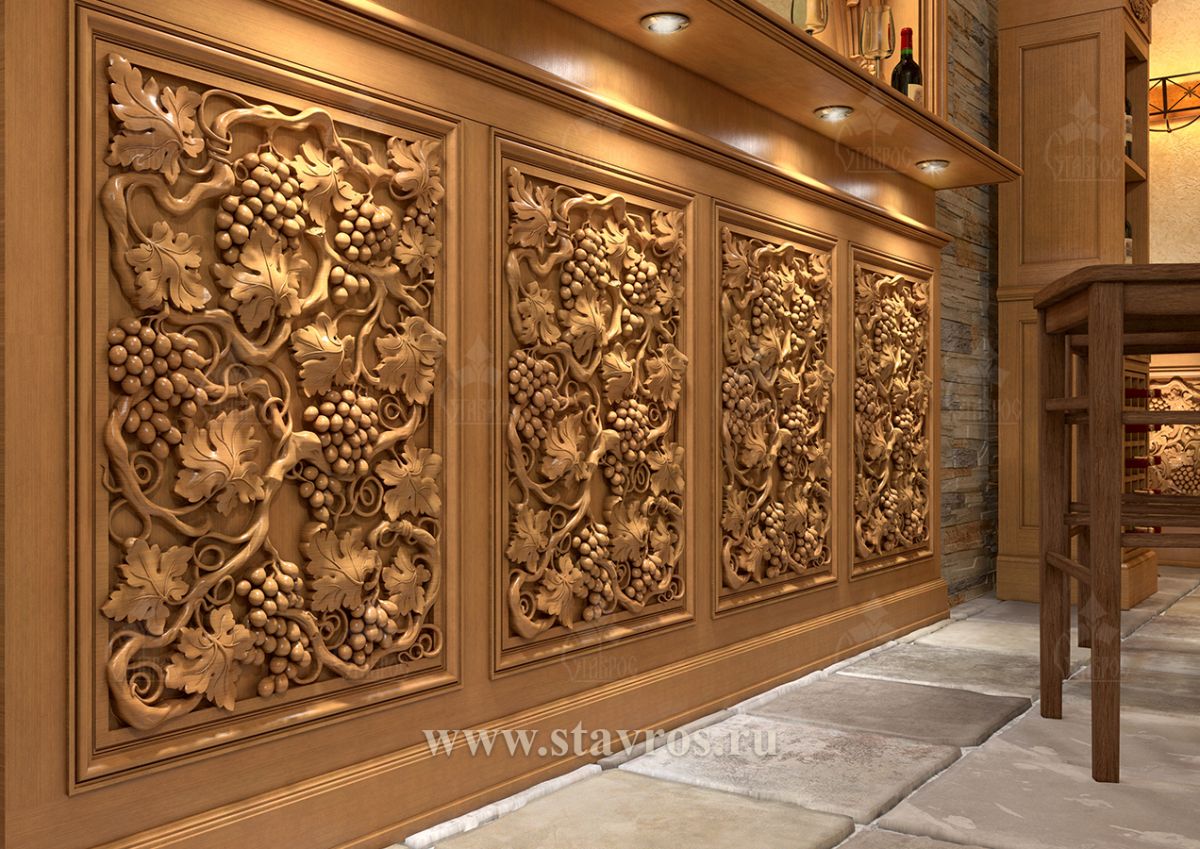
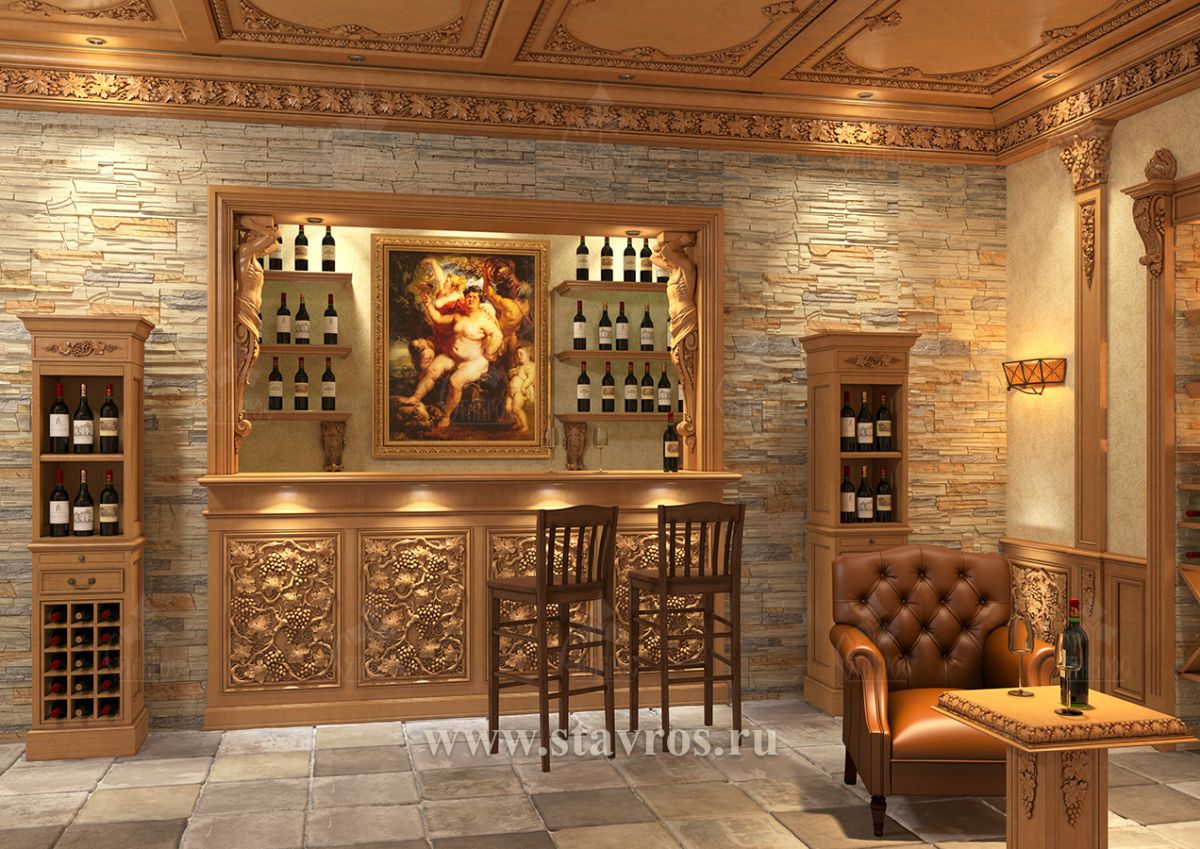
The centerpiece of the Wine Cellar V-001 interior is an elegant bar counter, adorned with exquisite wood carving and harmoniously integrated into the overall concept.
The counter includes:
-
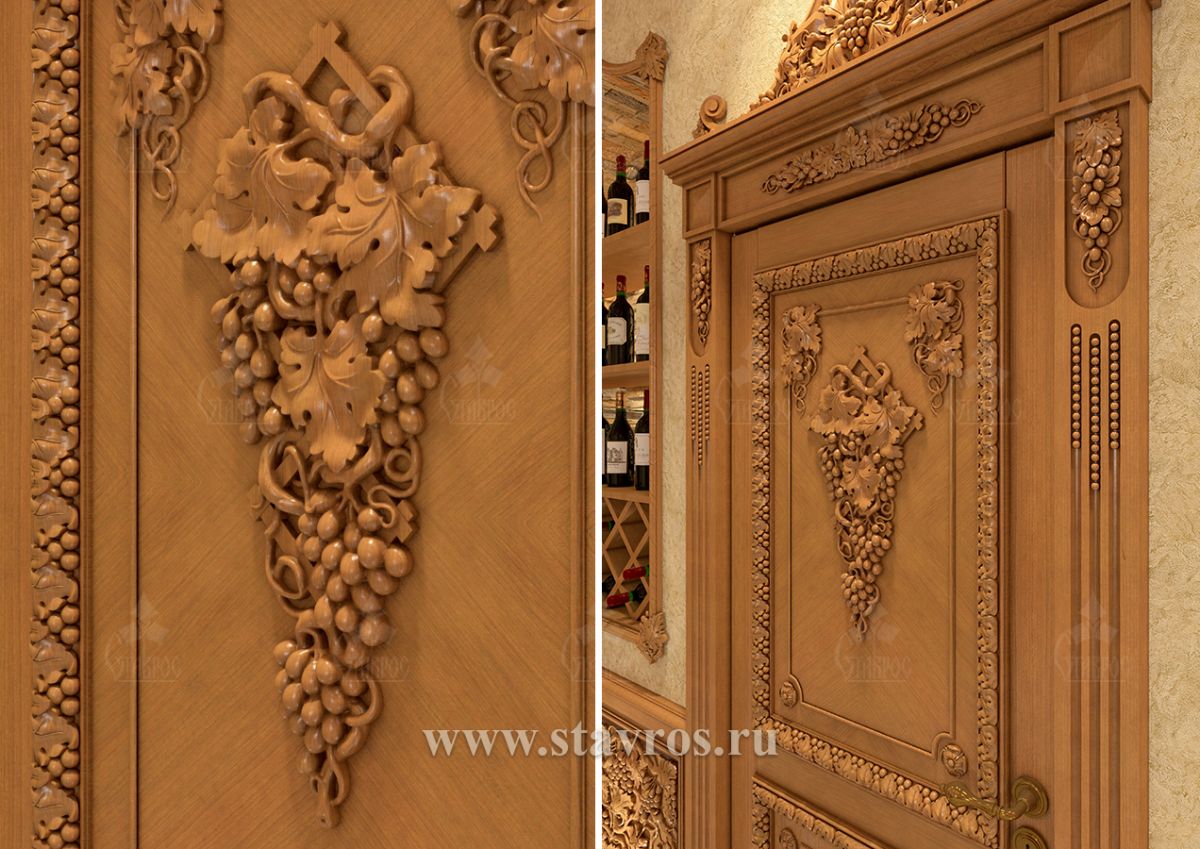
Carved wooden panels with grapevines and grape clusters — symbols of abundance and winemaking traditions;
-
Shelves for bottles, where you can store wine collections for tasting;
-
Glass shelves for glasses and accessories, creating a convenient storage system;
-
Lighting that highlights the texture of wood and adds additional expressiveness to the bar.
This area is perfect for tastings, hosting guests, and enjoying cozy evenings with good wine.
Tip: To enhance the cozy atmosphere, you can use vintage accessories — bronze candelabras, candle holders, carved wooden elements with gold leaf.
4. Decorative elements: art in every detail
The interior of wine cellar V-001 is filled with unique decorative elements that make it truly exclusive.
Main accents:
-
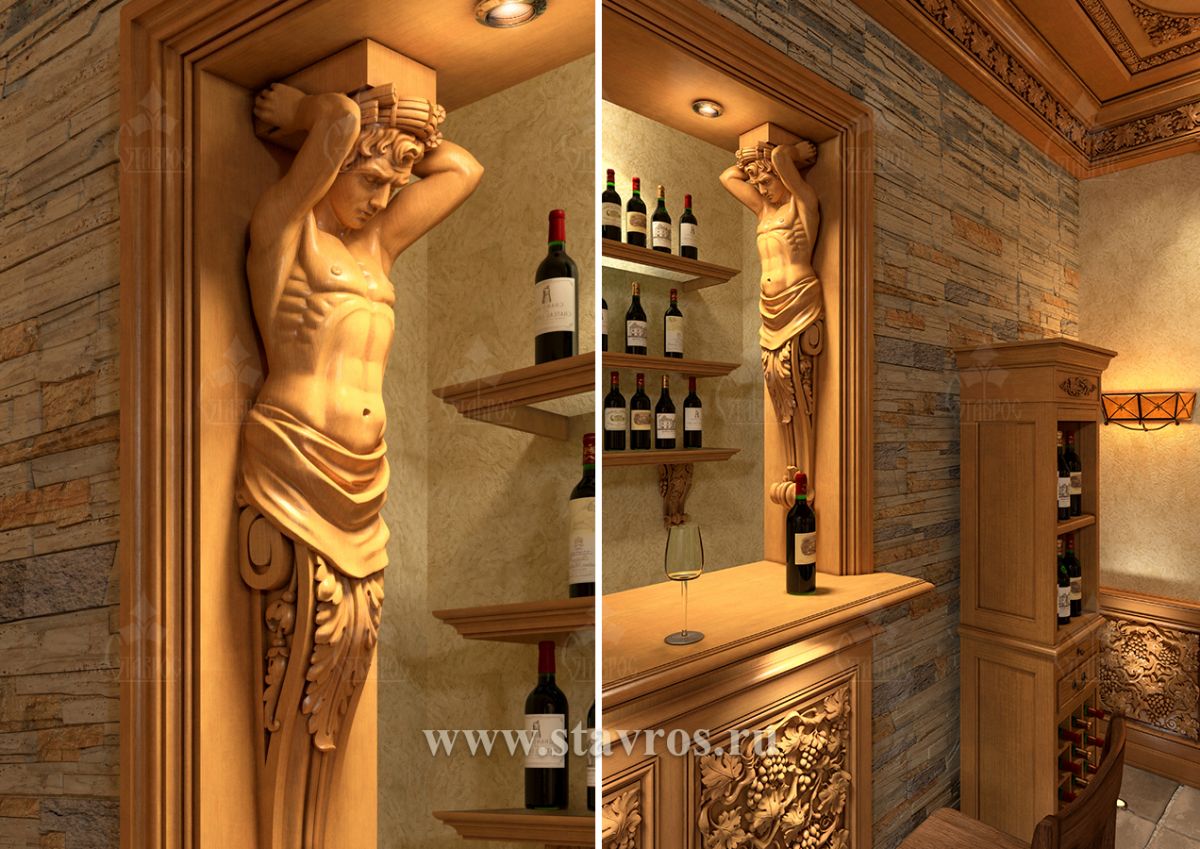
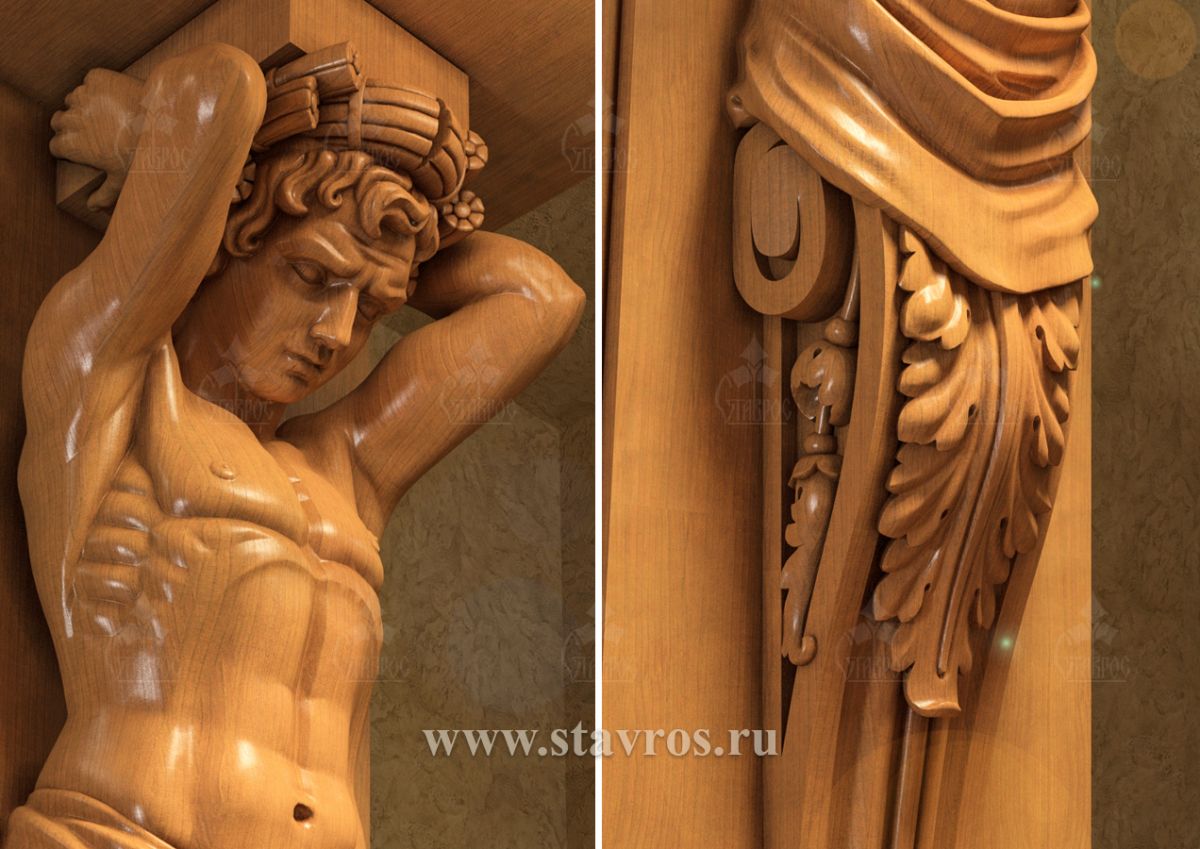
Sculptural Atlantes supporting the ceiling and creating a sense of grandeur;
-
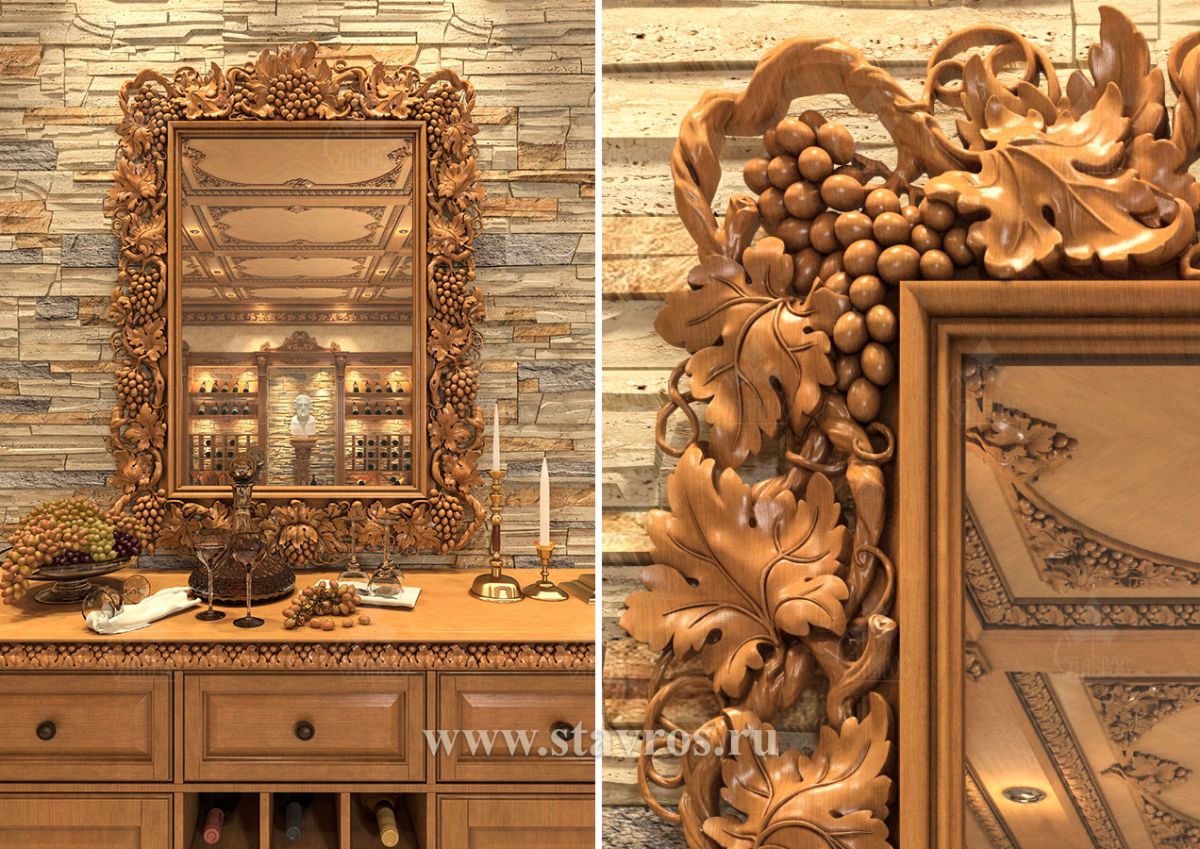
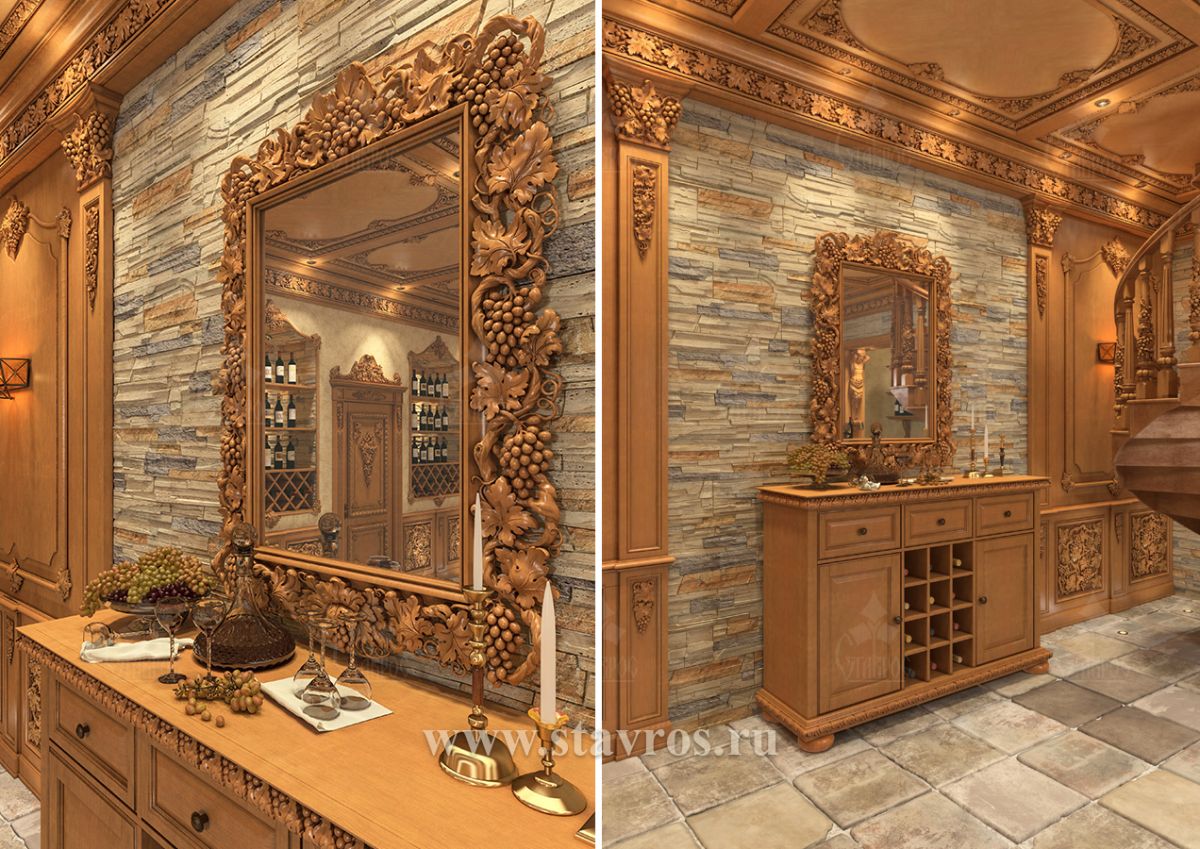
Carved panels with grapevine motifs, decorating walls and furniture;
-
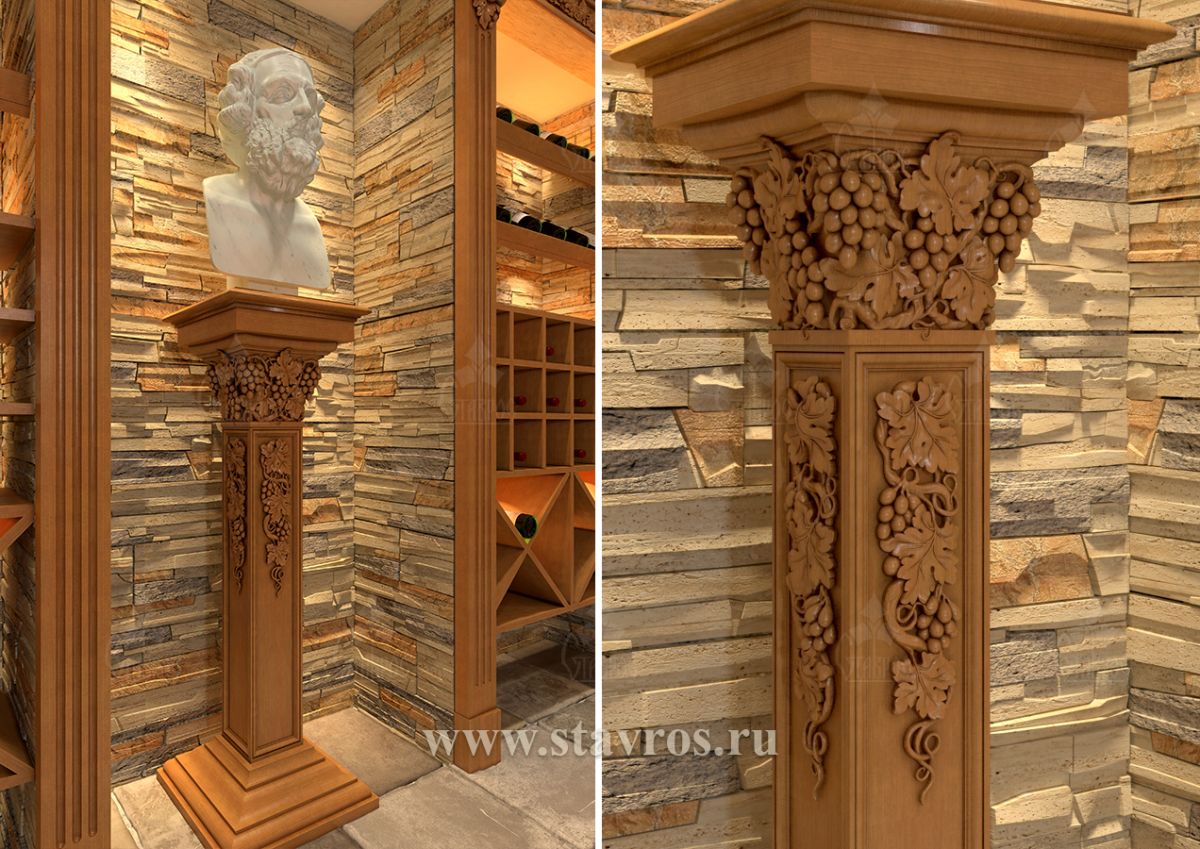
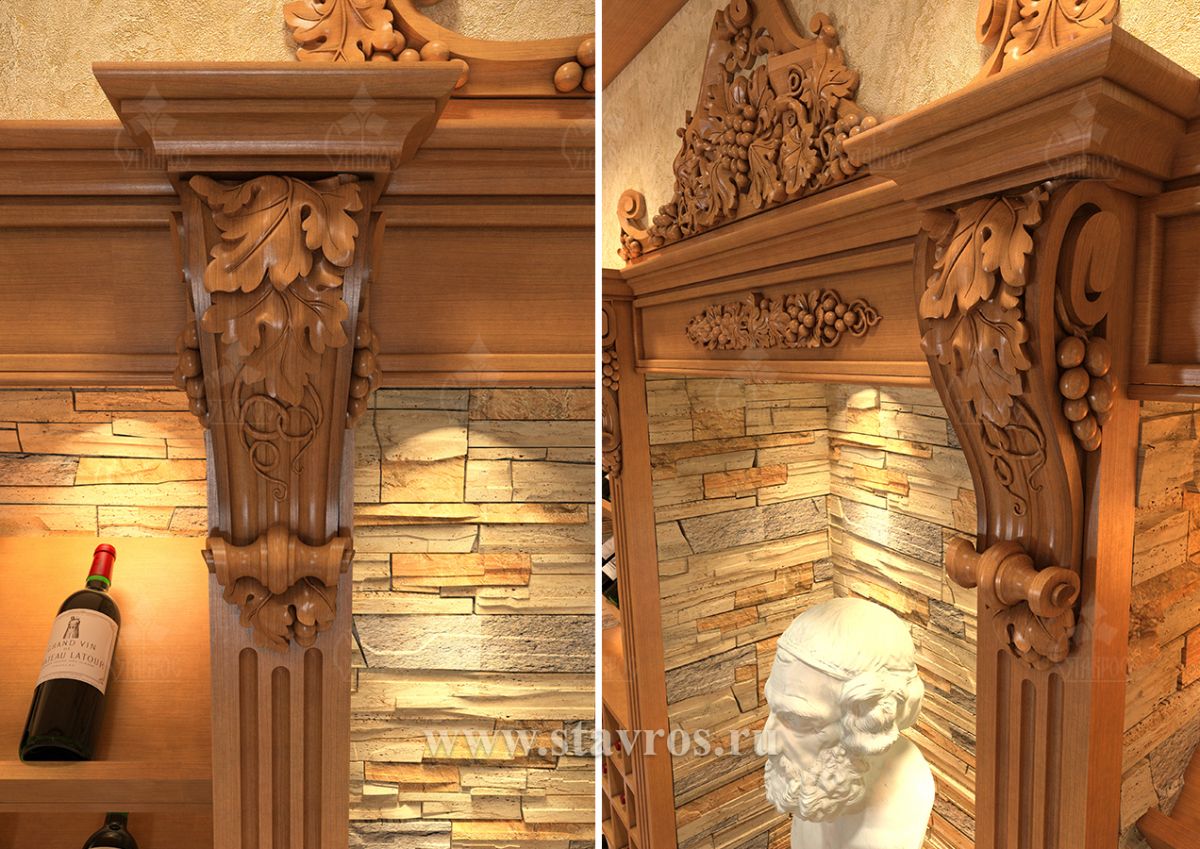
Decorative columns and pilasters, giving the space a monumental quality;
-
Paintings and antique accessories, emphasizing the noble style of the interior.
Tip: To make the interior even more expressive, you can add vintage elements such as old maps of wine regions, antique corkscrews, carved wooden picture frames.
5. Staircase: elegant connection of spaces
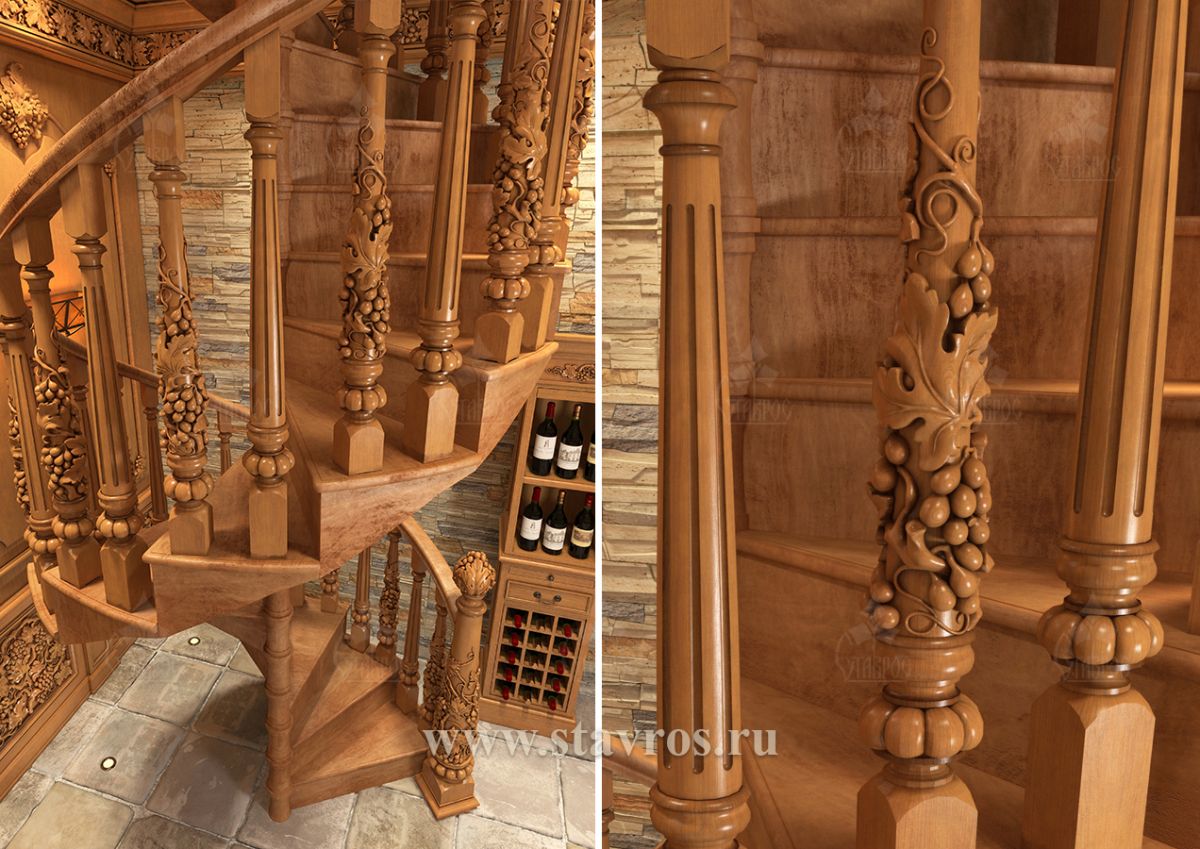
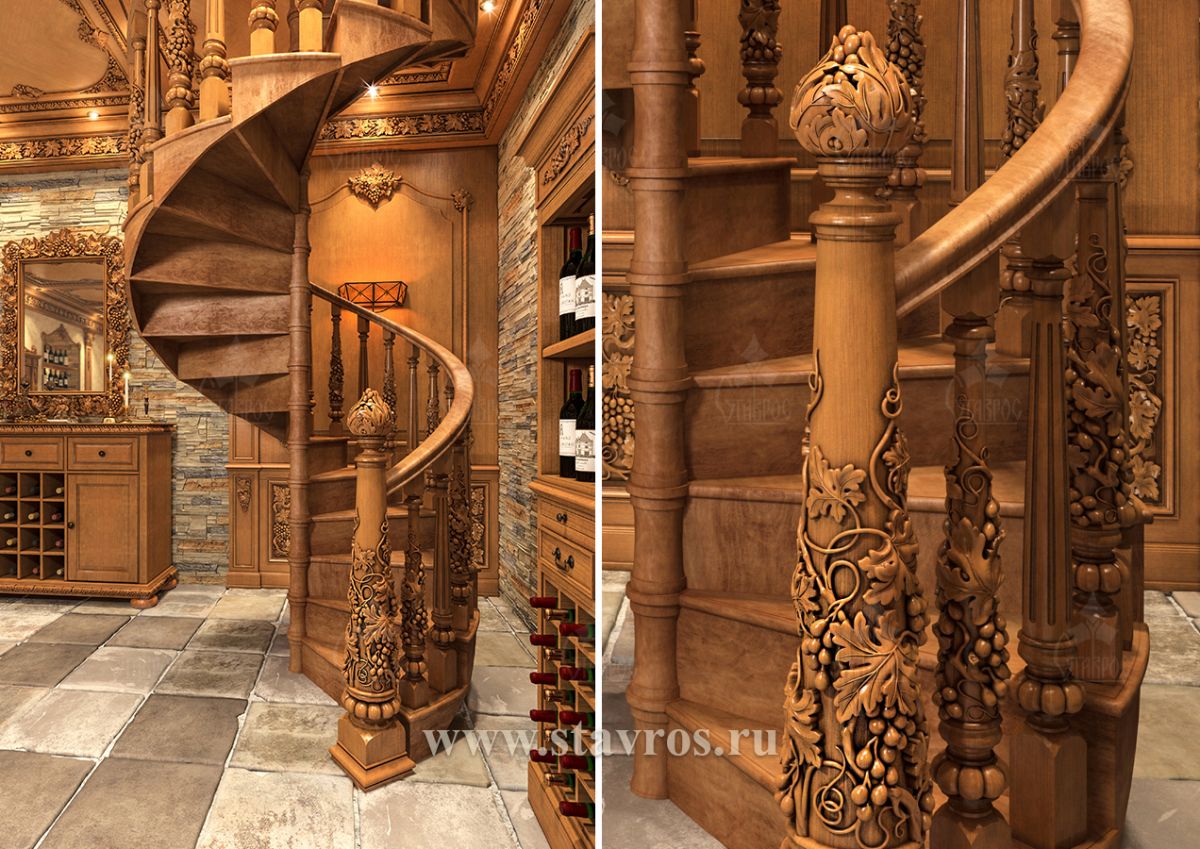
One of the key architectural elements of wine cellar V-001 is the spiral staircase leading to the main room.
Staircase features:
-
Carved balusters with grapevines and scrolls, giving the structure lightness and airiness;
-
Massive steps made of natural wood, ensuring reliability and durability;
-
Luxurious decorative columns adorning the base of the staircase.
This staircase is not just a functional element, but a full-fledged architectural object, combining aesthetics and ergonomics.
Wine cellar V-001 is the ideal balance of functionality and aesthetics. Its architectural concept includes:
✔ Ergonomic storage zone, allowing you to properly organize your collection;
✔ Cozy tasting zone, creating an atmosphere of comfort and elegance;
✔ Luxurious bar counter, which becomes the heart of the interior;
✔ Elegant decorative elements, turning the cellar into a true work of art;
✔ Elegant staircase, giving the space a sense of completion.
This wine cellar is not just a room, but a unique space reflecting status, taste, and love for noble beverages.
Wood carving: embodiment of elegance and style
One of the key features of wine cellar V-001 is the unique artistic wood carving that permeates the interior from walls to ceiling, transforming it into a true work of art. Masters of carving manually created intricate patterns inspired by classical architecture, winemaking traditions, and natural motifs, giving the space a unique appearance.
Carving does not merely decorate the interior, but serves as the central element of artistic design, creating harmony between luxury, history, and functionality.
Exquisite wood carvings
1. Grapevine – symbol of wealth and winemaking traditions
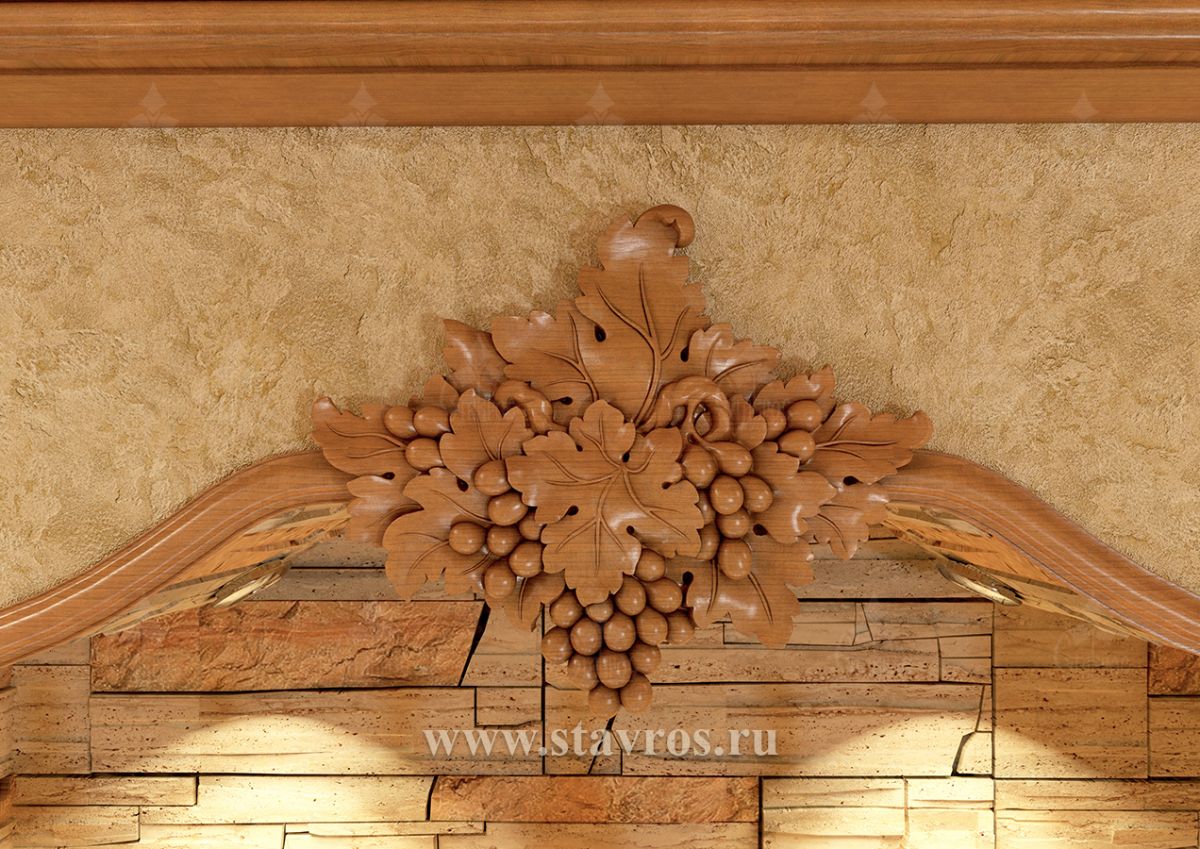
The main decorative theme became grapevines and grape clusters, executed with astonishing detail. This motif symbolizes:
-
Abundance, prosperity, and longevity, especially relevant in the context of wine culture;
-
The heritage and traditions of winemaking, uniting past and present in a single aesthetic concept;
-
Natural beauty, harmony, and authenticity, emphasizing the use of natural materials.
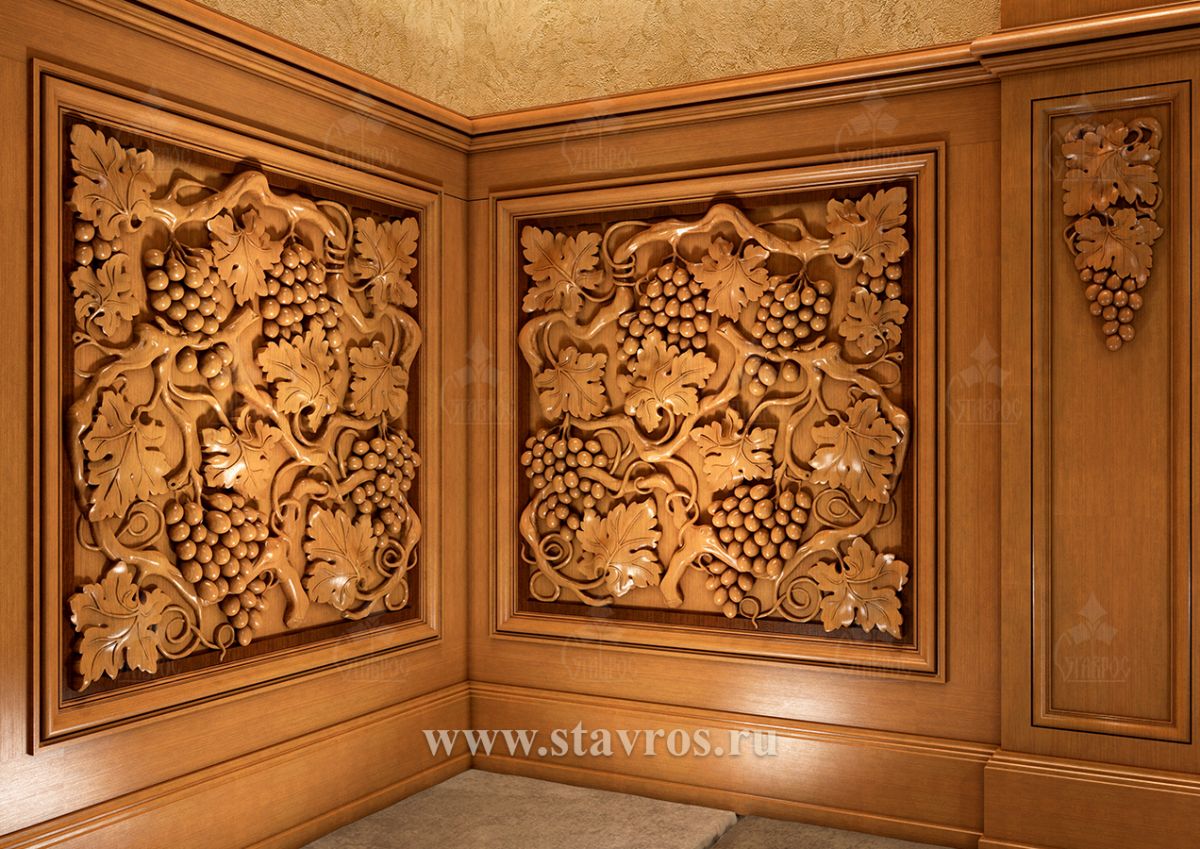
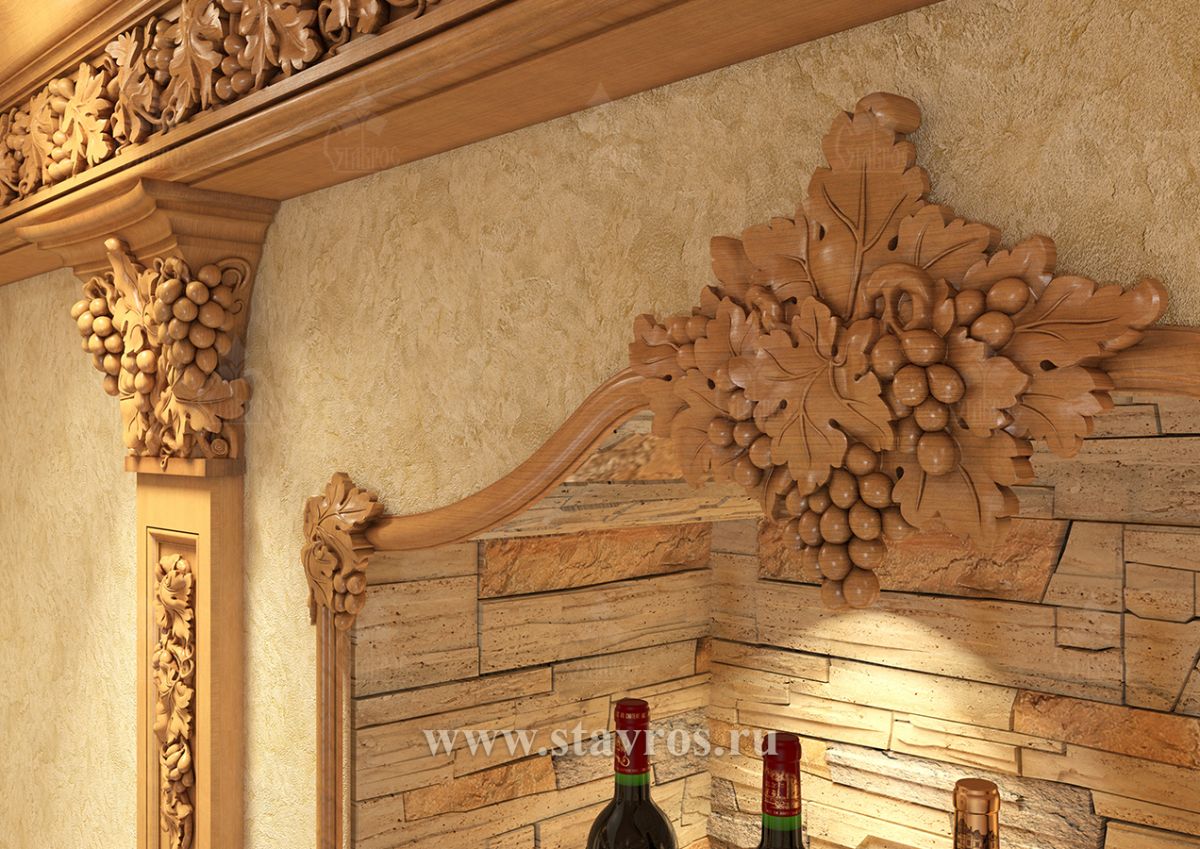
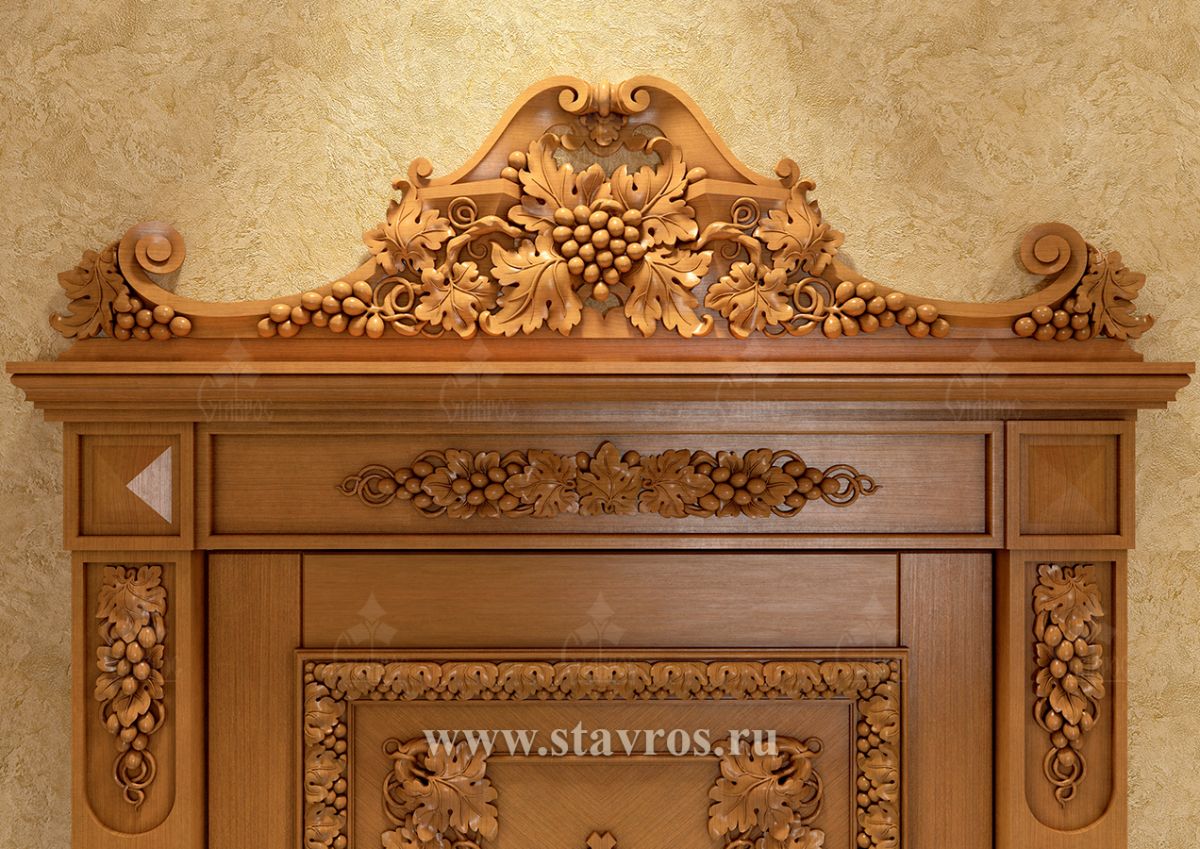
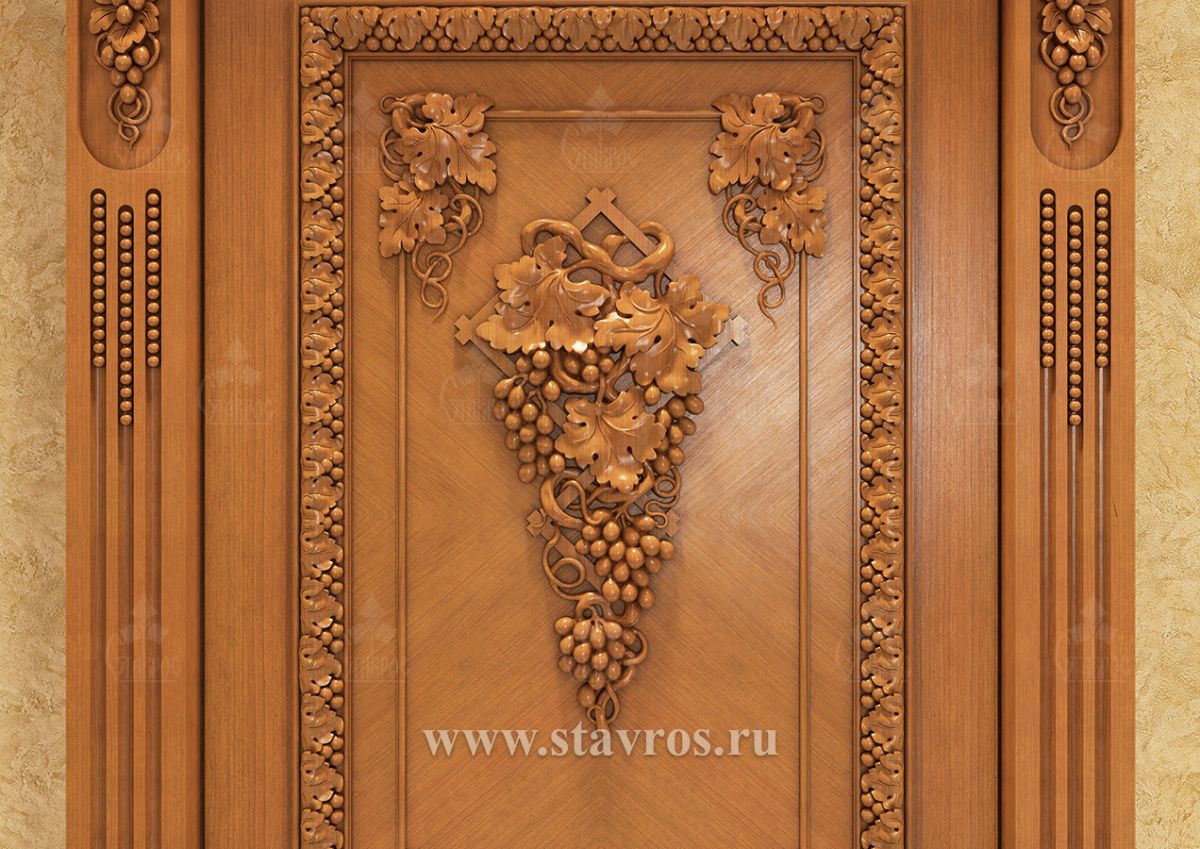
Carvings on wall panels and furniture are executed in the technique of deep relief, making patterns literally 'come alive,' creating volume and dynamism. Leaves, delicate tendrils, and grape clusters appear so realistic that they seem ready to be plucked directly from the wall.
Tip: If you wish to replicate such an effect in your interior, choose hardwoods such as oak, walnut, or mahogany. These materials possess durability, resistance to humidity and temperature fluctuations, which is especially important for wine cellars.
2. Elegant scrolls and floral motifs: embodiment of lightness and elegance
To prevent the interior from appearing bulky, graceful scrolls, leaf ornaments, and floral compositions were used. These patterns create:
-
An airy effect, softening the heaviness of wooden structures;
-
Dynamism and fluidity, making the carving more 'alive';
-
An aristocratic character, evoking the traditions of palace carved interiors.
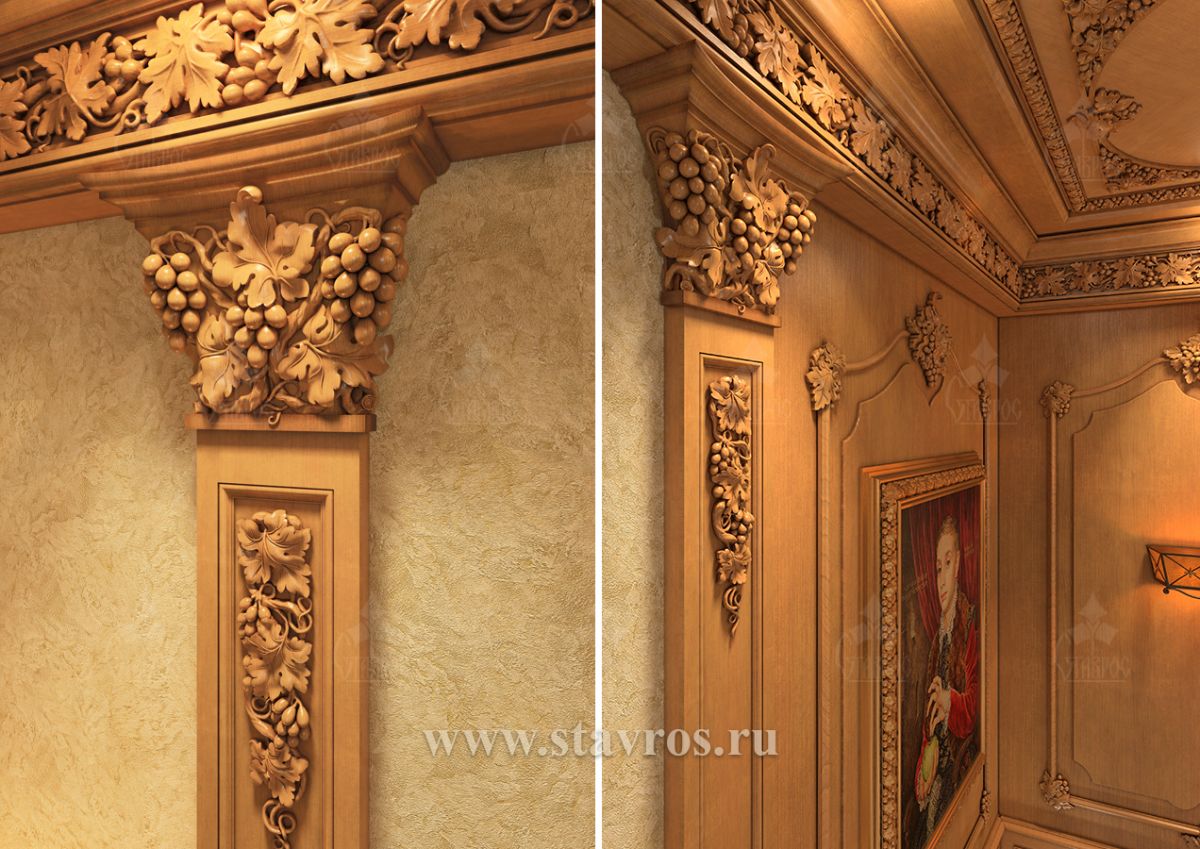
Especially impressive are sculptural elements, where winding vines and leaves seamlessly transition into architectural details, such as column capitals, door frames, and panels.
The carving is additionally patinated, giving the wood an antique and noble vintage tone.
Tip: To achieve an authentic look, you can use artificial aging techniques – patination or distressing. This will create an antique interior effect, ideally suited for a wine cellar.
3. Decorative panels and artistic wall carvings
The true gem of the project are carved panels executed in the technique of three-dimensional relief. They depict scenes inspired by nature, winemaking, and classical motifs.
These elements make the interior truly unique, as each composition was handcrafted, taking into account the architecture of the space and individual preferences.
Decorative panels create:
-
An effect of 'living' wood, making the interior dynamic and expressive;
-
Depth and texture of space, allowing the carving to literally 'project' beyond the plane of the walls;
-
A unique character of the cellar, transforming it into a premium, artist-designed project.
Tip: To enhance the effect of three-dimensional carving, use directional lighting. Spotlights will highlight the relief of patterns, while soft side lighting will create shadow play, adding magical depth to the interior.
4. Carved cornices, columns, and pilasters: architectural luxury
To create a unified stylistic design, carving is not only applied to walls and furniture, but also to architectural elements:
-
Cornices and ceiling moldings, emphasizing the geometry of the space;
-
Pilasters and columns adorned with grape motifs;
-
Carved arches and door frame moldings, creating a palace architectural effect.
Tip: If carved columns are used in the interior, it is important that their proportions match the height of the room. In cellars with low ceilings, half-columns or bas-reliefs are preferable, while in larger spaces, monumental columns with capitals are suitable.
Thread type: deep relief, allowing patterns to protrude beyond the surface, creating maximum detail;
-
Materials: oak, walnut, mahogany, ensuring durability and resistance to microclimate changes in the wine cellar;
-
Finishing: staining, patination, natural oil coating, highlighting the wood texture.
-
Wood carving in the wine cellar V-001 is not merely decorative but the foundation of architectural style. It:
✔ Adds sophistication and elegance to the interior;
✔ Creates an atmosphere of a traditional European wine cellar;
✔ Makes the space truly unique and exclusive.
Makes the space truly unique and exclusive.
Combined with atmospheric lighting, natural materials, and thoughtful zoning, artistic carving makes the wine cellar V-001 a model of luxury and elegance.
Sculptural Atlantes: Power and Elegance in Architecture
Among the most majestic and impressive decorative elements in the wine cellar V-001 are sculptural Atlantes, gracefully supporting ceiling structures and arches. These massive yet refined figures transport us to the era of classical architecture, where monumentality combined with intricate detailing.
The wine cellar, in itself a symbol of patience, nobility, and tradition, is enriched by the historical legacy embodied in the image of the Atlantes. They do not merely decorate the interior—they are its conceptual center, embodying beauty, strength, and the philosophy of time.
1. Symbolism of Atlantes in Architecture and Interior Design
Atlantes as embodiments of strength and eternity
Inspired by classical canons, Atlantes in the interior symbolize power, stability, and longevity. This is especially fitting for a wine cellar, where key values are patience, perseverance, and the art of winemaking.
Historically, Atlantes were used in the architecture of Ancient Greece and Rome, replacing classical columns. They appear in palaces, temples, and public buildings, emphasizing the grandeur and aristocratic character of the space.
In the wine cellar interior, they serve a dual function:
✔ Architectural, acting as load-bearing decorative elements that create a sense of scale and monumentality;
✔ Artistic, highlighting the high status of the owner and the refined interior.
2. Sculptural Details: Anatomical Accuracy and Artistic Expression
Each sculptural Atlante in the project is executed with astonishing detail. These are not merely stylized figures—they are true works of art, inspired by Renaissance and Baroque sculptural traditions.
Anatomical Accuracy
✔ Expressive musculature and dynamic poses – the figures convey physical tension, as if truly supporting the ceiling, yet appear elegant and harmonious;
✔ Detailed facial expressions and emotions – the faces of the Atlantes exude noble dignity, conveying an atmosphere of monumentality and inner strength;
✔ Hand-carved wood – every fold of drapery, curl of hair, and muscle contour is executed with exceptional care, creating the effect of living stone.
Tip: To emphasize the artistic detail of the sculptures, use directional lighting. Side lights or under-lighting will create shadow play, enhancing volume and giving the interior a theatrical effect.
3. Atlantes in Interior Composition
The Atlantes in the wine cellar V-001 are not randomly placed—they are precisely integrated into the architectural composition, creating a harmonious balance between monumentality and coziness.
Main Architectural Zones with Atlantes
-
Supporting arches and vaults – Atlantes become visual and structural supports, organically connecting the ceiling and walls;
-
Bar area decoration – Atlantean figures elegantly frame the bar counter, adding grandeur and evoking the traditions of luxurious European wine cellars;
-
Wall accent elements – bas-relief Atlantes are embedded into wall columns, making the interior visually lighter while preserving the monumental effect.
Tip: In smaller rooms, half-columns with Atlantean bas-reliefs are preferable, while spacious halls can accommodate monumental full-size sculptures that will create a truly palace-like atmosphere.
4. Use of Atlantes in different styles
Although Atlantes historically belong to classical and neoclassical styles, in project V-001 they harmoniously blend with natural materials and wine ambiance.
-
Classical style – strict, symmetrical figures with ancient proportions;
-
Baroque – more detailed, with expressive facial features and drapery;
-
Neorenaissance – a combination of massiveness and gracefulness, ideally suited for a wine cellar.
5. Materials and manufacturing technologies
Atlantes in this project are crafted from solid wood, making them unique and luxurious. Unlike plaster or stone versions, wooden figures possess:
✔ Warmth of texture, creating a cozy atmosphere;
✔ Strength and durability, especially when treated with special oils and varnishes;
✔ Depth of relief, allowing for high-detail patterns and elements.
To protect against humidity, a patina was applied, imparting a noble aged appearance and highlighting fine carving details.
Use of Atlantes in the wine cellar V-001 is not merely an architectural trick, but a deeply considered design solution. They:
✔ Convey a sense of grandeur and monumentality;
✔ Create visual balance between power and elegance;
✔ Emphasize the owner’s status, forming an atmosphere of luxury.
Combined with decorative carving, natural materials, and expert lighting, sculptural Atlantes become the central accent of the interior, transforming the wine cellar into a true work of art.
Staircase: a masterpiece of wood carving
Wine cellar V-001 is not merely a storage space for a wine collection, but a work of art where every detail is meticulously considered. One of the key architectural elements defining the character and grandeur of the space is the exquisite wooden staircase leading to the main cellar area.
This spiral staircase is not merely a functional necessity, but a central art object within the interior, combining functionality, aesthetics, and the traditions of European wine cellars.
1. Architectural significance of the staircase in the interior
The staircase not only serves a practical role in connecting floors, but also becomes a true ornament of the wine cellar. It sets the tone for the entire space, creating an atmosphere of coziness, aristocracy, and refinement.
Why exactly a spiral shape?
-
A spiral staircase is ideally suited for limited spaces, allowing maximum efficient use of area;
-
The twisted geometry adds dynamism and plasticity to the interior, creating a sense of movement and lightness;
-
Such a design emphasizes the elegance of the cellar and resonates with wine traditions, as the spiral shape evokes a grapevine winding around a support.
2. Artistic carving: richness of details and symbolism
The main aesthetic feature of the staircase is its unique wood carving, which makes it a fully-fledged artistic element of the interior.
What carved elements decorate the staircase?
✔ Luxurious grapevines, gracefully winding around balusters, symbolize abundance, fertility, and the art of winemaking;
✔ Grape clusters crafted in relief technique create a "living" wood effect, enhanced by play of shadows;
✔ Elegant scrolls and ornamental patterns inspired by classical and baroque carving add refinement and dynamism to the staircase;
✔ Carved columns at the base of the staircase, shaped like intertwined grapevines with acanthus leaves, create a sense of monumentality and structural stability.
Tip: To achieve a similar artistic carving effect, use hardwoods such as oak, beech, or walnut. These species offer high strength, moisture resistance, and allow for fine detailing in carving.
3. Balusters: Refined details creating an atmosphere
Staircase balusters are not merely railing elements, but finely crafted sculptural miniatures that continue the wine-themed interior motif.
What makes them special?
-
Hand-carved wood using deep relief technique — patterns literally "grow" from the wood block, creating a three-dimensional effect;
-
Fine detailing of the smallest elements, including leaves, clusters, and vine stems, makes balusters unique and lifelike;
-
Ideal proportions and symmetry, ensuring aesthetic harmony and structural integrity.
Thanks to these elements, the staircase appears light and delicate, yet remains reliable and durable.
Tip: To emphasize the beauty of the carving, consider patination — an artificial aging technique for wood. Light golden or dark tones on the relief will add expressiveness to the patterns.
4. Steps: Massiveness and smooth curves
The foundation of the staircase — massive wooden steps — possess not only strength but also a distinctive aesthetic.
Step features
✔ Smooth curves, perfectly mirroring the natural spiral lines, make the staircase ergonomic and safe;
✔ Absence of sharp angles emphasizes the softness and refinement of the form, lending elegance to the interior;
✔ Oil and wax treatment provides a natural shimmer to the wood texture, highlighting the depth of the grain pattern.
Each step on this staircase becomes comfortable and smooth, which is especially important for wine cellars, where maximum stability is required when descending with wine bottles.
Tip: To achieve a similar luxurious step effect, choose wood with a dense grain, such as oak or teak. These woods offer high durability and can retain their aesthetic appeal for decades.
5. Columns and support elements: Artistic monumentality
Decorative columns at the base of the staircase
✔ Executed in the form of twisted grapevines, creating a seamless transition of carving from one element to another;
✔ Supporting capitals are adorned with large leaves and clusters, symbolizing abundance and prosperity;
✔ Deeply worked texture achieves a three-dimensional effect, creating a rich architectural image.
Such columns make the staircase not merely functional, but status-enhancing, transforming it into the central element of the wine cellar’s interior.
6. Staircase lighting: Play of light and shadow
Proper staircase lighting allows:
✔ Highlight the depth of the carving – soft directional lighting creates contrast and dimensionality of elements;
✔ Create a 'floating structure' effect – built-in lighting under the steps makes the staircase visually light and weightless;
✔ Ensure safe movement by adding functional comfort.
Tip: For wine cellars, warm lighting tones (2700–3000K) are ideal, creating an atmosphere of coziness and intimacy.
Wine cellar V-001 is a place where every interior element becomes part of an artistic composition. The spiral staircase in this project does not merely connect levels, but unifies the space, adding elegance, smooth lines, and luxurious charm to the interior.
✔ Carved balusters with grapevine motifs create an atmosphere of elegance and dynamism;
✔ Massive steps ensure strength, reliability, and comfort;
✔ Monumental columns transform the staircase into the central accent of the wine cellar.
This masterpiece of wood carving, architectural craftsmanship, and engineering precision becomes a symbol of classic elegance and the owner's status, making the wine cellar a truly unique space for true connoisseurs of wine and art.
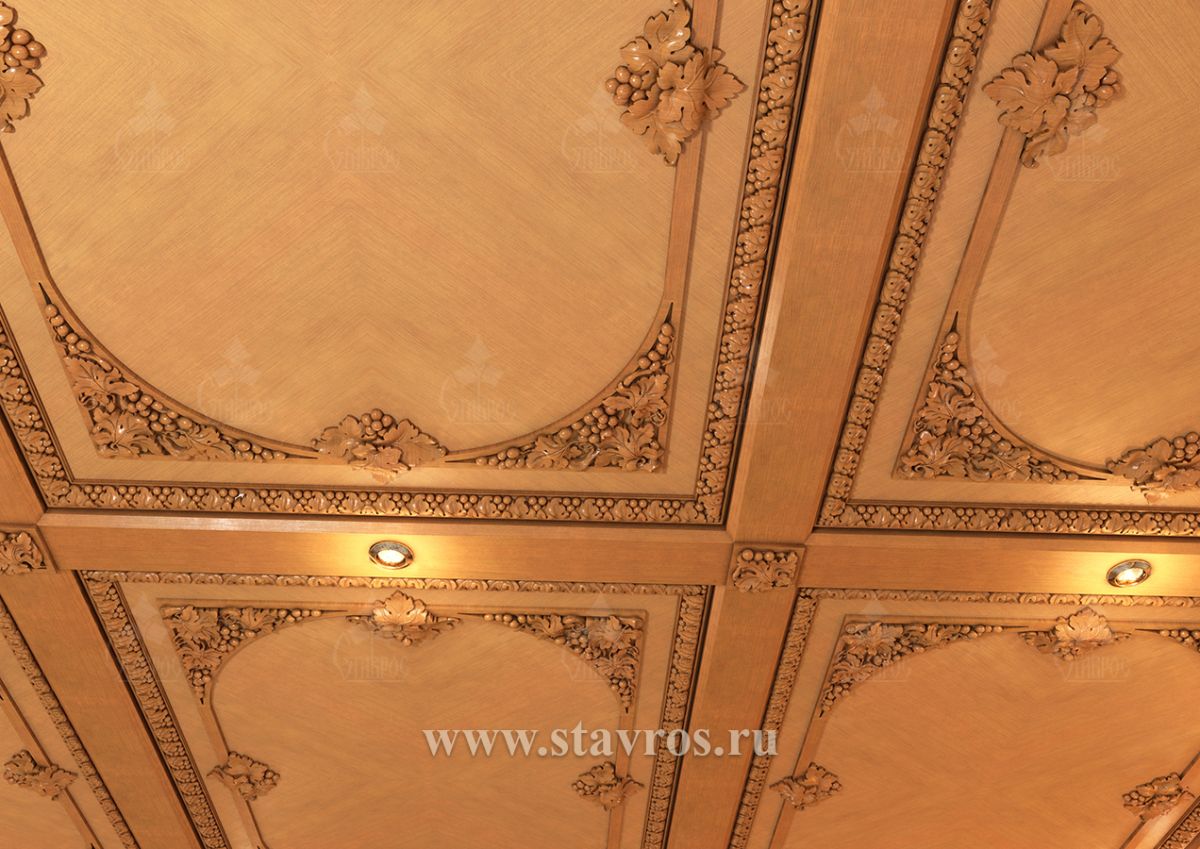
Ceiling: Decorative perfection
The ceiling in the wine cellar V-001 is not merely a structural element, but a true work of art playing a key role in creating the overall atmosphere of the space. In this interior, the ceiling has been transformed into an independent decorative object, astonishing for its delicacy of execution, richness of details, and harmony of forms.
It does not merely complete the composition – it enhances the effect of monumentality, refinement, and aristocracy, setting the right mood for enjoying noble wines.
1. Ceiling architectural style: balance of classicism and luxury
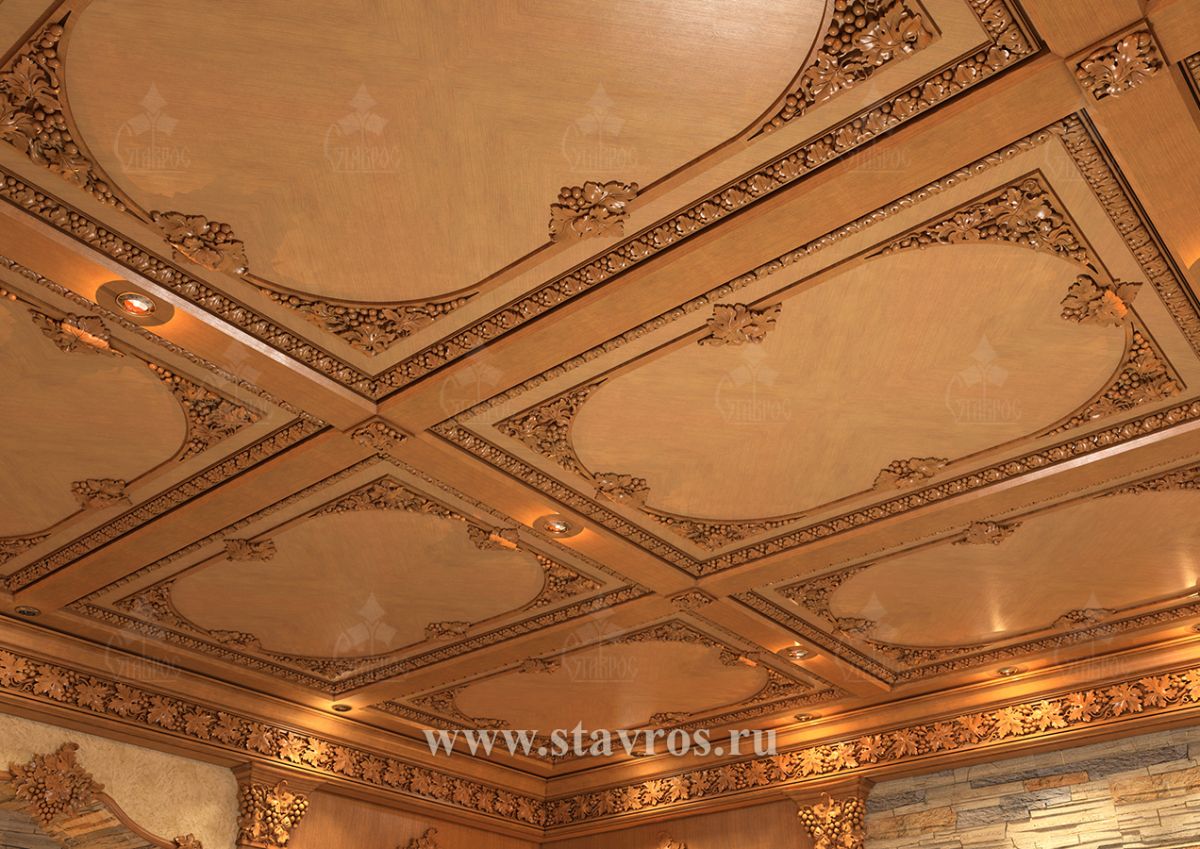
The ceiling in project V-001 is designed in a classical style, inspired by the architecture of palaces and wine cellars of old Europe. Its design incorporates:
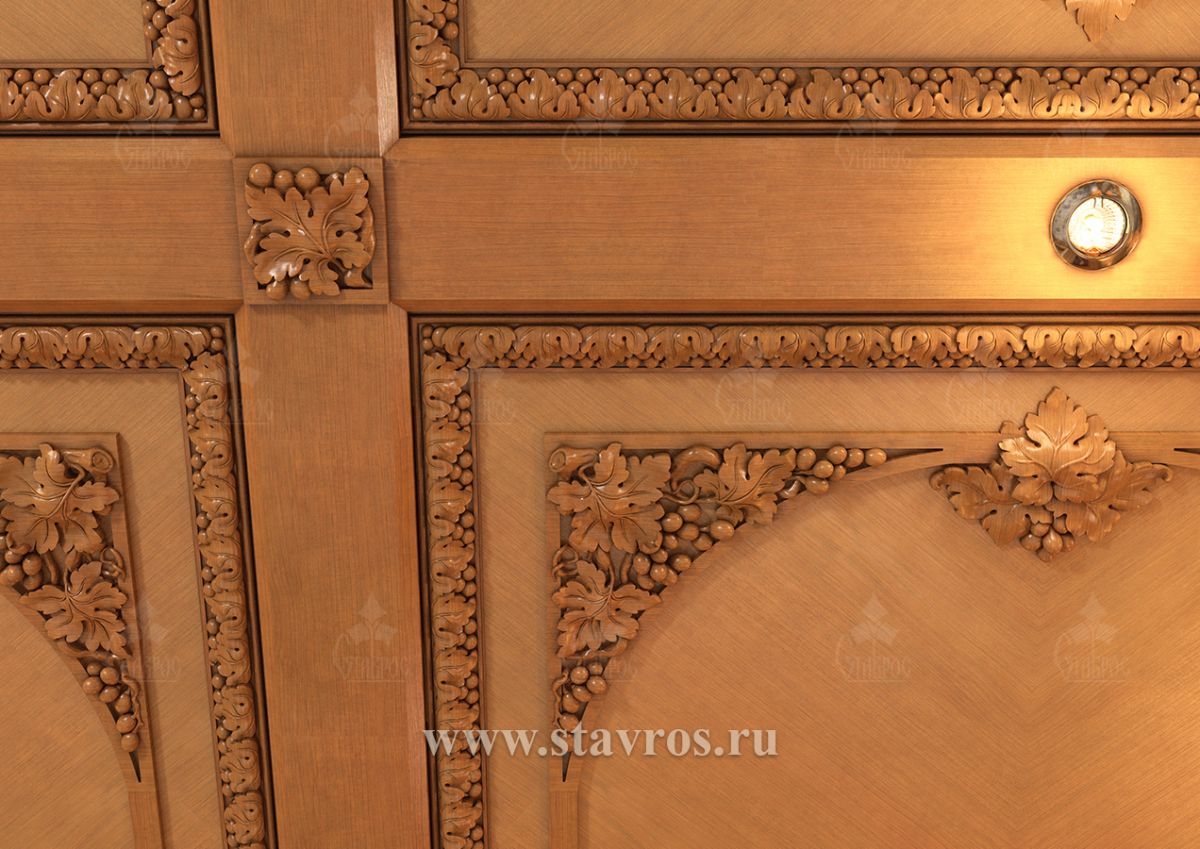
✔ Carved panels with deep ornamentation, giving the ceiling expressiveness and artistic completeness;
✔ Decorative moldings and cornices, creating a sense of volume and emphasizing the geometry of the space;
✔ Ornamental inserts forming an exquisite relief and visually increasing the ceiling height;
✔ Hidden LED lighting gently highlighting the structure of the carving and adding depth and intimacy to the space.
Thanks to the careful selection of decorative elements, the ceiling does not merely serve as a backdrop, but becomes a key element of the architectural composition, unifying all interior elements into a single artistic space.
2. Carved ornaments: art in every detail
The main decoration of the ceiling is intricate wood carving executed in the technique of deep relief. It creates a sense of volume, adds expressiveness to details, and emphasizes the interior’s aesthetics.
What decorative elements were used?
✔ Grapevine with clusters – a classic symbol of abundance, prosperity, and winemaking traditions;
✔ Acanthus leaves and floral patterns, giving the ceiling elegance and lightness;
✔ Elegant baroque scrolls, creating a sense of fluidity and luxury;
✔ Carved panels with three-dimensional reliefs imitating ancient vaults of medieval wine cellars.
This unique carving makes the ceiling a key element of the wine cellar’s artistic design, transforming it into a true masterpiece of interior art.
Tip: If you want to achieve a similar effect, choose natural hardwoods – oak, walnut, or teak. They hold their shape well, ensuring the longevity and durability of carved elements.
3. Decorative cornices and moldings: harmony and structure
One of the important elements of ceiling decoration are carved cornices and moldings, which:
✔ Create smooth transitions between walls and ceiling, giving the interior a sense of completeness and cohesion;
✔ Add additional volume and depth, visually expanding the space;
✔ Decorate the ceiling with delicate ornamental patterns that repeat the main carving motifs in the interior.
The cornices are adorned with grapevine and leaf motifs, making them a unified decorative ensemble with the other elements of the wine cellar.
In addition, moldings were used to divide the ceiling panels into segments. This gives the composition clarity, structure, and symmetry, creating the effect of a classical vault.
Tip: To enhance the artistic effect, you can tone the carvings and moldings with contrasting shades—for example, using patina or gilding, which will emphasize the patterns' three-dimensionality.
4. Lighting design: focus on details and cozy atmosphere
Lighting plays a key role in perceiving the ceiling. Here, a complex lighting system has been designed to highlight the depth of the carvings and create an intimate atmosphere.
What lighting solutions were used?
✔ Built-in spotlights softly illuminate carved elements and create shadow play;
✔ Hidden LED lighting along the perimeter, adding depth and lightness to the ceiling;
✔ Warm light (2700–3000K), which effectively highlights wood tones and makes the interior truly cozy.
Thanks to this lighting system, the ceiling becomes 'alive'—the interplay of light and shadow makes each carving element expressive, three-dimensional, and detailed.
Tip: To create a soft glow effect, use hidden LED strips in warm tones. This will visually lift the ceiling and create an atmosphere of comfort and coziness.
5. Final touch: architectural harmony of the ceiling
Wine cellar V-001 is an example of perfect harmony between aesthetics and functionality, and the ceiling here plays a key role in forming an atmosphere of luxury, coziness, and elegance.
✔ Carved ornaments and three-dimensional inserts give the ceiling artistic expressiveness;
✔ Decorative cornices and moldings create overall interior harmony;
✔ Warm lighting and lighting accents make the space truly cozy and atmospheric.
This ceiling is not just part of the architectural ensemble, but a true masterpiece that highlights the owner's refined taste and the uniqueness of the wine cellar's interior.
The ceiling in project V-001 is a true example of decorative art, where every detail is thought out to the smallest nuances. It sets the mood of the entire space, enhancing its aristocratic and status-oriented character.
This decorative element not only adorns the wine cellar but also makes it absolutely unique, transforming the wine storage space into an interior design art gallery.
A wine cellar is not just a room, but a place where art, tradition, and elegance merge into one, creating the ideal space for wine connoisseurs.
Wine storage: combination of aesthetics and functionality
Wine cellar V-001 is not just a luxurious interior, but a thoughtfully designed space where design harmoniously combines with functionality. Here, every detail is created with consideration for proper wine storage conditions, ensuring optimal aging conditions and convenient organization of the collection.
Wine storage is an entire science, including proper bottle placement, temperature and humidity control, appropriate lighting, and convenient access. In this project, all these nuances have been taken into account, making the cellar an ideal place for long-term storage and aesthetic enjoyment of the wine collection.
1. Construction and zoning: thoughtful space organization
For convenience and efficiency of storage in the cellar, several specialized zones have been provided, each serving its unique function.
✔ Main wine racks—spacious structures designed for horizontal and angled bottle placement, ensuring optimal aging conditions;
✔ Grid racks and niches—allow convenient organization of the collection by variety, region, and aging;
✔ Closed cabinets – used for storing wine accessories, including corkscrews, glasses, decanters, stoppers, and thermometers;
✔ Bar area – combines open shelves for displaying premium wines and closed sections for special wines;
✔ Cooling zones – separate sections maintaining optimal temperature for storing white and sparkling wines.
Why is zoning important?
Dividing the wine cellar into different functional zones not only allows convenient storage organization but also creates comfortable conditions for tasting. Such a solution transforms the cellar from a simple storage space into a full-fledged area for enjoying wine culture.
2. Optimal bottle positioning: horizontal and inclined
One of the key aspects of proper storage is bottle placement. In project V-001, two types of positioning are provided:
✔ Horizontal storage – used for most wines. This position ensures contact between wine and cork, preventing it from drying out and maintaining bottle seal;
✔ Inclined storage – used for wines requiring special aging. This angle allows controlling sediment and minimizing its movement, which is especially important for old collector wines.
Tip: When designing a wine cellar, it is important to provide inclined shelves – they provide the best storage conditions and add aesthetic completeness to the interior.
3. Finishing materials: maintaining microclimate
The correct choice of materials plays a crucial role in maintaining stable temperature and humidity inside the cellar. In project V-001, only natural, durable materials suitable for wine storage are used:
✔ Natural stone – used for wall and storage zone finishes. It naturally regulates humidity, creating a stable microclimate;
✔ Hardwood (oak, walnut, teak) – used for shelves and cabinets. It is resistant to changes in humidity and temperature;
✔ Wrought metal elements – used for decorating individual sections, giving the interior a vintage style.
Why natural stone?
This material not only highlights the elegance of the interior but also helps maintain an optimal temperature within 10-14°C. Stone heats and cools slowly, creating natural thermoregulation, which is crucial for storing collector wines.
Tip: If your cellar is located in a residential building, it is important to install a climate control system to avoid temperature fluctuations.
4. Humidity and climate control: protecting the collection
A wine cellar must maintain stable humidity at 60-70%. This prevents cork drying and mold formation.
What systems are used in V-001?
✔ Automatic humidity control system, maintaining optimal evaporation levels;
✔ Built-in thermometers and hygrometers, allowing real-time monitoring of the microclimate;
✔ Special ventilation grilles, ensuring air circulation and preventing moisture stagnation.
Thanks to these solutions, the collection is reliably protected from adverse external factors, and each bottle matures under ideal conditions.
Tip: If the cellar is located in a heated room, install an air conditioning system to avoid overheating the wine.
5. Lighting: soft light without overheating
When designing a wine cellar, lighting must be considered, as wine is sensitive to ultraviolet light and heat. In V-001, a special lighting system was used, which guarantees the preservation of the collection and highlights the interior’s aesthetics.
✔ Spotlights with warm light (2700-3000K) – create soft backlighting without overheating bottles;
✔ LED shelf lighting – adds depth and visual lightness to the composition;
✔ Hidden lighting panels highlight the texture of stone and wood carvings, creating a unique atmosphere.
Why can't bright light be used?
Intense lighting can heat bottles, negatively affecting the chemical processes inside the wine. Therefore, fixtures with low heat transfer were used in the project, which do not affect the room's temperature.
Tip: To enhance the decorative effect, you can use a smart lighting system that allows adjusting brightness according to the time of day and usage scenarios of the wine cellar.
The wine cellar V-001 is an example of the perfect combination of functionality and aesthetics. Here, every detail is thought out to the smallest extent to ensure proper storage conditions and create a luxurious atmosphere for enjoying wine.
✔ Proper zoning allows convenient distribution of the collection and accessories;
✔ Sloped and horizontal shelves ensure optimal bottle positioning;
✔ Natural stone and wood support a natural microclimate;
✔ Climate control and lighting protect wine from external factors.
This wine cellar is not just a storage space, but a true space for wine connoisseurs, where every bottle becomes part of an aesthetic experience.
A true wine cellar is not only a wine collection, but also an atmosphere, traditions, and the art of creating an ideal space.
Conclusion: The wine cellar as a reflection of taste and traditions
The wine cellar V-001 is much more than just a place to store wine. It is a refined space where centuries-old winemaking traditions, artistic carvings, and luxurious architecture intertwine. Each element here has its own history and meaning, creating a unique atmosphere for connoisseurs of fine beverages.
The wine cellar as an art of space
This interior combines aesthetics, traditions, and functionality, transforming an ordinary storage space into a work of art. Here, every detail is carefully considered to create a unique atmosphere of comfort and elegance.
✔ Elegant wood carvings fill the space with depth and character, symbolizing abundance and winemaking culture;
✔ Sculptural Atlantes emphasize the monumentality of the interior, symbolizing stability, strength, and time;
✔ Elegant ceiling cornices add architectural completeness, creating refined decoration;
✔ The spiral staircase becomes a true work of art, connecting levels of space and adding dynamism to the interior;
✔ Functional wine shelves provide ideal storage conditions and highlight the aesthetics of the collection.
This wine cellar is not just a room. It is a place for relaxation, enjoyment, and immersion in the world of wine, where every bottle has its own story.
For those who appreciate exclusivity
Creating a wine cellar is not just about designing space, but about creating an atmosphere where every detail plays its part. If you dream of a truly exclusive interior, it is important to pay attention not only to functionality, but also to artistic design.
✔ Using natural materials such as wood, stone, and metal will give the space a unique aesthetic and longevity;
✔ Proper zoning and lighting will help create a cozy atmosphere for tastings and gatherings;
✔ Architectural elements such as columns, Atlantes, and carved ceilings add depth and aristocracy.
The wine cellar V-001 is not just an interior. It is a place where winemaking traditions come alive, creating a space filled with history, character, and flavor.
A true wine cellar is not only a wine storage, but also a reflection of status, taste, and respect for the culture of noble beverages.