Article Contents:
- Evolution of the Lathe
- Woodturning as an Art
- Types of Woodturning: Variety of Possibilities
- Turning Between Centers
- Cup Turning
- Segment Turning
- Ornamental Turning
- Materials for Woodturning: Choosing Wood
- Hardwoods
- Softwoods
- Process of Woodturning: From Idea to Finished Product
- Exotic wood species
- Concept Development and Sketching
- Types of Products: What You Can Order from a Woodturner
- Material preparation
- Turning processing
- Final finishing
- Furniture Parts
- Household Items
- Souvenirs and Gifts
- Artistic Items
- Advantages of Ordering Woodturning from Professionals
- High-Quality Execution
- Individual approach
- High quality execution
- Ecological and natural properties
- Durability and practicality
- How to Choose a Master for Woodturning
- Portfolio and Work Experience
- Reviews and recommendations
- Communication and Understanding Your Needs
- Price and Delivery Time
- Conclusion: Art Tested by Time
Have you ever wondered how those exquisite wooden items that catch your eye in interiors are created? Carved legs of an antique table, elegant balusters of staircases, graceful cups and vases with perfectly smooth surfaces — all these items share one thing: they are crafted by woodturning masters.Custom Woodturning It is a wonderful symbiosis of ancient craftsmanship, artistic vision, and modern technology, allowing to bring almost any idea to life.
Over half a century of working with wood, I have witnessed how technologies, tools, and clients' preferences have changed, but one thing remained unchanged — the magic of transforming an ordinary piece of wood into a work of art. This magic is accessible to anyone who decides to order a unique piece from a professional woodturner.
Spring 2025 brought a new wave of interest in natural materials and handcrafted work. In an era of mass production and standardized solutions, people increasingly value individuality, eco-friendliness, and soulfulness that only a handmade item can offer. That is whyCustom Woodturning Today, they are experiencing a true renaissance, returning to our homes as exclusive furniture, interior items, and decorative elements.


Turning Art: From Origins to Our Days
The history of turning goes back to deep antiquity. Archaeological findings indicate that the first primitive turning lathes appeared in ancient Egypt around 1300 BCE. These devices were remarkably simple: the workpiece rotated using a rope, one end attached to a bowstring, and the other to a pedal. By pressing the pedal, the craftsman set the workpiece in motion and shaped it with a cutting tool.




Evolution of the Turning Lathe
Over time, lathe designs improved. In the Middle Ages, lathes appeared that converted reciprocating motion into rotary motion, significantly easing the work of craftsmen. A true breakthrough occurred in the 18th century, when the first turning copying machines were developed.
The Industrial Revolution brought new technologies: in the early 19th century, a tool carriage was installed on the lathe, greatly improving processing accuracy. With the advent of electricity, turning lathes received electric drives, making work even more efficient.
Today, craftsmen use both simple tabletop lathes for home use and complex industrial machines with computer numerical control (CNC). However, regardless of technical sophistication, the essence of turning remains unchanged: a rotating workpiece is shaped using a cutting tool to achieve the desired form.
Our factory also produces:


Turning as an Art
Interestingly, turning developed in parallel across different cultures, acquiring unique characteristics and traditions. In Russia, turning products were always distinguished by exceptional decorative qualities and vividness. Russian masters created not just functional items, but true works of art, adorned with carving, painting, and inlay.
In England, woodturning reached its peak during the Victorian era. Victorian furniture with finely turned details is still considered the epitome of elegance and quality. And in Japan, woodturning became part of the philosophy of minimalism and the natural beauty of the material.
The speed of woodturners even gave rise to the expression 'to turn balusters' or 'baluster-chatter,' which today is used to denote idle chatter. But behind this apparent ease lies years of experience and skill, enabling the creation of complex forms with astonishing speed and precision.
Get Consultation
Types of Turning Work: A Wide Range of Possibilities
Modern Custom Woodturning Offer a wide range of possibilities for creating diverse items. Let's consider the main types of turning work that professional craftsmen can perform.
Turning Between Centers
This is a classic turning method, where the workpiece is secured between the headstock and tailstock of the lathe. This method is used for creating long cylindrical parts, such as:
- Legs of tables and chairs
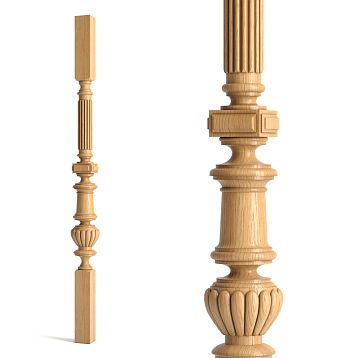
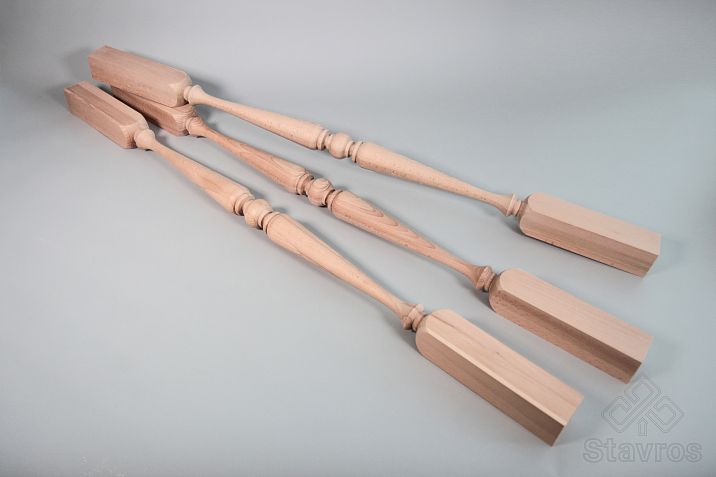
- Staircase balusters
- Columns and half-columns for furniture
- Tool handles
- Coffers and Panels
In this turning method, wood fibers run parallel to the axis of rotation, ensuring maximum strength of the finished product. The process typically begins by giving the blank a cylindrical shape using a half-round gouge (reys), followed by profiling and final surface finishing.
Bowl Turning
Bowl turning (or turning in a chuck) is used to create hollow forms — bowls, vases, boxes, plates. In this method, the workpiece is secured in the chuck from only one side, allowing processing of its inner surface.
This type of turning requires special skill, as the work is performed on a cantilevered blank, which creates additional vibrations. Moreover, when working on the internal surface, the cutter is outside the turner's line of sight, and turning is largely done "by feel," relying on sound and material resistance.
Bowl turning allows creating:
- Decorative and functional bowls
- Vases of various shapes
- Boxes and small containers
- Plates and dishes
- Candlesticks and candelabras
Segmental Turning
Segment turning is a technique in which an item is created from multiple individual segments glued together. This method allows creating complex forms using different types of wood, creating beautiful color and texture combinations.
Segment turning requires precise calculation and preparation of each segment, but opens practically limitless possibilities for creativity. With its help, unique decorative items are created that cannot be obtained from a single piece of wood.
Ornamental Turning
Ornamental turning is the creation of decorative elements using special fixtures, such as ornamental lathes or attachments. This technique allows creating various patterns, spirals, waves, and other decorative elements on the surface of the item.
Ornamental turning requires special equipment and skills, but the results of this work always impress with their complexity and beauty.
Materials for Turning Work: Choosing Wood
Choosing the right wood is one of the key aspects of turning work. Each wood species has its own characteristics that affect the processing and final result.
Hardwoods
Hardwoods are typically used for creating items requiring high strength and durability, as well as for parts with delicate elements:
- Oak — a classic choice for furniture parts. It is characterized by high strength, distinct grain, and good resistance to moisture. Oak is ideal for making table legs, chair legs, and balusters.
- Ash — has a beautiful grain and high strength. It is well-suited for turning, allowing the creation of complex-shaped parts.
- Buck - dense and hard wood with a uniform structure. Ideal for turning details requiring high precision.
- Maple - hard, light-colored wood with a silky sheen. Used for creating high-quality decorative items.
- Walnut - noble dark wood with an attractive grain. Perfect for creating luxury interior items.
Softwoods
Softwoods are easier to work with and allow for creating complex shapes with less effort:
- Linden - very popular for turning due to its softness and uniform structure. Ideal for beginners and for creating complex decorative elements.
- Willow - soft wood with a beautiful pinkish hue. Easily workable and used for making tableware, boxes, and souvenirs.
- Spruce - affordable coniferous wood with a distinct texture. Suitable for creating inexpensive items and for learning turning.
Exotic Wood Species
For creating especially valuable and unique items, exotic wood species are used:
- Padauk - hard wood with a beautiful purple-brown color. Used for creating luxury interior items.
- Ebony (black wood) - one of the hardest and densest black-colored wood species. Used for creating exclusive items and inlays.
- Zebrawood - exotic wood with a contrasting striped pattern. Ideal for creating decorative items.
Turning process: from idea to finished product
The process of custom wood turning includes several stages, each requiring attention, patience, and skill.
Concept and sketch development
First stage - developing the concept of the future item. At this stage, the client and craftsman discuss:
- Purpose of the item
- Desired shape and dimensions
- Choice of wood species
- Design features
- Timeline for completion
- Project budget
Based on these discussions, a sketch or drawing of the future item is created and agreed upon with the client. In some cases, a 3D model may be created for a more vivid representation of the final result.
Material preparation
Material preparation - an important stage, the quality of which largely determines the quality of the finished product. The wood must be well-dried (to a moisture content of 8-12%), free of visible defects such as cracks, rot, or loose branches.
For turning between centers, the blank is given a shape close to cylindrical, and center holes are drilled at the ends for mounting on the lathe. For bowl turning, the blank is given a shape as close as possible to the future item's shape, which allows reducing processing time and decreasing tool load.
Turning operation
Turning operation is the main stage of creating the item. It includes several operations:
- Rough turning - removal of excess material and shaping the blank to a form close to the future item. Performed using a half-round chisel (reaper).
- Finishing turning - forming the final shape of the item using various cutters. At this stage, the turner’s skill, ability to feel the material, and capacity to create smooth, harmonious lines are evident.
- Sanding - performed directly on the lathe, while the item rotates, using abrasive materials of various grits - from coarse to the finest. The goal of sanding is to create a perfectly smooth surface without tool marks.
Final finishing
Final finishing gives the item a finished appearance and protects it from external influences. It may include:
- Staining - changing the color of the wood using stains or dyes
- Oil finishing - highlights the natural beauty of the wood and protects it from moisture
- Polishing - creates a protective film on the surface of the item
- Waxing - gives the item a matte sheen and a pleasant to-the-touch surface
- Polishing - creates a glossy surface that highlights the wood's texture
The choice of finishing method depends on the item's purpose, wood species, and the client's preferences.
Types of items: what you can order from a turner
Modern turners can create almost any wooden item, from simple functional objects to complex artistic compositions.
Furniture parts
Turning parts are widely used in furniture manufacturing:
- Legs of tables and chairs
- Staircase balusters
- Columns and half-columns
- Coffers and Panels
- Decorative furniture elements
It is precisely turned parts that often define the style of furniture, giving it distinctive characteristics of classicism, baroque, empire, or modernism.
Household items
Items of household, created on a lathe, include:
- Tableware — bowls, plates, salt cellars, pepper mills
- Kitchen utensils — graters, mashers, mortars with pestles
- Candlesticks and candelabras
- Boxes and small storage containers
- Flower vases and decorative vases
These items combine functionality and aesthetic appeal, bringing elements of natural beauty and handcraft into everyday life.
Souvenirs and gifts
Turning items often become beautiful souvenirs and gifts:
- Chess pieces
- Decorative eggs
- Miniature boxes
- Keychains and pendants
- Writing utensils - pens, pencils, seals
Such gifts are valued for their uniqueness, the warmth of natural materials, and the craftsmanship invested in them.
Artistic items
At the highest level of craftsmanship, turning woodwork becomes true art:
- Sculptural compositions
- Decorative Panels
- Artistic vases of complex shapes
- Hollow forms with openwork carving
- Combined items with elements of inlay, carving, and painting
Such works are exhibited in galleries, participate in competitions and exhibitions, and become part of museum collections.
Advantages of ordering turning work from professionals
Ordering turning work from professional turners has several undeniable advantages, making it the optimal choice for those who value quality, individuality, and longevity.
Individual approach
A professional turner always works closely with the client, taking into account all their wishes and requirements. This allows creating an item that perfectly matches your vision and seamlessly fits into your interior.
Unlike mass production, where all items are standardized, custom turning work allows you to realize the most daring and unusual ideas, creating unique items that no one else has.
High-quality craftsmanship
Professional turners have years of experience working with wood, know the characteristics of different species, and master all necessary processing techniques. This guarantees high-quality finished items, their durability, and aesthetic appeal.
Masters use professional equipment and tools that allow achieving ideal precision and cleanliness of processing. Each item undergoes careful quality control at every stage of production.
Ecological and natural properties
Wooden items created on a lathe are an eco-friendly product that contains no harmful chemicals and does not emit toxic vapors. Wood is a renewable resource, and with responsible use, lathe production does not harm the environment.
Natural wood has unique properties: it 'breathes', regulates humidity in the room, has a pleasant aroma, and a warm to-the-touch surface. All these qualities make wooden items especially valuable in today's world, surrounded by so many artificial materials.
Durability and practicality
Well-executed wooden turning items can serve for decades, and with proper care, even for centuries. They do not lose their appeal over time, but rather acquire a noble patina that only enhances their beauty.
Wooden items are practical to use: they do not shatter like glass or ceramics, do not deform like plastic, do not oxidize like some metals. If necessary, they can be easily restored to their original appearance.
How to choose a master for wooden turning work
Choosing a professional turner is a responsible step that determines the quality of the future item and your satisfaction with the result. What should you pay attention to when choosing a master?
Portfolio and work experience
First, pay attention to the master's or company's portfolio. Study photos of previously completed works, pay attention to the quality of processing, complexity of forms, variety of items. A good turner should have experience working with different wood species and master various turning techniques.
Do not hesitate to ask about the master's professional experience, education, participation in exhibitions or competitions. The more experience, the higher the likelihood that your order will be completed with quality and on time.
Reviews and recommendations
Study reviews from previous clients, if available. Pay attention not only to the overall rating, but also to specific aspects of the work: adherence to deadlines, correspondence of the result to expectations, quality of communication, attitude towards the client's wishes.
If you have acquaintances who have already ordered turning work, ask for their recommendations. Personal experience is often more informative than online reviews.
Communication and understanding your needs
An important aspect of successful cooperation is the turner's ability to understand your ideas and wishes. Pay attention to how the turner communicates with you: does he ask clarifying questions, offer alternative solutions, explain technical aspects of the work?
A good master is always ready to discuss all details of the order, suggest optimal ways to realize your idea, explain possible limitations and ways to overcome them.
The cost and timeline for turning work depend on many factors: the complexity of the item, the type of wood selected, the volume of work, and the urgency of the order. Do not choose a craftsman solely based on price — an excessively low cost may indicate insufficient experience or the use of inferior materials.
Discuss the completion timeline with the craftsman and ensure it suits you. Remember, quality work requires time, especially when dealing with complex artistic pieces.
Custom woodturning is not just a way to obtain a unique item — it is an opportunity to connect with an ancient art that has endured through centuries, preserving its essence while continuously evolving. In today’s world, where so many standardized, mass-produced items dominate, precisely crafted wooden items attract attention for their uniqueness, the warmth of natural material, and the craftsmanship embedded within them.
Conclusion: art tested by time
And if you decide to order a wooden turned item, remember that you are not merely purchasing an object — you become part of a multi-century tradition that connects the past and present, nature and humanity, functionality and beauty.
Whether it is a simple wooden bowl for everyday use or a complex artistic composition for an exhibition, every turned item carries a piece of the master's soul, his vision of beauty and harmony. And in this, perhaps, lies the main value of turning art — it creates a connection between people through objects that can not only be seen but also touched, used, and lived with.
In a world where authenticity and connection to nature are increasingly valued, wooden turned items become not merely household or decorative objects, but symbols of a different relationship to life — more mindful, attentive, appreciating beauty in simple things.
Custom woodturning: the art of creating unique items | Company Stavros