Article Contents:
- From primitive mechanisms to modern lathes
- Woodturning in the cultures of different peoples
- Choosing wood: the character of the future product
- Materials and Tools: The Foundation of Mastery
- Turner's tools: the continuation of the master's hands
- Types of woodturning: variety of possibilities
- Turning between centers: the classic approach
- Cup turning: creating hollow forms
- Segment turning: creating complex forms
- Ornamental turning: decorative elements
- The woodturning process: from blank to masterpiece
- Preparing the blank: the first step to success
- Mounting on the lathe: secure fastening
- Rough turning: forming the base
- Finishing turning: revealing beauty
- Sanding and finishing: perfection in details
- Types of products: from utilitarian to artistic
- Household items: beauty in everyday life
- Furniture details: the foundation of style
- Souvenirs and gifts: memories for years to come
- Artistic items: art in its purest form
- Modern trends: traditions and innovations
- Combining materials: new horizons
- Using new technologies: expanding possibilities
- Ecological approach: responsible craftsmanship
- Learning woodturning: the path to mastery
- Formal education: structured approach
- Self-taught learning: freedom of creativity
- Self-taught learning: freedom of creativity
- Practice and Experiments: The Key to Perfection
- Conclusion: Eternal Art in the Modern World
Imagine: a piece of raw wood begins to rotate, the tool touches the surface, and before your eyes something wonderful emerges — an elegant vase, a graceful cup, or an intricate furniture detail. Magic? No, it's woodturning an ancient craft that, in skilled hands, becomes true art.
Over fifty years of working with wood, I have witnessed how technologies, tools, and materials have changed, but one thing has remained unchanged — the captivating feeling you experience when the first outlines of a future masterpiece emerge from under the tool. This feeling is familiar to every woodturner, whether a seasoned professional or a newcomer taking their first steps into this wonderful world.
Spring 2025 brought a new wave of interest in handcrafting. In the age of digital technology and mass production, people are increasingly turning to the roots, to working with their hands, to creating unique items. And woodturning they hold a special place in this movement — they allow not only to create functional items, but also to express oneself through form, texture, play of light and shadow.


A Journey Through Centuries: The History of Woodturning
The history of woodturning goes back to deep antiquity. Archaeological findings indicate that the first primitive lathes appeared in ancient Egypt around 1300 BCE. These devices were simple: the blank rotated using a rope, one end of which was attached to the bowstring of a bow fixed to the ceiling, and the other to a pedal; by pressing the pedal, the craftsman brought the blank into motion.




From Primitive Mechanisms to Modern Lathes
Over time, the construction of lathes improved. In the Middle Ages, lathes appeared that converted reciprocating motion into rotary motion, greatly easing the work of craftsmen. A true breakthrough occurred in the 18th century, when Russian scientist and mechanic Andrei Konstantinovich Nartov designed and built a series of lathes, including copying lathes.
The Industrial Revolution brought new technologies: in the early 19th century, English mechanic Henry Maudslay installed a tool carriage on the lathe, which significantly improved processing accuracy. And with the advent of electricity, lathes received electric drives, making the work even more efficient.
Today, we have at our disposal both simple tabletop lathes for home use and complex industrial machines with numerical control (CNC). But regardless of the level of technical equipment, the essence of woodturning remains unchanged: a rotating blank is shaped using a cutting tool to achieve the desired form.
Our factory also produces:


Woodturning in the Cultures of Different Peoples
Interestingly, woodturning developed in parallel in different cultures, acquiring unique features and traditions. In Russia, for example, turned items were always distinguished by particular decorative quality and vividness. Russian masters created not just functional items, but true works of art, adorned with carving, painting, and inlay.
In England, woodturning reached its peak during the Victorian era. Victorian furniture with finely turned details is still considered the epitome of elegance and quality. And in Japan, woodturning became part of the philosophy of minimalism and the natural beauty of the material.
The speed of woodturners even gave rise to the expression 'to turn balusters' or 'baluster-chatter,' which today is used to denote idle chatter. But behind this apparent ease lies years of experience and skill, enabling the creation of complex forms with astonishing speed and precision.
Get Consultation
Materials and Tools: The Foundation of Craftsmanship
for woodturning Almost all types of wood are suitable, but the choice of specific material depends on many factors: the purpose of the item, its size, conditions of use, as well as the artist's creative intent.
Choosing Wood: The Character of the Future Item
From the standpoint of processing, wood with uniform density and fine grain is preferred. Defects such as unjoined, loose, tobacco-like knots, resin pockets, cracks, and rot are not permitted. However, features such as wavy grain, spiral grain, and curls are not only not defects, but in fact significantly enhance the decorative qualities of the finished item.
For woodturning, hard deciduous woods are often used:
- Sandalwood — exceptionally dense and hard wood, ideal for small details
- Pear — uniform structure and pleasant pinkish hue
- Apple — hard wood with beautiful grain
- Maple — light-colored wood with a silky sheen
- Plane (Chinar) — with a distinctive 'marble' grain pattern
- Birch — affordable and easy to work with
- Hickory — very hard and durable wood
- Oak - dense wood with a beautiful texture
From hardwoods popular are:
- Ash - strong wood with a distinct texture
- Oak - symbol of strength and durability
- Walnut - noble dark wood
From softwoods, lime and alder are most commonly used, as they are easy to process and allow for complex shapes. From coniferous trees, pine, spruce, thuja, and larch are used, with the latter being particularly resistant to moisture and decay.
Turner's tools: extension of the master's hands
For turning operations, special tools are used, which can be divided into several groups:
Cutting Tools:
- Half-round gouges (reys) - for roughing and removing large amounts of material
- Groove cutters - universal tools for creating profiles, grooves, and rounded edges
- Finishing cutters - for final surface finishing
- Cutting cutters - for detaching the finished work from the blank
- Hook cutters - for working on internal surfaces of hollow forms
Marking and measuring tools:
- Compass - for marking circles
- Caliper - for precise diameter measurement
- Dividers - for transferring dimensions
Machine fixtures:
- Spindle with center clamp - for securing the blank
- Chuck - for clamping the blank
- Faceplate - for securing flat blanks
Each tool has its specific purpose and requires certain skills to use. A turner's skill largely depends on their ability to select the right tool for a specific operation and use it with maximum efficiency.
Types of turning work: variety of possibilities
Wood turning work can be divided into several main types depending on the method of securing the blank and the nature of the processing.
Turning between centers: classic approach
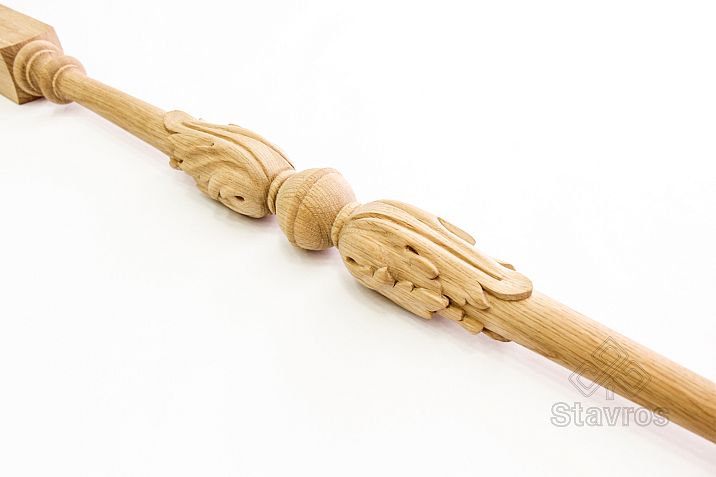
When turning between centers, the blank is secured between the headstock and tailstock of the lathe. This method is used to create long cylindrical parts, such as chair and table legs, balusters for staircases, and tool handles.
In this turning method, wood fibers run parallel to the axis of rotation, ensuring maximum strength of the finished product. The process typically begins by giving the blank a cylindrical shape using a half-round gouge (reys), followed by profiling and final surface finishing.
Bowl turning: creating hollow forms
Bowl turning (or turning in a chuck) is used to create hollow forms — bowls, vases, boxes. In this method, the blank is secured in the chuck from only one side, allowing for processing its internal surface.
This type of turning requires special skill, as the work is performed on a cantilevered blank, which creates additional vibrations. Moreover, when working on the internal surface, the cutter is outside the turner's line of sight, and turning is largely done "by feel," relying on sound and material resistance.
Segment turning: creating complex forms
Segment turning is a technique in which an item is created from multiple individual segments glued together. This method allows creating complex forms using different types of wood, creating beautiful color and texture combinations.
Segment turning requires precise calculation and preparation of each segment, but opens practically limitless possibilities for creativity. With its help, unique decorative items are created that cannot be obtained from a single piece of wood.
Ornamental turning: decorative elements
Ornamental turning is the creation of decorative elements using special fixtures, such as ornamental lathes or attachments. This technique allows creating various patterns, spirals, waves, and other decorative elements on the surface of the item.
Ornamental turning requires special equipment and skills, but the results of this work always impress with their complexity and beauty.
Turning process: from blank to masterpiece
The process of wood turning is a sequence of specific operations, each requiring attention, patience, and skill.
Blank preparation: the first step to success
Blank preparation begins with selecting a suitable piece of wood without visible defects. The blank must be dried to a moisture content of 8-12% to avoid deformation of the finished product.
For turning between centers, the blank is given a shape close to cylindrical, and center holes are drilled at the ends for mounting on the lathe. For bowl turning, the blank is given a shape as close as possible to the future item's shape, which allows reducing processing time and decreasing tool load.
Mounting on the lathe: secure fastening
When turning bowls, the blank is securely clamped in the chuck, and it is important to ensure its balancing to avoid vibrations during operation.
When turning on a chuck, the workpiece is securely clamped in the chuck, and it is important to ensure its balancing to avoid vibrations during operation.
Rough turning: forming the base
Rough turning is performed using a half-round gouge (reaper) and is aimed at removing excess material and giving the blank a shape close to the future item's shape. At this stage, it is important not to rush, removing material gradually, layer by layer, to avoid chips and cracks.
Finish turning: revealing beauty
Finish turning is performed using various cutters and is aimed at creating the final shape of the item and preparing the surface for finishing. At this stage, the turner's skill is revealed, their ability to feel the material and create smooth, harmonious lines.
Polishing and finishing: perfection in details
Polishing is performed directly on the lathe, while the item is rotating, using abrasive materials of various grits — from coarse to the finest. The goal of polishing is to create a perfectly smooth surface without tool marks.
Finishing includes applying protective and decorative coatings — oils, waxes, varnishes — that highlight the natural beauty of wood and protect the item from moisture and contamination.
Types of items: from utilitarian to artistic
Wood turning allows creating a wide range of items — from simple utilitarian objects to complex artistic compositions.
Household items: beauty in everyday life
Items of household, created on a lathe, include:
- Tableware — bowls, plates, salt cellars, pepper mills
- Kitchen utensils — graters, mashers, mortars with pestles
- Candlesticks and candelabras
- Boxes and small storage containers
- Flower vases and decorative vases
These items combine functionality and aesthetic appeal, bringing elements of natural beauty and handcraft into everyday life.
Furniture Details: The Foundation of Style
Turning parts are widely used in furniture manufacturing:
- Legs of tables and chairs
- Staircase balusters
- Columns and half-columns
- Coffers and Panels
- Decorative furniture elements
It is precisely turned parts that often define the style of furniture, giving it distinctive characteristics of classicism, baroque, empire, or modernism.
Souvenirs and Gifts: Memories for Years to Come
Turning items often become beautiful souvenirs and gifts:
- Chess pieces
- Decorative eggs
- Miniature boxes
- Keychains and pendants
- Writing utensils - pens, pencils, seals
Such gifts are valued for their uniqueness, the warmth of natural materials, and the craftsmanship invested in them.
Artistic Items: Art in Its Purest Form
At the highest level of craftsmanship, turning woodwork becomes true art:
- Sculptural compositions
- Decorative Panels
- Artistic vases of complex shapes
- Hollow forms with openwork carving
- Combined items with elements of inlay, carving, and painting
Such works are exhibited in galleries, participate in competitions and exhibitions, and become part of museum collections.
Modern Trends: Tradition and Innovation
Turning, like any other craft, does not stand still. Modern masters combine traditional techniques with new materials, tools, and technologies, creating unique works that reflect the spirit of the times.
Combining Materials: New Horizons
Modern turners are not limited to working only with wood. They combine wood with metal, glass, plastic, stone, creating unexpected and striking combinations. Especially popular are combinations of wood with epoxy resin, which can be transparent or colored, with the addition of various decorative elements.
Using New Technologies: Expanding Possibilities
Modern technologies significantly expand the possibilities of turners:
- CNC machines allow creating complex shapes with high precision
- Laser engraving adds decorative elements to the surface of items
- 3D modeling helps visualize the future item and identify possible problems even before starting work
- New finishing materials provide better protection and greater expressiveness of wood texture
It is important to remember that technology is merely a tool in the master's hands, and it does not replace, but complements traditional skills and techniques.
Ecological approach: responsible craftsmanship
Modern turning is increasingly oriented toward an ecological approach:
- Use of wood from sustainably managed forests
- Working with 'urban' wood — trees felled in cities due to disease or land clearing
- Use of non-toxic, environmentally friendly finishing materials
- Minimizing waste, using sawdust and shavings for compost or as fuel
This approach allows creating beautiful and functional items without harming the environment.
Learning turning: the path to mastery
Turning is a craft that can be learned at any age. There are many ways to master this art, from formal education to self-study.
Formal education: structured approach
Formal education in turning can be obtained at:
- Vocational schools and colleges specializing in woodworking
- Art schools and institutes where turning is studied as part of decorative and applied arts
- Specialized craft schools offering courses of varying duration and complexity
The advantage of formal education is a structured approach, access to experienced instructors, and professional equipment.
Self-study: freedom of creativity
Many masters learn turning independently, using:
- Books and magazines on turning
- Video tutorials and online courses
- Workshops by experienced turners
- Participation in communities and forums dedicated to turning
Self-study requires greater discipline and motivation, but it offers freedom in choosing direction and pace of learning.
Practice and experiments: the key to mastery
Regardless of the chosen learning path, the key to mastery is constant practice and experimentation. Only through regular work with materials, through trials and errors, through continuous refinement of technique can one achieve a high level of mastery.
It is also important to study the works of other masters, analyze their techniques and approaches, while simultaneously developing one's own style and vision.
Conclusion: eternal art in the modern world
woodturning This is an art that has passed through centuries, preserving its essence while continuously evolving. In today's world, where so many standardized, mass-produced items exist, precisely crafted wooden items attract attention with their uniqueness, the warmth of natural material, and the craftsmanship embedded within them.
Whether it is a simple wooden bowl for everyday use or a complex artistic composition for an exhibition, every turned item carries a piece of the master's soul, his vision of beauty and harmony. And in this, perhaps, lies the main value of turning art — it creates a connection between people through objects that can not only be seen but also touched, used, and lived with.
In a world where authenticity and connection to nature are increasingly valued, wooden turned items become not merely household or decorative objects, but symbols of a different relationship to life — more mindful, attentive, appreciating beauty in simple things.
And if you have not yet tried your hand at turning, perhaps now is the perfect time to begin this fascinating journey into the world of wood, form, and creativity. For as the great Michelangelo once said, 'I see a statue in every piece of marble; I only need to remove the excess.' Similarly, every piece of wood hides a beautiful creation — one only needs to help it reveal itself.