












































































Article Contents:
- Evolution of the square shape in architecture
- Philosophy of geometric purity
- Technological advantages of square cross-section
- Wood science: choosing wood for square balusters
- Oak: the standard of strength and nobility
- Ash: flexibility and expressiveness
- Beech: uniformity and stability
- Larch: northern strength
- Manufacturing Technologies
- Raw material preparation: the foundation of quality
- Mechanical processing: precision of every millimeter
- Decorative processing: art in details
- Design solutions and stylistic directions
- Minimalism: beauty of simplicity
- Modern classicism: traditions in a new interpretation
- Loft: industrial aesthetics
- Scandinavian style: northern restraint
- Technical Specifications and Standards
- Dimensional parameters
- Requirements for strength
- Moisture and dimensional stability
- Installation of square balusters
- Mounting methods
- Marking and positioning
- Final processing after installation
- Protective coatings and final processing
- Oil finishes
- Lacquer systems
- Wax coatings
- Economic aspects of selection
- Pricing factors
- Comparison with alternatives
- Long-Term Economic Efficiency
- Trends and innovations
- Thermo-modification of wood
- Composite materials
- Digital technologies in production
- Maintenance and care
- Regular Cleaning
- Updating Finishes
- Prevention of damage
- Conclusion
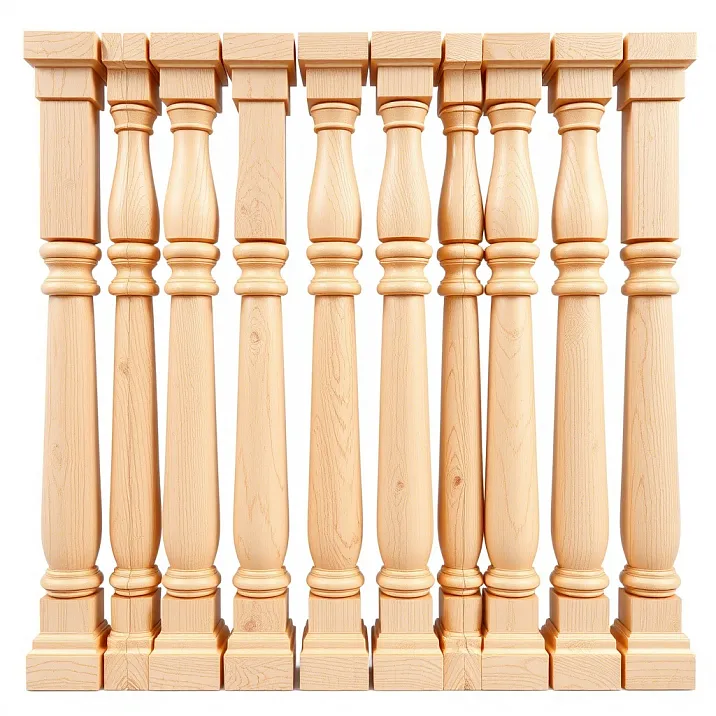
When it comes to creating a stair railing capable of captivating the imagination while simultaneously ensuring maximum functionality, square wooden balusters become an indisputable choice for admirers of modern design. These architectural elements embody the philosophy of minimalism, where every line has meaning, and every angle tells a story of craftsmanship.
Imagine a staircase where the strictness of geometric forms combines with the warmth of natural wood. Where sharp edges create a play of light and shadow, transforming ordinary movement between floors into an aesthetic delight. It is precisely this atmosphere that square wooden balusters create — elements that prove beauty can be both simple and complex, minimalist and expressive.


Evolution of the square shape in architecture
The history of square balusters is inseparably linked to the development of architectural thought. Unlike their round counterparts, which inherited the forms of ancient columns, square supports represent a product of modern understanding of space and functionality.




Philosophy of geometric purity
The square in architecture is a symbol of stability, reliability, and order. Wooden square balusters embody these principles in material form, creating a sense of immovability and confidence. Four equal sides, four right angles — mathematical precision embodied in living material.
Modern designers value square shapes for their ability to integrate into any interior, not competing with other elements but complementing them. This universality makes square balusters an ideal choice for projects where harmony and balance are important.
Our factory also produces:


Technological advantages of square section
From a technical standpoint, a square section has several indisputable advantages. Even load distribution across all four faces ensures maximum strength with minimal material usage. This is especially important when creating tall railings or structures subjected to significant loads.
Square balusters are also easier to manufacture and install. Sharp edges allow for precise connections, and flat surfaces simplify the attachment of additional decorative or functional elements.
Get Consultation
Wood Science: Choosing Wood for Square Balusters
Creating quality square wooden balusters begins with careful selection of wood. Each species has unique characteristics that affect not only the appearance of the finished product but also its performance properties.
Oak: The Standard of Strength and Elegance
Square oak balusters represent the pinnacle of wood processing quality. Oak density, reaching up to 700 kg/m³, ensures exceptional strength and durability of the structure. The characteristic texture with clearly visible growth rings creates a unique pattern on each face of the square baluster.
The peculiarity of oak lies in its ability to improve with age. Under exposure to light and air, the wood acquires a noble golden hue, and tannins contained in the wood structure provide natural protection against pests and fungal damage.
Ash: Flexibility and Expressiveness
Square ash wooden balusters are distinguished by their expressive texture. Contrasting bands of light and dark wood create an eye-catching pattern, especially prominent on the flat faces of the square section.
High bending strength makes ash ideal for long balusters or structures subjected to dynamic loads. The wood's elasticity allows creating slender, elegant profiles without compromising strength.
Beech: Uniformity and Stability
Beech balusters are valued for their exceptional structural uniformity. The absence of a pronounced texture allows creating products with perfectly smooth surfaces, where attention is focused on the purity of geometric forms.
Beech is highly workable and paintable, opening up wide possibilities for design experimentation. Square-section beech balusters can imitate more expensive species or acquire entirely new color solutions.
Larch: Northern Strength
Siberian larch deserves special attention due to its unique combination of strength and resistance to external influences. High resin content provides natural protection against moisture and biological damage.
The amber hue of larch with clearly visible growth rings creates a warm, cozy atmosphere. Over time, the wood develops a noble silver patina, giving square balusters a distinctive charm.
Manufacturing Technologies
Producing high-quality square balusters requires strict technological standards at every stage. From proper wood drying to final finishing — each operation affects the quality of the finished product.
Raw Material Preparation: The Foundation of Quality
The process begins with careful selection of wood. Logs must be free of knots, cracks, resin pockets, and other defects. Special attention is paid to the direction of the grain — it must be parallel to the future baluster's axis to ensure maximum strength.
Wood drying is conducted in special chambers with precise temperature and humidity control. Final moisture content must not exceed 8-10%, preventing deformation of finished products during use.
Mechanical Processing: Precision of Every Millimeter
Manufacturing square wooden balusters requires high precision of processing. Modern four-sided planers allow obtaining perfectly flat faces with deviation no more than ±0.1 mm.
Special attention is paid to corner processing. They must be perfectly straight and sharp, without chips or burrs. For this, special milling cutters with carbide inserts are used, ensuring a clean cut.
Decorative Processing: Art in Details
Square balusters can be enhanced with various decorative elements. Milled square balusters are adorned with grooves, bevels, relief patterns that emphasize the geometry of the form.
Modern CNC milling machines allow creating complex decorative elements with jewel-like precision. Each detail is reproduced with perfect repeatability, which is critically important for mass production.
Design Solutions and Stylistic Directions
Square balusters have an amazing ability to adapt to various stylistic directions while retaining their individuality and character.
Minimalism: the beauty of simplicity
In minimalist interiors, wooden square balusters embody the philosophy 'less is more'. Clean lines, absence of decoration, emphasis on material quality and craftsmanship perfection — these are the main principles of this style.
Square balusters in a minimalist style often have an increased cross-section — 60×60 mm or even 80×80 mm. This creates a sense of monumentality and reliability, highlighting the architectural significance of the staircase.
Modern Classicism: Traditions in a New Interpretation
A modern interpretation of classic style implies using traditional proportions and forms in a simplified manner. Square balusters in classic style may have a base and capital, but executed in a laconic manner.
Decorative elements are limited to simple bevels, grooves, or relief bands. The color palette is usually natural, highlighting the beauty of the wood.
Loft: industrial aesthetics
In loft-style interiors, square balusters are often combined with metallic elements. Rough surface treatment, intentionally visible tool marks, contrasting material combinations — all of this creates the characteristic atmosphere of an industrial space.
Square-section balusters in a loft style may have artificially aged surfaces, imitating long-term use. Such treatment emphasizes the authenticity and historicity of the space.
Scandinavian style: northern restraint
Scandinavian design values functionality, eco-friendliness, and restrained beauty. Square balusters in this style are usually made from light-colored woods — birch, pine, spruce.
The surface is treated with transparent oils or wax, preserving the natural color and texture of the wood. Decorative elements are minimal or completely absent.
Technical Specifications and Standards
Production square wooden balusters is regulated by strict technical standards ensuring the safety and durability of structures.
Dimensional Parameters
Standard sizes of square balusters vary depending on their purpose and stylistic requirements:
Cross-section:
- 40×40 mm — for light structures and decorative railings
- 50×50 mm — universal size for most applications
- 60×60 mm — for heavy structures and modern styles
- 80×80 mm — for monumental staircases and special designer solutions
Height:
- 900 mm — standard height for residential spaces
- 1000–1100 mm — for public buildings
- 1200 mm and above — for special architectural solutions
Strength Requirements
Square balusters must withstand a horizontal load of at least 100 kg applied to the top. To meet this requirement, it is important to correctly calculate the baluster’s cross-section and select the appropriate wood species.
Bending strength depends on the wood species and fiber orientation. For oak, this value is approximately 100 MPa, for ash — 110 MPa, for beech — 95 MPa.
Moisture and dimensional stability
The moisture content of finished balusters should not exceed 12%. This ensures dimensional stability and prevents cracking during operation. Moisture control is performed at every stage of production.
Installation of Square Balusters
Correct installation of square balusters is the key to the long-term durability and safety of the entire structure. The installation process has specific features related to the geometry of the square cross-section.
Methods of mounting
Dowel joint — a traditional and most reliable method of attaching wooden balusters. A dowel of 8–12 mm diameter is carved into the lower part of the baluster, which fits into a corresponding hole in the tread or newel post.
Threaded fastening using metal bolts ensures maximum joint strength. This method is especially effective for heavy balusters with large cross-sections.
Surface mounting is used when drilling holes in the base is not possible. Special metal plates are attached to the side face of the baluster and the base.
Marking and Positioning
Accurate marking is the foundation of quality installation. The distance between baluster axes is usually 120–150 mm, ensuring an optimal balance of strength and aesthetics.
When marking, it is important to consider the orientation of square balusters. The faces can be positioned parallel or at a 45° angle to the direction of the staircase, creating different visual effects.
Final finishing after installation
After installation, all joints and connections are carefully processed. Mounting points are sanded, minor defects are removed, and protective coatings are applied.
Special attention is paid to the ends of the balusters. They must be perfectly flat and perpendicular to the baluster's axis. Additional trimming and sanding may be performed if necessary.
Protective coatings and final finishing
Quality final finishing not only highlights the beauty of the wood but also ensures the longevity of square wooden balusters.
Oil finishes
Natural oils penetrate deeply into the wood structure, emphasizing its texture and providing protection from within. Oil-based coatings preserve the wood's ability to "breathe," preventing moisture accumulation.
Modern oils contain UV filters that protect the wood from fading. They are easily renewed without completely removing the previous layer.
Urethane coatings create a wear-resistant, high-strength finish for heavily used surfaces. Acrylic formulations provide an eco-friendly coating for residential spaces with children.
Polyurethane varnishes form a strong protective film on the wood surface. They provide high resistance to abrasion and mechanical damage.
Modern varnishes have varying degrees of gloss — from matte to high-gloss. The choice depends on stylistic preferences and usage conditions.
Wax coatings
Wax creates a soft, silk-like finish with a natural sheen. Wax coatings are especially popular in classic and traditional interiors.
The drawback of wax is the need for regular renewal. However, this process is simple and can be done independently.
Economic aspects of selection
Cost square wooden balusters depends on many factors that are important to consider when planning the project.
Pricing Factors
Wood species is the main pricing factor. Balusters made of oak and beech cost 2-3 times more than pine, but they also last significantly longer.
Cross-sectional size affects material consumption and processing complexity. 80×80 mm balusters cost nearly twice as much as 50×50 mm ones.
Processing complexity — plain planed balusters are cheaper than those with decorative elements milled by router.
Order volume — significant discounts apply for large quantities.
Comparison with alternatives
Compared to metal balusters, wooden ones have comparable cost but significantly better aesthetic and performance characteristics.
Stone balusters are 3-5 times more expensive than wooden ones, and their installation requires special equipment and expertise.
Long-term economic efficiency
Quality wooden balusters, with proper care, last 50-100 years. This makes them one of the most cost-effective investments in home furnishing.
The possibility of restoration and renewal of coatings allows maintaining the original appearance throughout the entire service life.
Trends in development and innovation
Modern technologies open new opportunities for improving square-section balusters.
Thermo-modification of wood
Thermal treatment at 180-220°C fundamentally changes the properties of wood. Thermomodified balusters gain increased dimensional stability and resistance to biological damage.
Color change of wood during thermo-treatment allows achieving new decorative effects without using dyes.
Composite materials
Advancements in bonding technologies allow creating composite balusters from different wood species. The core, made of strong but inexpensive wood, is covered with veneer of valuable species.
This approach allows reducing the cost of products without compromising appearance or key performance characteristics.
Digital technologies in production
The introduction of automated design and production systems increases manufacturing accuracy and reduces the number of defects.
3D modeling allows clients to see the future result even during the design stage, while CNC machines ensure exquisite manufacturing precision.
Care and Maintenance
Proper care of square wooden balusters extends their lifespan and preserves their original beauty.
Regular cleaning
Daily care involves removing dust with a dry, soft cloth. Wet cleaning is performed as needed using special wood cleaning agents.
It is important to avoid excessive moisture and aggressive cleaning agents that may damage the protective coating.
Coating renewal
The frequency of renewal depends on the type of coating and the intensity of use. Oil-based coatings are renewed every 2-3 years, while varnish coatings every 5-7 years.
The renewal process includes light sanding of the surface and applying a new layer of protective coating.
Damage Prevention
Protection from mechanical damage, direct sunlight, and humidity fluctuations — these are the main preventive measures.
Upon detecting minor defects, immediate action should be taken to address them, preventing the development of serious damage.
Conclusion
Square wooden balusters represent the perfect combination of functionality, aesthetics, and durability. They can transform any space, giving it a modern and stylish look while preserving the warmth and coziness of natural wood.
Choosing square balusters is choosing quality, reliability, and unique beauty. The geometric clarity of forms, variety of design solutions, and adaptability to any style make them a universal solution for modern construction.
Investing in quality wooden balusters means investing in the beauty and comfort of your home, its value and prestige. This solution will delight you for many years and become a source of pride for future generations.
STAVROS is a recognized leader in the production of high-quality wooden products for staircases. Our rich experience, modern technologies, and team of talented craftsmen enable us to create products that combine traditional quality with modern innovations. Choosing STAVROS products guarantees exceptional quality, reliability, and unique beauty that will adorn your home for years to come.


