Article Contents:
- History of Woodturning: From Antiquity to the Present Day
- Saint Petersburg School of Woodturning
- Hardwoods
- Hardwood species
- Hardwoods
- Softwood Species
- Coniferous species
- Tools for Woodturning
- Cutting Tools
- Marking and Measuring Tools
- Machine Accessories
- Types of Woodturning
- Turning Cylindrical Forms
- Turning of Planishing Plates / Bowls
- Combined Processing Methods
- Popular turned wooden items
- Interior and Furniture Elements
- Tableware and Kitchen Utensils
- Decorative Items
- Toys and Games
- Artistic Items
- Technology of Woodturning
- Preparation of Blank
- Turning Process
- Finishing the Item
- Advantages of Woodturning Items
- Ecological safety
- Uniqueness
- Aesthetic value
- Durability
- Tactile comfort
- Where to Order Woodturning in Saint Petersburg
- Experience and Professionalism
- Equipment and Materials
- Timeline and Cost
- Reviews and recommendations
- Care for Woodturning Items
- Moisture Protection
- Regular treatment with protective compounds
- Cleaning
- Storage
- Conclusion
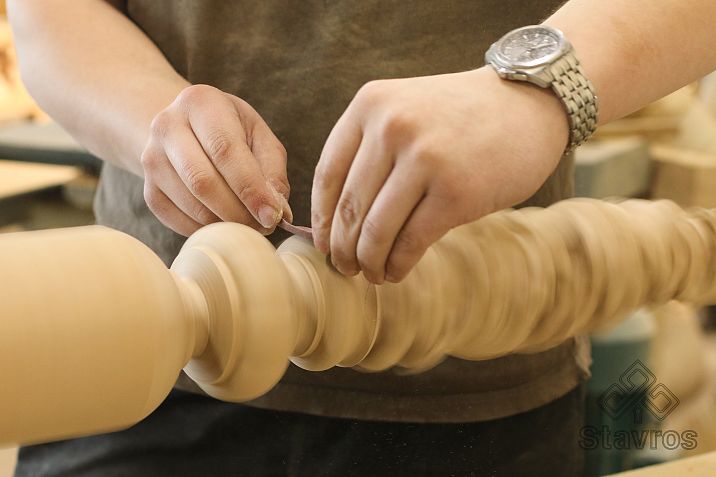
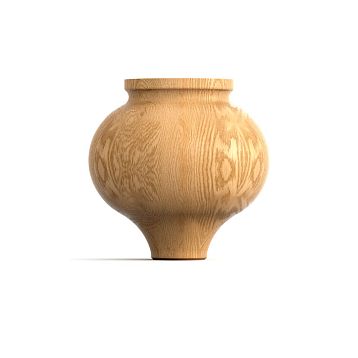
In a world where mass production has flooded the market with identical items, handcrafted items created by skilled artisans hold particular value. Woodturning in St. Petersburg It is not just a craft, but a true art, allowing to transform an ordinary piece of wood into a work filled with soul and individuality. St. Petersburg masters, preserving centuries-old woodworking traditions, create unique items capable of transforming any interior and becoming its central accent.
When talking about woodturning, one inevitably recalls the phrase 'turning balusters,' an expression firmly rooted in the Russian language. But modern woodturning in the Northern capital is much more than just creating balusters for staircases. It is a whole world of possibilities for realizing the boldest design ideas in wood.


History of woodturning: from antiquity to our days
Woodturning is one of the oldest crafts of humanity. Even in ancient Egypt, craftsmen used primitive lathes, where the rotation of the blank was achieved using a rope passed over it. One end of the rope was attached to the bowstring fixed to the workshop ceiling, and the other to a wooden pedal. Such a construction allowed the craftsman to control the wood processing, creating objects of astonishing beauty.
Over time, the technology improved. Machines appeared that converted reciprocating motion into rotary motion, significantly easing the work of craftsmen. A significant contribution to the development of woodturning was made by the Russian scientist, mechanic, and sculptor Andrei Konstantinovich Nartov, who in the early 18th century designed and built a series of innovative machines, including copying lathes. And in the early 19th century, the English mechanic Henry Maudslay made a real breakthrough by installing a tool carriage on the lathe.
Today, woodturning machines are equipped with electric drives, and some models even have mechanical or even automatic control, opening new horizons of possibilities for craftsmen. However, despite technological progress, the fundamental principles of woodturning remain unchanged, and the ability to feel wood is still the main quality of a true master.




Saint Petersburg School of Woodturning
Saint Petersburg has always been renowned for its master carpenters and turners. Since the time of Peter I, who himself was a great enthusiast of woodturning, the city has developed woodworking traditions. The Saint Petersburg school of woodturning is distinguished by special attention to details, elegance of lines, and flawless execution.
Modern Woodturning in St. Petersburg These traditions continue, combining them with new technologies and design solutions. Masters of the city on the Neva create both classic items and avant-garde pieces, meeting the most daring requests of clients.
Our factory also produces:


Materials for Turning Work: Choosing Wood
Choosing wood for woodturning is the first and one of the most important stages in creating a quality item. Almost all types of wood are suitable for woodturning, but the choice of a specific type is determined by the purpose, size, construction, and usage conditions of the future item, as well as artistic-decorative requirements.
From the standpoint of material processing, wood with uniform density and fine grain is preferred. Such defects as non-joined, falling out, tobacco knots, resin pockets, cracks, and rot are not allowed. However, certain structural features of wood, such as waviness, spiral grain, and curls, can significantly enhance the decorative properties of the finished item.
Get Consultation
Hardwood species
Hardwood species commonly used for woodturning include:
- Walnut - exceptionally hard and dense wood, ideal for small details and items requiring high precision.
- Pear - wood with beautiful texture, easily processed and polished.
- Apple - has a beautiful pinkish hue and fine texture.
- Maple - light-colored wood with a silky sheen.
- Plane (chinar) - wood with beautiful grain and high strength.
- Birch - accessible and easy-to-process wood with uniform structure.
- Hornbeam - very hard and strong wood, well-suited for items subjected to mechanical loads.
- Oak - a classic wood with distinct texture and high strength.
Large-vascular species
Large-vascular species often used for woodturning include:
- Ash - strong and elastic wood with beautiful texture.
- Oak - classic wood with distinct texture and high strength.
- Walnut - noble wood with beautiful dark tone and expressive texture.
Softwood species
Softwood species most popular for woodturning include:
- Linden - soft and easy-to-process wood, ideal for beginners and for creating complex shapes.
- Ash - soft wood with a beautiful pinkish tone.
Coniferous species
From coniferous species used for turning work are:
- Spruce - affordable and easy-to-process wood, but requires caution due to resin content.
- Fir - soft wood with a light tone.
- Teak - rare and valuable wood with a beautiful reddish tone.
- Larch - strong and durable wood with a beautiful texture.
Saint Petersburg masters performing Woodturning in St. Petersburg, often work with local wood species such as birch, spruce, fir, but also use exotic species to create particularly valuable items.
Turning tools
The quality of turning work largely depends on the tools used. Modern masters use both traditional and innovative tools, which can be divided into several groups:
Cutting tools
- Half-round gouge (reyer) - used for rough shaping of the blank and removing large amounts of material. According to Dal's dictionary, a reyer is a half-round gouge used for rough turning of wood.
- Kosyak - a tool with an oblique cut, used for precise processing of details.
- Groove cutter - a universal tool for creating profiles, recesses, rounded edges, and V-shaped grooves.
- Finishing cutter - has a shallower groove compared to a groove cutter and is used for final surface finishing.
- Cutting cutter - used for detaching the finished work from the blank and for cutting grooves.
- Hooked cutters - universal tools for shaping blanks, suitable both for removing large amounts of wood and for finishing work.
Marking and measuring tools
- Compass - used for marking circles and arcs.
- Caliper - used for precise measurement of part dimensions.
- Internal/external caliper - used for measuring internal and external diameters.
Machine fixtures
- Body with center clamp - holds the blank during processing.
- Chuck - clamping device for securing the blank.
- Planishing plate - fixture for securing blanks of non-standard shapes.
Masters performing Woodturning in St. Petersburg, often have their own set of tools, which is formed over years and reflects the individual working style of each turner.
Types of wood turning
Wood turning can be divided into several main types, each with its own characteristics and requiring specific skills and tools.
Turning cylindrical forms
When turning using this method, wood fibers run parallel to the axis of rotation, simplifying the processing. Items produced by turning cylindrical forms include:
- Legs of chairs and tables
- Candlesticks
- Tool handles
- Vases
- Glasses
- Staircase balusters
- Columns and half-columns for furniture
For turning cylindrical forms, various cutters are used, depending on the stage of work and desired result:
- Roughing cutter (reeder) - for initial roughing of blanks and removal of large amounts of material.
- Grooving cutter - for creating profiles, recesses, and rounded edges.
- Finishing cutter - for final surface finishing.
- Cutting cutter - for detaching the finished work from the blank.
Turning processing of turntable/ bowl
In this turning method, wood fibers run perpendicular to the axis of rotation, meaning the craftsman must work with cross-grain twice per revolution. Tools for turning the face panel must be stronger than those for turning cylindrical forms to withstand cutting forces.
Items produced by turning turntable/bowl include:
- Bowls
- Boxes
- Plates
- Bowls
- Platters
- Decorative Panels
For turning turntable/bowl, special tools are used:
- Turntable cutter for bowls - used for rough processing of blanks and removal of large amounts of material.
- Round-nose scrapers - designed for processing the inner part of blanks.
- Square-nose scrapers - used for processing the outer surface of blanks.
Combined processing methods
For manufacturing large and non-standard parts with a surface of revolution, a combined processing method using CNC milling machines is often employed. This allows creating items that are either impossible or very difficult to produce using traditional turning methods.
For example, to manufacture large wooden spheres, a combination of turning and milling may be required. The result is a laminated structure made of many disks and layers, which is then processed to achieve an ideal spherical shape.
Popular turned wooden items
The range of items that can be created using wooden turning is extremely wide. Here are some of the most popular categories:
Interior elements and furniture
- Balusters for staircases - classic elements that add elegance and style to staircases.
- Legs for tables and chairs - can be simple or complex, with various profiles and decorations.
- Columns and half-columns - used as decorative elements in furniture and interior design.
- Curtain rods - finely turned wooden rods that give interiors a special charm and coziness.
- Decorative furniture elements - rosettes, appliqués, capitals, and other details that make furniture unique.
Tableware and kitchen utensils
- Bowls and cups - practical and beautiful items for table setting.
- Plates - from simple to decorative, with various profiles and finishes.
- Glasses and mugs - an eco-friendly alternative to plastic and glass tableware.
- Cutting boards - functional and decorative kitchen items.
- Rollers - an indispensable tool for preparing dough.
- Mortars and pestles - traditional items for grinding spices and herbs.
Decorative items
- Vases - from miniature to large, for fresh and dried flowers.
- Candlesticks - create a cozy atmosphere and serve as stylish interior decorations.
- Boxes - for storing jewelry and small items.
- Balls and spheres - decorative elements that can be used as standalone items or as part of compositions.
- Art objects - unique works of art created using turning techniques.
Toys and games
- Chess pieces - a classic example of turned items requiring high precision and craftsmanship.
- Matryoshkas - traditional Russian toys often made using turning techniques.
- Yo-yos and spinning tops - simple yet engaging toys that demonstrate principles of physics.
- Puzzles - educational games that stimulate logical thinking.
Souvenirs and gifts
- Handles - personalized gifts for business partners and friends.
- Keychains - small but memorable souvenirs.
- Figurines - miniature works of art that can become valuable gifts.
- Corporate gifts - unique items with company logos or personalized engravings.
Masters performing Woodturning in St. PetersburgThese, along with many other items, are created taking into account individual customer preferences and modern design trends.
Wood turning technology
The process of wood turning includes several stages, each requiring specific skills and attention to detail.
Preparation of the blank
Before beginning turning, it is necessary to properly prepare the blank:
- Material selection - choosing an appropriate wood species depending on the purpose of the item.
- Cutting - obtaining a blank of the required size.
- Blank processing - giving the blank a shape close to the future item's shape to reduce the amount of work on the lathe.
- Marking - drawing lines on the blank to assist during turning.
- Blank mounting - securing the blank on the lathe using a chuck, faceplate, or between centers.
Turning Process
The turning process includes several stages:
- Rough turning - removing a large volume of material to give the blank an approximate shape of the future item.
- Profile turning - creating the main profile elements of the item.
- Finish turning - final shaping of the item and preparing the surface for finishing.
- Polishing - surface treatment to remove irregularities and prepare for final finishing.
Item Finishing
After completing turning, the item requires final finishing:
- Sanding - surface treatment with abrasive paper of different grits to achieve a smooth surface.
- Polishing - giving the surface a shine using special polishing compounds.
- Applying protective coating - treating the item with oil, wax, varnish, or other compounds to protect against moisture and damage.
- Decorating - if necessary, applying carving, painting, engraving, or other decorative elements to the item.
Advantages of wooden turned items
Wooden turned items have several undeniable advantages that make them popular and in demand:
Ecological safety
Wood is a natural, eco-friendly material that does not emit harmful substances and is safe for health. Wooden items create a special atmosphere of warmth and coziness in the home that synthetic materials cannot provide.
Uniqueness
Each wooden turned item is unique, even if it is made according to the same pattern. This is due to the unique structure of wood, which makes each item special. Moreover, handcrafted work by a master always carries its individual style and signature.
Natural wood
Wooden turned items have special aesthetic value. The beauty of natural wood, enhanced by the turner's skill, creates items that become true interior ornaments and delight the eye with their harmony and perfection of form.
Durability
With proper care, wooden items can serve for decades, sometimes even centuries. Over time, they acquire a special patina that only increases their value and attractiveness.
Tactile comfort
Wood is pleasant to the touch, it is 'warm' and comfortable for tactile perception. This is especially important for items that a person interacts with directly - tableware, furniture, toys.
Where to order wooden turning work in Saint Petersburg
In Saint Petersburg, there are many workshops and individual masters who perform Woodturning in St. PetersburgWhen choosing an executor, it is important to pay attention to several key points:
Experience and professionalism
Experienced masters usually have a portfolio of completed works, which allows you to assess the quality and style of their pieces. Do not hesitate to ask about their experience, specialization, and workshop technical capabilities.
Equipment and Materials
Quality turning work requires modern equipment and high-quality materials. Find out which wood species the master uses, and what machines and tools they have at their disposal.
Timeline and Cost
The cost of turning work depends on the complexity of the item, materials used, and urgency of the order. Prices typically start from 500–850 rubles per hour for simple items and may reach several thousand rubles per hour for complex artistic works or urgent orders.
Reviews and recommendations
Before placing an order, it is advisable to review previous clients' feedback or obtain recommendations from acquaintances who have already used the services of this master or workshop.
Care for Wooden Turning Items
To ensure wooden turning items last long and retain their beauty, proper care is necessary:
Moisture protection is especially important for wooden items. Maintaining optimal humidity levels in the room prevents deformation and cracking of wood.
Wood is a hygroscopic material that may deform with changes in humidity. Therefore, wooden items should be protected from direct contact with water and should not be placed near heat sources that may cause wood to dry out.
Regular Treatment with Protective Coatings
To maintain the beauty and protect wooden items, they should be periodically treated with special compounds—oils, waxes, or varnishes—depending on the type of item and its purpose.
Cleaning
For cleaning wooden items, it is best to use a soft dry cloth. If necessary to remove dirt, you can slightly dampen the cloth with warm water and a small amount of mild detergent, then thoroughly dry the item.
Storage
Wooden items should be stored in a dry place, protected from direct sunlight, which may cause wood to fade.
Conclusion
Woodturning in St. Petersburg This is a unique blend of traditional craftsmanship and modern art, enabling the creation of unique items imbued with soul and individuality. St. Petersburg masters, preserving and developing turning traditions, offer a wide range of services—from manufacturing simple household items to creating complex artistic pieces.
Choosing wooden turning items means you not only acquire functional and beautiful objects, but also become the owner of a piece of living nature transformed by the master’s talent. Each such item carries the warmth of human hands and the energy of wood, which will fill your home with harmony and comfort for many years.
Regardless of whether you are looking for practical items for everyday use or unique artworks to decorate your interior, wooden turning items will be an excellent choice that never goes out of style and will delight you with their beauty and functionality.