Article Contents:
- Historical heritage: from antiquity to the present day
- Engineering aspects: balance between strength and elegance
- Production technologies: from traditions to innovations
- Variety of styles and forms: from strict classicism to bold avant-garde
- Wood science: choosing wood for balusters
- Installation and mounting: technical nuances of assembly
- Care and maintenance: Preserving beauty for years
- Design solutions: integration into interior
- Frequently asked questions about balusters
- STAVROS: craftsmanship proven by time
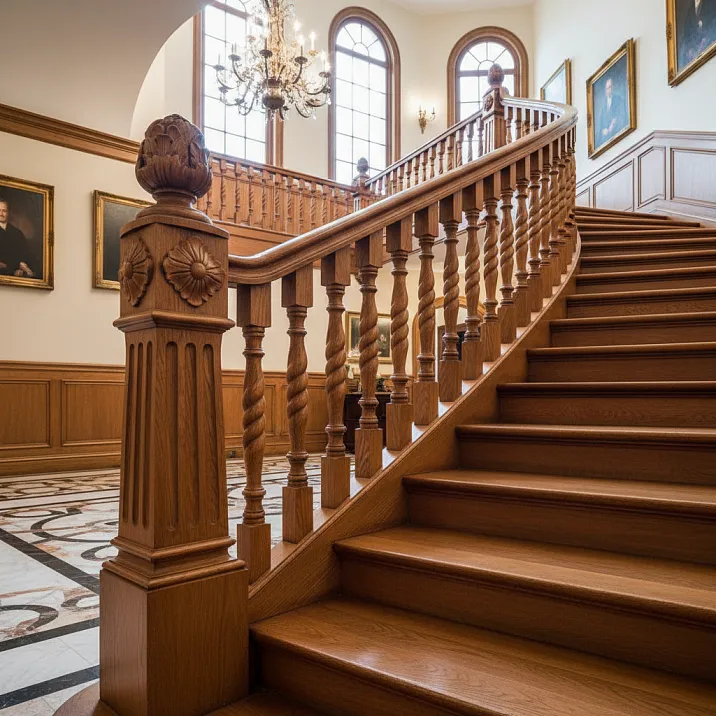
The staircase in a house is not just a functional structure for moving between floors. It is an architectural centerpiece that sets the tone for the entire interior and reflects the owners' taste. And if the supporting columns of the staircase can be compared to columns of an ancient temple, thenbalusters— these are elegant guardians of safety that transform an ordinary staircase into a work of art.
What makes us stop before a beautiful staircase and admire it? Why do some staircase structures inspire awe, while others remain unnoticed? The secret lies in the details, and balusters play a key role here. These vertical railing elements not only ensure safety but also create rhythm, harmony, and visual continuity throughout the entire structure.
In the modern world, where mass production often strips objects of individuality, wooden balusters remain an island of true craftsmanship. Each baluster carries the warmth of living material, the uniqueness of natural grain, and the imprint of the master’s hands. This is not just a structural element — it is a link between tradition and modernity, between functionality and beauty.


Historical heritage: from antiquity to the present day
The art of creating balusters traces its roots to deep antiquity. Already in the architecture of ancient Greece and Rome, prototypes of modern balusters appeared — elegant columns supporting railings of temples and public buildings. These elements not only served a practical function but also acted as important decorative accents, emphasizing the grandeur and solemnity of architectural structures.
The Renaissance brought a new understanding of beauty and proportions in architecture. Italian masters of that time perfected the art of making balusters, creating works that remain a standard of elegance and harmony to this day. It was precisely during this period that the main canonical forms of balusters were established, which, with minor variations, have reached our days.
The Baroque era introduced opulence and ornamentation into baluster design. Masters of that time created true masterpieces of wood carving, where each baluster was a miniature work of art. Complex profiles, floral ornaments, heraldic symbols — all this turned stair railings into luxurious decorative compositions.
Classicism restored the strictness of lines and noble restraint to balusters. Symmetry, mathematical precision of proportions, simplicity of forms — these principles of classical style had a tremendous influence on the development of baluster art and largely defined modern perceptions of the beauty of staircase structures.
Russian wooden architecture made an indelible contribution to the history of balusters. Domestic masters created unique samples that combined European architectural traditions with national characteristics. Russian balusters were distinguished by a special warmth and soulfulness, achieved through masterful use of the natural properties of various wood species.
The Industrial era of the 19th-20th centuries introduced new technologies into baluster production, but could not displace handcraftsmanship. On the contrary, the contrast between mass production and individual pieces only emphasized the value of a personalized approach to creating architectural elements.
Modern times offer a synthesis of the best traditions of the past with the possibilities of new technologies.Wooden balustersToday, they are created using high-precision equipment, yet still retain the soul and individuality characteristic of handcrafted items.




Engineering aspects: balance between strength and elegance
Creating a quality baluster is a complex engineering task requiring a deep understanding of material mechanics and construction principles. EachWooden balustermust withstand significant loads while maintaining its elegant appearance.
Load calculations begin with determining the maximum forces a baluster may experience during operation. Horizontal loads from people leaning on railings, dynamic impacts during rapid movement on the stairs, possible impact loads — all these factors must be considered when designing balusters.
Critical points of a baluster are the areas where it connects to treads and handrails. It is here that maximum stresses concentrate, and the quality of these joints determines the reliability of the entire structure. Modern technologies allow creating fasteners that ensure secure connections without compromising aesthetics.
The geometry of a baluster affects not only its appearance but also its mechanical properties. The classic baluster shape with thickening in the middle (so-called 'bulb') is not accidental — such a configuration ensures optimal stress distribution under bending loads. Thinner sections are located in zones of minimal stress, while thickened areas are where the material experiences maximum loads.
The choice of wood for making balusters is determined not only by aesthetic preferences but also by technical requirements. Hardwood species — oak, beech, ash — provide maximum strength and durability but require more complex processing. Softwoods — pine, spruce, linden — are easier to process but may not provide the necessary strength for heavily used staircases.
Wood moisture plays a critical role in the longevity of balusters. Improperly dried wood may lead to warping, cracking, and weakened joints. The optimal moisture content for balusters is 8-12%, ensuring dimensional stability and minimizing the risk of cracking.
Thermal treatment of wood improves its performance characteristics. Controlled exposure to high temperatures alters the wood’s structure, enhancing its stability and resistance to external influences. Thermally treated balusters are less prone to warping and exhibit increased resistance to moisture.
Our factory also produces:


Production technologies: from traditions to innovations
Modern baluster production combines traditional carpentry techniques with advanced woodworking technologies. This synergy allows creating products that meet the highest quality standards while preserving the individuality and soul of handcrafted work.
Turning remains the primary method for manufacturing balusters of traditional shapes. Modern CNC turning machines enable the creation of items with perfect geometry and high repeatability. At the same time, manual finishing of each detail is preserved, giving the products individuality.
Milling is used to create complex profiles and decorative elements. Multi-axis milling centers allow performing operations of any complexity, producing balusters with intricate shapes and rich decoration. The accuracy of modern equipment is measured in hundredths of a millimeter, ensuring perfect fitting of components.
Laser cutting opens new possibilities for creating delicate and intricate elements. A thin laser beam allows cutting the most complex patterns without risking chipping or damaging the material. This technology is especially effective for creating decorative inserts and applied elements.
Hand carving remains the pinnacle of craftsmanship in baluster production. An experienced carver can create a unique piece impossible to reproduce mechanically. Each baluster crafted by a master carver bears the imprint of his individual style and is a genuine work of art.
Combined technologies allow optimally combining the advantages of various processing methods. The basic shape is created on automated equipment, ensuring precision and repeatability, while decorative elements are hand-finished, imparting uniqueness and expressiveness to the product.
Quality control at every stage of production guarantees that finished products meet the highest standards. Modern measuring instruments allow controlling dimensions with precision down to microns, while visual inspection reveals the slightest surface defects.
Finishing includes several stages of sanding with gradually decreasing abrasive grit. A well-sanded surface is not only beautiful but also ensures better adhesion of protective coatings. Modern sanding systems allow processing even the most complex profiles, preserving line clarity and smooth transitions.
Get Consultation
Variety of styles and forms: from strict classicism to bold avant-garde
The world of balusters is amazed by the diversity of styles and forms. Each era and architectural style has contributed to the development of this direction of decorative-applied art. Today, we have the opportunity to choose from the richest heritage of world architecture or to create entirely new, original solutions.
Classic balusters are distinguished by strict proportions and noble restraint of forms. The core of a classic baluster is a central part with a characteristic thickening, smoothly transitioning into thinner upper and lower parts. Such a form is not only beautiful but also functional — it ensures optimal load distribution and maximum structural strength.
Baroque balusters impress with rich decoration and complex forms. Vegetal ornaments, volutes, cartouches, heraldic elements — all this turns each baluster into a miniature architectural masterpiece. Creating such items requires the highest level of craftsmanship and years of experience working with wood.
Empire balusters combine classical strictness with grandeur and pomp. Characteristic elements of the Empire style — laurel wreaths, military insignia, classical motifs — are reflected in the decoration of balusters of this style. Such items create an atmosphere of grandeur and pomp.
Modern balusters may be executed in various styles — from strict minimalism to bold avant-garde solutions. Geometric forms, non-traditional proportions, unusual material combinations — all this allows creating unique interior solutions.
Ethnic styles open wide opportunities for creativity. Russian traditions of wood carving, Scandinavian motifs, Eastern ornaments — each culture has contributed to the development of baluster art.
In ethnic style, it is possible to create an interior with a distinctly national character.decorative elementsEthnic styles allow creating an interior with a distinctly national character.
Custom balusters are the highest form of the master’s creative self-expression. Such items are created according to individual sketches and have no analogs. Each custom baluster is a unique work of art reflecting the vision and craftsmanship of its creator.
Wood science: selection of wood for balusters
Choosing the wood species for manufacturing balusters is a responsible decision that affects the appearance, longevity, and performance characteristics of the finished product. Each wood species has its unique properties, and understanding these features will help make the right choice.
Oak is the king among wood species for manufacturing balusters. Its exceptional strength, beautiful texture, and noble appearance make oak an ideal material for creating premium items. Oak balusters serve for decades, gradually acquiring a special patina that only enhances their beauty. The high density of oak ensures excellent machinability during turning and allows creating thin details without the risk of breakage.
Ash is distinguished by high strength and elasticity, making it an excellent choice for heavily used staircases. The light-colored wood of ash with its expressive texture is well-suited for staining and can imitate more expensive species. Ash balusters are especially popular in modern interiors due to their fresh and dynamic appearance.
Beech combines strength with a beautiful, uniform texture. This species is easy to process and allows creating balusters of complex shapes with fine details. Beech balusters accept various finishes well — from natural oil to colored varnishes. Especially striking are stained beech balusters that imitate valuable exotic species.
Birch is a versatile species suitable for creating balusters of various styles. The light, uniform birch wood is easy to process and well-suited for staining. Birch balusters are an excellent choice for interiors in Scandinavian or modern minimalist styles.
Spruce is an economical option that does not fall short in beauty compared to more expensive species. The resinous spruce wood has natural resistance to rot and insects. The characteristic pattern of annual rings and contrast between early and late wood create an expressive texture, especially beautiful with natural finishing.
Linden is an ideal material for carved balusters. The soft, uniform linden wood allows creating the thinnest and most detailed carved elements. Linden balusters are often used in classic-style interiors, where strength is less important than the beauty of decoration.
Larch combines the beauty of coniferous species with exceptional longevity. Natural resins make larch resistant to moisture and biological factors. Larch balusters are an excellent choice for staircases in country houses and rooms with high humidity.
Exotic species — wenge, merbau, teak — allow creating balusters with unique decorative properties. These species are distinguished by their unusual texture and color, but require special processing technologies and cost significantly more than local species.
Combining different species in one baluster opens up new design possibilities. Contrasting inlays, inlay, marquetry — all these techniques allow creating unique decorative effects and highlighting the individuality of each piece.
Installation and mounting: technical nuances of assembly
Correct installation of balusters is no less important a stage than their manufacturing. The quality of installation affects not only the appearance of the staircase, but also its safety, durability, and functionality. There are several main methods of mounting balusters, each with its own features and area of application.
Mounting in a groove — a traditional and most reliable method of installing balusters. Grooves are made in the lower part of the baluster and in the tread, ensuring precise fitting and secure fixation. Such a connection withstands significant loads and is visually almost imperceptible.
Bolted connection is used for balusters of large cross-section and in cases where especially secure mounting is required. Hidden bolts are installed from below through the tread, providing exceptional strength of the connection. This method is often used for balusters made of hardwood, where drilling may cause cracks.
Mounting on dowels — an intermediate option between groove and bolted connections. Wooden or metal dowels provide secure fixation with relatively simple installation. This method is especially popular when installingbalusters for staircasein wooden houses.
Preparation for installation begins with accurate marking of baluster locations. The distance between adjacent balusters should be equal and comply with safety requirements. There are building codes regulating the maximum distance between balusters, especially in homes where children live.
Marking is done using special templates and measuring tools. Even minor deviations in baluster placement will be visually noticeable and spoil the overall impression of the staircase. Professional installers use laser levels and other precision tools to ensure perfect accuracy.
Drilling holes requires special care, especially when working with valuable wood species. Incorrect drilling mode may lead to chips, cracks, or burning of the wood. For each wood species, there are optimal drilling parameters — rotational speed, feed rate, drill type.
Adhesive connections play an important role in mounting balusters. Modern wood adhesives provide connection strength exceeding the strength of the wood itself. Proper selection of adhesive and adherence to its application technology ensure the long-term durability of the entire structure.
Finishing operations include filling mounting sites, sanding, and applying protective-decorative coatings. Properly executed mounting should be practically invisible — balusters should appear as a single unit with the staircase.
Quality control of installation includes checking the reliability of mounting, verticality of installation, and absence of play. Correctly installed balusters should not exhibit movement or deformation under load.
Care and Maintenance: Preserving Beauty for Years
Wooden balusters are durable items that, with proper care, can serve for decades, preserving their beauty and functionality. However, like any wooden item, they require certain attention and regular maintenance.
Daily care involves removing dust and dirt from baluster surfaces. For this, it is best to use a soft dry cloth or a special brush with natural bristles. Wet cleaning should be done carefully — excess moisture may cause wood deformation and damage the coating.
Protective coatings play a key role in preserving the appearance of balusters. Lacquers, oils, waxes create a barrier between the wood and the external environment, protecting against moisture, dirt, and mechanical damage. The choice of coating type depends on the wood species, operating conditions, and aesthetic preferences.
Restoring the coating is a periodic procedure necessary to maintain protective properties and the appearance of balusters. The frequency of coating renewal depends on the intensity of use and the type of material used. Oil-based coatings require more frequent renewal, but they are easier to restore locally.
Repair of damage should be performed immediately after its detection. Minor scratches and chips can be fixed independently using special repair compounds. Serious damage requires professional repair or replacement of damaged elements.
Climate conditions significantly affect the condition of wooden balusters. Sudden temperature and humidity changes may lead to deformation and cracking. Maintaining a stable microclimate in the room is the best prevention for such problems.
Preventive inspections should be conducted regularly, especially at baluster mounting points. Weakening of mounting elements may lead to dangerous situations and must be addressed immediately. During inspection, attention should be paid to the appearance of cracks, color changes, signs of insect pests.
Seasonal maintenance may include deeper cleaning, coating renewal, tightening mounting elements. Special attention should be paid to balusters in rooms with variable heating regimes — cottages, suburban homes with periodic occupancy.
Professional maintenance is recommended every few years, especially for expensive balusters made of valuable wood species. Specialists can perform deep restoration, replacement of damaged elements, and renewal of the entire protective-decorative coating system.
Design solutions: integration into interior
Balusters are not just functional elements of a staircase — they are important design accents that can radically change the perception of the entire interior. When properly selected and skillfully integrated into the overall concept of the room, they become true works of art.
Style unity of the interior is achieved by coordinating the design of balusters with other decorative elements.Classic FurnitureIt requires appropriate balusters with noble proportions and restrained decoration. Modern interiors are better complemented by minimalist geometric forms or avant-garde solutions.
Color solutions play an important role in the overall perception of the staircase structure. Balusters can be made to match the main elements of the staircase, creating a unified composition, or contrast with them, becoming bright accents. Staining wood allows achieving almost any desired shade.
Scaling — an important aspect of baluster design. In rooms with high ceilings, more massive and decorative balusters are appropriate, while in compact spaces, it is better to use elegant, visually light constructions. Proper proportions create a sense of harmony and comfort.
Lighting can dramatically change the perception of balusters. Directed lighting highlights the texture of wood and creates an interesting play of light and shadow on carved elements. Hidden backlighting in handrails or steps creates an impressive ambient lighting effect, transforming the staircase into an art object.
Combining materials opens up wide creative possibilities. The combination of wood with metal, glass, stone, or leather creates a rich textural palette and allows for implementing the most daring design ideas.Wooden itemsperfectly complement modern materials, creating stylish eclectic compositions.
Functional design implies not only beauty but also ease of use. Ergonomic handrails, safe distances between balusters, convenient railing height — all these factors must be considered when designing staircase structures.
Custom solutions allow creating a truly unique interior. Individual design of balusters according to the client's sketches guarantees uniqueness and full alignment with personal preferences and room characteristics.
Frequently Asked Questions about Balusters
What is the optimal distance between balusters?
The distance between balusters is determined by safety requirements and aesthetic considerations. According to building codes, the gap between adjacent balusters should not exceed 150 mm to prevent children from passing through. For adults, this distance can be increased to 180-200 mm. Aesthetically, the most attractive distance is 120-150 mm, which creates a rhythmic composition without excessive density.
Can balusters be made according to an individual project?
Yes, manufacturing balusters according to individual sketches is one of the specialties of the company STAVROS. Our masters can realize any design ideas, creating unique balusters that will perfectly fit your interior. Individual design allows taking into account all room specifics, the client's personal preferences, and functional requirements.
Which type of wood is the most durable for balusters?
The most durable balusters are made from hardwoods — oak, ash, beech. Oak is considered the gold standard due to its exceptional strength and resistance to external influences. Ash has high elasticity, reducing the risk of breakage under dynamic loads. Beech combines strength with beautiful texture and good workability.
How often should baluster finishes be renewed?
The frequency of coating renewal depends on the type of material used and the intensity of use. Lacquered coatings typically last 5-7 years in residential spaces and 3-5 years in public buildings. Oil-based coatings require more frequent renewal — every 2-3 years, but they are easier to locally restore. Wax coatings require regular renewal once a year, but they create especially pleasant tactile sensations.
Can a damaged baluster be repaired?
Most baluster damages can be repaired. Minor chips and scratches are removed by sanding and recoating. Cracks can be filled with special compounds or wooden inserts. Severe damage may require replacing individual elements or the entire baluster. The possibility of repair is one of the advantages of wooden balusters over products made from other materials.
Are wooden balusters suitable for humid rooms?
With proper treatment and protection, wooden balusters can be used in rooms with high humidity. It is important to choose a wood species resistant to moisture (larch, oak) and quality protective coatings. Regular maintenance and monitoring of the coating condition will help prevent problems related to moisture exposure.
STAVROS: craftsmanship proven by time
STAVROS leads in the production of high-quality wooden interior items. Our long-standing experience, modern equipment, and team of professional craftsmen enable us to create balusters that meet the highest international standards of quality and aesthetics.
STAVROS production facilities are equipped with the most modern equipment from leading European manufacturers. High-precision turning and milling centers with CNC control ensure ideal product geometry and high parameter repeatability. At the same time, we do not forget about traditional handcrafting — our workshops employ experienced woodcarvers capable of creating unique decorative elements.
Quality control at every stage of production is an integral part of our philosophy. From raw material receipt to delivery of finished products, each element undergoes careful inspection. We use only premium wood, specially prepared and dried according to European standards. Modern measuring instruments allow controlling dimensions with precision down to hundredths of a millimeter.
STAVROS offers a wide range of products including balusters of various styles — from strict classic to modern avant-garde. Our catalog features items made from different wood species with diverse finishing options. We also execute custom orders based on client sketches, creating unique items that fully match the project's design concept.
Environmental responsibility is an important principle of STAVROS operations. We use only legally harvested wood from certified suppliers. Our production processes minimize environmental impact, and production waste is recycled into secondary raw materials. All protective and decorative coatings comply with the strictest ecological standards.
STAVROS professional team includes designers, engineers, technologists, and master craftsmen. Each specialist has years of experience in their field and continuously improves their skills. We regularly participate in industry exhibitions and seminars, keeping up with the latest trends in interior design and woodworking.
Customer service is an essential part of our work with clients. We provide consultations on selecting optimal solutions, assist with calculations and design, ensure professional installation. Our specialists are ready to visit the site for inspection and consultations. We also offer restoration and repair services for products.
STAVROS innovative solutions include using modern materials and technologies while preserving traditional carpentry techniques. We experiment with new finishes, develop our own technological processes, implement advanced quality control methods. This allows us to offer clients products that combine classic beauty with modern functionality.
buy balustersSTAVROS — an investment in the beauty, quality, and longevity of your interior. Our products will become a decoration of your home and a source of pride for many years. Choosing STAVROS means choosing craftsmanship traditions, modern technologies, and impeccable quality, proven over time.