











































































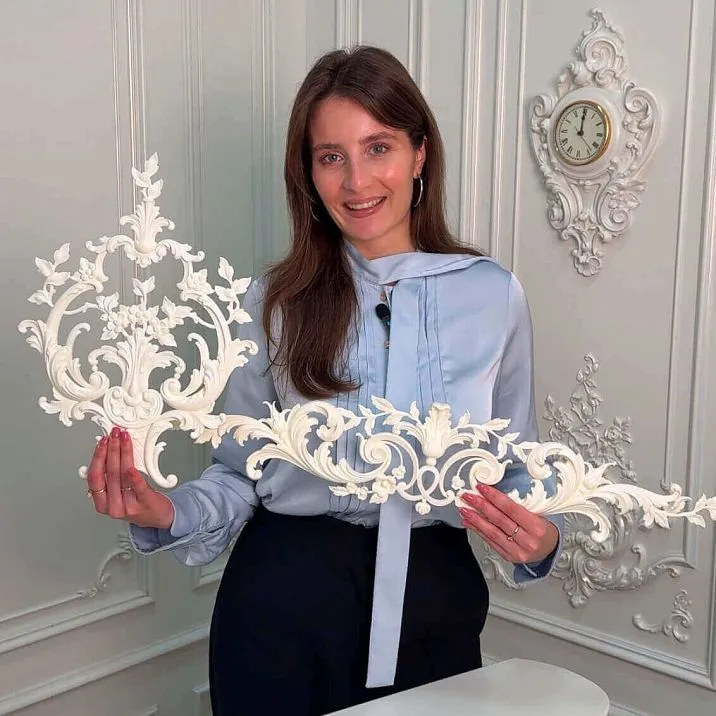

Molding Decor CPU.VRS-064.1
Dimensions and Options
Description
The set is delivered unassembled and without adhesive.
Molding elements are supplied with extended shoulders for cutting to the required size.
Moldings are supplied with extra allowance.
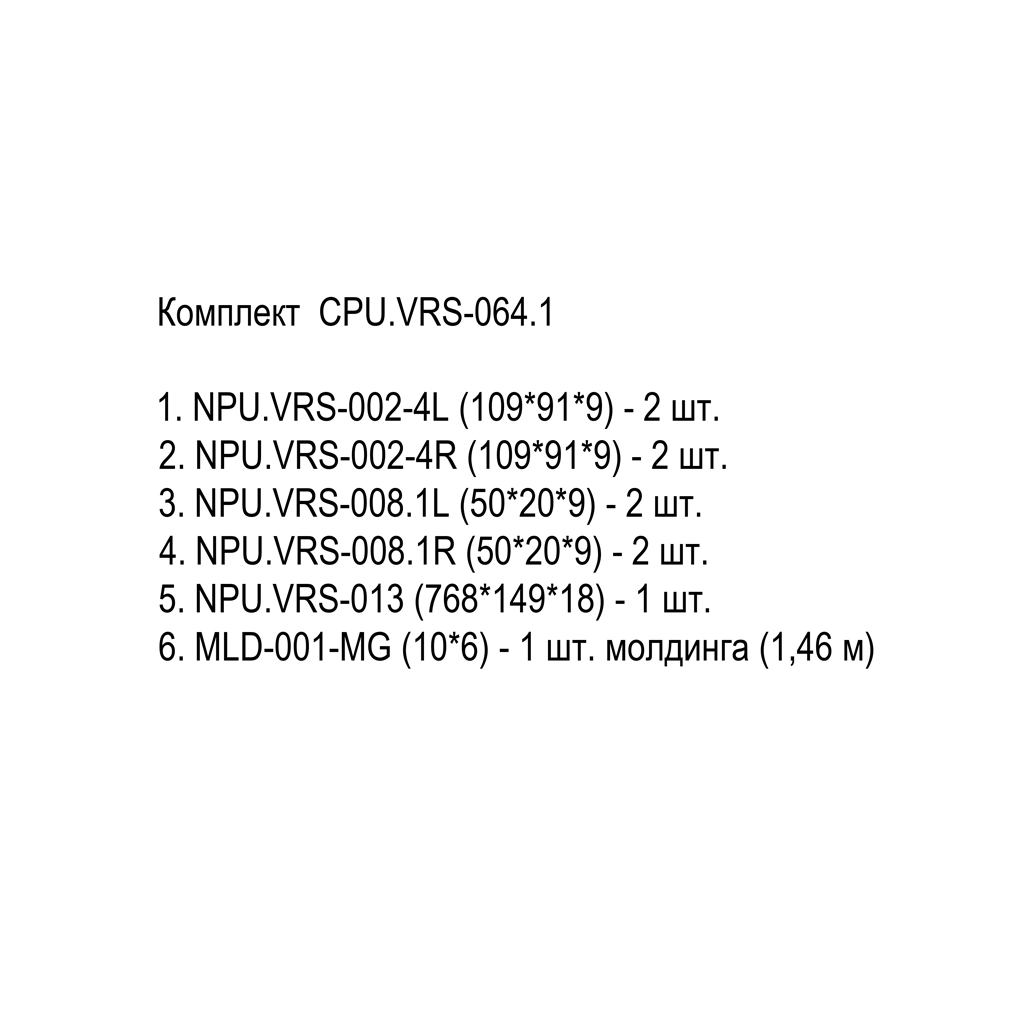
Set Composition


Have questions?
Customers also buy

Polina Sh.
February 4, 2026
Went on a tour. To say I'm delighted is an understatement. The largest production facility in Russia, impressive in its scale and dedication to the craft! It was very interesting and informative. You can immediately see - true masters of their trade! We were welcomed in the best possible way, were polite...
Elena B.
January 29, 2026
Thank you for always having a magnificent assortment and the possibility of manufacturing standard products to non-standard, individual dimensions. Special thanks to manager Oksana for her efficiency and quality of services provided.
Elena K.
January 27, 2026
The moldings are high-quality and beautiful, they were packaged very securely, I will order again, I liked everything!
More than 20 years on the market
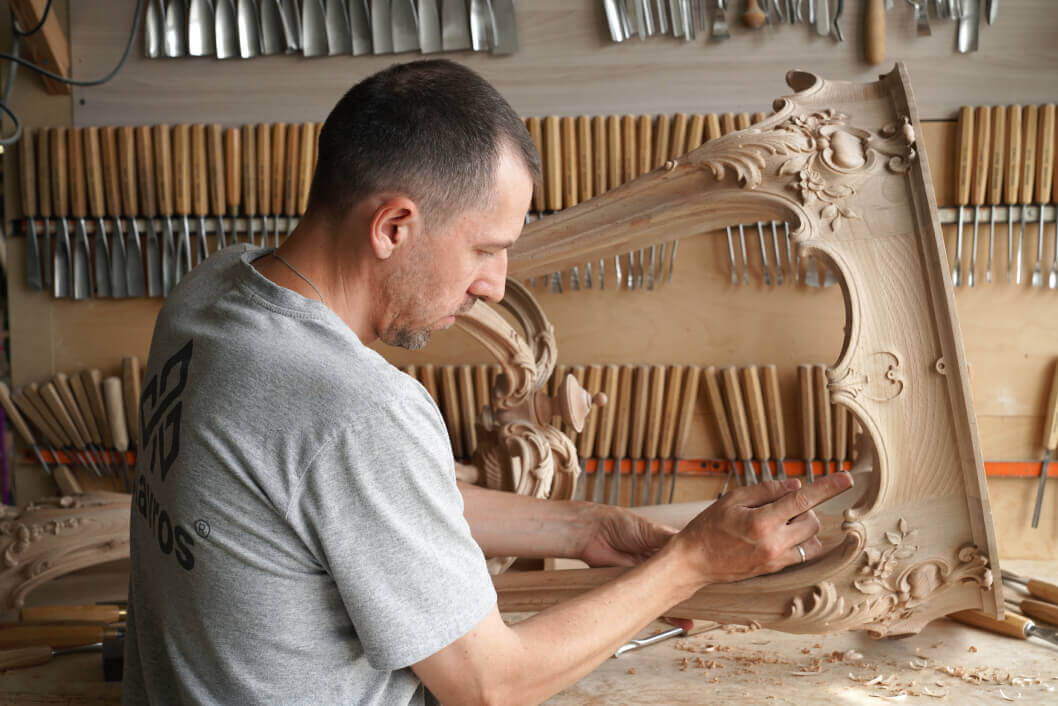
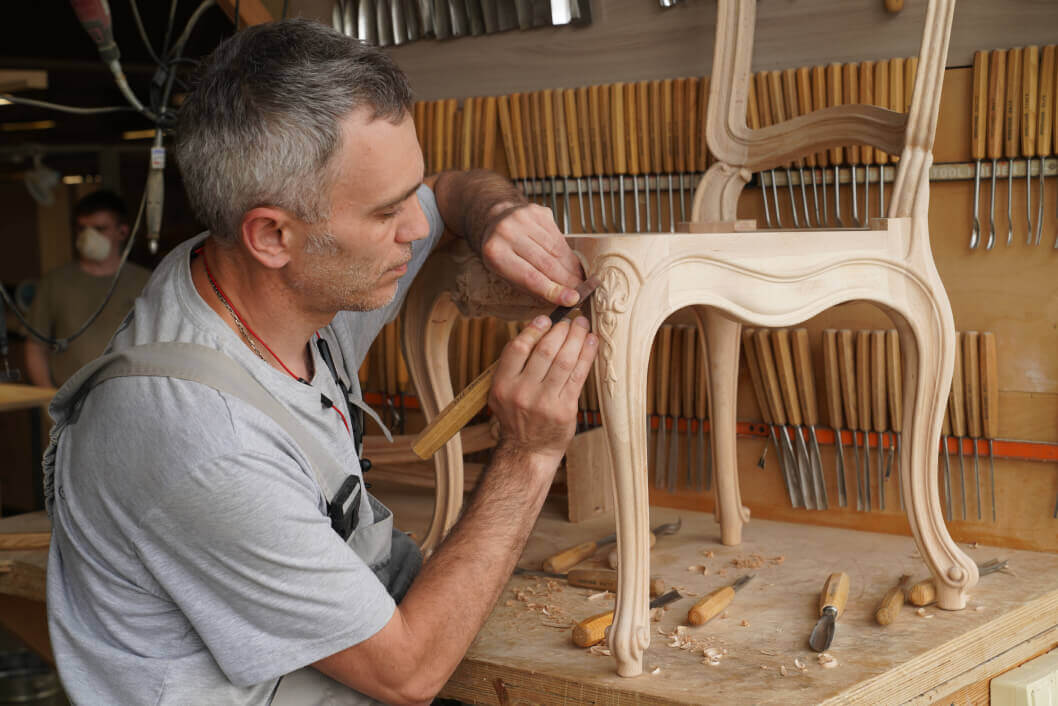
The company's success began in 2002, when two artists — Andrey Ragozin and Evgeny Tsapko — created a small creative workshop for producing wooden carved items. The masters' work was quickly noticed, and within a year they were invited to participate in the reconstruction of the Konstantinovskiy Palace in Strelna.
After the success of this project, the company focused on recreating palace interiors, furniture, church furnishings, and carved decorations in various artistic styles. They worked with cultural heritage sites: The Hermitage, the Alexandrovsky Palace, the Troitsko-Izmaylovsky Cathedral, the Sheremetyevsky Mansion, and many others.
The masters' task — and still is — to create wooden items with the highest level of detail and understanding of every element, based on impeccable knowledge of artistic laws and interior styles.
STAVROS Guarantees
Quality of products without complaints
We save your time, peace of mind, and budget
Large warehouse program
We solve your tasks with maximum speed
Adherence to production deadlines
Streamlined process reduces all risks
Delivery from 1 piece throughout Russia
Quality service regardless of order volume
Your positive business reputation
Reliable partner — the foundation of your business
More polyurethane molding products
Frequently asked questions
Our showrooms are located in Saint Petersburg and Moscow. Production is located in Saint Petersburg.
Moscow contacts: https://www.stavros.ru/contacts_all/?tab=msk
Contacts of Saint Petersburg: https://www.stavros.ru/contacts_all/?tab=spb
- Send request by email [email protected]
- Write to us at WhatsApp
- Order by phone 8 (800) 55-46-75
- Visit our showroom in Saint Petersburg and Moscow
Yes, we ship orders throughout Russia and to CIS countries.
We cooperate with transportation companies such as СДЭК and DPD.
You can also arrange pickup of your order through any convenient transportation company for you.
Delivery cost depends on the size, weight of the item, and delivery address.
When placing an order, the delivery cost is calculated automatically and displayed as a separate line on our website.
Prices and availability of items on the website are always current. Data is updated daily.
Note: items in stock are stored on the warehouse in unpolished form and shipped within 3 working days.
If the item is not in stock, average production time: 5–10 working days.
This is the quality of polishing of the items.
Standard — machine polishing, at a more attractive price.
Prestige — detailed hand polishing, items do not require further work.
More details: https://www.stavros.ru/information/kachestvo/
This is the type of veneer of the items.
Under enamel: produced by gluing wooden laminates without color and texture matching. Contrast tonal and textural differences are noticeable. This blank should be chosen if the item is intended for opaque coating.
Under tinting: produced by gluing wooden laminates with color and texture matching. Tonal and textural differences may occur. This blank should be chosen if the item is intended for semi-transparent finish.
More details: https://www.stavros.ru/information/kachestvo/
Beech — dense, non-porous wood, most often used for items covered with enamel.
Oak — dense, porous wood with clearly visible natural grain. Due to its strength and decorative properties, it is often used in items with semi-transparent coating, highlighting the wood pattern.
Custom-made, if non-standard items are required, we can produce products from other types of wood, including blanks provided by the customer, manufactured according to our technical specifications.
All our furniture legs can withstand a vertical load of at least 100 kg.
Average production time for custom-made items: 5–10 working days.
Most items are stored on the warehouse in unpolished form. We need time to polish and pack orders.
Yes, we manufacture non-standard items according to individual projects, but we only accept orders with a minimum quantity.
We can manufacture items of the desired size, but we only work with bulk orders. For details, please consult the sales department manager.
Yes, some of our products can be used outdoors. For example, polyurethane items, as well as carved door casings made of pine.
Other items are produced to order using PUR glue, if minimum quantity is available. No warranty is provided for such products, as outdoor conditions are considered aggressive.
Yes, we paint items when ordering products for a total amount of 150,000 rubles or more.
- Dust removal. After sanding, the surface must be dusted.
- Priming. Apply primer in an even layer.
- Matting. After the primer has fully dried, the surface should be matted (lightly sanded for better adhesion).
- Finish coating. Apply finish coating: lacquer or enamel, in 2 layers, with interlayer drying.
More details: https://www.stavros.ru/information/sovety/
Apply adhesive to the decor. Place it on the surface and press briefly. Then, lift the decor from the surface and leave it open for 3–5 minutes. Press the decor firmly onto the surface and hold for 5–10 seconds.
More details: https://www.stavros.ru/information/sovety/
Ideally, you should prepare a design project before placing an order.
You can do this yourself by downloading drawings of our products from our website, or you can order a project from us.
If the number of decorative elements and fittings is small, our company's manager can assist you with selection.
Unfortunately, this service is not provided.
The packaging method depends on the type of items, but in each case, we ensure sufficient protection for safe transportation.
We most often use corrugated cardboard and stretch film. Fragile items are additionally secured on a rigid base to prevent damage during transport.
We ship all items starting from 1 piece.
Room measurements and item installation can be performed by our partners — carpentry companies represented in most regions of Russia.
Often searched in category Molded decor
1618
1483
1256
1145
347
221
72
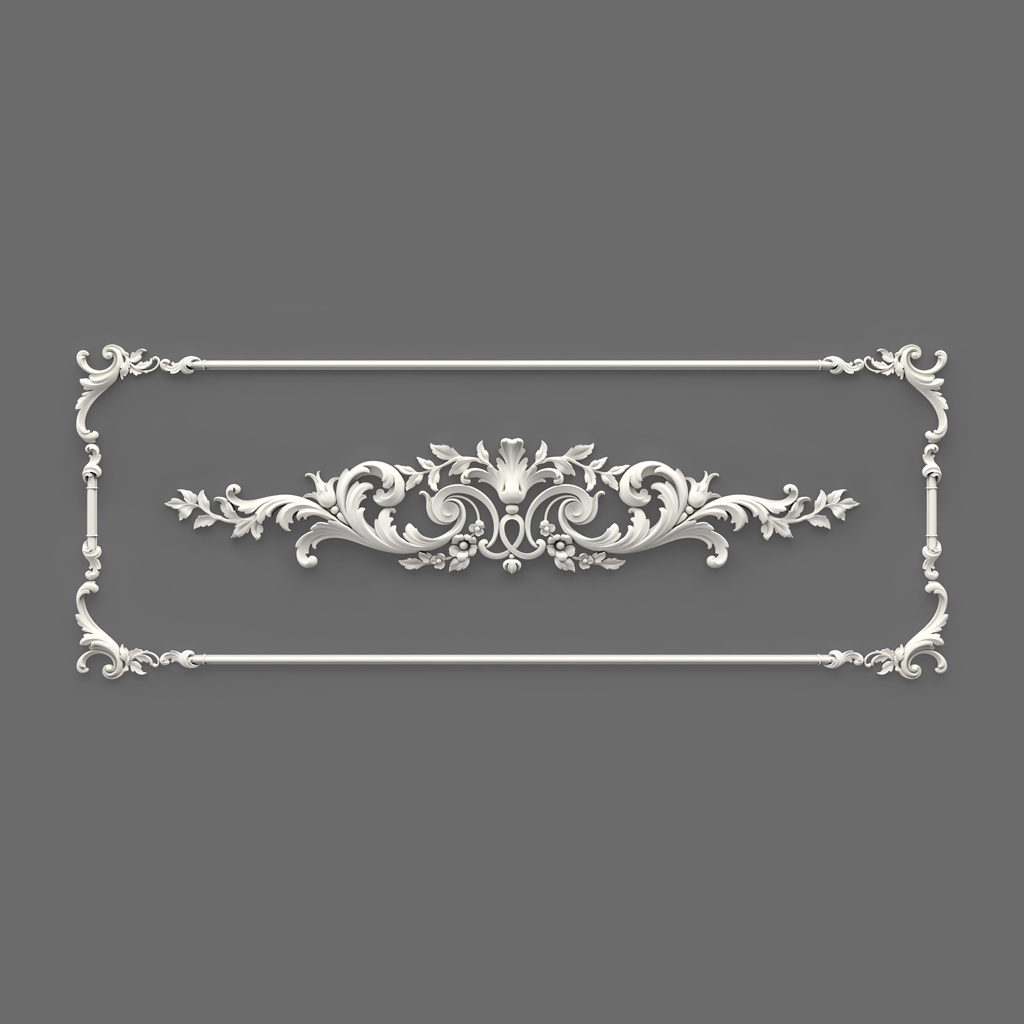
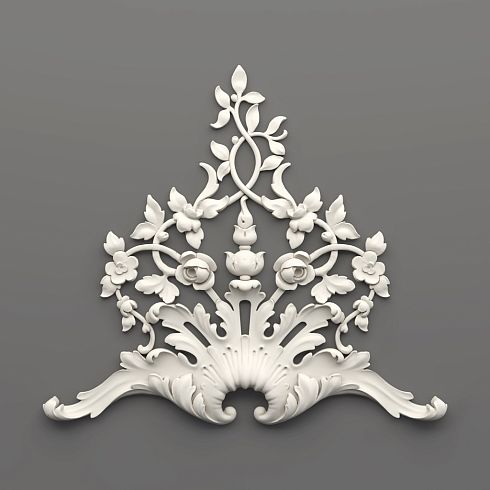
Molding Decor CPU.VRS-064.1 — a classic horizontal panel with a Baroque ornament
Relief molding that transforms a wall into an architectural accent
Molding Decor CPU.VRS-064.1 is a compact-format horizontal decorative panel designed for interiors that value precise proportions, noble ornamentation, and material richness of surfaces. With dimensions of 960 × 370 × 18 mm, the product occupies an optimal scale between an intimate accent element and a monumental palace panel: it is large enough to become a full-fledged visual focal point of a wall, yet compact enough to fit organically into most residential and commercial spaces without a sense of overload. This is not just a decorative overlay — it is a complete architectural statement in the plastic arts of European Baroque and Rococo, recreating the ornamental culture of formal interiors of the 17th–18th centuries using modern materials: high-density polyurethane and factory-primed MDF. The 18 mm deep relief ensures convincing three-dimensionality of the decor: under any directional lighting, the ornament lives in shadows and highlights, is perceived as genuine sculptural plasterwork, and creates the impression of a piece crafted by a master plasterer, not factory-produced. Once installed on a wall, the CPU.VRS-064.1 panel instantly gives the space scale, character, and that special sense of architectural dignity that distinguishes an interior created with an understanding of classical tradition from a merely fashionably decorated room.
The size that decides everything: proportions and placement scenarios
The 960 × 370 mm format is one of the most versatile proportions for a horizontal decorative panel in a residential interior. A width of 960 mm corresponds to approximately half of a standard wall width of 2.0–2.4 m or precisely covers the space above a standard 900 mm wide door opening. A height of 370 mm fits into zones from the top line of a door leaf to the ceiling, above standard consoles and fireplace mantels, and also sits organically in the middle belt of a boiserie wall system between horizontal moldings. It is precisely this combination of dimensions that makes the CPU.VRS-064.1 product a working tool in several interior application scenarios. Above a fireplace portal in a compact living room or study, a 960 mm wide panel creates an architecturally correct proportion: it does not overload a small fireplace wall, yet is substantial enough to become its semantic center. In a bedroom, the product works excellently above a single bed headboard 90–100 cm wide or above a small double bed 140 cm wide — in the latter case, a slight visual mismatch in width creates the effect of an intimate, cozy 'canopy' without a physical structure. In a living room or dining room, the panel is placed as an independent decorative accent on a free section of wall, above a small sideboard, console, or decorative shelf. In a hallway or on a stair landing, the horizontal format and rich ornamentation transform a transit space into a full-fledged gallery with architectural character.
The product's ornament: a language of forms born in the era of Louis
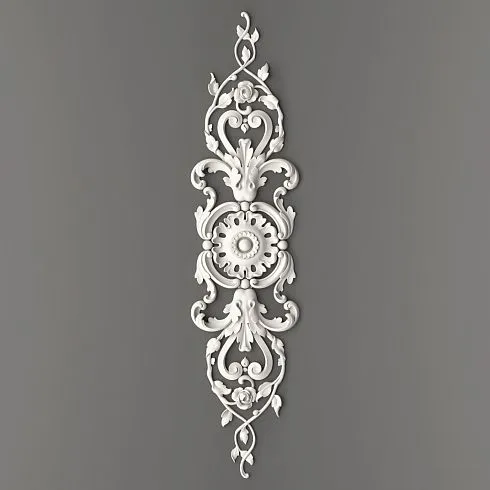
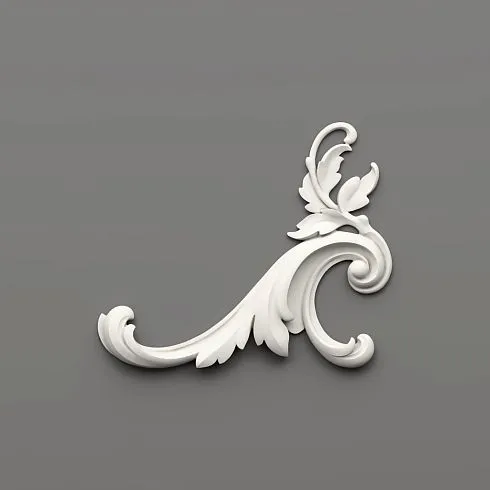
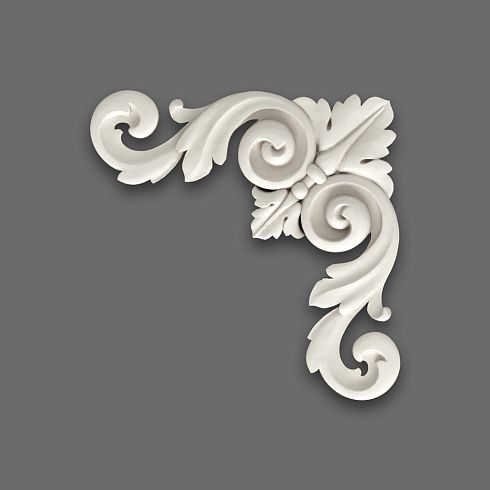
The central ornament of the CPU.VRS-064.1 panel unfolds in a horizontal arabesque characteristic of French Rococo, with axial symmetry and increasing relief density from the edges to the center. The structure of the ornament is built on a principle well-known to anyone who has studied the decorative programs of European palaces: from the central semantic core, branching shoots with leaves, flowers, and scrolls radiate in both directions, gradually losing density towards the edges and giving way to framing elements. The central motif — a palmette or shell with vertical ribs, traditional for Baroque and Rococo — crowns the entire composition and serves as its visual axis, around which the rest of the ornamental space unfolds symmetrically. From the central node grow large acanthus leaves with the soft, almost living plasticity characteristic of Rococo — they are not inscribed in a rigid geometric scheme but seem to choose their own direction of growth, curling into spirals, unfolding in volume, and engaging in dialogue with neighboring elements. Floral garlands and individual flower heads — roses, buds, inflorescences with petals of varying degrees of openness — are woven into the ornament with the precision characteristic of mature Rococo: not as a decorative stencil, but as an imitation of living nature captured at the moment of maximum bloom. Twining shoots fill the space between large elements, binding them into a single ornamental fabric without voids or breaks. Around the perimeter, the ornament is inscribed within a framing contour formed by a molding with a fine profile — it fixes the panel's boundaries and creates a clear architectural silhouette, without which even the richest ornament would be perceived as a chaotic accumulation of details. The corner nodes of the frame are resolved with figured corner overlays with Baroque scrolls — they accentuate the transitions of horizontal and vertical lines and add ornamental detailing at the intersection of axes. The relief, with a maximum depth of 18 mm, ensures full sculptural volume for the entire composition: under side lighting, every leaf, every scroll, every petal luxuriously lives in its own shadow.
Technical specifications: precise data for professional selection
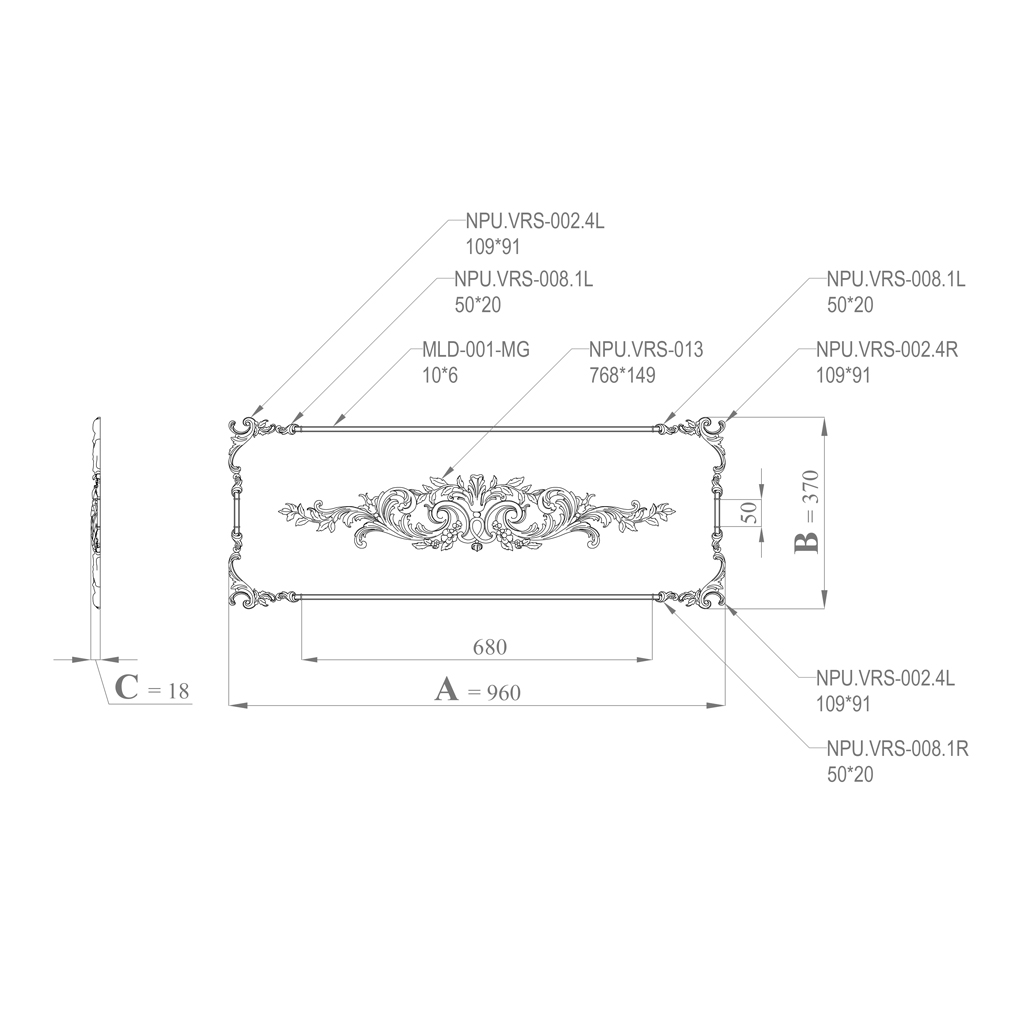
The CPU.VRS-064.1 decor has the following precise parameters: width — 960 mm, height — 370 mm, maximum relief depth — 18 mm. The product material is a combination of rigid high-density polyurethane and factory-primed white MDF. Polyurethane is used to reproduce all ornamental relief details — leaves, scrolls, flowers, corner overlays, profile molding. MDF is used as the flat load-bearing base of the panel, ensuring structural rigidity, geometric stability, and absence of deformation during operation. All surfaces of the product are treated with factory acrylic primer, which ensures high adhesion to any type of finishing paint coating without additional preparation. The product's weight at these dimensions is moderate — the lightness of polyurethane components compensates for the relatively greater density of MDF, and the final mass of the panel allows for reliable adhesive mounting without mandatory anchor fastening under normal conditions. The product is supplied in protective packaging that prevents damage to the relief during transportation.
Polyurethane as the material of the architectural future
Choosing polyurethane as the primary material for the relief components of the CPU.VRS-064.1 decor is not a forced compromise between quality and cost, but a technologically justified solution that surpasses traditional materials in a number of parameters. Plaster, which for centuries was the only alternative for molding decor, has serious operational limitations: it is fragile under impact load, critically sensitive to moisture, heavy, and labor-intensive to install. High-density polyurethane is devoid of all these shortcomings while fully preserving plaster's main virtue — the ability to reproduce the finest details of sculptural form with photographic accuracy. The water absorption coefficient of polyurethane is less than one percent: the material is absolutely insensitive to high humidity, does not swell, does not lose shape, and does not create a breeding ground for mold and fungus. This opens up the possibility of using the CPU.VRS-064.1 decor in bathrooms, kitchens, and other high-humidity areas — where plaster molding degrades within three to five years, polyurethane decor maintains impeccable condition for decades. The temperature stability of polyurethane covers a range from −60°C to +100°C — the material does not deform under seasonal temperature fluctuations in a room, does not crack due to shrinkage of building structures, and does not react to changes between heating season and summer period. The impact resistance of polyurethane significantly exceeds that of plaster: the product withstands accidental mechanical impacts without chips and fractures, which are inevitable for a plaster counterpart under the same force of impact. The service life of high-quality polyurethane decor, subject to installation conditions and normal operation, is at least 30–50 years without any degradation of relief, geometry, or adhesion to the finishing coating.
MDF as the load-bearing base: stability and geometric precision
The presence of MDF in the construction of the CPU.VRS-064.1 panel is not accidental — this material performs a function that polyurethane, for all its virtues, cannot fully undertake. Medium-density MDF provides an absolutely flat, rigid load-bearing surface with precise geometry and stable right angles. Unlike polyurethane foam products, which may exhibit slight sagging if stored or installed incorrectly, an MDF base guarantees that the panel will fit tightly and evenly against the wall across its entire area without gaps, bulges, or waves. MDF sands and primes excellently — its surface after final painting is visually indistinguishable from painted polyurethane, ensuring a monolithic perception of the entire product as a single whole. The MDF base also facilitates installation: its geometric predictability simplifies marking and installation, and standard fasteners — screws, dowels — work with MDF as reliably as with wood. It is important to note that MDF is not recommended for use in rooms with constantly high humidity — in such cases, fully polyurethane versions of the decor should be chosen. Under standard conditions in residential premises with normal humidity levels, MDF behaves exceptionally stably and requires no special attention throughout the product's entire service life.
Styles and interiors where this panel finds its full voice
The horizontal format and ornamental vocabulary of the CPU.VRS-064.1 product ensure a wide stylistic range of application, extending far beyond a single direction. In classic and neoclassical styles — it is one of the key elements of architectural decoration: combined with ceiling cornices, wall moldings, and pilasters, the panel participates in creating a unified decorative program for a room, based on rhythm, symmetry, and hierarchy of elements. It is in this context that the product's true scale is revealed — within a system with other elements, it ceases to be merely a 'pretty thing on the wall' and becomes part of the architectural logic that defines the character of the entire space. In French Provençal and shabby chic styles, decor with an aged milky-white or cream finish and light patina creates the feeling of an authentic provincial château — the soft floral garlands and living acanthus leaves of the ornament are completely organic for this romantic aesthetic with its cult of imperfection and history. In the Empire style, the more strict geometric contour of the frame and monumental central palmette work within the characteristic pathos of forms for this direction — especially convincingly in black-and-gold or deep blue with gold color schemes. In modern classic and transitional interiors, the CPU.VRS-064.1 panel serves as the sole, yet undeniably weighty, ornamental accent in a laconic setting — it saturates a minimalist space with cultural content without violating its contemporary character. In interiors of restaurants, hotels, spas, and luxury boutiques, the product creates an atmosphere that is unmistakably read as 'high style' regardless of the overall designer context.
Color solution: from monochrome bas-relief to gilded splendor
The primed surface of the CPU.VRS-064.1 product opens complete freedom in choosing the finishing treatment, and it is the color solution that largely determines the final character of the decor in the interior. Monochrome painting in the wall color is the most restrained and sophisticated technique: the relief is then read exclusively through shadows, creating the effect of a sculptural bas-relief inscribed directly into the wall's architecture. This method is especially effective in rooms with rich side lighting, when sunlight or artificial light grazes along the wall surface — the 18 mm deep ornament literally comes to life under such lighting, changing the pattern of shadows throughout the day. Painting in white on a wall of any other tone creates a soft color contrast and brings the panel to the foreground, turning it into an unconditional decorative focal point of the wall. Gold patina on the relief over a white or cream base — a classic technique directly descended from the gilding technique on genuine palace plasterwork: gold is applied with a brush to the protruding parts of the ornament, while the recesses remain the base color, creating depth and sculptural expressiveness. Evening artificial lighting, especially spotlights with warm light, makes such a surface shimmer and gleam with almost theatrical splendor. Silver patina combined with cool gray-pearl or gray-blue walls creates a more restrained, contemporary image — luxurious without ostentatious pomp. The technique of double toning with umber or burnt sienna in the recesses of the relief and a light color on the protrusions imitates the effect of natural aging of plasterwork and creates the illusion of a product with centuries of history — this technique is most in demand in professional interior practice when working with classic decor.
Installation of the horizontal panel: from marking to final painting
Installing the CPU.VRS-064.1 decor with dimensions of 960 × 370 mm is quite feasible on your own without involving specialists — this size is on the border between a small element installed solo and a large-format product for which a second person is desirable. The preparatory stage begins with careful wall marking: the horizontal axis of the panel is verified with a spirit level to an accuracy of one millimeter — with a width of 960 mm, any deviation from horizontal will be visually noticeable. The central vertical is marked at the center of the architectural element above which the panel is installed, or at the center of a free wall section. The wall surface must be clean, dry, sufficiently even — variations exceeding 3–4 mm are recommended to be leveled beforehand with finishing putty, as with a significant contact area, wall irregularities can create gaps between the panel base and the surface. To improve adhesive adhesion, the wall is recommended to be pre-primed with deep-penetration acrylic primer. Mounting adhesive — a polymer high-adhesion composition such as liquid nails or specialized adhesive for MDF — is applied to the back of the product in a zigzag pattern with a pitch of 8–10 cm. Additional fixation with screws and decorative overlay caps is recommended at the four corners and central point — this safeguards the product from gradual adhesive delamination in the long term. The panel is applied strictly according to the markings and held pressed for at least 30–45 seconds until initial adhesive setting. After the adhesive has completely dried — after 24 hours — the joints between the panel edges and the wall are filled with white acrylic sealant, sanded after drying, and painted along with the entire surface in the final color. The seam becomes completely invisible, and the product is perceived as an organic part of the wall.
Decorative Ensemble: What Surrounds This Panel in the Right Interior
The CPU.VRS-064.1 panel is designed for interiors with a well-thought-out decorative program, where every furnishing element is consciously related to the others. In the correct architectural context, the horizontal panel achieves maximum expressiveness. A ceiling cornice with a developed profile creates the upper horizontal frame of the entire space and echoes the horizontal rhythm of the panel—their proportional correspondence creates a sense of unity and intentionality in the decorative solution. Wall moldings on the sides of the panel's installation site form a side frame and integrate the decor into the system. Wall sconces with gilded or silvered fittings, placed symmetrically on the sides of the panel, greatly enhance its decorative effect in the evening hours. A console or shelf under the panel creates a 'plinth' and completes the vertical composition, giving it visual support—decorative vases, candles in candelabras, a small sculpture, or fresh flowers are appropriate on the console. A mirror in a classic frame above the panel, or a painting on the sides, integrates the decor into a gallery context and multiplies its visual significance. Herringbone parquet or a patterned carpet picks up the ornamental leitmotif of the stucco at floor level—the interior begins to be perceived as a holistic work of decorative art, where all elements engage in dialogue with each other.
Durability and Care: The Material That Doesn't Age
The combination of polyurethane and MDF in the CPU.VRS-064.1 product ensures durability that, with proper installation and use under normal residential conditions, reaches 30–50 years without loss of decorative qualities. Daily care of the panel surface involves wiping with a soft, slightly damp cloth or a soft brush with natural bristles—dust and light stains are removed with minimal effort. For more noticeable stains, the use of neutral soap solutions and mild household cleaners without abrasive components or solvents based on acetone or white spirit is permitted. Polyurethane components are completely moisture-resistant and do not require immediate wiping after accidental water contact. The MDF base requires protection from prolonged direct contact with water—the final paint reliably protects the surface under normal operating conditions. In case of mechanical damage—a small chip or scratch—repair is performed with acrylic putty followed by sanding and spot painting to match the color; with a professional approach, the repair result is completely invisible. Refreshing the finish coating, if desired or necessary, is done by repainting without any special surface preparation—the product accepts a new layer of paint with the same reliability as the first. The relief of the ornament retains clarity during repainting, provided sufficiently liquid paint is used without excessive brush thickening in the recesses—professionals recommend applying a thin layer of paint with an aerosol or spray gun, not a brush, to preserve maximum ornament detail.
Your request has been sent!
Our manager will contact you within 5 minutes