












































































Wooden cornice KZ-012
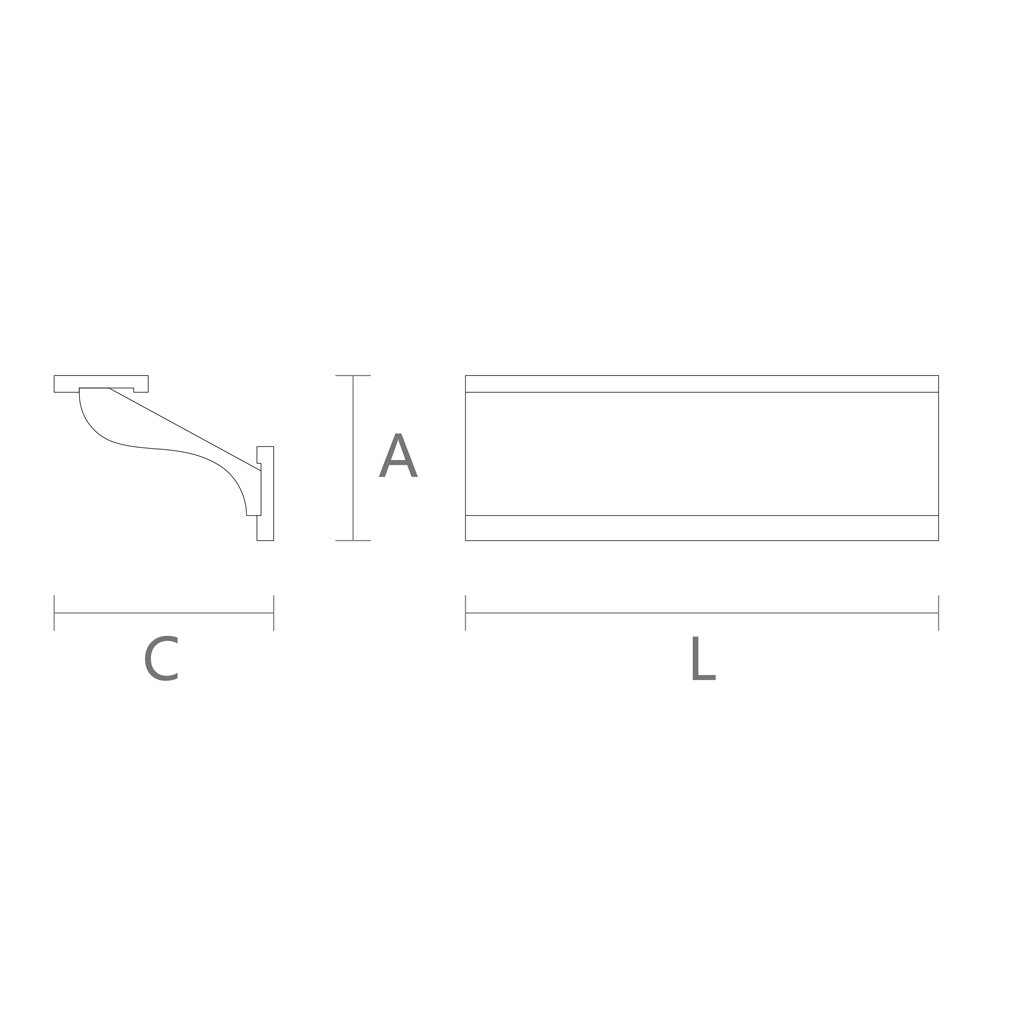
Dimensions and Options
Have questions?
Customers also buy

Polina Sh.
February 4, 2026
Went on a tour. To say I'm delighted is an understatement. The largest production facility in Russia, impressive in its scale and dedication to the craft! It was very interesting and informative. You can immediately see - true masters of their trade! We were welcomed in the best possible way, were polite...
Elena B.
January 29, 2026
Thank you for always having a magnificent assortment and the possibility of manufacturing standard products to non-standard, individual dimensions. Special thanks to manager Oksana for her efficiency and quality of services provided.
Elena K.
January 27, 2026
The moldings are high-quality and beautiful, they were packaged very securely, I will order again, I liked everything!
More than 20 years on the market
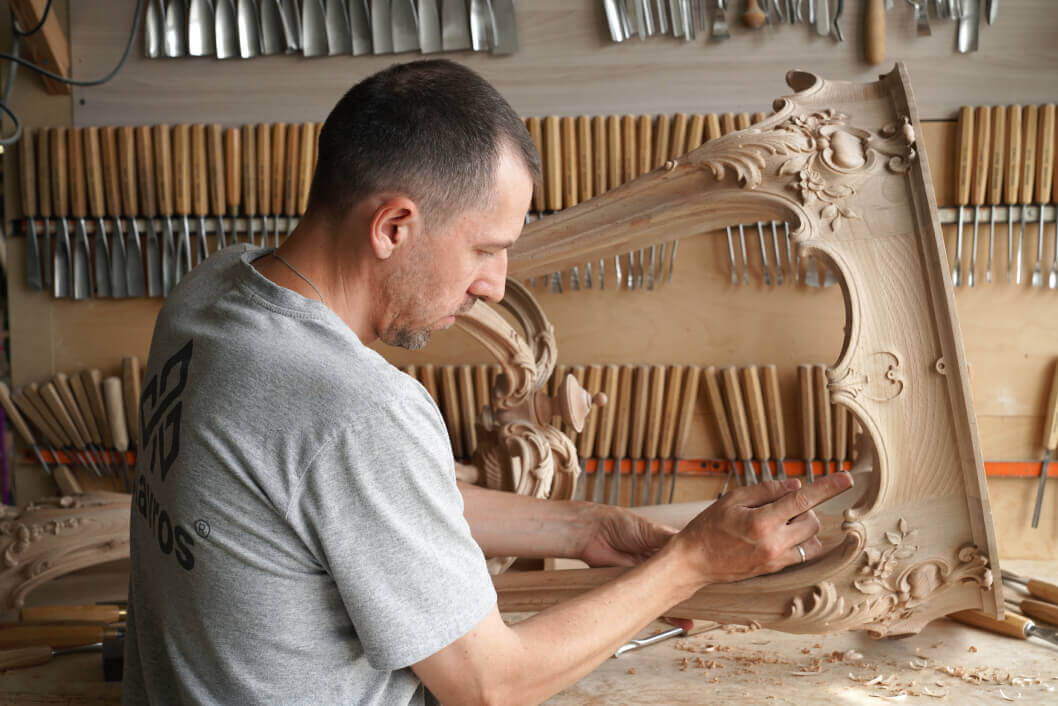
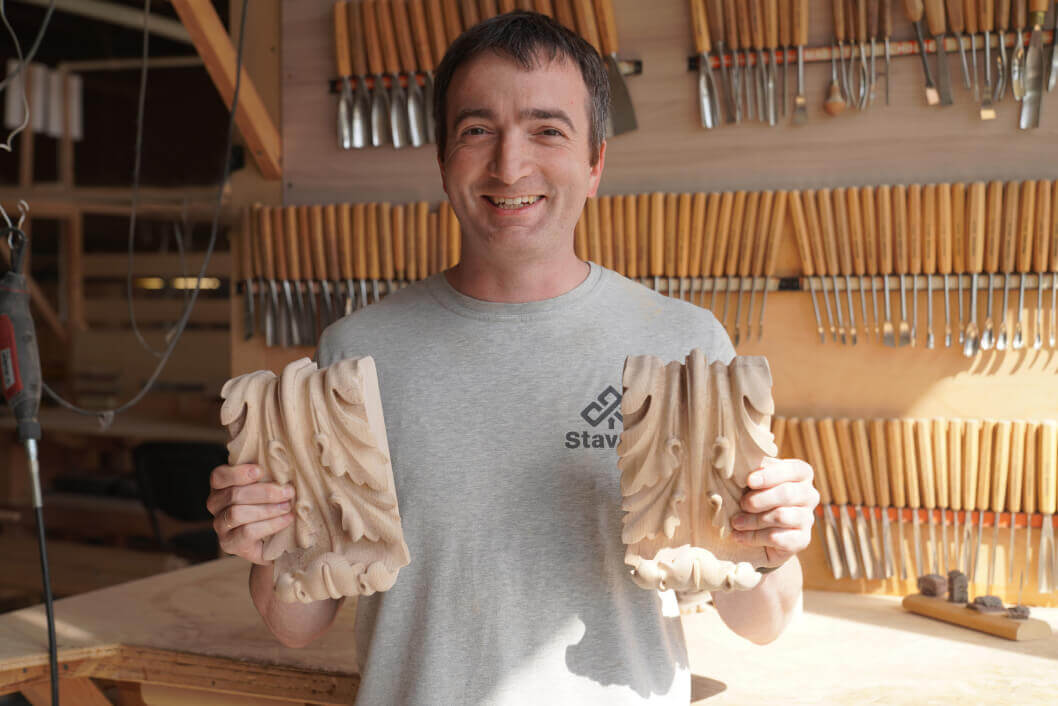
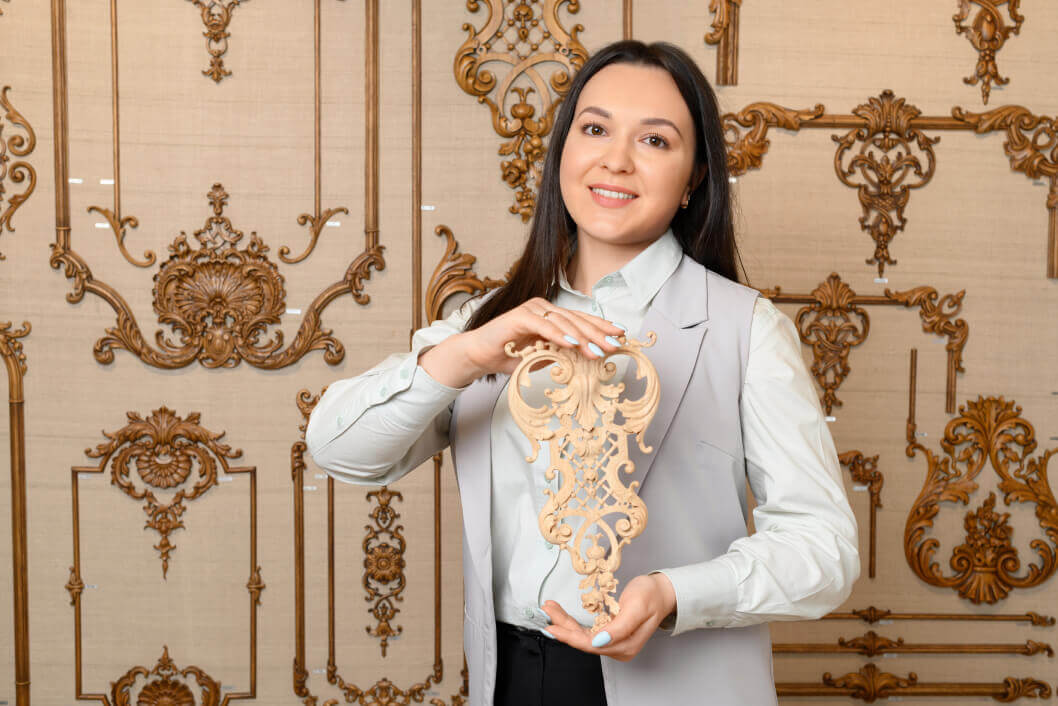
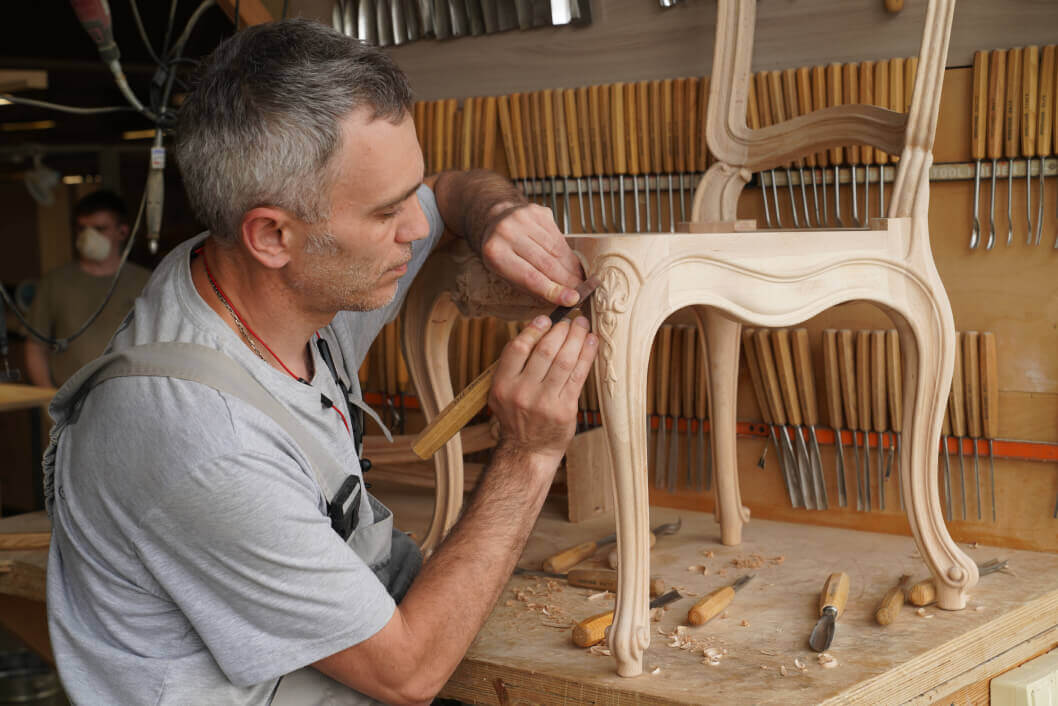
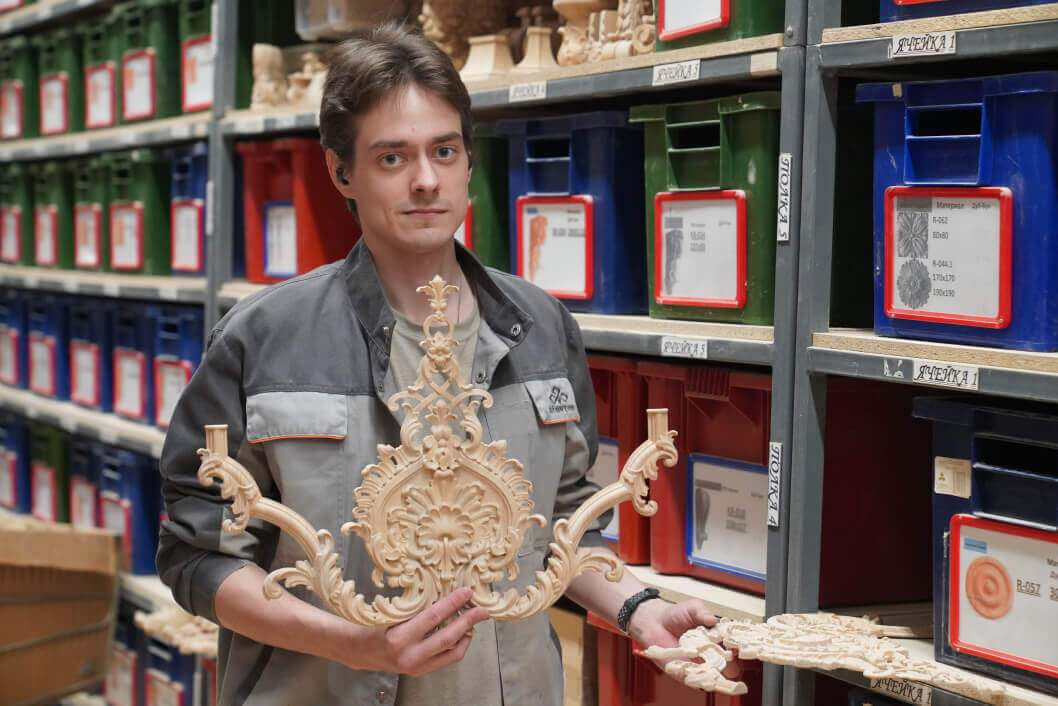
The company's success began in 2002, when two artists — Andrey Ragozin and Evgeny Tsapko — created a small creative workshop for producing wooden carved items. The masters' work was quickly noticed, and within a year they were invited to participate in the reconstruction of the Konstantinovskiy Palace in Strelna.
After the success of this project, the company focused on recreating palace interiors, furniture, church furnishings, and carved decorations in various artistic styles. They worked with cultural heritage sites: The Hermitage, the Alexandrovsky Palace, the Troitsko-Izmaylovsky Cathedral, the Sheremetyevsky Mansion, and many others.
The masters' task — and still is — to create wooden items with the highest level of detail and understanding of every element, based on impeccable knowledge of artistic laws and interior styles.
STAVROS Guarantees
Quality of products without complaints
We save your time, peace of mind, and budget
Large warehouse program
We solve your tasks with maximum speed
Adherence to production deadlines
Streamlined process reduces all risks
Delivery from 1 piece throughout Russia
Quality service regardless of order volume
Your positive business reputation
Reliable partner — the foundation of your business
More products in the category of trim items
Frequently asked questions
Our showrooms are located in Saint Petersburg and Moscow. Production is located in Saint Petersburg.
Moscow contacts: https://www.stavros.ru/contacts_all/?tab=msk
Contacts of Saint Petersburg: https://www.stavros.ru/contacts_all/?tab=spb
- Send request by email [email protected]
- Write to us at WhatsApp
- Order by phone 8 (800) 55-46-75
- Visit our showroom in Saint Petersburg and Moscow
Yes, we ship orders throughout Russia and to CIS countries.
We cooperate with transportation companies such as СДЭК and DPD.
You can also arrange pickup of your order through any convenient transportation company for you.
Delivery cost depends on the size, weight of the item, and delivery address.
When placing an order, the delivery cost is calculated automatically and displayed as a separate line on our website.
Prices and availability of items on the website are always current. Data is updated daily.
Note: items in stock are stored on the warehouse in unpolished form and shipped within 3 working days.
If the item is not in stock, average production time: 5–10 working days.
This is the quality of polishing of the items.
Standard — machine polishing, at a more attractive price.
Prestige — detailed hand polishing, items do not require further work.
More details: https://www.stavros.ru/information/kachestvo/
This is the type of veneer of the items.
Under enamel: produced by gluing wooden laminates without color and texture matching. Contrast tonal and textural differences are noticeable. This blank should be chosen if the item is intended for opaque coating.
Under tinting: produced by gluing wooden laminates with color and texture matching. Tonal and textural differences may occur. This blank should be chosen if the item is intended for semi-transparent finish.
More details: https://www.stavros.ru/information/kachestvo/
Beech — dense, non-porous wood, most often used for items covered with enamel.
Oak — dense, porous wood with clearly visible natural grain. Due to its strength and decorative properties, it is often used in items with semi-transparent coating, highlighting the wood pattern.
Custom-made, if non-standard items are required, we can produce products from other types of wood, including blanks provided by the customer, manufactured according to our technical specifications.
All our furniture legs can withstand a vertical load of at least 100 kg.
Average production time for custom-made items: 5–10 working days.
Most items are stored on the warehouse in unpolished form. We need time to polish and pack orders.
Yes, we manufacture non-standard items according to individual projects, but we only accept orders with a minimum quantity.
We can manufacture items of the desired size, but we only work with bulk orders. For details, please consult the sales department manager.
Yes, some of our products can be used outdoors. For example, polyurethane items, as well as carved door casings made of pine.
Other items are produced to order using PUR glue, if minimum quantity is available. No warranty is provided for such products, as outdoor conditions are considered aggressive.
Yes, we paint items when ordering products for a total amount of 150,000 rubles or more.
- Dust removal. After sanding, the surface must be dusted.
- Priming. Apply primer in an even layer.
- Matting. After the primer has fully dried, the surface should be matted (lightly sanded for better adhesion).
- Finish coating. Apply finish coating: lacquer or enamel, in 2 layers, with interlayer drying.
More details: https://www.stavros.ru/information/sovety/
Apply adhesive to the decor. Place it on the surface and press briefly. Then, lift the decor from the surface and leave it open for 3–5 minutes. Press the decor firmly onto the surface and hold for 5–10 seconds.
More details: https://www.stavros.ru/information/sovety/
Ideally, you should prepare a design project before placing an order.
You can do this yourself by downloading drawings of our products from our website, or you can order a project from us.
If the number of decorative elements and fittings is small, our company's manager can assist you with selection.
Unfortunately, this service is not provided.
The packaging method depends on the type of items, but in each case, we ensure sufficient protection for safe transportation.
We most often use corrugated cardboard and stretch film. Fragile items are additionally secured on a rigid base to prevent damage during transport.
We ship all items starting from 1 piece.
Room measurements and item installation can be performed by our partners — carpentry companies represented in most regions of Russia.
Often searched in category Wooden and MDF items
6691
2639
2366
1320
1278
858
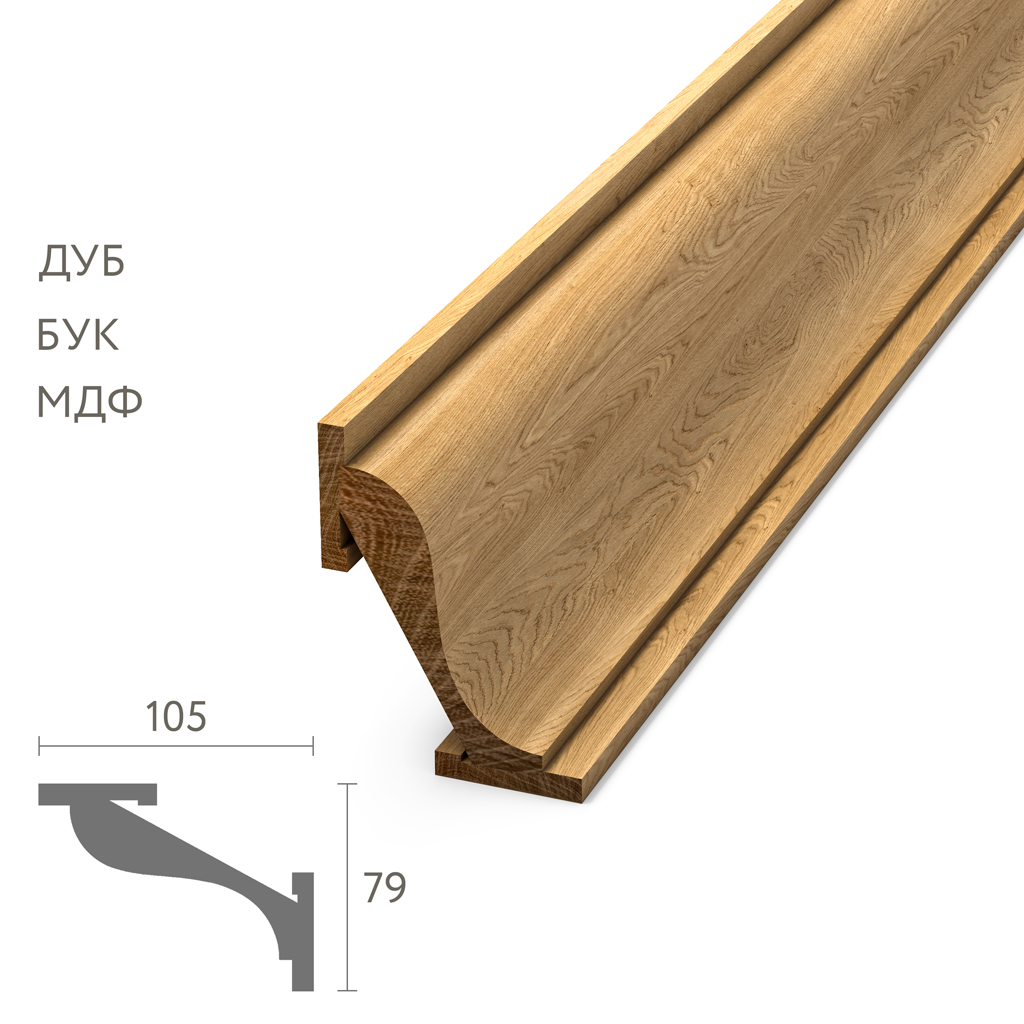
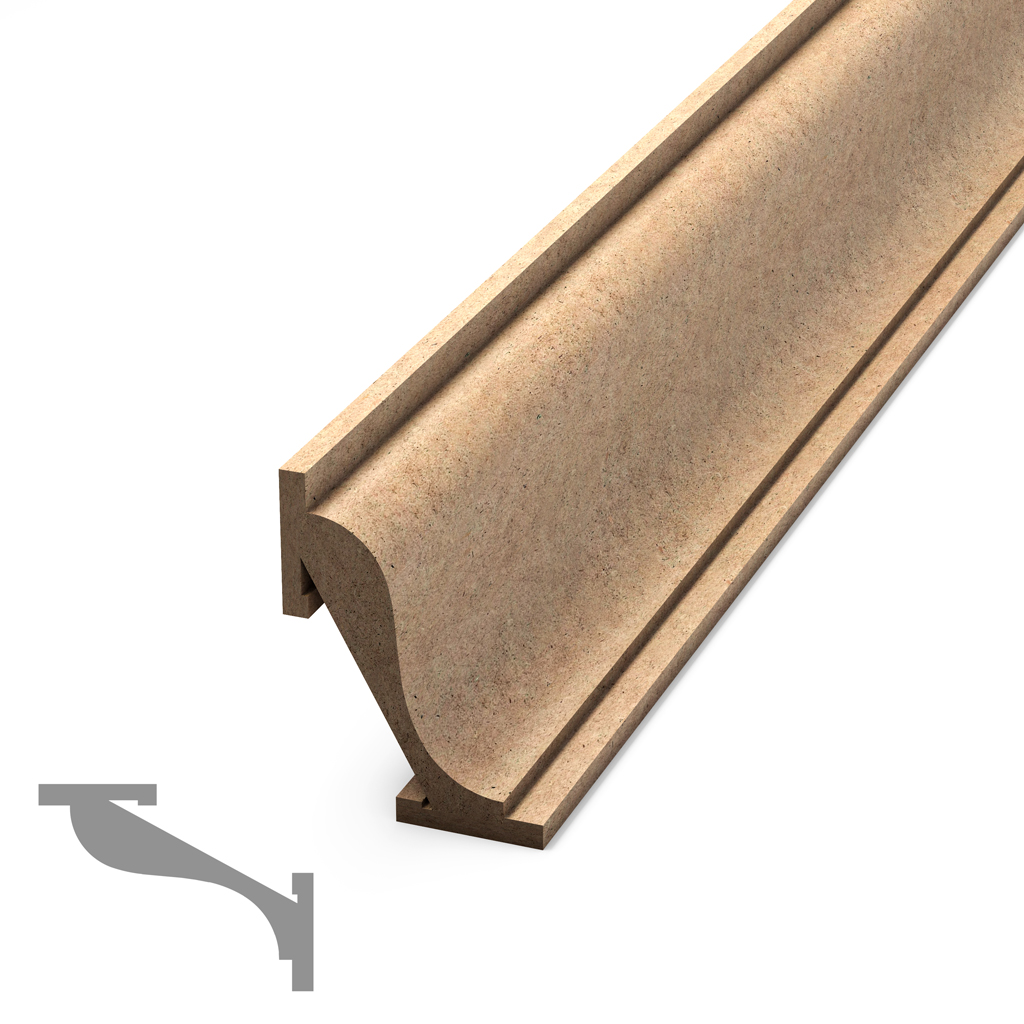
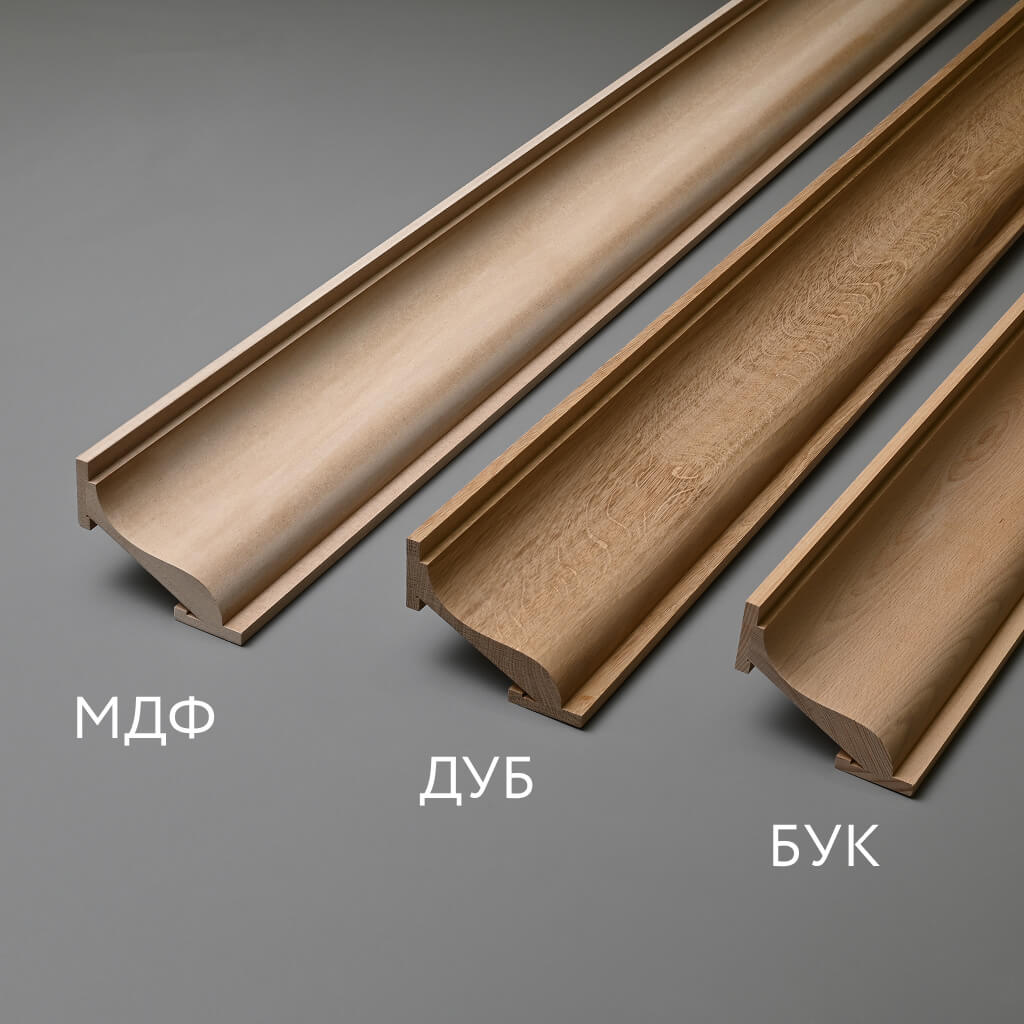
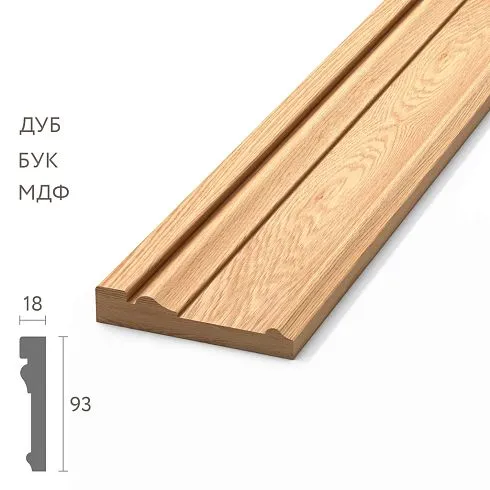
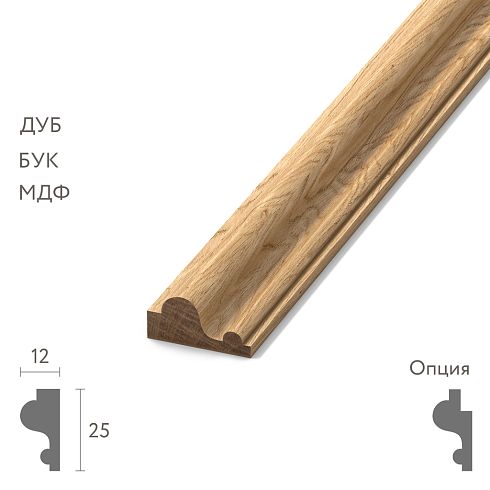
Wooden cornice KZ-012 79 × 105 mm made of solid oak, beech and MDF
cornice made of wood and MDFcornice made of wood and MDFexpressive profile with harmonious proportions, ideal for ceiling transitions, creating architectural accents, and decorating upper parts of cabinet facades.
Technical Specifications and Dimensional Parameters
cornice KZ-012 features thoughtfully designed geometric parameters, where the profile height of 79 mm and width of 105 mm create a balanced composition visually optimal for rooms with ceiling heights from 2.6 to 3.5 meters. These proportions ensure sufficient architectural expressiveness without overloading the interior with excessive bulk, making thiswooden cornicea universal solution for various stylistic directions.
Standard profile length is 2600 mm for the MDF variant and 2400 mm for the beech solid wood variant, allowing efficient use of the cornice in rooms of various sizes and configurations. The oak variant is also available in 2400 mm length, enabling material selection based on project requirements and budget. Processing accuracy is maintained within tolerances of ±0.3 mm, ensuring perfect element alignment during installation of complex architectural compositions and creating a unified perimeter line.
Wood moisture is strictly controlled at 8-10% to ensure geometric stability of the product throughout its service life. This moisture level corresponds to the equilibrium state of wood in heated rooms and prevents warping, cracking, and other material deformations. Each batch undergoes mandatory moisture control using calibrated moisture meters, confirmed by appropriate test protocols.
Material execution variants
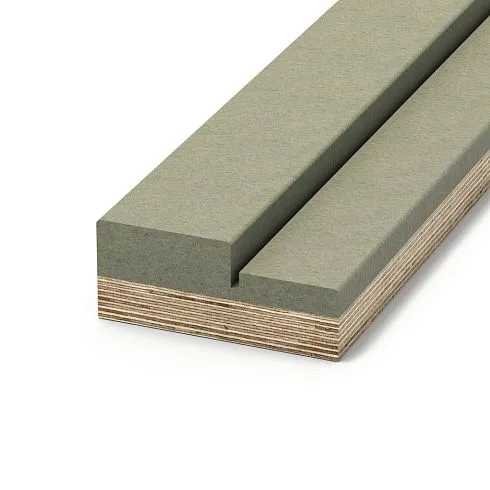
Cornice KZ-012 made of high-density MDF is an optimal solution for projects requiring ideal geometric stability and subsequent painting. Material density is at least 720 kg/m³, ensuring sufficient strength and resistance to mechanical impacts. The MDF surface has an ideally smooth structure without pores or irregularities, allowing for thin application of coatings to achieve a flawless result.
The main advantage of the MDF variant is absolute geometric stability under varying temperature and humidity conditions during operation. Unlike solid wood, composite material does not react to humidity fluctuations by changing linear dimensions, which is critically important when using cornice in rooms with active heating during winter. ThisMDF cornice for paintingis ideally suited for modern interiors where precise color matching to walls or ceilings is required.
Beech cornice features a noble light texture with characteristic small pinpoint inclusions, creating an expressive natural pattern. Beech belongs to hardwoods with a density of about 680 kg/m³, ensuring high strength and durability of the product. Beech wood has a uniform fine-pored structure, even color ranging from light rose to cream tones, and minimal knots, making it an ideal material for manufacturing architectural elements.
Beech cornices are ideally suited for classic interiors where the natural beauty of wood is valued. After toning, beech can imitate more expensive wood species such as walnut, cherry, or mahogany, while retaining its excellent performance characteristics. Beech surface is perfectly sanded, creating a smooth base for applying transparent varnishes, oils, or wax-based finishes that highlight the natural texture of the material.
Oak cornice represents an epitome of durability, strength, and nobility. Oak is traditionally considered one of the most prestigious wood species due to its unique expressive texture with large annual rings and its ability to become stronger over time. Oak wood density ranges from 690 to 720 kg/m³, and its hardness by Brinell reaches 3.7–3.9 units, ensuring exceptional resistance to mechanical damage and wear.
Oak color varies from light golden to rich brown depending on the tree’s growing conditions. The coarse-grained structure of the wood creates an expressive relief pattern, especially noticeable after toning or brushing. OakWooden beamsacquires special beauty after treatment with various finishes, revealing the depth and richness of the natural pattern. Tannin content in the wood provides natural protection against rot and insect damage, which is especially important for long-term use.
Profile and design features
The profile of the wooden cornice KZ-012 is designed according to classical proportions of architectural orders and adapted for modern interiors. The cross-section shape represents a harmonious combination of smooth curved elements and sharp linear segments, creating an expressive play of light and shadow on the surface. The upper part of the profile has a characteristic protrusion, creating a clear horizontal line and visually separating the ceiling from the wall plane.
The central part of the profile is shaped as a concave element, softening the transition between the upper protrusion and the lower decorative shelf. This recess creates soft shadows, adding volume and depth to the architectural element. The lower part of the cornice is a pronounced decorative protrusion, completing the composition and creating a smooth transition to the wall surface. This profile configuration allows the cornice to harmoniously fit into both classical and modern interiors.
Profile proportions are carefully calibrated to create a harmonious visual image at various ceiling heights. The height-to-width ratio of approximately 3:4 ensures optimal visual mass without creating a heavy or overloaded effect. The profile is perceived as an elegant and refined element that highlights the architecture of the room without dominating the interior composition. This makes cornice KZ-012 a universal solution for rooms of various purposes, from living rooms to reception halls.
Areas of application in interior design
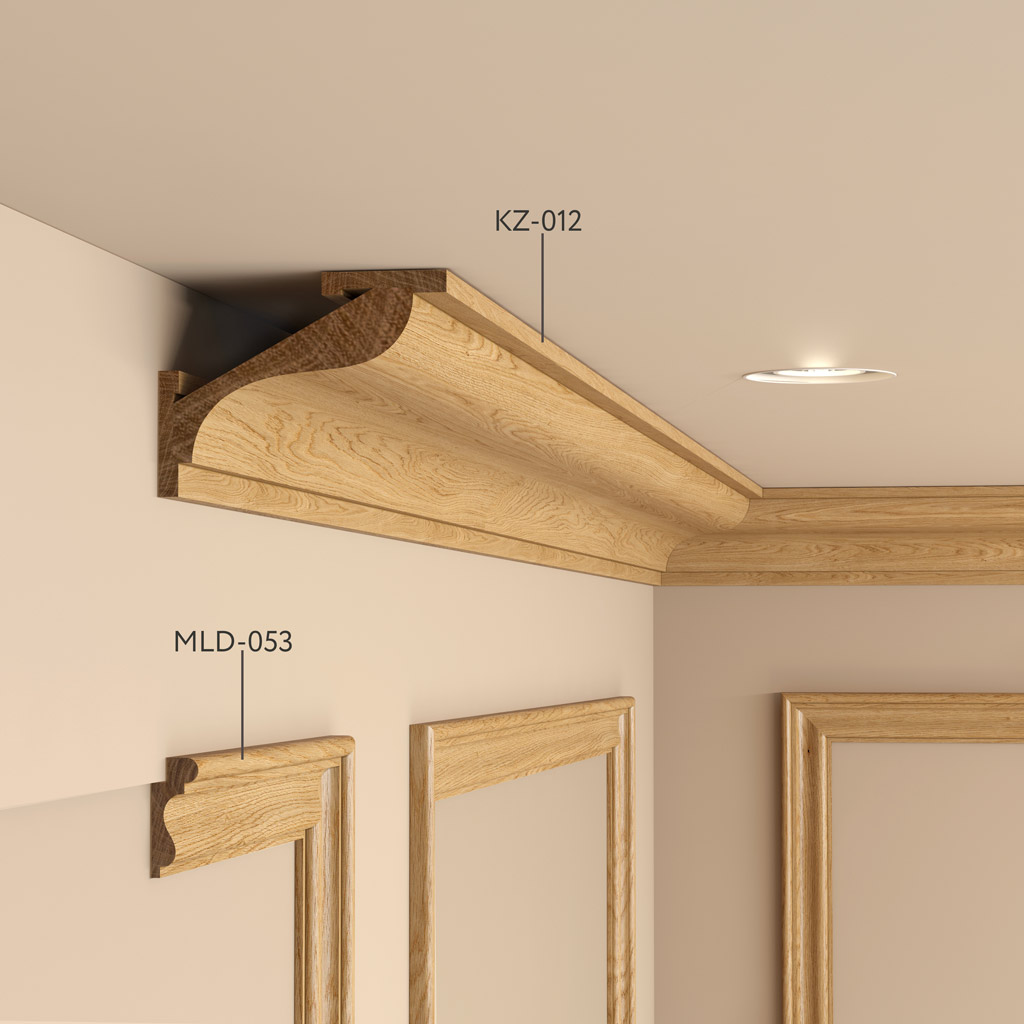
Ceiling cornices are a classic application of the KZ-012 profile, where they create an expressive transition between the wall and ceiling. Installed around the perimeter of the room, suchCeiling Moldingvisually increases room height, gives the interior a finished look, and emphasizes architectural features of the space. The cornice conceals irregularities at the junction between wall and ceiling, masks technological gaps, and creates a clear architectural line organizing the space.
In classical interiors, ceiling cornices serve as an important element of architectural order, conforming to historically established rules of room decoration. A white-painted cornice against a light ceiling creates a refined relief composition, highlighting the elegance of the classical style. A toning cornice in the color of valuable wood species adds warmth and respectability to the interior, typical for offices and libraries. Gilded or patinated cornices create an atmosphere of palace luxury and sophistication.
In modern interiors, cornice KZ-012 is used to create architectural accents and space zoning. Painted in a contrasting color relative to walls and ceiling, the cornice becomes an expressive decorative element emphasizing the room’s geometry. In monochromatic interiors, a cornice matching wall color creates a subtle relief effect, discernible due to the interplay of light and shadow. Using the cornice as a concealed backlight for LED lighting creates an eye-catching ceiling glow, visually increasing room height.
Cabinet moldings are an important application area of the KZ-012 profile for finishing the upper part of cabinets, buffets, kitchen sets, and other furniture. Installed on the top edge of the furniture body,Furniture cornicecreates the effect of furniture being integrated into the room's architecture and gives the item a finished, respectable appearance. Particularly striking are moldings on tall cabinets and kitchen sets, where they visually connect the furniture to the ceiling.
Kitchen moldings made of MDF for painting allow creating a unified color solution for the set, where the molding is painted to match the facade color or, conversely, serves as a contrasting accent. Moldings made of solid oak or beech are ideal for classic kitchens with wooden facades, creating a harmonious ensemble of natural materials. A properly selected furniture molding can transform the perception of standard furniture, giving it individuality and exclusivity.
Decorative wall panels using moldings create expressive architectural interior finishes. The KZ-012 molding can be used as the top finishing element of wall panels, creating a clear horizontal line and logical composition closure. In combination withmoldingsandbaseboardsthe same profile, complex multi-level compositions typical of classic interiors can be created.
Production technology and quality control
The KZ-012 molding is manufactured on high-precision woodworking equipment with numerical control, ensuring ideal repeatability of the profile's geometric parameters. Milling is performed using specialized multi-profile end mills made of high-alloy high-speed steel, ensuring surface finish cleanliness without fiber tearing or other defects. Spindle rotation speed and feed rate are calculated based on wood species and profile configuration to achieve optimal processing quality.
For manufacturing moldings from solid wood, glued laminated beams made from individual lamellas are used, ensuring geometric stability of the product. Lamellas 20-30 mm thick are cut from dried wood, undergo calibration, and are glued under pressure using professional water-resistant adhesives of class D3-D4. Counter-directional fiber arrangement in adjacent lamellas compensates for internal wood stresses and prevents warping of the finished product.
After milling, the profile undergoes multi-stage sanding using abrasive materials of different grits. Initial processing is performed with belts of 80-100 grit to remove milling marks, followed sequentially by abrasives 120, 150, 180, and finally 220-240 grit. Special attention is paid to processing curved sections of the profile, where special profiled sanding pads replicating the cross-section shape are used. Ideally sanded surface is a guarantee of quality application of lacquer coatings.
Quality control is performed at all production stages using calibrated measuring tools. Geometric parameters of the profile are checked using templates manufactured according to standard drawings with tolerance ±0.05 mm. Straightness of the product is controlled on special tables using laser levels. Wood moisture is measured using electronic pin-type moisture meters at several points of each profile. Surface quality is visually assessed under bright lighting for absence of scratches, fiber tearing, chips, and other defects.
Installation and Mounting Methods
Surface preparation before installing the molding includes wall leveling and checking the ceiling’s horizontal level. The allowable deviation from horizontal is no more than 2 mm per linear meter. For significant deviations, walls must be leveled using putty or drywall. The surface must be cleaned of dust, dirt, and old coatings that may reduce adhesive bond strength of the glue compound.
Molding attachment to the wall is performed using a combined method with polyurethane glue and mechanical fasteners. Glue is applied to the back of the molding in a zigzag pattern using a caulking gun, ensuring even distribution over the entire contact area. The molding is pressed against the wall and held for several seconds to allow initial glue setting. Additional mechanical fixation is performed using finishing nails or screws with heads driven in to a depth of 2-3 mm.
The spacing of fastener installation depends on the molding material and is 400-500 mm for solid wood and 300-400 mm for MDF. Fasteners are installed at the top of the profile, where holes will be concealed after final finishing. Heads of nails or screws are filled with appropriate tone wood putty. After putty dries, fastener installation points are sanded with fine sandpaper to achieve a smooth surface.
Molding joints in room corners are made using a 45-degree beveled cut with a fine-toothed circular saw. Cutting accuracy is critically important for achieving a tight joint without gaps. The joint is glued with PVA glue and additionally secured with thin finishing nails installed perpendicular to the cut plane. After installation, the joint may be sanded with fine putty and sanded if necessary.
Final finishing and painting
Preparation for painting MDF or solid wood moldings includes priming with a specialized isolating compound to prevent resinous substances and tannins from penetrating through the finish coating. Primer is applied with a brush or roller in a thin, even layer, carefully working into all profile recesses. After primer dries, the surface is sanded with fine sandpaper of 240-320 grit to remove raised wood fibers.
Sanding is performed using fine-grit acrylic wood putty to level minor surface defects and fill pores. Putty is applied in a thin layer with a rubber squeegee, carefully filling all recesses and uneven areas. After complete drying, which takes 2-4 hours depending on temperature and humidity, the surface is sanded to a perfectly smooth finish. If necessary, the sanding and sanding operation is repeated until a flawless result is achieved.
Painting with enamel paints is performed in 2-3 coats with inter-coat drying times according to the manufacturer’s recommendations for lacquer coatings. The first coat is applied diluted to improve penetration into wood pores and create a strong base. Subsequent coats are applied with normal consistency paint to form a covering layer. Each coat is sanded with fine sandpaper after complete drying to remove minor defects and create a smooth surface for the next layer.
Staining solid wood with stains or oils allows highlighting the natural texture of the material and changing its color tone. The compound is applied with a brush or cloth along the direction of wood fibers, carefully working into all profile areas. Excess material is wiped off with a dry cloth to prevent stains and streaks. After the staining layer dries, the surface is coated with protective lacquer in 2-3 coats to create a durable, wear-resistant finish.
Patina and brushing create an aged wood effect, giving the interior a unique charm and aristocracy. Brushing involves mechanically removing soft wood fibers with metal brushes, followed by staining the recesses with a darker color. Patina is applied by applying patina into profile recesses, followed by polishing raised areas to create an effect of natural aging.
Care and Maintenance
Regular care for wooden moldings includes dust removal with a dry soft cloth or special cleaning brush. Wet cleaning is not recommended for uncoated solid wood moldings, as excess moisture may cause material deformation. Coated and lacquered moldings can be wiped with slightly damp cloth, followed by drying thoroughly. For significant dirt, special cleaning agents for painted wooden surfaces can be used.
Protection from direct sunlight is especially important for solid wood moldings with transparent finish, as ultraviolet radiation causes wood color change and lacquer coating degradation. It is recommended to use heavy curtains or blinds on south-facing windows. Coated moldings are more resistant to fading, but also require protection from prolonged direct sunlight exposure.
Control of room temperature and humidity prevents deformation of wooden moldings. Optimal relative air humidity is 40-60%, temperature 18-24°C. Significant humidity fluctuations cause wood to expand or contract, potentially leading to cracks and molding detachment from the wall. Using humidifiers during heating periods helps maintain stable operating conditions.
Local repair of finish upon appearance of scratches or chips is performed using furniture wax pencils of matching color or small brush touch-up. More serious damage requires sanding the damaged area, filling with putty, priming, and repainting. Timely repair of minor defects prevents their spread and maintains the molding’s aesthetic appearance.
Renewal of lacquer finish is recommended every 5-7 years to maintain protective properties and appearance. Old lacquer is sanded with fine sandpaper to create a rough surface with good adhesion, then a new lacquer layer is applied. Complete removal of old finish with subsequent re-finishing is performed for significant damage or desire to change the molding’s color.
Advantages of KZ-012 molding
The versatility of KZ-012 molding in various interior styles, from classic to modern, makes it a popular choice for designers and architects. Harmonious profile proportions allow using the molding in residential and public spaces. The option to choose material for manufacturing — MDF, beech, or oak — ensures flexibility in selecting the optimal solution for each specific project, considering budget and aesthetic requirements.
High manufacturing quality using modern equipment and strict control at all production stages guarantees stable product characteristics. Precision of geometric parameters ensures perfect element fitting without gaps or misalignments. Surface sanding quality creates an excellent base for any type of finish, from transparent lacquering to complex decorative techniques such as patina and gilding.
Durability of materials guarantees long service life of the molding without loss of functional or aesthetic properties. Solid oak and beech last 25-30 years, MDF — 15-20 years. Strength of glued laminated beam joints exceeds strength of solid wood, ensuring structural reliability. Resistance to temperature and humidity fluctuations prevents deformation and cracking.
Ecological safety of natural wood and high-quality MDF meets the strictest sanitary-hygienic standards. Materials do not contain harmful volatile compounds, formaldehyde, or other toxic substances. Use of water-resistant polyurethane-based adhesives without solvents ensures health safety. Woodencornices and moldingscreate a favorable microclimate in the room, regulating air humidity.
The ability to restore and refresh the appearance of the cornice extends its service life and allows adapting the decoration to changing interior preferences. A wooden cornice can be repainted, stained, or patinated multiple times, creating new decorative effects. Local repair of damaged areas is performed using simple methods and readily available materials. Such flexibility is impossible with polyurethane or plastic analogs, which cannot be restored.
wooden cornicewooden corniceoptimal choice for implementing projects of any complexity, from simple residential spaces to premium-class executive interiors.
Your request has been sent!
Our manager will contact you within 5 minutes